Introduction
WebAssembly, commonly known as WASM, is a binary instruction format designed as a portable compilation target for high-level languages like C++, Rust, and Go. Initially developed to bring near-native execution speed to web browsers, WASM has rapidly evolved into a universal runtime for server-side applications, edge computing, and IoT devices. It operates as a memory-safe, sandboxed execution environment that allows code to run at high velocity across different hardware architectures without the overhead of traditional virtual machines.
The significance of WebAssembly in the current landscape cannot be overstated. As we move deeper into a cloud-native and AI-driven era, the demand for lightweight, secure, and fast-starting execution units has surged. WebAssembly provides a “nano-service” architecture that starts in microseconds—thousands of times faster than a standard Linux container. This makes it the ideal choice for scaling functions at the network edge and securing third-party plugin systems in large software ecosystems.
Real-World Use Cases
- Executing complex AI and machine learning inference models at the edge with minimal latency.
- Powering high-performance browser-based tools for video editing, 3D rendering, and scientific simulation.
- Running serverless functions with near-zero cold start times to improve application responsiveness.
- Providing a secure, isolated sandbox for third-party extensions in enterprise SaaS platforms.
- Enabling cross-platform game logic that runs identically on web, mobile, and desktop environments.
Evaluation Criteria for Buyers
- Compatibility with the WebAssembly System Interface (WASI) for accessing system resources like files and networks.
- The performance trade-off between Just-In-Time (JIT) and Ahead-Of-Time (AOT) compilation modes.
- Support for the Component Model to enable seamless interoperation between different programming languages.
- The memory footprint and binary size, especially for constrained IoT or mobile environments.
- Integration capabilities with existing container orchestration tools like Kubernetes.
- The maturity of the security sandbox and its ability to prevent unauthorized memory access.
- The quality of developer tooling, including debugging support and language-specific SDKs.
Best for: Backend engineers, cloud architects, edge computing developers, and systems programmers looking for portable, high-performance execution.
Not ideal for: Simple website scripting where standard JavaScript is sufficient, or applications that require deep, non-portable integration with a specific operating system kernel.
Key Trends in WebAssembly Runtimes & Toolchains
- The shift toward “AI-on-Wasm” where runtimes optimize for specialized hardware like TPUs and GPUs via standardized APIs.
- Broad adoption of the WebAssembly Component Model, allowing a Rust library to be used effortlessly by a Python application.
- The rise of “Nano-services” which replace traditional Docker containers for lightweight, ephemeral workloads at the edge.
- Standardization of WASI Preview 2, bringing mature networking and filesystem capabilities to non-browser environments.
- Increased focus on “Green Coding” as WASM’s efficiency leads to lower CPU cycles and reduced energy consumption in data centers.
- Integration of zero-trust security principles directly into the runtime level rather than relying on network perimeters.
- The emergence of JIT-less execution modes to comply with strict security policies on platforms like iOS.
- Universal deployment where a single WASM binary runs on x86, ARM, and RISC-V architectures without recompilation.
How We Selected These Tools
Our selection process for the top WebAssembly runtimes and toolchains is based on technical merit and production readiness in the current ecosystem. We prioritized tools that are backed by major industry alliances, such as the Bytecode Alliance, ensuring long-term stability and standards compliance. A significant weight was given to execution speed and the versatility of the compiler backends, such as Cranelift or LLVM. We also evaluated the “developer experience,” looking for runtimes that provide intuitive CLIs and robust language support. Finally, we ensured a balance between heavy-duty server runtimes and lightweight, embedded interpreters to cover the full spectrum of modern development needs.
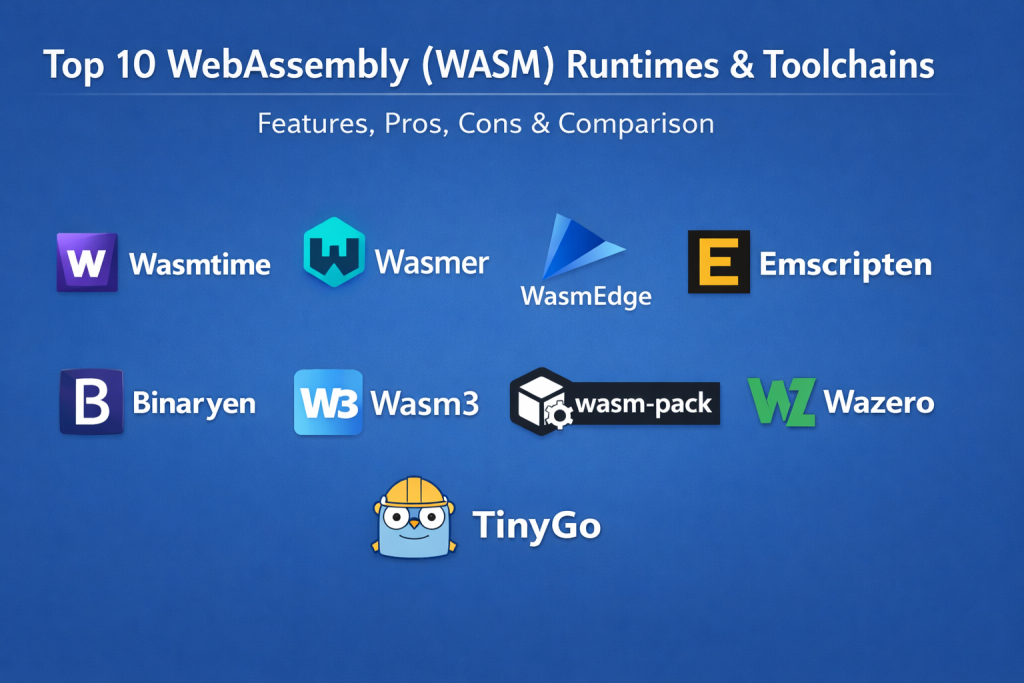
Top 10 WebAssembly (WASM) Runtimes & Toolchains
1. Wasmtime
Wasmtime is a standalone, small, and fast WebAssembly runtime that serves as the reference implementation for many WASI standards. Developed by the Bytecode Alliance, it is built on the Cranelift code generator and is designed to be easily embedded into other applications. It is widely considered the most production-ready runtime for server-side and cloud-native workloads.
Key Features
- High-performance JIT compilation using the Cranelift backend.
- Full support for WASI (WebAssembly System Interface) standards.
- Configurable sandboxing with strict memory and resource limits.
- Seamless integration with Rust, C, and Python via dedicated embeddings.
- Support for the latest WebAssembly proposals like SIMD and multi-memory.
Pros
- Industry-standard compliance and backing from major tech leaders.
- Excellent performance for long-running server processes.
Cons
- Higher memory overhead compared to lightweight interpreters.
- Focuses primarily on server/desktop environments rather than tiny embedded chips.
Platforms / Deployment
Windows / macOS / Linux — Hybrid
Security & Compliance
Implements robust sandboxing and is a core project of the Bytecode Alliance with high security standards.
Integrations & Ecosystem
Wasmtime is the engine behind many edge platforms. It integrates deeply with the Rust ecosystem and provides the foundation for several serverless platforms.
Support & Community
Extensive documentation and a highly active community of systems engineers and researchers.
2. Wasmer
Wasmer is a universal WebAssembly runtime that emphasizes the ability to run WASM on any platform, from the desktop to the cloud and even embedded devices. It is unique for supporting multiple compiler backends, including LLVM, Cranelift, and Singlepass, allowing developers to choose between maximum execution speed or ultra-fast compilation.
Key Features
- Pluggable compiler architecture supporting LLVM, Cranelift, and Singlepass.
- A built-in package manager (WAPM) for sharing and installing WASM modules.
- Support for WASIX, an extension of WASI that brings POSIX-like features like threads and signals.
- A powerful CLI that makes running WASM files as simple as running a script.
- Headless mode for extremely lightweight production deployments.
Pros
- Incredible flexibility across different hardware and use cases.
- Very fast startup times and a user-friendly developer experience.
Cons
- WASIX extensions are not yet part of the universal WASM standard.
- The multi-compiler approach can lead to larger binary sizes for the runtime itself.
Platforms / Deployment
Windows / macOS / Linux / iOS / Android — Cloud / Hybrid
Security & Compliance
Provides standard sandboxing and secure execution environments for untrusted code.
Integrations & Ecosystem
Wasmer has a vast ecosystem including integrations for Go, C++, and even PHP. It also powers the Wasmer Edge cloud platform.
Support & Community
A large and vocal community of developers with excellent documentation and a dedicated registry for WASM packages.
3. WasmEdge
WasmEdge is a high-performance WebAssembly runtime optimized for edge computing and AI workloads. It is a CNCF (Cloud Native Computing Foundation) hosted project and is specifically designed to handle heavy computational tasks like machine learning inference and complex data processing at the network edge.
Key Features
- Ahead-of-Time (AOT) compiler for maximum execution performance.
- Native support for AI frameworks like TensorFlow and PyTorch via specialized plug-ins.
- Optimized for integration with Kubernetes and other cloud-native orchestrators.
- Extremely low memory footprint, making it suitable for high-density deployments.
- Advanced networking capabilities for high-throughput edge microservices.
Pros
- Top-tier performance for AI and data-intensive applications.
- Deeply integrated into the modern cloud-native stack.
Cons
- The focus on high performance can make it more complex to configure than simpler runtimes.
- Primarily focused on Linux-based edge and cloud environments.
Platforms / Deployment
Windows / macOS / Linux / Android — Cloud / Hybrid
Security & Compliance
CNCF-backed project with rigorous security reviews and enterprise-grade sandboxing.
Integrations & Ecosystem
Integrates perfectly with Docker and Kubernetes (via crun). It is a favorite for developers building AI agents and edge functions.
Support & Community
Strong backing from the CNCF community and extensive resources for AI and edge development.
4. Emscripten
Emscripten is the foundational toolchain for WebAssembly, primarily used to compile C and C++ code into WASM for the web. It has been instrumental in bringing major applications like games and productivity suites to the browser. It provides a complete environment that mimics a traditional OS to help legacy code run on the web.
Key Features
- Full LLVM-based compiler for converting C/C++ to WebAssembly and JavaScript.
- Emulation of POSIX APIs, including filesystems and networking.
- Built-in support for OpenGL and SDL to bring 3D graphics to the browser.
- Highly optimized output with advanced dead-code elimination.
- Deep integration with the browser’s JavaScript engine.
Pros
- The most mature and battle-tested toolchain for web-based WASM.
- Allows massive legacy codebases to run in a browser with minimal changes.
Cons
- The generated glue code can be bulky for simple projects.
- The toolchain itself is large and can be complex to set up.
Platforms / Deployment
Windows / macOS / Linux (as a toolchain) — Web
Security & Compliance
Relies on the browser’s security model and provides standard WASM sandboxing.
Integrations & Ecosystem
Integrates with almost any C/C++ library and is the standard choice for porting desktop software to the web.
Support & Community
Decades of community knowledge and a massive amount of documentation and tutorials.
5. AssemblyScript
AssemblyScript is a programming language and toolchain that allows developers to write WebAssembly using a syntax that is almost identical to TypeScript. It is designed for developers who want the performance of WASM without having to learn a low-level language like Rust or C++.
Key Features
- TypeScript-like syntax specifically tailored for WebAssembly.
- A lightweight compiler that produces very small and efficient WASM binaries.
- Built-in support for WebAssembly features like SIMD and bulk memory.
- Direct access to WASM-specific instructions for manual optimization.
- Easy integration with existing JavaScript and TypeScript projects.
Pros
- Extremely low barrier to entry for web developers.
- Produces some of the smallest and most efficient binaries for simple tasks.
Cons
- Not a full implementation of TypeScript; it has its own strict type system.
- Lacks the massive ecosystem of a language like C++ or Rust.
Platforms / Deployment
Web / Node.js — Self-hosted
Security & Compliance
Inherits the safety of the WASM runtime it executes on.
Integrations & Ecosystem
Integrates perfectly with NPM and the modern web build pipeline (Vite, Webpack).
Support & Community
A dedicated community of web developers looking for performance wins without the complexity of systems programming.
6. Binaryen
Binaryen is a compiler infrastructure and toolchain library for WebAssembly. It acts as a middle-layer that provides optimization passes to make WASM files smaller and faster. While not a runtime itself, it is a critical component used by almost every other tool in the WASM ecosystem to refine their output.
Key Features
- A powerful set of optimization passes for WASM modules.
- Wasm-opt, a command-line tool for shrinking and speeding up binaries.
- An internal intermediate representation (IR) designed specifically for WebAssembly.
- Support for multiple input formats, including AssemblyScript and LLVM.
- Tools for translating between different versions of the WASM specification.
Pros
- Essential for achieving the smallest possible binary sizes.
- Highly efficient and reliable optimization logic.
Cons
- A low-level tool intended for tool authors and advanced developers.
- Can significantly increase build times during the final optimization phase.
Platforms / Deployment
Windows / macOS / Linux (as a toolchain)
Security & Compliance
Not publicly stated.
Integrations & Ecosystem
It is used internally by Emscripten, AssemblyScript, and many other compilers. It is the “Swiss Army knife” of WASM optimization.
Support & Community
Core part of the WebAssembly ecosystem with strong support from major industry contributors.
7. Wasm3
Wasm3 is an extremely lightweight WebAssembly interpreter designed specifically for embedded systems and microcontrollers. It is known for being the fastest WASM interpreter in the world, allowing code to run on devices with very limited memory and CPU power where JIT compilation is impossible.
Key Features
- A high-performance interpreter designed for low-latency execution.
- Incredibly small memory footprint (less than 64KB).
- Easy to embed in C/C++ projects with a simple API.
- Supports a wide range of architectures including ESP32, Arduino, and RISC-V.
- No need for a complex JIT or AOT compiler stage.
Pros
- The best choice for IoT and constrained hardware.
- Zero compilation delay; the code starts executing immediately.
Cons
- Execution speed is slower than JIT-based runtimes like Wasmtime.
- Lacks the advanced optimization features of larger engines.
Platforms / Deployment
Embedded / Windows / macOS / Linux — Self-hosted
Security & Compliance
Provides a simple, secure sandbox for small-scale embedded logic.
Integrations & Ecosystem
Integrates with standard embedded C toolchains and is often used for running logic on sensors and small controllers.
Support & Community
A specialized but active community focused on embedded systems and the “Internet of Wasm.”
8. Wasm-pack
Wasm-pack is the primary toolchain for Rust developers who want to compile their code for WebAssembly and publish it to the NPM registry. it automates the process of building the WASM binary and generating the necessary JavaScript glue code for web applications.
Key Features
- One-command build process for Rust-to-Wasm projects.
- Generates high-quality JavaScript bindings automatically.
- Seamless integration with the NPM ecosystem.
- Support for testing WASM modules in real browsers.
- Optimizes binaries for the web using Binaryen under the hood.
Pros
- The standard way to use Rust on the web.
- Automates the most tedious parts of the WASM development workflow.
Cons
- Specific only to the Rust language.
- Can feel like a “black box” when something goes wrong in the glue code.
Platforms / Deployment
Windows / macOS / Linux (as a toolchain) — Web
Security & Compliance
Leverages Rust’s inherent memory safety and the WASM sandbox.
Integrations & Ecosystem
Perfectly integrated with Cargo (Rust’s package manager) and the modern web ecosystem.
Support & Community
Excellent documentation and the full backing of the Rust WebAssembly working group.
9. Wazero
Wazero is a WebAssembly runtime written entirely in the Go programming language. It is designed to be a “zero-dependency” runtime, meaning it doesn’t require any CGO or external libraries, making it incredibly easy to include in any Go-based application.
Key Features
- 100% Go implementation with no CGO requirements.
- Extremely easy to embed in Go microservices and tools.
- Full support for WASI for interacting with the host system.
- Fast execution using a built-in JIT compiler for common architectures.
- Clean, idiomatic Go API for managing WASM modules.
Pros
- Simplified deployment for Go developers—just one binary.
- No need to worry about cross-compiling complex C dependencies.
Cons
- Execution speed is generally lower than C++ or Rust-based runtimes.
- A newer project with a smaller feature set than Wasmtime.
Platforms / Deployment
Windows / macOS / Linux — Self-hosted
Security & Compliance
Inherits Go’s safety and provides a standard isolated WASM environment.
Integrations & Ecosystem
The premier choice for the Go community, often used for adding plugin systems to Go applications.
Support & Community
A rapidly growing community focused on making WebAssembly accessible to Go developers.
10. TinyGo
TinyGo is a specialized compiler and toolchain that brings the Go programming language to WebAssembly and microcontrollers. It is designed to solve the problem of Go’s large binary sizes by producing tiny, optimized WASM files that are suitable for the web and embedded devices.
Key Features
- A Go compiler based on LLVM that focuses on small binary sizes.
- Support for a significant subset of the Go standard library.
- Excellent integration with WebAssembly features like imports and exports.
- Ability to target both the web and a wide variety of microcontrollers.
- Significantly smaller output compared to the standard Go compiler.
Pros
- Allows Go developers to build lightweight WASM modules.
- Ideal for high-performance web components or IoT logic.
Cons
- Not every Go package is compatible with TinyGo.
- Compilation can be slower than the standard Go toolchain.
Platforms / Deployment
Web / Embedded / Linux — Self-hosted
Security & Compliance
Not publicly stated.
Integrations & Ecosystem
Integrates with the standard Go toolset and is used heavily in the “Go-to-Wasm” community for web development.
Support & Community
Active and helpful community of Go enthusiasts pushing the boundaries of what the language can do on small platforms.
Comparison Table (Top 10)
| Tool Name | Best For | Platform(s) Supported | Deployment | Standout Feature | Public Rating |
| 1. Wasmtime | Server-side WASM | Windows, macOS, Linux | Hybrid | Cranelift Backend | 4.7/5 |
| 2. Wasmer | Universal Apps | Windows, macOS, Linux, Mobile | Cloud | Multi-Compiler | 4.6/5 |
| 3. WasmEdge | Edge AI & Cloud Native | Linux, macOS, Windows | Hybrid | AOT Performance | 4.5/5 |
| 4. Emscripten | Porting C/C++ to Web | Windows, macOS, Linux | Web | POSIX Emulation | 4.8/5 |
| 5. AssemblyScript | Web Devs / TypeScript | Web, Node.js | Self-hosted | TS-like Syntax | 4.4/5 |
| 6. Binaryen | WASM Optimization | Windows, macOS, Linux | N/A | Wasm-opt tool | 4.7/5 |
| 7. Wasm3 | Embedded / IoT | Embedded, Windows, Linux | Self-hosted | Smallest Footprint | 4.6/5 |
| 8. Wasm-pack | Rust to Web | Windows, macOS, Linux | Web | NPM Integration | 4.8/5 |
| 9. Wazero | Go-based Plugins | Windows, macOS, Linux | Self-hosted | No CGO required | 4.3/5 |
| 10. TinyGo | Small Go Binaries | Web, Embedded | Self-hosted | LLVM-based Go | 4.5/5 |
Evaluation & Scoring of WebAssembly Runtimes & Toolchains
| Tool Name | Core (25%) | Ease (15%) | Integrations (15%) | Security (10%) | Perf (10%) | Support (10%) | Value (15%) | Total |
| 1. Wasmtime | 10 | 6 | 9 | 10 | 9 | 10 | 8 | 8.9 |
| 2. Wasmer | 9 | 9 | 9 | 8 | 9 | 9 | 7 | 8.6 |
| 3. WasmEdge | 9 | 7 | 10 | 9 | 10 | 8 | 7 | 8.5 |
| 4. Emscripten | 10 | 5 | 10 | 7 | 8 | 10 | 9 | 8.4 |
| 5. AssemblyScript | 7 | 10 | 8 | 7 | 7 | 8 | 10 | 8.0 |
| 6. Binaryen | 8 | 6 | 10 | 5 | 10 | 9 | 9 | 8.0 |
| 7. Wasm3 | 7 | 8 | 6 | 7 | 6 | 7 | 10 | 7.4 |
| 8. Wasm-pack | 8 | 7 | 8 | 8 | 9 | 9 | 8 | 8.0 |
| 9. Wazero | 7 | 9 | 7 | 8 | 7 | 7 | 8 | 7.6 |
| 10. TinyGo | 8 | 7 | 7 | 6 | 7 | 8 | 9 | 7.7 |
The scoring matrix emphasizes that while some tools like Wasmtime are superior in core standards and security, others like AssemblyScript or Wasmer excel in ease of use and developer experience. Performance scores are weighted toward those offering AOT or high-speed JIT compilers.
Which WebAssembly Software Tool Is Right for You?
Solo / Freelancer
For an individual looking to add performance to a web app, AssemblyScript or Wasm-pack (if you know Rust) are the best starting points. They integrate into the workflows you already know with minimal friction.
SMB (Small to Medium Business)
Small teams building cloud-native apps should look at Wasmer. Its CLI and package management system make it easy to distribute and run WASM modules across a small team without complex infrastructure.
Mid-Market
For companies building high-performance edge services or AI-driven features, WasmEdge is the optimal choice. Its focus on AI inference and cloud-native integration provides the scale needed for growing applications.
Enterprise
Enterprises requiring the highest levels of security and standards compliance should standardize on Wasmtime. Its backing from the Bytecode Alliance ensures it follows the latest security protocols and specification changes.
Budget vs Premium
Almost all tools in the WASM ecosystem are open-source and free to use. The “cost” comes in development time. AssemblyScript is the “budget” choice for time-savings, while Emscripten is the “premium” choice for its massive feature set.
Feature Depth vs Ease of Use
Emscripten offers the most depth for porting complex software, but Wasmer or Wazero are significantly easier to use for modern greenfield projects.
Integrations & Scalability
WasmEdge and Wasmtime lead in scalability, particularly within Kubernetes and serverless environments. Binaryen is a necessary integration for anyone looking to scale by minimizing bandwidth and storage costs.
Security & Compliance Needs
If you are operating in a highly regulated environment, Wasmtime is the safest bet due to its strict adherence to the formal WebAssembly specification and its focus on formal verification.
Frequently Asked Questions (FAQs)
1. Is WebAssembly only for the web browser?
No, WebAssembly has moved far beyond the browser. It is now widely used in server-side environments, edge computing, and even embedded systems through runtimes like Wasmtime and Wasm3.
2. Does WebAssembly replace Docker or containers?
It doesn’t replace them but offers a lighter alternative for specific tasks. WASM is much smaller and starts much faster than a Docker container, making it better for ephemeral, high-density workloads.
3. Which language is best for writing WebAssembly?
Rust is currently the most popular choice due to its excellent toolchain, but C++, Go, and AssemblyScript are also very mature and widely used in production.
4. What is the difference between JIT and AOT compilation?
JIT (Just-In-Time) compiles code as it runs, while AOT (Ahead-Of-Time) compiles it before it ever starts. AOT generally offers better peak performance, while JIT can be more flexible.
5. Is WebAssembly secure?
Yes, it is designed from the ground up to be secure. It runs in a strictly isolated sandbox that has no access to the host system unless specifically granted through the WASI interface.
6. Can I run existing C++ libraries in the browser with WASM?
Yes, this is one of the primary use cases for Emscripten. It allows you to compile existing C++ libraries and run them at near-native speed on the web.
7. How do I choose between Wasmtime and Wasmer?
Wasmtime is often preferred for its strict standards compliance and “reference” status, while Wasmer is liked for its ease of use, built-in package manager, and flexibility.
8. What is WASI?
WASI stands for WebAssembly System Interface. It is a set of standards that allows WebAssembly modules to talk to the host operating system in a secure, portable way.
9. Can WebAssembly access the DOM directly?
Currently, WASM must go through a JavaScript glue layer to access the browser’s DOM, though proposals are being developed to allow more direct access in the future.
10. Why is my WASM binary so large?
Binary size depends on the language and toolchain. For example, standard Go binaries are large, which is why specialized toolchains like TinyGo were created to produce smaller WASM files.
Conclusion
WebAssembly has transitioned from an experimental web technology into a fundamental building block of modern distributed systems. The diverse ecosystem of runtimes and toolchains available today—ranging from the industrial-strength Wasmtime to the web-centric AssemblyScript—ensures that there is a solution for every technical requirement. Whether you are optimizing edge performance, securing a plugin system, or porting complex desktop applications to the browser, the current crop of WASM tools provides the speed, safety, and portability needed to succeed. As the industry continues to consolidate around these standards, choosing the right toolchain today is the best way to future-proof your technical architecture.

Best Cardiac Hospitals Near You
Discover top heart hospitals, cardiology centers & cardiac care services by city.
Advanced Heart Care • Trusted Hospitals • Expert Teams
View Best Hospitals