Introduction
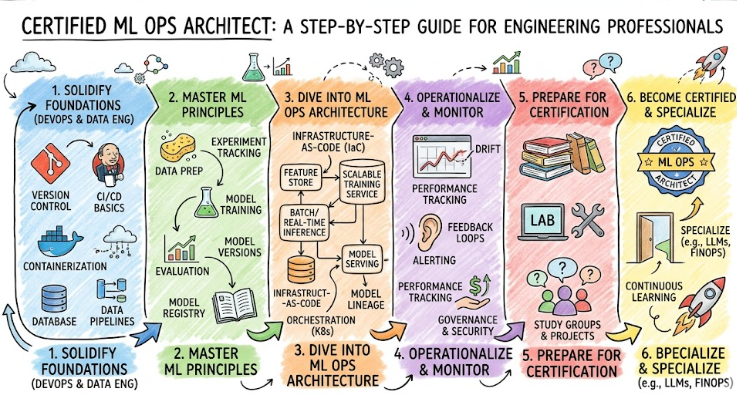
The Certified MLOps Architect is a comprehensive professional program designed to bridge the gap between data science experimentation and production-grade software engineering. This guide is crafted for professionals who recognize that the greatest challenge in modern technology is not just building a machine learning model, but deploying, monitoring, and scaling it within a reliable ecosystem. As organizations transition from manual AI workflows to automated pipelines, the role of an architect who understands both the mathematical nuances of models and the rigors of cloud-native infrastructure becomes critical.
Whether you are coming from a DevOps background, SRE discipline, or data engineering, this guide provides a clear roadmap to navigating the AIOps School curriculum. We will explore how this certification impacts your career trajectory within the broader landscape of platform engineering and cloud architecture. By the end of this article, you will have a deep understanding of the skills required, the levels of mastery available, and how to align your learning path with current industry demands for operational excellence in machine learning.
What is the Certified MLOps Architect?
The Certified MLOps Architect represents a standardized benchmark for engineers who manage the intersection of Machine Learning, DevOps, and Data Engineering. It exists to address the “hidden technical debt” in machine learning systems, moving beyond the Jupyter Notebook and into the realm of automated, reproducible, and scalable production environments. Unlike theoretical academic courses, this program emphasizes the operationalization of models, focusing on the entire lifecycle from data ingestion to model decay monitoring.
In a modern enterprise, an MLOps Architect is responsible for creating the scaffolding that allows data scientists to deliver value without getting bogged down in infrastructure hurdles. This certification validates your ability to implement CI/CD for ML, manage feature stores, and ensure that model drift is detected before it impacts business outcomes. It aligns perfectly with cloud-native practices, treating models as code and data as a first-class citizen in the deployment pipeline.
Who Should Pursue Certified MLOps Architect?
This certification is tailored for a wide range of technical professionals who are looking to specialize in the operational side of artificial intelligence. DevOps engineers and SREs are the primary candidates, as they already possess the foundational knowledge of automation and reliability but need to understand the specific artifacts and behaviors of ML workloads. Cloud architects who want to design robust environments for AI-driven applications will find the architectural patterns covered here indispensable for their daily design decisions.
Data engineers and software developers also stand to benefit significantly, as it allows them to move into high-impact roles where they oversee the delivery of AI products. For engineering managers and technical leaders, the certification provides the vocabulary and framework necessary to lead teams of data scientists and engineers effectively. In regions like India and across the global tech landscape, the demand for these hybrid professionals is outstripping supply, making it a strategic move for anyone looking to future-proof their career.
Why Certified MLOps Architect is Valuable Today and Beyond
The value of the Certified MLOps Architect lies in its focus on longevity and enterprise-level adoption rather than just chasing the latest tooling trends. While tools change every few months, the principles of versioning data, tracking experiments, and automating deployments remain constant. This program helps professionals stay relevant by teaching the underlying patterns that govern successful AI implementations across any cloud provider or software stack.
Enterprises are no longer satisfied with “cool demos”; they require production reliability and measurable return on investment. Professionals who hold this certification demonstrate that they can lower the cost of model deployment and increase the speed of iteration. This translates directly to high career mobility and competitive compensation packages, as the ability to bridge the gap between “it works on my machine” and “it works at scale” is currently one of the most sought-after skill sets in the technology sector.
Certified MLOps Architect Certification Overview
The program is delivered via the official portal at the provided curriculum site and is hosted on the AIOps School platform. The certification is structured to take a candidate from foundational concepts to advanced architectural design through a series of progressively difficult levels. It utilizes a performance-based assessment approach, meaning that candidates are tested on their ability to solve real-world problems rather than just memorizing definitions.
The ownership of the curriculum is maintained by industry experts who have experience running large-scale ML systems at major technology firms. The structure is practical, dividing the learning into manageable modules that cover infrastructure as code, data pipeline automation, and model governance. Each level is designed to provide a milestone that corresponds to specific responsibilities within an engineering team, ensuring a clear path for professional development.
Certified MLOps Architect Certification Tracks & Levels
The certification is divided into three primary levels to accommodate professionals at different stages of their journey. The Foundation level focuses on the basic terminology, the MLOps lifecycle, and the core differences between traditional software and ML-based systems. This is ideal for those new to the field who need to understand the high-level landscape before diving into technical implementation details.
The Professional level moves into the implementation phase, covering CI/CD pipelines, containerization of models, and the use of orchestration tools like Kubernetes. The Advanced level is geared toward seasoned architects and technical leads, focusing on governance, security, multi-cloud strategies, and the optimization of large-scale distributed systems. This tiered approach ensures that an individual can continuously grow their expertise without feeling overwhelmed by the complexity of the domain.
Complete Certified MLOps Architect Certification Table
| Track | Level | Who it’s for | Prerequisites | Skills Covered | Recommended Order |
| Core Architecture | Foundation | Beginners, Managers | Basic IT knowledge | MLOps Lifecycle, Terminology | 1 |
| Engineering | Professional | DevOps, Data Engineers | Foundation level | CI/CD, Containerization, Monitoring | 2 |
| Strategy | Advanced | Senior Architects, Leads | Professional level | Governance, Scale, Security | 3 |
| SRE/Operations | Specialized | SREs, Platform Engineers | Professional level | Model Observability, Reliability | 4 |
Detailed Guide for Each Certified MLOps Architect Certification
Certified MLOps Architect – Foundation
What it is
This certification validates a professional’s understanding of the fundamental principles of MLOps and how they differ from standard DevOps practices. It serves as an entry point for those looking to understand the “why” behind MLOps before tackling the “how.”
Who should take it
Software engineers, business analysts, and entry-level DevOps professionals who want to pivot into the machine learning operations space. It is also highly recommended for managers who need to oversee ML teams.
Skills you’ll gain
- Understanding the MLOps maturity model.
- Identifying the components of a standard ML pipeline.
- Grasping the importance of data versioning and experiment tracking.
- Learning the vocabulary needed to collaborate with data scientists.
Real-world projects you should be able to do
- Map out a conceptual MLOps pipeline for a business use case.
- Identify bottlenecks in a manual machine learning workflow.
- Create a basic strategy for transitioning from manual to automated deployments.
Preparation plan
- 7–14 days: Review the official documentation and take practice quizzes on terminology.
- 30 days: Deep dive into whitepapers on MLOps best practices and case studies.
- 60 days: Engage in community discussions and webinars to understand real-world application scenarios.
Common mistakes
- Treating MLOps exactly like standard DevOps without accounting for data drift.
- Skipping the foundational theory to jump straight into tool-specific tutorials.
Best next certification after this
- Same-track option: Professional MLOps Architect
- Cross-track option: Certified DataOps Associate
- Leadership option: Technical Program Manager for AI
Certified MLOps Architect – Professional
What it is
The Professional level validates the technical capability to build and maintain automated pipelines for machine learning models. It focuses on the integration of tools and the automation of the entire model delivery process.
Who should take it
DevOps engineers, SREs, and Data Engineers who are actively building infrastructure for machine learning teams. Candidates should have a working knowledge of cloud platforms and automation scripts.
Skills you’ll gain
- Implementing CI/CD pipelines specifically for machine learning models.
- Automating model training and evaluation cycles.
- Deploying models using container orchestration systems.
- Setting up basic monitoring for model performance and data health.
Real-world projects you should be able to do
- Build a fully automated pipeline that triggers model retraining on new data.
- Containerize an ML model and deploy it to a Kubernetes cluster.
- Integrate a feature store into an existing data pipeline.
Preparation plan
- 7–14 days: Focus on hands-on labs involving Jenkins or GitLab CI for ML.
- 30 days: Practice deploying various model types (TensorFlow, Scikit-learn) in containers.
- 60 days: Build a complete end-to-end project from data ingestion to model serving.
Common mistakes
- Focusing only on the model deployment while ignoring the data pipeline.
- Failing to implement proper versioning for both code and data.
Best next certification after this
- Same-track option: Advanced MLOps Architect
- Cross-track option: Certified SRE Professional
- Leadership option: Principal MLOps Engineer
Certified MLOps Architect – Advanced
What it is
This is a high-level certification that focuses on the strategic and architectural aspects of MLOps at scale. It validates the ability to design resilient, secure, and cost-effective AI ecosystems across large organizations.
Who should take it
Senior Architects, Principal Engineers, and Technical Leads with several years of experience in production environments. It is for those responsible for the overall technical direction of AI platforms.
Skills you’ll gain
- Designing multi-cloud and hybrid MLOps architectures.
- Implementing advanced security and compliance for AI (DevSecOps for ML).
- Optimizing costs and resources for large-scale training jobs.
- Developing governance frameworks for model bias and explainability.
Real-world projects you should be able to do
- Architect a global model serving infrastructure with low latency requirements.
- Design a federated learning system for privacy-preserving AI.
- Create an enterprise-wide model governance and auditing dashboard.
Preparation plan
- 7–14 days: Review architectural patterns for high availability and disaster recovery.
- 30 days: Case study analysis of failed ML projects and how to prevent them through architecture.
- 60 days: Designing and defending a complex architecture proposal for a hypothetical enterprise client.
Common mistakes
- Over-engineering the solution for small teams or simple use cases.
- Neglecting the legal and ethical implications of automated decision-making systems.
Best next certification after this
- Same-track option: Industry-specific specialization (e.g., MLOps for Finance)
- Cross-track option: Certified Cloud Solutions Architect
- Leadership option: Chief Technology Officer (CTO) path
Choose Your Learning Path
DevOps Path
The DevOps professional focuses on the automation of the “Code” and “Model” components. In this path, the emphasis is on integrating ML into existing CI/CD workflows. You will learn how to treat a model as a build artifact and how to manage dependencies that are unique to the ML ecosystem. This path is ideal for those who want to ensure that AI delivery is as seamless as standard software delivery.
DevSecOps Path
The security-focused path addresses the unique vulnerabilities introduced by machine learning, such as model poisoning and data leakage. You will study how to integrate security scanning into the ML pipeline and ensure that data privacy regulations are met. This is a critical path for industries like healthcare and finance where data sensitivity is a top priority. Professionals here act as the guardians of the AI ecosystem.
SRE Path
Site Reliability Engineers in MLOps focus on the availability and performance of the model serving infrastructure. This path covers concepts like “Model Error Budgets” and automated rollbacks when model performance drops. You will learn to apply the principles of observability to non-deterministic systems. It is the perfect path for those who enjoy troubleshooting complex, high-scale production environments.
AIOps Path
The AIOps path is distinct from MLOps as it focuses on using AI and ML to improve traditional IT operations. You will learn to use algorithmic approaches to correlate logs, detect anomalies in system performance, and automate incident response. This path is less about building models for products and more about using models to run infrastructure better. It is a highly specialized track for platform engineers.
MLOps Path
This is the core path focusing on the end-to-end lifecycle of machine learning. It covers the synchronization of data, code, and models to produce reliable outputs. You will learn about feature engineering pipelines, experiment management, and model registries. This path is the most direct route for those wanting to become a specialized MLOps Architect.
DataOps Path
DataOps focuses on the “Data” pillar of the MLOps triangle. This path emphasizes data quality, data lineage, and the automation of data pipelines. You will learn how to provide clean, versioned, and reliable data to the ML models. This is essential for ensuring that the “Garbage In, Garbage Out” problem does not undermine the work of the data science team.
FinOps Path
The FinOps path for MLOps is becoming increasingly important as the cost of GPU training and cloud inference rises. You will learn to track the cost of individual models and optimize resource allocation to ensure profitability. This path bridges the gap between engineering and finance, focusing on the economic sustainability of AI projects. It is a must for organizations operating at a massive scale.
Role → Recommended Certified MLOps Architect Certifications
| Role | Recommended Certifications |
| DevOps Engineer | Foundation, Professional |
| SRE | Professional, SRE-Specialized |
| Platform Engineer | Professional, Advanced |
| Cloud Engineer | Foundation, Professional |
| Security Engineer | Foundation, DevSecOps-Specialized |
| Data Engineer | Foundation, DataOps-Specialized |
| FinOps Practitioner | Foundation, FinOps-Specialized |
| Engineering Manager | Foundation, Advanced |
Next Certifications to Take After Certified MLOps Architect
Same Track Progression
Deepening your specialization in MLOps involves moving toward platform-specific expert levels. After completing the architect series, you may look into specialized certifications for Kubernetes-based ML (like Kubeflow) or cloud-specific MLOps certifications from AWS or Azure. The goal is to move from a generalist architect to an expert who can implement these patterns on any specific stack.
Cross-Track Expansion
To become a well-rounded leader, expanding into DataOps or DevSecOps is highly recommended. Understanding the nuances of data engineering helps an MLOps architect design better ingestion layers, while DevSecOps knowledge ensures the entire system is “secure by design.” This broadening of skills makes you more versatile and capable of handling complex, cross-functional projects.
Leadership & Management Track
For those looking to move away from hands-on engineering, the next logical step is a certification in Technical Leadership or Engineering Management. These programs focus on team dynamics, strategic planning, and the business value of technology. Combining an MLOps Architect background with management skills positions you for roles like VP of Engineering or Head of AI Infrastructure.
Training & Certification Support Providers for Certified MLOps Architect
DevOpsSchool
DevOpsSchool provides an intensive training environment designed for working professionals who need practical, hands-on experience. Their curriculum for MLOps is built around real-world scenarios and project-based learning. They offer flexible schedules, including weekend batches, making it accessible for those with full-time jobs. Their instructors are industry veterans who provide deep insights into the challenges of production environments. The school is known for its strong community support and extensive library of recorded sessions and documentation. This makes it a reliable choice for candidates in India and globally who prefer a guided learning approach with plenty of mentorship.
Cotocus
Cotocus focuses on delivering high-end technical training with a strong emphasis on cloud-native technologies and automation. Their approach to MLOps certification preparation involves deep dives into containerization and orchestration tools. They provide a structured environment where students can experiment with various tools in a safe, lab-based setting. Cotocus is recognized for its ability to simplify complex architectural concepts into digestible modules. Their training programs are often updated to reflect the latest changes in the technology landscape, ensuring that students are learning the most current practices. It is an excellent option for engineers who want to sharpen their technical edge.
Scmgalaxy
Scmgalaxy is a prominent community-driven platform that has been a staple in the DevOps world for years. They offer specialized tracks for MLOps that leverage their vast repository of tutorials, blogs, and scripts. Their training style is very practical, often focusing on the integration of various open-source tools to create a cohesive pipeline. Scmgalaxy is particularly valuable for those who learn best through community interaction and shared knowledge. They provide a wealth of free resources alongside their formal training programs, making them a great starting point for anyone exploring the MLOps domain without a massive initial investment.
BestDevOps
BestDevOps prides itself on offering premium training experiences that focus on the “best practices” of the industry. Their MLOps program is designed to transform traditional engineers into specialized architects who can handle enterprise-grade challenges. They emphasize the strategic side of operations, including governance and cost management. The instructors at BestDevOps are often practitioners who are currently working in top-tier tech firms, providing students with “from the trenches” knowledge. Their certification support is comprehensive, covering everything from initial concepts to final exam preparation and career coaching, making it a high-value choice for serious career movers.
devsecopsschool.com
DevSecOpsSchool is the go-to provider for those who want to integrate security into every step of the MLOps lifecycle. Their curriculum is uniquely positioned to address the security concerns specific to machine learning, such as data integrity and model security. They provide specialized labs that simulate security breaches and teach students how to build resilient pipelines. For an MLOps Architect, understanding the security layer is non-negotiable, and this school provides the specialized knowledge needed to excel in that area. Their certifications are highly respected in industries that demand high compliance and security standards, offering a clear advantage to their graduates.
sreschool.com
SRESchool focuses on the reliability and observability aspects of modern infrastructure, which are core components of the MLOps discipline. Their training programs teach engineers how to manage models as services, ensuring they meet strict uptime and performance requirements. They introduce candidates to the concepts of SLIs, SLOs, and SLAs in the context of machine learning. This is a vital perspective for any architect who wants their models to survive the rigors of production. SRESchool provides a rigorous curriculum that challenges students to think about failure modes and how to build self-healing systems, which is essential for scaling AI operations.
aiopsschool.com
AIOpsSchool is the primary authority and hosting platform for the Certified MLOps Architect program. They provide the most direct and comprehensive path to certification, with materials specifically designed to align with the exam objectives. Their platform is a hub for all things related to AI in operations, offering a mix of foundational courses and advanced specialization tracks. By learning directly from the source, candidates ensure they are getting the most accurate and up-to-date information. The school offers a seamless experience from enrollment to certification, providing all the necessary tools and support to help professionals succeed in their MLOps journey.
dataopsschool.com
DataOpsSchool addresses the critical data layer that powers every machine learning model. Their curriculum focuses on the automation of data pipelines and the maintenance of data quality, which are foundational to successful MLOps. For an architect, understanding how to manage the “data” part of the equation is just as important as the “model” part. DataOpsSchool provides specialized training that covers data versioning, lineage, and orchestration. This knowledge allows MLOps Architects to build more robust and reliable systems. Their programs are ideal for those who want to master the entire data-to-model lifecycle and ensure high-fidelity outputs for their organizations.
finopsschool.com
FinOpsSchool provides the essential financial perspective that is often missing from purely technical training. As AI infrastructure costs continue to escalate, the ability to manage and optimize these expenses is a crucial skill for any senior architect. This school teaches the principles of cloud financial management specifically tailored for high-compute workloads like machine learning. Students learn how to build cost-aware architectures and how to communicate the economic value of their technical decisions to stakeholders. FinOpsSchool is a vital resource for professionals looking to move into high-level strategic roles where budget accountability is a key responsibility of the engineering leadership.
Frequently Asked Questions (General)
- Is the Certified MLOps Architect difficult?
The difficulty is moderate to high, depending on your background. It requires a solid understanding of both software engineering and data science concepts. - How much time does it take to get certified?
Most professionals complete the journey in 3 to 6 months, depending on their existing experience and the level of certification they are pursuing. - Are there any prerequisites for the Foundation level?
There are no strict technical prerequisites, but a basic understanding of cloud computing and the software development lifecycle is helpful. - Is this certification recognized globally?
Yes, the program follows international standards for MLOps and is recognized by enterprises worldwide as a valid measure of professional skill. - Does the certification expire?
The certification is typically valid for two to three years, after which recertification or moving to a higher level is required to stay current. - Can I take the exam online?
Yes, the assessments are conducted through a secure online platform, allowing candidates from any location to participate. - What is the format of the exam?
The exam consists of a mix of multiple-choice questions and performance-based tasks that simulate real-world engineering challenges. - How much does the certification cost?
Pricing varies based on the level and any bundled training packages; you should check the official portal for the most current rates. - Is there a community for certified professionals?
Yes, holders of the certification get access to an exclusive community of architects for networking and knowledge sharing. - Do I need to be a programmer to pass?
For the Professional and Advanced levels, a strong command of scripting (Python) and automation tools is essential. - How does this differ from a Data Science certification?
Data science focuses on building models; MLOps focuses on the infrastructure, deployment, and maintenance of those models. - Will this certification help me get a job in India?
Absolutely. The Indian tech market is rapidly adopting AI, and the demand for MLOps talent in major hubs like Bangalore and Hyderabad is very high.
FAQs on Certified MLOps Architect
- What specific tools are covered in the curriculum?
The program covers a wide range of industry-standard tools including Kubernetes, Docker, MLflow, Kubeflow, and various CI/CD platforms. - Does it cover specific cloud providers like AWS or Azure?
The principles are cloud-agnostic, but the practical labs often use major cloud providers to demonstrate real-world implementation. - Is the focus more on the model or the infrastructure?
The focus is heavily on the infrastructure and the automation pipelines required to support the model throughout its lifecycle. - How often is the curriculum updated?
The curriculum is reviewed and updated annually to ensure it reflects the latest shifts in the MLOps and AIOps landscape. - Can I skip the Foundation level?
If you have significant experience, you may be able to challenge the Professional exam directly, but the Foundation level is recommended for a complete understanding. - Are there hands-on labs?
Yes, the Professional and Advanced levels include extensive hands-on labs that require building actual MLOps pipelines. - What is the passing score for the exams?
Generally, a score of 70% or higher is required to pass the assessments and earn the certification. - Is there a retake policy?
Yes, candidates who do not pass on their first attempt can retake the exam after a mandatory waiting period and a retake fee.
Final Thoughts: Is Certified MLOps Architect Worth It?
From a mentor’s perspective, the decision to pursue the Certified MLOps Architect should be based on your long-term career goals. If you enjoy the challenge of building complex, reliable systems and want to be at the forefront of the AI revolution, this certification is a sound investment. It provides more than just a badge; it provides a structured framework for thinking about one of the most difficult problems in modern engineering.
The field of MLOps is not a hype cycle—it is a fundamental shift in how software is built and maintained. As machine learning becomes a standard component of every application, the need for architects who can bridge the gap between “science” and “operations” will only grow. This certification puts you in that elite group of professionals who can turn raw algorithms into reliable business value. If you are willing to put in the effort to master both the data and the infrastructure, the career rewards will be significant and long-lasting.

Best Cardiac Hospitals Near You
Discover top heart hospitals, cardiology centers & cardiac care services by city.
Advanced Heart Care • Trusted Hospitals • Expert Teams
View Best Hospitals