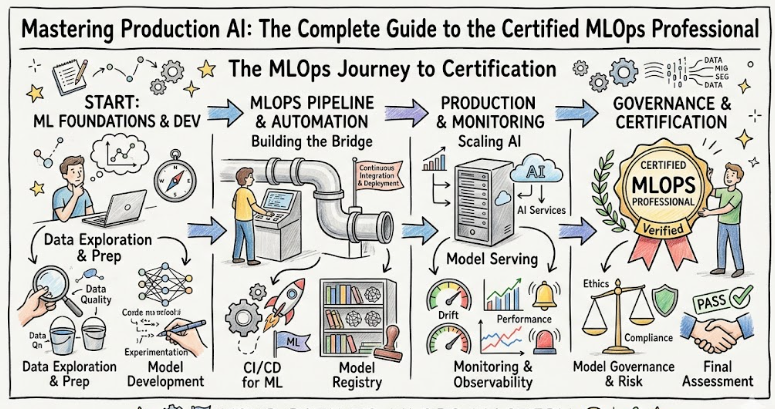
Introduction
The transition from experimental data science to production-grade machine learning is one of the most significant challenges facing modern enterprises. While building a model in a notebook is straightforward, maintaining that model in a live environment requires a robust framework of automation, monitoring, and governance. This is where the Certified MLOps Professional designation comes into play, serving as a benchmark for engineers who bridge the gap between data science and operations.
This guide is designed for professionals who recognize that the future of software engineering is increasingly intelligent and data-driven. Whether you are a DevOps engineer looking to expand into AI or a data scientist aiming to operationalize your workflows, this breakdown offers an unbiased perspective on the certification’s value. Hosted by AIOps School, this program provides a structured pathway to mastering the complexities of the ML lifecycle within modern platform engineering.
The following sections will dissect the curriculum, map it to real-world roles, and help you determine if this investment aligns with your career trajectory. By moving beyond theoretical AI, this guide emphasizes the practical “plumbing” required to make AI scalable and reliable in an enterprise setting.
What is the Certified MLOps Professional?
The Certified MLOps Professional is a technical accreditation designed to validate an engineer’s ability to design, implement, and manage automated machine learning pipelines. It represents a shift away from pure algorithmic research toward the operational excellence required to run models at scale. In a typical software environment, code is the primary variable, but in MLOps, we must manage code, data, and models simultaneously.
This certification exists because traditional DevOps practices often fall short when applied to the non-deterministic nature of machine learning. It focuses on the intersection of data engineering, machine learning, and continuous delivery. Learners are expected to understand how to handle data versioning, model drift, and automated retraining, ensuring that AI remains an asset rather than a technical debt.
Production-focused learning is the cornerstone of this program. Instead of focusing solely on how to write a neural network, it asks how that network will be deployed, how it will be monitored for bias, and how it will be updated without breaking the user experience. It aligns perfectly with modern cloud-native workflows, utilizing containers, orchestrators, and automated CI/CD triggers.
Who Should Pursue Certified MLOps Professional?
The primary audience for this certification includes DevOps engineers and Site Reliability Engineers (SREs) who are increasingly tasked with managing infrastructure for data science teams. These professionals already understand uptime and scalability but need to learn the specific nuances of GPU orchestration, feature stores, and model serving. By gaining these skills, they become indispensable to organizations moving toward “AI-First” strategies.
Data Engineers and Data Scientists also benefit significantly from this path. While Data Scientists focus on model accuracy, the Certified MLOps Professional curriculum teaches them how to make their models reproducible and portable. This reduces the friction during the “hand-off” process to operations teams. Security professionals also find value here, as securing an ML pipeline involves unique challenges like model inversion attacks and data poisoning.
For engineering managers and technical leaders, this certification provides the vocabulary and conceptual framework needed to build effective MLOps teams. In the Indian market and globally, there is a massive talent gap for professionals who can handle the “Ops” side of AI. This certification serves as a signal to recruiters that the candidate can handle the rigors of a production environment, not just a development sandbox.
Why Certified MLOps Professional is Valuable in the Current Era and Beyond
The demand for MLOps expertise is driven by the reality that most AI projects fail to reach production due to operational hurdles. As enterprises move past the pilot phase of AI adoption, they require professionals who can ensure long-term stability and ROI. This certification provides longevity because it teaches principles—such as version control for data and automated testing for models—that remain relevant regardless of which specific tool or framework is currently in vogue.
Standardization is another key factor. As industries like finance and healthcare face increasing regulation around AI, the ability to provide an audit trail for a model’s lifecycle becomes a legal necessity. This certification covers the governance and reproducibility aspects of MLOps, making certified professionals highly attractive to regulated industries. It helps engineers stay relevant by evolving their skill sets alongside the rapid growth of generative AI and large language models.
Furthermore, the return on time investment is high because the skills are immediately transferable to high-paying roles. Companies are willing to pay a premium for engineers who can reduce the time-to-market for ML features. By mastering the automation of the ML lifecycle, you are not just learning a tool; you are learning how to build a factory that produces intelligent software reliably and at scale.
Certified MLOps Professional Certification Overview
The Certified MLOps Professional program is delivered through the official portal at Certified MLOps Professional and is hosted on the AIOps School platform. The program is structured to accommodate different levels of expertise, moving from foundational concepts to complex architectural designs. It is built on a “hands-on first” philosophy, where theoretical knowledge is always tethered to practical implementation.
The certification is categorized into distinct levels to help learners progress logically. Each level is designed to validate a specific set of competencies, ensuring that a “Professional” designation actually carries weight in a technical interview or a performance review. The assessment approach typically involves a combination of theoretical exams and lab-based projects that simulate real-world production outages or pipeline failures.
Ownership of the learning journey stays with the student, but the structure is guided by industry veterans. The program emphasizes the use of open-source tools as well as cloud-specific services, giving the learner a well-rounded view of the ecosystem. It is not tied to a single vendor, which is crucial for engineers working in multi-cloud or hybrid environments where flexibility is a core requirement.
Certified MLOps Professional Certification Tracks & Levels
The certification framework is divided into three primary tiers: Foundation, Professional, and Advanced. The Foundation level is intended for those new to the concept of MLOps, focusing on the terminology and the basic “Why” behind the movement. It covers the general lifecycle of a model and the differences between traditional software and machine learning software.
The Professional level, which is the core of the program, dives deep into the “How.” This track covers the implementation of CI/CD/CT (Continuous Training) pipelines. It focuses on specialization tracks such as MLOps for SREs, where the focus is on latency and model monitoring, or MLOps for DataOps, where the focus is on data lineage and quality. This level is where most engineers will find the most direct career impact.
The Advanced level is for architects and senior leads. It deals with complex topics like multi-tenancy in ML platforms, cost optimization (FinOps for ML), and enterprise-grade security for model endpoints. These levels align with career progression from an individual contributor to a technical lead or architect role, providing a clear roadmap for long-term professional growth in the AI space.
Complete Certified MLOps Professional Certification Table
| Track | Level | Who it’s for | Prerequisites | Skills Covered | Recommended Order |
| MLOps Foundation | Beginner | Junior Engineers, Managers | Basic Linux & Python | MLOps terminology, ML Lifecycle, Versioning basics | 1st |
| MLOps Professional | Intermediate | DevOps/SRE/Data Engineers | CI/CD knowledge, Docker | CI/CD/CT Pipelines, Model Monitoring, Kubernetes | 2nd |
| Advanced MLOps Architect | Expert | Senior Architects, Leads | MLOps Professional Cert | Scalable Infrastructure, ML Governance, FinOps | 3rd |
| MLOps for Data Engineers | Specialization | Data Professionals | SQL, Data Pipeline experience | Feature Stores, Data Lineage, DVC | 4th (Optional) |
| MLOps Security Specialist | Specialization | Security Engineers | Cloud Security basics | Adversarial ML, Model Encryption, IAM for ML | 4th (Optional) |
Detailed Guide for Each Certified MLOps Professional Certification
Certified MLOps Professional – Foundation Level
What it is
This certification validates a candidate’s understanding of the fundamental principles of MLOps. It ensures the learner can distinguish between standard DevOps and the specialized needs of machine learning pipelines.
Who should take it
Aspiring MLOps engineers, project managers, and traditional DevOps professionals who need a conceptual starting point. It is ideal for those with 0-1 years of experience in AI operations.
Skills you’ll gain
- Understanding the 3 pillars: Data, Model, and Code.
- Basic familiarity with ML lifecycle stages (Ingestion to Deployment).
- Knowledge of common MLOps tools and their roles in the stack.
Real-world projects you should be able to do
- Mapping a manual ML workflow to an automated lifecycle diagram.
- Setting up a basic version control system for a small dataset.
Preparation plan
- 7-14 days: Focus on terminology, reading the MLOps manifesto, and understanding the core differences between CI/CD and CT.
- 30 days: Explore basic tools like Git and DVC (Data Version Control) through introductory tutorials.
- 60 days: Not typically required for Foundation, but can be used to shadow a real MLOps project at work.
Common mistakes
- Focusing too much on the math of machine learning rather than the process of deployment.
- Underestimating the importance of data quality in the operational phase.
Best next certification after this
- Same-track option: Certified MLOps Professional – Intermediate.
- Cross-track option: DataOps Foundation.
- Leadership option: AI Strategy for Managers.
Certified MLOps Professional – Professional Level
What it is
This is the flagship certification that validates the ability to build and maintain end-to-end automated pipelines. It proves you can move models from a researcher’s notebook to a production-ready Kubernetes cluster.
Who should take it
Engineers with 2+ years of experience in DevOps, Cloud, or Data Engineering. This is the “sweet spot” for practitioners who want to be recognized as experts in the field.
Skills you’ll gain
- Implementing CI/CD/CT pipelines using tools like Jenkins, GitLab CI, or GitHub Actions.
- Orchestrating ML workloads on Kubernetes (Kubeflow, Seldon).
- Configuring model monitoring and alerting for data and concept drift.
Real-world projects you should be able to do
- Building an automated retraining pipeline that triggers when model performance drops.
- Deploying a model as a REST API with auto-scaling and health checks.
Preparation plan
- 7-14 days: Review containerization and basic Kubernetes primitives.
- 30 days: Deep dive into ML-specific tools like MLflow for tracking and BentoML for serving.
- 60 days: Build a complete end-to-end project including monitoring and automated deployment.
Common mistakes
- Building “brittle” pipelines that break when the data schema changes slightly.
- Ignoring the costs of running heavy GPU instances in a production environment.
Best next certification after this
- Same-track option: Advanced MLOps Architect.
- Cross-track option: Certified SRE Professional.
- Leadership option: Technical Program Management for AI.
Choose Your Learning Path
DevOps Path
For the traditional DevOps engineer, the transition to MLOps is about adding “Data” and “Models” to your existing CI/CD pipelines. You will focus on how to use your existing knowledge of Jenkins, Terraform, and Kubernetes to support data science workloads. This path emphasizes the creation of “Model Factories” where researchers can deploy their work with a single click. You become the architect of the platform that makes AI possible.
DevSecOps Path
The security-focused path is critical because ML models introduce new attack vectors. You will learn about “Model Governance” and how to ensure that the data used for training hasn’t been tampered with. This path covers scanning model containers for vulnerabilities and implementing strict IAM roles for access to sensitive training data. You ensure the AI pipeline is as secure as it is efficient.
SRE Path
Site Reliability Engineers focusing on MLOps care about “Model Observability.” In this path, you learn to treat a model as a living service that can fail in silent, non-binary ways. You will focus on latency, throughput, and the specific metrics that indicate a model is no longer providing accurate predictions. This path is for those who want to ensure that AI services meet their Service Level Objectives (SLOs).
AIOps Path
AIOps focuses on using machine learning to improve IT operations. In this path, you learn how to apply ML techniques to log analysis, anomaly detection in monitoring data, and automated incident response. It is a “meta” path where you use the principles of MLOps to build tools that help other engineers sleep better at night. You are essentially operationalizing AI to manage operations.
MLOps Path
The pure MLOps path is for those who want to specialize entirely in the machine learning lifecycle. It covers everything from feature engineering pipelines to model registries and deployment strategies like Canary and Shadow releases. This is the most comprehensive path for someone who wants to be titled an “MLOps Engineer.” You will bridge the technical gap between the data scientist’s research and the end user’s experience.
DataOps Path
DataOps is the foundation upon which MLOps is built. This path focuses on the reliability and quality of the data pipelines that feed the machine learning models. You will learn about data versioning, automated data testing, and building robust feature stores. If the data is bad, the model will be bad, and this path ensures that the “fuel” for the AI engine is always high-grade.
FinOps Path
Machine learning can be incredibly expensive due to the cost of high-performance computing. The FinOps path for MLOps focuses on cost attribution and optimization of ML workloads. You will learn how to select the right instance types, use spot instances for training, and set up alerts for cost overruns. This path makes you a favorite of the finance department by ensuring AI growth is sustainable.
Role → Recommended Certified MLOps Professional Certifications
| Role | Recommended Certifications |
| DevOps Engineer | MLOps Foundation, MLOps Professional |
| SRE | MLOps Professional, SRE Specialized Track |
| Platform Engineer | MLOps Professional, Advanced MLOps Architect |
| Cloud Engineer | MLOps Foundation, Professional (Cloud-specific focus) |
| Security Engineer | MLOps Foundation, MLOps Security Specialist |
| Data Engineer | MLOps for Data Engineers, MLOps Professional |
| FinOps Practitioner | MLOps Foundation, FinOps for ML |
| Engineering Manager | MLOps Foundation, AI Strategy / Management Track |
Next Certifications to Take After Certified MLOps Professional
Same Track Progression
Once you have cleared the Professional level, the natural progression is toward the Advanced MLOps Architect certification. This involves moving from building pipelines to designing entire platforms that can support hundreds of models across multiple teams. You will focus on high-level orchestration, cross-cloud portability, and building internal “Self-Service” portals for data science teams.
Cross-Track Expansion
If you want to broaden your skills, moving into the SRE or DataOps tracks is highly beneficial. An MLOps professional who understands the rigors of Site Reliability Engineering is a formidable asset. Alternatively, diving into DataOps allows you to control the entire supply chain of an AI application, from the raw data source to the final API response.
Leadership & Management Track
For those looking to move away from hands-on coding, the transition into AI Product Management or Engineering Leadership is a viable path. Your technical background in MLOps will allow you to realistically estimate timelines and resource requirements for complex AI projects. You will be the person who decides which AI initiatives are technically feasible and economically sound.
Training & Certification Support Providers for Certified MLOps Professional
DevOpsSchool
DevOpsSchool provides a comprehensive ecosystem for technical training, specifically tailored for engineers looking to upskill in modern automation. Their approach to the MLOps curriculum is grounded in years of experience teaching DevOps principles, making the transition to machine learning operations seamless for their students. They offer a blend of instructor-led sessions and self-paced labs that reflect the actual challenges faced by industry professionals. The school has built a reputation for high-quality content that is updated frequently to keep pace with the rapidly evolving tech landscape. Their community support is a significant advantage for learners.
Cotocus
Cotocus operates at the intersection of consulting and training, providing a unique perspective on the implementation of MLOps in real-world environments. Their training modules are often derived from the solutions they build for their enterprise clients, ensuring that students are learning practical, battle-tested strategies rather than just theory. They focus heavily on cloud-native architectures and help professionals master the tools required for scalable AI deployments. By choosing Cotocus, learners gain access to insights from active consultants who understand the specific pain points of operationalizing machine learning in a corporate setting. Their focus is on excellence.
Scmgalaxy
Scmgalaxy is a cornerstone of the technical community, offering a wealth of resources for software configuration management and DevOps. Their support for MLOps training is characterized by a deep commitment to open-source tools and community-driven learning. They provide a platform where engineers can share knowledge, troubleshoot issues, and stay updated on the latest trends in the ML space. Their curriculum is designed to be accessible yet technically rigorous, making it a great choice for self-motivated learners. The platform’s history of supporting engineers makes it a reliable partner for anyone pursuing the MLOps professional certification path.
BestDevOps
BestDevOps focuses on curated learning experiences that prioritize high-impact skills for the modern workforce. Their training for the MLOps certification is streamlined to remove fluff and focus on the core competencies required by top-tier employers. They utilize case studies from leading tech companies to illustrate the importance of robust ML pipelines. The instructors are typically industry practitioners who bring a wealth of “on-the-job” knowledge to the virtual classroom. This provider is excellent for professionals who want a focused, results-oriented training program that respects their time while providing deep technical value and career coaching.
devsecopsschool.com
As the name suggests, this provider specializes in the integration of security into the automated lifecycle. For the MLOps certification, they offer unique insights into model security, data privacy, and compliance. Their curriculum is essential for engineers working in sensitive sectors like finance or government, where security cannot be an afterthought. They teach how to build “Secure-by-Design” ML pipelines, covering topics like adversarial attacks and secure model hosting. Their expertise ensures that MLOps professionals are not just building fast pipelines, but safe ones that protect the organization’s most valuable data assets.
sreschool.com
Sreschool.com is dedicated to the art and science of reliability. Their support for the MLOps certification path focuses on how to keep machine learning models running consistently in production. They apply SRE principles like error budgets and toil reduction to the world of AI. Students learn how to monitor model health, manage latency, and automate recovery from model failures. This training is vital for anyone who wants to move beyond just deploying a model to actually owning its availability and performance over the long term. Their approach is highly analytical and deeply technical.
aiopsschool.com
AIOps School is the primary host and authority for this certification, providing the most direct and comprehensive learning path available. Their curriculum is specifically designed to bridge the gap between traditional operations and the new world of AI. Because they specialize in this niche, their labs and assessments are perfectly aligned with the certification requirements. They provide a structured environment where learners can experiment with the latest MLOps tools and receive feedback from experts in the field. Choosing AIOps School ensures that you are getting the most authoritative and up-to-date information regarding the certification standards.
dataopsschool.com
DataOps School focuses on the foundational layer of MLOps: the data pipeline. Their training programs emphasize that a machine learning model is only as good as the data it consumes. They provide deep dives into data versioning, quality automation, and feature engineering at scale. For those pursuing the MLOps certification, this provider offers the necessary context on how to manage the “Data” pillar of the MLOps triad. Their courses are designed to help engineers build the reliable data architecture needed to support complex AI initiatives without the common pitfalls of data silos.
finopsschool.com
FinOps School addresses the critical but often overlooked aspect of MLOps: cost management. As AI workloads can quickly become expensive, their training teaches engineers how to build cost-efficient pipelines. They cover cloud billing for ML services, resource optimization, and how to communicate the financial impact of AI projects to stakeholders. This training is invaluable for professionals who want to ensure their technical solutions are also financially sustainable for the business. By mastering FinOps for ML, engineers can justify larger projects and ensure that their AI initiatives provide a clear return on investment.
Frequently Asked Questions (General)
- How difficult is the Certified MLOps Professional exam?
The exam is moderately difficult as it requires both a solid understanding of DevOps principles and a functional knowledge of the machine learning lifecycle. It is designed to test your ability to solve real-world architectural problems. - What are the prerequisites for this certification?
While there are no strict barriers to entry for the foundation level, the Professional level assumes you are comfortable with Python, Linux, and containerization (Docker). - How long does it take to prepare for the certification?
A professional with a DevOps background usually requires 4 to 8 weeks of consistent study to feel confident for the Professional level exam. - Is the certification recognized by major tech companies?
Yes, companies looking for SREs and Data Engineers increasingly value this certification as it proves the candidate can handle the operational side of AI. - What is the return on investment (ROI) for this certification?
Certified professionals often see a significant salary bump and are eligible for specialized roles that are in high demand and short supply. - Do I need to be a math expert or a data scientist?
No. The focus is on the “Ops” (operations) side. You need to understand what the models do, but you don’t necessarily need to know the calculus behind them. - What tools are covered in the curriculum?
The program covers a mix of open-source tools like Kubeflow, MLflow, and DVC, as well as cloud-native services from AWS, Azure, and Google Cloud. - Is there a practical lab component?
Yes, the higher-level certifications require you to complete hands-on projects to demonstrate your ability to build working pipelines. - Can I skip the Foundation level?
If you have several years of experience in DevOps or Data Engineering, you may be able to go straight to the Professional level, though Foundation is recommended for a complete conceptual base. - How often do I need to recertify?
Typically, certifications are valid for two to three years, after which you may need to pass an update exam to stay current with the latest technology. - Are there any hidden costs?
Beyond the exam fee and training costs, you may need a small budget for cloud resources to practice the lab exercises. - Does this certification cover Generative AI and LLMs?
The principles taught apply directly to LLMs, and the advanced tracks include specific modules on operationalizing large language models (LLMOps).
FAQs on Certified MLOps Professional
- What makes Certified MLOps Professional different from a standard DevOps certification?
Standard DevOps focuses on the lifecycle of code. This certification adds the dimensions of data versioning and model state, which are unique to machine learning applications. - How does this certification help in an interview?
It provides a structured way to discuss complex topics like concept drift and feature stores, showing the interviewer that you have a comprehensive view of the system. - Is the curriculum vendor-neutral?
Yes, while it uses popular cloud tools for labs, the core principles are applicable across any cloud provider or on-premises environment. - Can I take the exam online?
Yes, the certification is designed to be accessible globally through online proctored examination platforms. - Is there a community for certified professionals?
AIOps School maintains a community where certified individuals can network, share job opportunities, and discuss the latest industry changes. - How does this fit into a Platform Engineering role?
Platform engineers use these skills to build the internal infrastructure that allows data scientists to work efficiently without worrying about underlying hardware. - Does this certification help with career transitions?
Absolutely. It is one of the most effective ways for a traditional software engineer to pivot into the high-growth field of Artificial Intelligence. - Is the certification updated regularly?
Yes, the curriculum is reviewed annually to ensure it reflects the latest best practices and toolsets in the MLOps ecosystem.
Final Thoughts: Is Certified MLOps Professional Worth It?
The decision to pursue a certification should always be based on your long-term career goals. In the case of the Certified MLOps Professional, the value is clear for those who want to be at the forefront of the next wave of computing. We are moving away from a world where AI is a research project and toward a world where AI is a standard component of every software application. If you enjoy the challenge of building complex, automated systems and you want to future-proof your career against the commoditization of basic DevOps, this is a path worth taking.
However, do not view this certification as a “magic bullet.” The real value comes from the hours spent in the labs, breaking things and learning how to fix them. The certificate is a signal to the market, but the skills are what will keep you employed. If you are willing to put in the work to understand the nuances of data pipelines and model orchestration, the ROI will manifest in the form of more interesting projects, higher compensation, and a central role in your organization’s digital transformation. It is a pragmatic, high-value investment for the serious engineer.

Best Cardiac Hospitals Near You
Discover top heart hospitals, cardiology centers & cardiac care services by city.
Advanced Heart Care • Trusted Hospitals • Expert Teams
View Best Hospitals