Introduction
eBPF (extended Berkeley Packet Filter) is a revolutionary technology that allows creators to run sandboxed programs inside the Linux kernel without changing the core code or loading risky modules. Traditionally, seeing deep into a system required heavy agents or sidecars that slowed down applications. eBPF changes this by moving visibility directly into the operating system’s “brain.” This allows for high-performance monitoring, networking, and security that can see every system call, network packet, and file access with almost zero overhead.
In the modern world of Kubernetes and cloud-native environments, eBPF has become the gold standard for observability and security. It provides a way to “see everything” across a cluster without needing to modify a single line of application code. Whether it is detecting a hidden hacker in real-time or tracing a slow database query across a complex network, eBPF-based tools offer a level of depth and efficiency that older technologies simply cannot match.
Real-World Use Cases
- Detecting container escapes and unauthorized privilege escalations at the exact moment they occur.
- Monitoring network traffic between microservices without the resource cost of traditional sidecar proxies.
- Identifying the root cause of application latency by tracing system calls directly in the kernel.
- Enforcing “least privilege” security policies by blocking unauthorized file or network access at the kernel level.
- Continuous profiling of production environments to find CPU-heavy code paths without impacting performance.
Evaluation Criteria for Buyers
- The ability to not just detect threats but also block them automatically at the kernel level.
- How much the tool impacts the CPU and memory of the production nodes.
- Seamless connectivity with existing platforms like Prometheus, Grafana, and OpenTelemetry.
- How easily the tool maps raw kernel data to high-level concepts like Pods, Namespaces, and Services.
- The availability of pre-built security rules and dashboards to reduce setup time.
- Support for various Linux kernel versions and cloud provider environments.
- The strength of the vendor or community behind the tool for long-term updates and security patches.
Best for: Security engineers, platform teams, SREs, and DevOps professionals managing large-scale Kubernetes or Linux environments.
Not ideal for: Teams running legacy Windows-only environments or those with very simple, non-containerized applications where basic logging is sufficient.
Key Trends in eBPF Observability & Security
- The move toward “sidecar-less” service meshes that use eBPF to handle networking more efficiently than traditional proxies.
- AI-driven anomaly detection that uses eBPF data to learn “normal” system behavior and flag suspicious patterns automatically.
- Increased adoption of BPF-LSM (Linux Security Module) for more granular and powerful security enforcement.
- Integration of continuous profiling into standard observability stacks to catch performance regressions early.
- Standardizing eBPF data exports into the OpenTelemetry format for better tool interoperability.
- “Zero-instrumentation” becoming the norm, where tools provide full application traces without code changes.
- Deployment of eBPF at the “Edge” and on IoT devices to provide security in resource-constrained environments.
- The rise of eBPF-based “Identity-Aware” networking that focuses on workload identity rather than just IP addresses.
How We Selected These Tools
To identify the top ten eBPF tools, we analyzed the current landscape of cloud-native security and observability. We prioritized tools that are officially part of the Cloud Native Computing Foundation (CNCF) or have widespread industry adoption. Our evaluation looked for a balance between pure observability (seeing what is happening) and runtime security (blocking bad behavior). We also considered the “developer experience,” favoring tools that make complex kernel data easy to understand through intuitive dashboards. Finally, we ensured the list includes both open-source foundations and enterprise-ready platforms to suit different organizational needs.
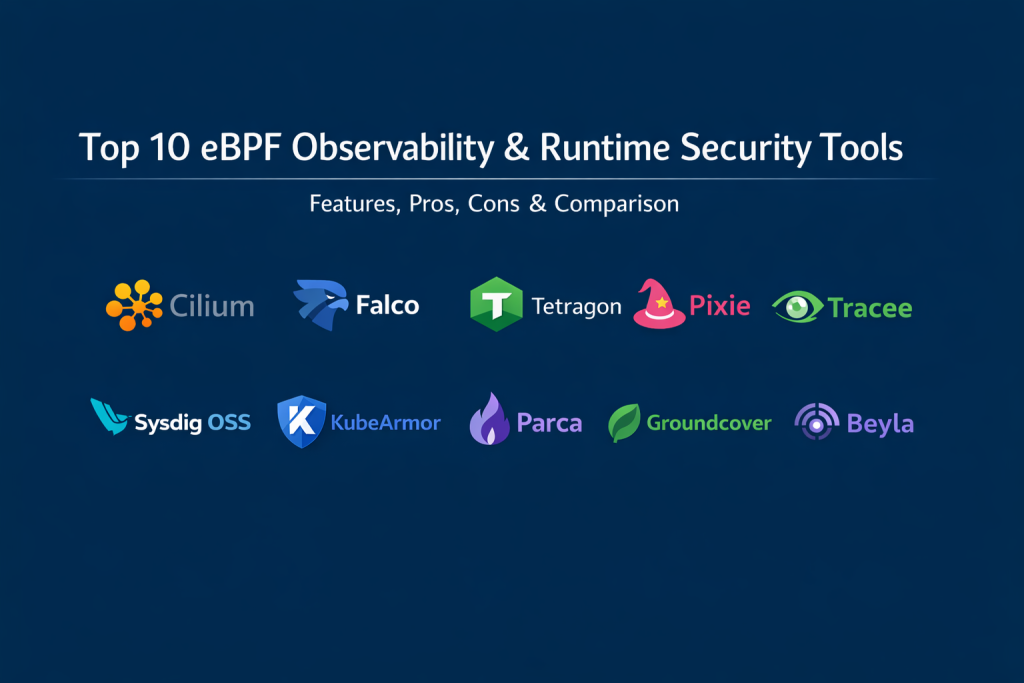
Top 10 eBPF Observability & Runtime Security Tools
1. Cilium & Hubble
Cilium is the industry leader for eBPF-based networking and security. It replaces traditional networking layers in Kubernetes with a high-performance plane. Its companion, Hubble, provides a visual layer that shows every network connection and security event in real-time, making it indispensable for managing large clusters.
Key Features
- High-performance load balancing and network policy enforcement at the kernel level.
- Deep L7 visibility for protocols like HTTP, gRPC, and Kafka without sidecars.
- Transparent encryption for all traffic between nodes using IPsec or WireGuard.
- Hubble UI for real-time graphical visualization of service dependencies.
- Identity-aware security that uses Kubernetes labels instead of unstable IP addresses.
Pros
- The most mature and widely adopted eBPF project in the cloud-native ecosystem.
- Combines networking, security, and observability into a single platform.
Cons
- Can be complex to configure for those new to advanced networking.
- Requires a relatively modern Linux kernel to access all features.
Platforms / Deployment
Windows (limited) / Linux — Hybrid
Security & Compliance
Supports advanced RBAC, network encryption, and identity-based security policies.
Integrations & Ecosystem
Integrates perfectly with Prometheus, Grafana, and all major Kubernetes distributions. It is the default networking choice for many cloud providers’ managed services.
Support & Community
A massive community and professional backing from Isovalent. It is a CNCF graduated project with extensive documentation and training resources.
2. Falco
Falco is the de facto standard for cloud-native runtime security. It acts as a security camera for your Linux systems, watching every system call and alerting you when it sees suspicious activity, such as a shell being opened inside a container or a sensitive file being modified.
Key Features
- A powerful rule engine with a vast library of pre-built security signatures.
- Real-time alerting for container escapes, privilege escalations, and suspicious logins.
- Ability to monitor both system calls and Kubernetes audit logs simultaneously.
- Lightweight eBPF probe that runs with minimal impact on system performance.
- Support for a wide range of output formats including Slack, PagerDuty, and SIEMs.
Pros
- The most respected open-source tool for runtime threat detection.
- Extremely flexible rule language allows for very specific security policies.
Cons
- Focused on detection only; it does not block malicious actions natively.
- Managing a large number of custom rules can become complex over time.
Platforms / Deployment
Linux — Self-hosted / Cloud
Security & Compliance
CNCF Graduated; widely used for meeting compliance requirements like SOC 2 and PCI-DSS.
Integrations & Ecosystem
Strong ties to the entire CNCF landscape. Works seamlessly with FalcoSidekick to manage alerts across dozens of different platforms.
Support & Community
Excellent community support and a large contributor base. Many commercial security vendors build their platforms on top of the Falco engine.
3. Tetragon
Tetragon is a powerful security and observability tool from the creators of Cilium. Unlike tools that only alert you, Tetragon uses eBPF to actually block malicious behavior at the kernel level. It provides deep visibility into process execution and file access while giving you the power to stop threats instantly.
Key Features
- Real-time runtime enforcement that can kill unauthorized processes or block network calls.
- Deep tracing of process ancestry to see exactly how a suspicious command was started.
- Fine-grained file and network access monitoring at the kernel level.
- Native integration with Cilium for a unified networking and security posture.
- Support for BPF-LSM for high-performance security policy enforcement.
Pros
- One of the few open-source tools that can block threats at the kernel level.
- Low overhead compared to traditional system call auditing tools.
Cons
- Newer than Falco, so the library of pre-made rules is still growing.
- Requires a very modern kernel for advanced blocking features.
Platforms / Deployment
Linux — Self-hosted
Security & Compliance
Provides the “blocking” capabilities often required for high-security enterprise environments.
Integrations & Ecosystem
Designed to work perfectly within the Cilium and Hubble ecosystem. Exports data in standard formats for use with OpenTelemetry.
Support & Community
Backed by the Isovalent team with a rapidly growing community of contributors and users.
4. Pixie
Pixie is an observability tool that gives developers “magical” visibility into their Kubernetes clusters. By using eBPF, it automatically collects metrics, traces, and logs without requiring any code changes. It is famous for its “Pixie Scripts” which allow you to query your cluster like a database.
Key Features
- Automatic, zero-instrumentation telemetry collection for all applications.
- Real-time service maps that show how all your microservices are interacting.
- Ability to run “scripts” to debug performance issues or find network bottlenecks.
- Very low overhead because data is stored and processed locally on the nodes.
- Rich UI that provides immediate insights after a single command installation.
Pros
- No need to add agents or change your code to get deep visibility.
- The scriptable interface is incredibly powerful for advanced debugging.
Cons
- Data is typically stored in a short-term buffer, so it is not a long-term logging solution.
- Can be resource-heavy on the nodes if many complex scripts are running.
Platforms / Deployment
Linux — Self-hosted / Cloud
Security & Compliance
Primarily an observability tool, but useful for forensic investigations after a security event.
Integrations & Ecosystem
Part of the CNCF; integrates well with New Relic and other major observability platforms.
Support & Community
Originally created by Pixie Labs and now a CNCF project with a strong and active user base.
5. Aqua Tracee
Tracee is a specialized runtime security and forensics tool that focuses on making eBPF data easy to understand for security professionals. It excels at capturing the “story” of an attack, showing exactly what a hacker did from the moment they entered the system.
Key Features
- A high-level events engine that turns raw kernel data into readable security events.
- Advanced “behavioral signatures” that detect common attack patterns automatically.
- Capabilities to capture deleted files or memory artifacts during an investigation.
- Lightweight deployment that works as a single binary or a container.
- Integration with the Aqua Security platform for enterprise-grade management.
Pros
- Excellent for forensic investigations and understanding the “how” of a breach.
- Very easy to get started with meaningful security events immediately.
Cons
- Performance impact can increase when high-level event processing is enabled.
- Some advanced features are reserved for the commercial version.
Platforms / Deployment
Linux — Self-hosted / Cloud
Security & Compliance
Widely used by security researchers and incident response teams for threat hunting.
Integrations & Ecosystem
Works well with various SIEMs and security orchestration tools.
Support & Community
Maintained by Aqua Security with a dedicated open-source community.
6. Sysdig OSS
Sysdig was one of the first companies to embrace eBPF for deep system visibility. Their open-source toolset provides a powerful way to capture and analyze system activity, acting like a “system-wide debugger” that can see into every container on a host.
Key Features
- High-performance system call capture and filtering.
- A powerful command-line interface for real-time system inspection.
- Support for “capture files” that allow you to analyze a system’s state after it has crashed.
- Container-native visibility that automatically adds context like Pod and Namespace names.
- Extensive “chisel” scripts for common analysis tasks like finding slow file I/O.
Pros
- Unrivaled for deep, low-level troubleshooting of complex system issues.
- Very mature toolset with years of development and professional use.
Cons
- The open-source version lacks a central dashboard for managing multiple nodes.
- Primarily focused on inspection rather than automated runtime protection.
Platforms / Deployment
Linux — Self-hosted
Security & Compliance
Commonly used for forensic analysis during post-mortem security reviews.
Integrations & Ecosystem
The foundation for the Sysdig Secure enterprise platform. Integrates with Prometheus for metrics.
Support & Community
Backed by Sysdig Inc. with a large user base in the professional DevOps and SRE communities.
7. KubeArmor
KubeArmor is a specialized security tool that focuses on “hardening” workloads. It uses eBPF and Linux Security Modules (LSM) to restrict what a container can do, effectively creating a “shield” around your applications that prevents them from being used in unintended ways.
Key Features
- Policy-based enforcement of file, process, and network restrictions.
- Ability to run on various environments including Kubernetes, IoT, and Edge.
- Deep observability into policy violations without slowing down the application.
- Support for AppArmor and SELinux for even deeper kernel-level protection.
- Automatic generation of security policies based on observed application behavior.
Pros
- Excellent for implementing a “Zero Trust” model at the host level.
- Works well in resource-constrained environments like Edge devices.
Cons
- Setting up strict policies can lead to application breakage if not tested carefully.
- The community is smaller than that of Cilium or Falco.
Platforms / Deployment
Linux — Self-hosted / Edge
Security & Compliance
Highly effective for achieving strict compliance standards that require workload hardening.
Integrations & Ecosystem
Integrates with AccuKnox for enterprise management and works across multiple cloud providers.
Support & Community
A CNCF sandbox project with a growing group of contributors and specialized enterprise support.
8. Parca
Parca is a modern observability tool that focuses on “continuous profiling.” Using eBPF, it samples what every process on your server is doing many times per second. This allows you to see exactly which lines of code are using the most CPU or memory over time.
Key Features
- Always-on, low-overhead profiling for all processes on a host.
- Detailed “Flame Graphs” that visualize resource usage across your entire cluster.
- Ability to compare profiles from different times to find performance regressions.
- Support for a wide range of programming languages without code changes.
- Efficient storage system designed for high-volume profiling data.
Pros
- The best way to find hidden performance bottlenecks in production.
- Provides a level of detail that standard metrics and traces cannot provide.
Cons
- Focused strictly on performance profiling, not general observability or security.
- Understanding flame graphs requires some technical expertise.
Platforms / Deployment
Linux — Self-hosted
Security & Compliance
Useful for finding “resource exhaustion” attacks or unauthorized background processes.
Integrations & Ecosystem
Integrates with Prometheus and Grafana for a unified performance dashboard.
Support & Community
Maintained by Polar Signals with an active and growing community in the SRE space.
9. Groundcover
Groundcover is a newer observability platform built from the ground up on eBPF. It aims to replace expensive, traditional monitoring tools with a high-performance alternative that covers logs, metrics, and traces with very low cost and zero configuration.
Key Features
- Full-stack observability (logs, metrics, traces) powered entirely by eBPF.
- Automatic detection of service dependencies and performance issues.
- Unique architecture that processes data on the node to reduce cloud costs.
- One-click installation that provides immediate visibility into Kubernetes clusters.
- Scalable design that can handle thousands of nodes with minimal overhead.
Pros
- Offers a very competitive pricing model by reducing data transfer costs.
- Extremely easy to set up and get value from immediately.
Cons
- Newer platform with a smaller ecosystem than established players.
- Some advanced security features are still under development.
Platforms / Deployment
Linux — Cloud / Hybrid
Security & Compliance
Not publicly stated.
Integrations & Ecosystem
Integrates with standard tools like Slack and Grafana for alerting and visualization.
Support & Community
Managed by Groundcover with a focused and responsive professional support team.
10. Grafana Beyla
Beyla is Grafana’s entry into the eBPF space. It is a lightweight tool that provides “auto-instrumentation,” giving you application performance metrics and traces without requiring you to use an SDK or change your code. It is designed to be the easiest way to get started with eBPF.
Key Features
- Automatic collection of RED metrics (Rate, Errors, Duration) for services.
- Support for distributed tracing without manual instrumentation.
- Lightweight design focused on being a data “exporter” for Grafana.
- Ability to filter and transform telemetry data at the source.
- Deep integration with the broader Grafana LGTM stack.
Pros
- The simplest way to add observability to existing applications without code changes.
- Seamlessly fits into the workflows of teams already using Grafana.
Cons
- Less feature-rich for deep system debugging compared to tools like Pixie.
- Primarily an observability tool with limited focus on runtime security.
Platforms / Deployment
Linux — Self-hosted / Cloud
Security & Compliance
Useful for identifying abnormal application behavior and latency spikes.
Integrations & Ecosystem
Perfectly integrated with Grafana, Prometheus, and Tempo.
Support & Community
Backed by the massive Grafana Labs team and community.
Comparison Table (Top 10)
| Tool Name | Best For | Platform(s) Supported | Deployment | Standout Feature | Public Rating |
| 1. Cilium | Networking & Security | Linux, Windows | Hybrid | Sidecar-less Mesh | 4.8/5 |
| 2. Falco | Runtime Threat Detection | Linux | Self-hosted | Massive Rule Library | 4.7/5 |
| 3. Tetragon | Security Enforcement | Linux | Self-hosted | Kernel Blocking | 4.6/5 |
| 4. Pixie | Developer Observability | Linux | Cloud | Scriptable Telemetry | 4.6/5 |
| 5. Tracee | Forensic Investigation | Linux | Self-hosted | Behavioral Stories | 4.4/5 |
| 6. Sysdig OSS | Deep Troubleshooting | Linux | Self-hosted | Syscall Capture | 4.5/5 |
| 7. KubeArmor | Workload Hardening | Linux | Edge / Hybrid | Policy Enforcement | 4.3/5 |
| 8. Parca | Continuous Profiling | Linux | Self-hosted | Visual Flame Graphs | 4.5/5 |
| 9. Groundcover | Low-Cost Observability | Linux | Cloud | On-Node Processing | 4.4/5 |
| 10. Beyla | Auto-Instrumentation | Linux | Self-hosted | Zero-Code Metrics | 4.2/5 |
Evaluation & Scoring of eBPF Tools
| Tool Name | Core (25%) | Ease (15%) | Integrations (15%) | Security (10%) | Perf (10%) | Support (10%) | Value (15%) | Total |
| 1. Cilium | 10 | 6 | 10 | 10 | 9 | 10 | 7 | 8.9 |
| 2. Falco | 9 | 7 | 9 | 10 | 9 | 9 | 8 | 8.7 |
| 3. Tetragon | 9 | 6 | 8 | 10 | 9 | 8 | 8 | 8.3 |
| 4. Pixie | 9 | 9 | 8 | 6 | 8 | 8 | 8 | 8.0 |
| 5. Tracee | 8 | 8 | 7 | 9 | 8 | 7 | 8 | 7.7 |
| 6. Sysdig OSS | 9 | 5 | 8 | 7 | 8 | 8 | 8 | 7.6 |
| 7. KubeArmor | 8 | 6 | 7 | 9 | 8 | 7 | 8 | 7.5 |
| 8. Parca | 7 | 7 | 8 | 5 | 9 | 7 | 9 | 7.4 |
| 9. Groundcover | 8 | 9 | 7 | 5 | 8 | 7 | 8 | 7.3 |
| 10. Beyla | 7 | 9 | 8 | 5 | 8 | 8 | 7 | 7.1 |
Scoring reflects the tool’s effectiveness in professional production environments. High core scores indicate a broad feature set, while ease of use highlights how quickly a team can derive value. The performance score is critical for eBPF tools, reflecting their impact on the host system.
Which eBPF Tool Is Right for You?
Solo / Freelancer
If you are learning or working on smaller projects, Blender is often the first choice for many, but in the eBPF world, Falco and Beyla are excellent starting points. They are free, powerful, and provide immediate value with minimal configuration.
SMB (Small to Medium Business)
Small teams should look at Pixie for instant observability and Falco for basic runtime security. These tools are lightweight and can be managed without a dedicated security team.
Mid-Market
For growing companies, Cilium becomes essential for managing complex network policies, while Tetragon offers a proactive way to block threats before they can cause damage.
Enterprise
At the enterprise scale, Cilium and Falco are indispensable. Large organizations need the deep security compliance, identity-aware networking, and professional support that these platforms provide.
Budget vs Premium
If you need to lower your monitoring costs, Groundcover is designed specifically to reduce data transfer bills. For teams with a healthy budget that need the best-in-class features, the enterprise versions of Cilium and Falco are the premium choices.
Feature Depth vs Ease of Use
Sysdig OSS and Houdini-level technical tools offer deep inspection but take time to learn. Beyla and Pixie prioritize “one-click” visibility, making them much easier for developers to use daily.
Integrations & Scalability
Cilium is built for massive clusters and integrates with every major cloud provider. If your goal is to scale to thousands of nodes, staying within the CNCF ecosystem of tools like Falco and Cilium is the safest path.
Security & Compliance Needs
For organizations with high security requirements (like Fintech or Healthcare), KubeArmor and Tetragon provide the kernel-level blocking and hardening that standard observability tools simply cannot match.
Frequently Asked Questions (FAQs)
1. Does eBPF slow down my applications?
No, eBPF is designed to be extremely efficient. Because it runs directly in the kernel and avoids context switches between user and kernel space, it has much lower overhead than traditional agents.
2. Can I use these tools on any Linux server?
Most eBPF tools require a relatively modern Linux kernel (typically version 5.10 or higher) to access the latest features. Older systems may have limited functionality.
3. Is eBPF only for Kubernetes?
While most popular in Kubernetes, eBPF tools work on any modern Linux system, including standard virtual machines and physical servers.
4. Do I need to know how to code in C to use these tools?
No, most tools like Falco or Cilium provide high-level policy languages or dashboards. You only need to write eBPF code if you are building your own custom tools.
5. How is eBPF different from a traditional agent?
Traditional agents run in “user space” and must constantly ask the kernel for data. eBPF runs “inside” the kernel, seeing events as they happen without the extra communication step.
6. Can eBPF block a hacker in real-time?
Yes, tools like Tetragon and KubeArmor can use eBPF to kill a process or block a network connection the instant a security rule is violated.
7. Can I use these tools with my existing Grafana or Prometheus?
Yes, almost all modern eBPF tools are designed to export their data to standard observability platforms like Grafana and Prometheus.
8. Is eBPF safe to run in production?
Yes, every eBPF program must pass a “verifier” in the kernel that ensures it cannot crash the system or cause a security hole before it is allowed to run.
9. Can eBPF help with network performance?
Absolutely. Tools like Cilium use eBPF to bypass inefficient parts of the traditional Linux network stack, significantly reducing latency for microservices.
10. How do I start learning eBPF?
Start with a tool like Pixie or Beyla to see the data eBPF can collect, then explore more complex projects like Falco and Cilium to understand security and networking.
Conclusion
The shift toward eBPF-based observability and security represents a major milestone in how we manage modern infrastructure. These ten tools provide a way to see deeper, act faster, and run more efficiently than ever before. Whether you are looking for the networking power of Cilium, the security of Falco, or the performance insights of Parca, eBPF offers a unified foundation for a more secure and observable cloud-native future. As the technology continues to mature, it will move from being a specialized tool to the invisible engine that powers all high-performance digital environments. Successfully implementing eBPF requires moving past “traditional” thinking about monitoring and security. It is about embracing the idea that the operating system itself can be a powerful partner in keeping your applications healthy and safe. The journey might seem technical, but the reward is a level of control and visibility that was previously impossible.

Best Cardiac Hospitals Near You
Discover top heart hospitals, cardiology centers & cardiac care services by city.
Advanced Heart Care • Trusted Hospitals • Expert Teams
View Best Hospitals