Introduction
Change Data Capture (CDC) is a sophisticated data integration technique that identifies and captures changes made to a database in real-time. Instead of performing traditional bulk exports that can stress a production system, CDC monitors the transaction logs of a database to detect inserts, updates, and deletes as they happen. These change events are then streamed to downstream systems like data warehouses, lakes, or event-driven applications, ensuring that all platforms remain perfectly synchronized with the source of truth.
In the current data-driven era, the demand for “zero-latency” information has made CDC a foundational technology. Businesses can no longer afford to wait for nightly batch windows to see their sales figures or user behavior. By capturing data at the log level, CDC allows organizations to power real-time analytics, maintain high-availability disaster recovery sites, and feed live AI models without impacting the performance of the primary operational databases.
Real-World Use Cases
- Feeding real-time dashboards for monitoring financial transactions and fraud detection.
- Synchronizing data between legacy on-premise mainframes and modern cloud data warehouses like Snowflake or BigQuery.
- Powering microservices architectures where one service needs to react instantly to data changes in another.
- Creating a continuous audit trail for compliance by capturing every single row-level modification.
- Enabling zero-downtime database migrations by keeping the old and new systems in sync during the transition.
Evaluation Criteria for Buyers
- The ability to read transaction logs directly to ensure minimal overhead on the source database.
- The speed at which changes are captured and delivered to the target system (latency).
- How well the tool handles changes to the source table structure without breaking the pipeline.
- The breadth of supported source databases (SQL, NoSQL, Mainframe) and target destinations.
- Built-in features for data cleansing and mapping during the streaming process.
- The presence of encryption, identity management, and audit logging to protect sensitive data.
- The availability of professional support and a strong user community for troubleshooting.
Best for: Data engineers, cloud architects, and enterprise organizations needing real-time data synchronization for analytics and event-driven systems.
Not ideal for: Small teams with simple, infrequent data movement needs or organizations that only require daily batch updates for non-critical reporting.
Key Trends in Change Data Capture (CDC) Software
- The shift from self-managed open-source connectors toward fully managed serverless CDC platforms.
- Deep integration with streaming platforms like Apache Kafka and Pulsar to handle massive event volumes.
- The use of AI to automatically map schemas and predict potential pipeline failures before they occur.
- A move toward “low-code” CDC interfaces that allow analysts to set up pipelines without writing complex code.
- Increased focus on hybrid-cloud CDC, moving data seamlessly between local data centers and multiple public clouds.
- The adoption of exactly-once processing semantics to ensure data integrity and prevent duplicate records.
- Enhanced support for capturing changes from SaaS applications and non-relational databases like MongoDB.
- The integration of data quality checks directly into the CDC stream to prevent “garbage-in, garbage-out” scenarios.
How We Selected These Tools
The tools featured in this list were selected based on their market share and technical reliability in high-stakes production environments. We prioritized software that offers log-based capture, as this is the gold standard for performance. Our evaluation considered the maturity of the connectors, the ease of deployment, and how well the tools scale from small startups to global enterprises. We also looked for platforms that provide strong security features and clear documentation, ensuring that teams can deploy them confidently. The final list represents a mix of open-source frameworks, cloud-native services, and established enterprise platforms to provide a balanced view for different business needs.
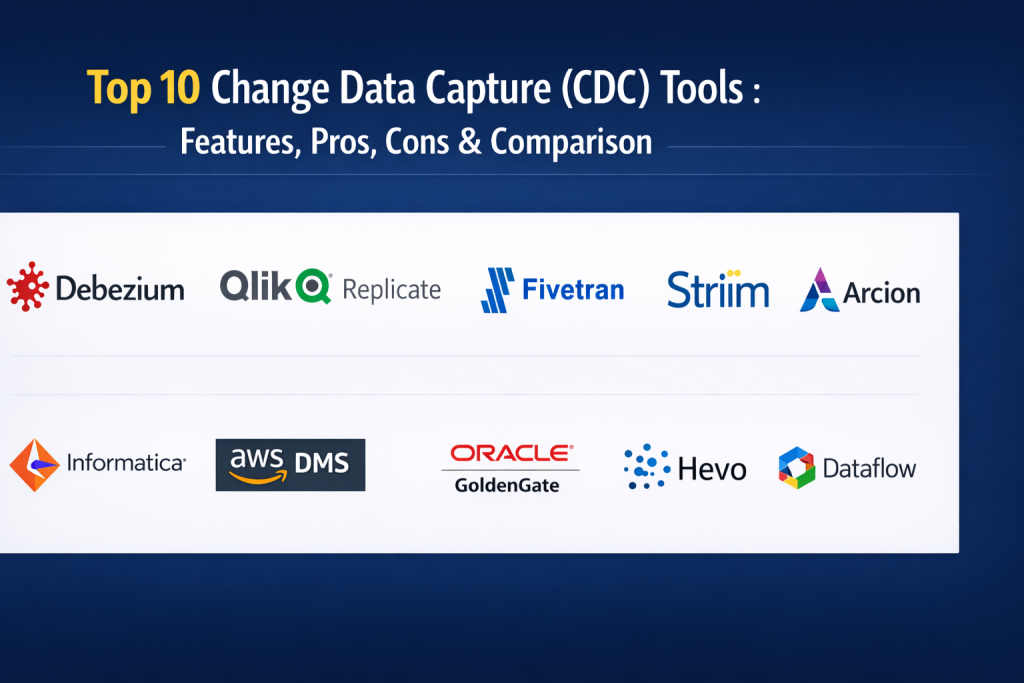
Top 10 Change Data Capture (CDC) Tools
1. Debezium
Debezium is a popular open-source distributed platform built on top of Apache Kafka. It acts as a set of Kafka Connect connectors that monitor various database transaction logs and convert the changes into a standardized event stream. Because it is open-source, it has become the standard for developers building custom event-driven architectures.
Key Features
- Log-based capture for MySQL, PostgreSQL, MongoDB, SQL Server, and Oracle.
- Captures every row-level change with millisecond-level latency.
- Deep integration with the Apache Kafka ecosystem for high scalability.
- Snapshotting capability to capture the initial state of a database.
- Schema change tracking to handle evolution in source tables automatically.
Pros
- Completely free and open-source with a massive community.
- Extremely flexible for technical teams building custom streaming pipelines.
Cons
- Requires significant engineering effort to set up and manage Kafka Connect.
- No built-in visual UI for managing pipelines without third-party tools.
Platforms / Deployment
Windows / macOS / Linux — Self-hosted
Security & Compliance
Inherits security features from Apache Kafka, including SSL/TLS and SASL authentication.
Integrations & Ecosystem
As a Kafka-native tool, it integrates with everything in the Kafka world. It is frequently used with Flink, Spark, and various cloud data warehouses.
Support & Community
One of the largest open-source communities in the data engineering space with extensive third-party tutorials.
2. Qlik Replicate
Qlik Replicate (formerly Attunity) is an enterprise-grade solution known for its high performance and ease of use. It provides a simple, “click-to-start” interface that hides the complexity of setting up real-time data movement across heterogeneous environments.
Key Features
- Non-invasive log-based CDC that minimizes source system impact.
- Broad support for mainframes, SAP systems, and all major relational databases.
- Automated target schema generation and updates.
- Parallel loading for handling massive data volumes at high speed.
- Centralized monitoring dashboard for all active data tasks.
Pros
- Very high reliability in complex, legacy enterprise environments.
- Extremely user-friendly interface that doesn’t require deep coding skills.
Cons
- The pricing is premium and typically aimed at large enterprises.
- Initial configuration can be complex for very specific edge cases.
Platforms / Deployment
Windows / Linux — Hybrid / Cloud
Security & Compliance
Highly certified with SOC 2, GDPR, and HIPAA compliance features.
Integrations & Ecosystem
Strong ties to the Qlik analytics platform but works well with all major cloud providers and data lakes.
Support & Community
Provides dedicated enterprise support tiers and professional training via Qlik’s global network.
3. Fivetran
Fivetran is a leading automated data movement platform that specializes in managed CDC. It is designed for modern data teams who want to move data from databases to cloud warehouses without managing any infrastructure or writing code.
Key Features
- Zero-configuration CDC connectors that deploy in minutes.
- Automatic handling of schema drift and table migrations.
- Log-based capture available for high-volume database sources.
- Idempotent architecture to ensure data is never lost or duplicated.
- SaaS-based delivery with no local software to install or maintain.
Pros
- Fastest time-to-value for teams moving data to the cloud.
- Predictable consumption-based pricing for growing companies.
Cons
- Limited options for on-premise to on-premise data movement.
- Less control over the fine-tuning of the underlying CDC process.
Platforms / Deployment
Web / Cloud — Managed SaaS
Security & Compliance
Features SOC 2, ISO 27001, and end-to-end data encryption.
Integrations & Ecosystem
Boasts over 300 pre-built connectors and deep partnerships with Snowflake, Databricks, and BigQuery.
Support & Community
Highly rated 24/7 technical support and a wealth of documentation for analysts.
4. Striim
Striim is a real-time data streaming and integration platform that combines CDC with in-flight data processing. It allows users to not only capture data but also transform, enrich, and analyze it as it moves through the pipeline.
Key Features
- Sub-second latency for real-time data movement across hybrid environments.
- In-flight SQL-based transformations and data enrichment.
- Real-time monitoring and alerting for data pipelines.
- Support for a wide variety of sources including IoT sensors and log files.
- High-availability architecture with built-in recovery features.
Pros
- Excellent for use cases that require data transformation during the stream.
- Highly scalable for massive throughput and complex event processing.
Cons
- The pricing can be high for smaller organizations.
- The broad feature set creates a steeper learning curve than simple replication tools.
Platforms / Deployment
Windows / Linux — Cloud / Hybrid
Security & Compliance
Supports advanced encryption, RBAC, and audit logging.
Integrations & Ecosystem
Integrates deeply with Azure, AWS, and GCP, often used as a bridge for real-time AI workloads.
Support & Community
Responsive technical support team and strong professional services for implementation.
5. Arcion (Databricks)
Now part of Databricks, Arcion is built for high-performance, real-time data replication into the Lakehouse. It is designed to be a high-speed, zero-code solution for moving data from legacy and operational databases into modern AI-ready environments.
Key Features
- High-speed log-based CDC for Oracle, SQL Server, and SAP.
- Agentless architecture that simplifies deployment and maintenance.
- Automatic schema evolution and mapping.
- Optimized for loading data into Databricks and other cloud warehouses.
- Guaranteed transactional integrity and data consistency.
Pros
- Best-in-class performance for loading large-scale data into Databricks.
- Simplifies the process of making operational data available for AI and ML.
Cons
- Deeply tied to the Databricks ecosystem, which may not fit all strategies.
- Newer compared to legacy giants like Oracle GoldenGate.
Platforms / Deployment
Cloud — Managed SaaS / Hybrid
Security & Compliance
Standard enterprise cloud security including SSO and data-at-rest encryption.
Integrations & Ecosystem
Strongest integration is with Databricks Delta Lake, but it also supports other cloud destinations.
Support & Community
Backed by Databricks’ global support and a rapidly growing user base.
6. Informatica Cloud Data Integration
Informatica is a long-standing leader in the data management world. Its cloud-native platform provides a robust environment for CDC, allowing large organizations to manage complex data flows between on-premise systems and the cloud.
Key Features
- Mass ingestion capability for moving large volumes of data via CDC.
- Advanced data quality and governance tools built into the platform.
- Support for a massive range of legacy and modern connectors.
- AI-powered metadata management to help discover and map data.
- Unified platform for ETL, ELT, and real-time CDC.
Pros
- The most comprehensive data management suite for large enterprises.
- Strong focus on data governance and compliance.
Cons
- Can be overly complex and “heavy” for simple data movement tasks.
- Requires a significant investment in both licensing and training.
Platforms / Deployment
Windows / Linux — Cloud / Hybrid
Security & Compliance
Enterprise-grade certifications including HIPAA, SOC 2, and GDPR.
Integrations & Ecosystem
Certified connectors for virtually every enterprise application, including SAP, Salesforce, and Oracle.
Support & Community
Extensive global support, training certifications, and a massive network of implementation partners.
7. AWS Database Migration Service (DMS)
AWS DMS is a managed service that makes it easy to migrate databases to AWS quickly and securely. It also supports ongoing replication using CDC, allowing users to keep their AWS databases in sync with on-premise or other cloud sources.
Key Features
- Low-cost ongoing data replication between various source and target engines.
- Minimal downtime during the migration and synchronization process.
- Support for homogeneous and heterogeneous database migrations.
- Fully managed by AWS, reducing operational overhead.
- Automatic failover and monitoring for high availability.
Pros
- Most cost-effective choice for teams already operating on AWS.
- Simple to set up directly from the AWS Management Console.
Cons
- Strictly designed for moving data into or within the AWS ecosystem.
- Limited transformation capabilities compared to specialized tools.
Platforms / Deployment
Web / AWS Console — Cloud Managed
Security & Compliance
Uses AWS IAM for access control and KMS for data encryption.
Integrations & Ecosystem
Perfectly integrated with all AWS services like RDS, Redshift, and S3.
Support & Community
Backed by AWS Support and a massive library of AWS-specific documentation.
8. Oracle GoldenGate
Oracle GoldenGate is arguably the most powerful and trusted CDC tool in the industry. It is the gold standard for mission-critical systems that require ultra-low latency and absolute transactional consistency across global deployments.
Key Features
- Ultra-low latency capture and delivery of transactional data.
- Supports bi-directional replication for active-active high availability.
- Deeply integrated with the Oracle Database kernel for maximum performance.
- Microservices-based architecture for modern, flexible deployments.
- Veridata tool for comparing and repairing out-of-sync data.
Pros
- Unrivaled reliability for the world’s most critical financial and retail systems.
- Extremely high throughput capability for massive global organizations.
Cons
- One of the most expensive and complex tools on the market.
- Requires highly specialized expertise to configure and maintain.
Platforms / Deployment
Windows / Linux / Mainframe — Cloud / On-premise
Security & Compliance
Highest level of security certifications and advanced encryption protocols.
Integrations & Ecosystem
While specialized for Oracle, it has a vast ecosystem of connectors for non-Oracle systems.
Support & Community
Premier Oracle support and a global community of specialized GoldenGate engineers.
9. Hevo Data
Hevo is a no-code data pipeline platform that helps companies integrate data from various sources into their data warehouse. Its CDC feature allows for real-time replication with a focus on ease of use and affordability for small to mid-sized businesses.
Key Features
- Completely no-code interface for setting up CDC pipelines.
- Automated schema mapping and evolution handling.
- Real-time data streaming with minimal latency.
- Pre-load and post-load transformation capabilities.
- Reverse ETL to move data from the warehouse back to operational tools.
Pros
- Budget-friendly entry point for startups and SMBs.
- Extremely simple UI that allows non-engineers to move data.
Cons
- May experience performance issues with extremely large enterprise volumes.
- Limited support for niche or legacy legacy systems compared to Informatica.
Platforms / Deployment
Web / Cloud — Managed SaaS
Security & Compliance
SOC 2 Type II certified and GDPR compliant.
Integrations & Ecosystem
Strong library of SaaS and database connectors with a focus on modern cloud warehouses.
Support & Community
Provides 24/7 live chat support and a growing user base of data analysts.
10. Google Cloud Dataflow
Google Cloud Dataflow is a fully managed service for unified stream and batch data processing. Using Apache Beam templates, it provides a powerful and serverless way to implement CDC at scale within the Google Cloud ecosystem.
Key Features
- Serverless architecture that scales automatically based on data volume.
- Built-in templates for efficient CDC and BigQuery integration.
- High-performance processing of both streaming and batch data.
- Confidential VM support for encrypting data while in use.
- Detailed monitoring and diagnostics tools for pipeline health.
Pros
- Excellent scalability and cost-efficiency for Google Cloud users.
- Unified model for both historical data loads and real-time changes.
Cons
- Requires familiarity with Apache Beam for custom, complex pipelines.
- Best suited only for organizations already committed to Google Cloud.
Platforms / Deployment
Web / GCP Console — Cloud Managed
Security & Compliance
Integrates with VPC Service Controls and Google Cloud IAM.
Integrations & Ecosystem
Native integration with BigQuery, Pub/Sub, and Cloud Spanner.
Support & Community
Professional GCP support and a technical community focused on the Apache Beam framework.
Comparison Table (Top 10)
| Tool Name | Best For | Platform(s) Supported | Deployment | Standout Feature | Public Rating |
| 1. Debezium | Event-Driven Apps | Windows, macOS, Linux | Self-hosted | Open-Source log CDC | 4.4/5 |
| 2. Qlik Replicate | Legacy Enterprises | Windows, Linux | Hybrid | User-friendly UI | 4.6/5 |
| 3. Fivetran | Modern Data Teams | Cloud | Managed SaaS | No-maintenance sync | 4.5/5 |
| 4. Striim | In-flight Processing | Windows, Linux | Hybrid | SQL Transformations | 4.5/5 |
| 5. Arcion | Databricks Users | Cloud | Managed SaaS | High-speed AI ingestion | 4.3/5 |
| 6. Informatica | Data Governance | Windows, Linux | Hybrid | Enterprise Metadata | 4.4/5 |
| 7. AWS DMS | AWS Ecosystem | AWS Console | Cloud Managed | Managed AWS Migration | 4.2/5 |
| 8. Oracle GoldenGate | Mission-Critical | Windows, Linux, Main | Hybrid | Zero-Latency Sync | 4.7/5 |
| 9. Hevo Data | Startups & SMBs | Cloud | Managed SaaS | No-code Affordability | 4.3/5 |
| 10. Dataflow | Google Cloud Users | GCP Console | Cloud Managed | Serverless Apache Beam | 4.4/5 |
Evaluation & Scoring of Change Data Capture (CDC) Tools
| Tool Name | Core (25%) | Ease (15%) | Integrations (15%) | Security (10%) | Perf (10%) | Support (10%) | Value (15%) | Total |
| 1. Debezium | 10 | 3 | 9 | 7 | 9 | 8 | 10 | 7.9 |
| 2. Qlik Replicate | 9 | 9 | 8 | 9 | 9 | 8 | 5 | 8.1 |
| 3. Fivetran | 8 | 10 | 10 | 9 | 8 | 8 | 7 | 8.6 |
| 4. Striim | 9 | 6 | 8 | 8 | 10 | 8 | 6 | 7.7 |
| 5. Arcion | 8 | 8 | 7 | 8 | 9 | 7 | 7 | 7.7 |
| 6. Informatica | 10 | 5 | 10 | 10 | 8 | 9 | 4 | 7.8 |
| 7. AWS DMS | 7 | 8 | 7 | 9 | 7 | 8 | 9 | 7.6 |
| 8. Oracle GoldenGate | 10 | 2 | 9 | 10 | 10 | 10 | 3 | 7.4 |
| 9. Hevo Data | 7 | 10 | 7 | 8 | 7 | 7 | 10 | 8.0 |
| 10. Dataflow | 8 | 6 | 8 | 9 | 9 | 8 | 8 | 8.0 |
The scores provided above are based on the standard professional requirements for a CDC pipeline. High core scores indicate the platform’s ability to handle the most complex database logs. High ease-of-use scores signify a tool that can be deployed by analysts, while high performance scores highlight tools capable of ultra-low latency and massive throughput.
Which Change Data Capture (CDC) Tool Is Right for You?
Solo / Freelancer
If you are working on a budget and have strong technical skills, Debezium is the best choice as it provides professional-grade CDC for free. However, for those who want a simpler “plug-and-play” experience without managing a server, Hevo Data offers an affordable managed entry point.
SMB (Small to Medium Business)
Small and medium businesses should prioritize ease of use and low maintenance. Fivetran is the standout option here, as it automates the entire process, allowing your team to focus on analyzing data rather than managing pipelines.
Mid-Market
Organizations with moderate data volumes but complex integration needs may find Striim or Arcion to be excellent fits. These tools provide a balance between powerful transformation features and a manageable cost.
Enterprise
For global organizations with mission-critical databases and strict compliance needs, Oracle GoldenGate and Qlik Replicate are the industry standards. These platforms are built to handle the highest possible data volumes with absolute reliability.
Budget vs Premium
If the goal is to keep costs as low as possible, Debezium (open-source) or AWS DMS (pay-as-you-go) are the best bets. If you need dedicated support and enterprise features, the premium investment in Informatica or GoldenGate pays off in stability and governance.
Feature Depth vs Ease of Use
Tools like GoldenGate and Debezium offer deep technical control but require significant expertise. In contrast, Fivetran and Hevo prioritize ease of use, making them accessible to data analysts and business intelligence teams.
Integrations & Scalability
If your infrastructure is heavily focused on a single cloud, using the native services like AWS DMS or Google Dataflow provides the best integration. For hybrid or multi-cloud strategies, Qlik Replicate or Informatica offer superior flexibility.
Security & Compliance Needs
Enterprises with high security requirements should lean toward Oracle GoldenGate or Informatica. These tools provide the robust encryption, auditing, and administrative controls necessary for highly regulated industries like banking and healthcare.
Frequently Asked Questions (FAQs)
1. What is the difference between CDC and traditional ETL?
Traditional ETL typically moves data in large batches at scheduled intervals, while CDC captures and moves data in real-time as changes occur, reducing the load on the source database.
2. Does CDC impact the performance of my production database?
Log-based CDC tools have almost zero impact on performance because they read from the database transaction logs rather than querying the live tables directly.
3. Is CDC secure for sensitive data?
Yes, professional CDC tools provide end-to-end encryption, data masking, and secure authentication to ensure that sensitive data is protected during transmission.
4. How does CDC handle changes to the table structure?
Advanced tools like Fivetran and Qlik Replicate offer “schema evolution” features that automatically detect and apply changes to the target table when the source structure changes.
5. Can I use CDC for cloud migration?
Absolutely. CDC is a primary technique for zero-downtime migrations, as it keeps the old and new databases in sync until you are ready to switch over.
6. Do I need to be a coder to use CDC tools?
Not necessarily. Many modern tools like Hevo and Fivetran offer no-code interfaces, while tools like Debezium require significant technical knowledge of Java and Kafka.
7. Can CDC work with NoSQL databases?
Yes, tools like Debezium and Striim support capturing changes from NoSQL sources like MongoDB and Cassandra.
8. What is “log-based” versus “trigger-based” CDC?
Log-based CDC reads the database logs directly, which is faster and safer. Trigger-based CDC uses database triggers to log changes, which can slow down the source database.
9. Is it expensive to implement CDC?
Costs vary widely. Open-source tools like Debezium are free but have high engineering costs, while enterprise managed services like Fivetran have a predictable subscription fee.
10. How do I decide which CDC tool to choose?
You should choose based on your source and target databases, your team’s technical skill level, your budget, and how quickly you need the data to be synchronized.
Conclusion
Implementing a Change Data Capture strategy is a critical step for any organization aiming to become truly data-driven. The ability to synchronize data in real-time without straining operational systems allows businesses to unlock the full potential of their analytics, AI, and customer-facing applications. Whether you choose the open-source flexibility of Debezium or the enterprise-grade reliability of Oracle GoldenGate, the right tool depends on your unique architectural needs and long-term goals. By moving away from batch-based thinking, you position your organization to react instantly to every change in your digital ecosystem. The most successful organizations are those that treat their data as a continuous stream rather than a static asset. Selecting a tool that fits your current requirements while providing the scalability for future growth is the key to maintaining a competitive edge in the modern data landscape.

Best Cardiac Hospitals Near You
Discover top heart hospitals, cardiology centers & cardiac care services by city.
Advanced Heart Care • Trusted Hospitals • Expert Teams
View Best Hospitals