Introduction
Function-as-a-Service (FaaS) is a specific category of cloud computing that allows developers to execute small, discrete blocks of code—known as functions—in response to specific events. Unlike traditional server models or even broader serverless architectures, FaaS is strictly event-driven and stateless. This means the underlying infrastructure only exists for the duration of the function’s execution. Once the task is completed, the resources are instantly released, and the billing stops.
In the mid-2020s, FaaS has become the primary driver for lean, modular application development. It matters now because it enables extreme scalability without the need for capacity planning. As businesses shift toward microservices and real-time data processing, FaaS provides the agility to handle millions of requests or a single sporadic trigger with the same level of efficiency. It is the ultimate tool for developers who want to pay only for the exact milliseconds their code is actually running.
Real-World Use Cases
- API Gateways: Powering the backend logic for web and mobile applications that only consume resources when a user interacts with a feature.
- Event-Driven Data Processing: Automatically resizing images, transcribing audio, or validating data the moment a file is uploaded to cloud storage.
- Webhooks & Third-Party Integration: Managing notifications and data synchronization between different SaaS platforms like Stripe, GitHub, or Slack.
- IoT Messaging: Processing millions of small data packets from connected sensors and devices across a global network.
- Automated Maintenance: Running periodic database cleanups, security audits, or report generation without maintaining a dedicated cron server.
Evaluation Criteria for Buyers
- Cold Start Latency: The delay experienced when a function is invoked after a period of inactivity.
- Runtime Support: The availability of your preferred programming languages (Node.js, Python, Go, Java, Rust).
- Trigger Variety: The number of native events (HTTP, storage changes, database updates) that can initiate a function.
- Memory & Timeout Limits: The maximum resources and time allowed for a single function execution.
- Developer Tooling: The quality of local emulators, CI/CD integrations, and debugging environments.
- Concurrency Controls: The ability to limit or scale the number of simultaneous function instances to protect downstream databases.
- Observability: Integrated logging and distributed tracing to monitor function health and performance.
Best for: Developers building event-driven microservices, startups focused on minimizing operational costs, and teams needing rapid, elastic scaling for unpredictable workloads.
Not ideal for: Long-running processes exceeding 15 minutes, stateful applications requiring persistent connections, or steady-state workloads where dedicated instances provide better cost predictability.
Key Trends in FaaS Platforms
- Wasm (WebAssembly) Support: A move toward using WebAssembly for function runtimes to achieve near-instant startup times and improved security isolation.
- Edge-Native FaaS: The expansion of functions to “the edge,” running code at global points of presence rather than centralized data centers to reduce user latency.
- AI Inference at the Edge: Specialized FaaS runtimes equipped with GPU access to run lightweight AI models on-demand for real-time predictions.
- FinOps Maturity: Granular billing dashboards that provide real-time visibility into the cost of every individual function execution.
- Streaming Responses: The ability for functions to stream data back to the client, which is essential for modern generative AI and large data transfers.
- Snapshotting Technology: Using memory “warm-ups” and snapshots to eliminate the traditional cold start problem for heavy runtimes like Java.
- Unified Multi-Cloud Orchestration: Tools that allow developers to deploy the same function across multiple FaaS providers to avoid vendor lock-in.
- Ephemeral GPU Access: The rise of specialized FaaS providers offering on-demand GPU cycles for short-lived machine learning tasks.
How We Selected These Tools
To identify the top ten FaaS platforms, we evaluated the global landscape of cloud providers through the lens of developer productivity and production reliability. Our methodology focused on three primary areas: market penetration, technical innovation, and ecosystem integration. We prioritized platforms that provide a “zero-administration” experience while offering robust security and compliance features. We included the major “Big Three” cloud providers due to their massive integration depth, alongside specialized edge and developer-centric platforms that are currently defining the future of FaaS. Performance signals such as cold start management and global availability were heavily weighted to ensure these tools can handle modern, high-concurrency demands.
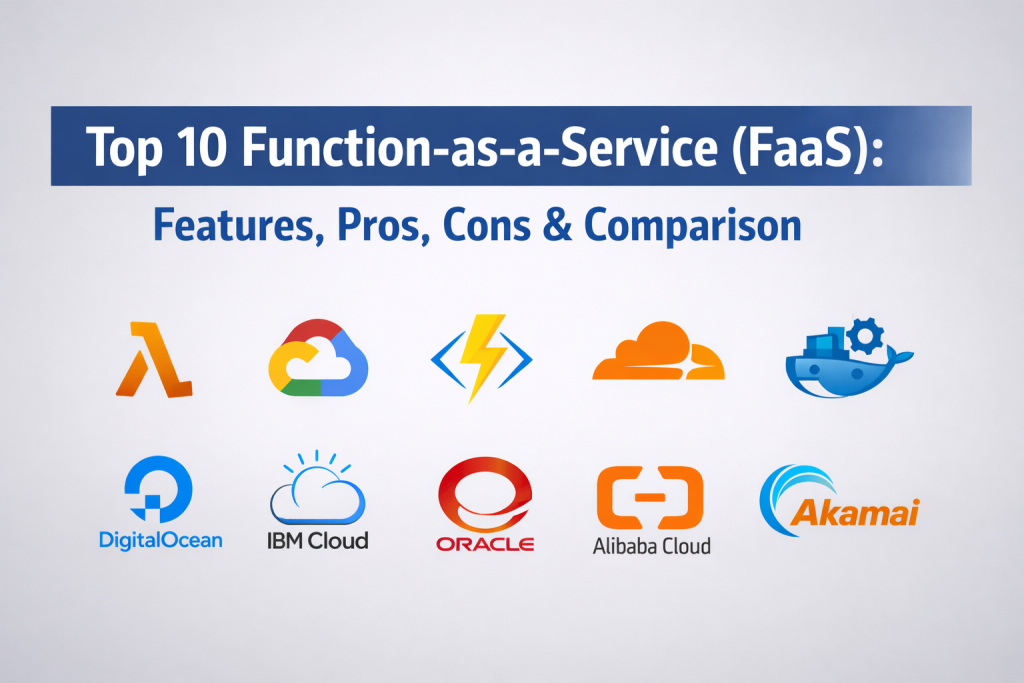
Top 10 Function-as-a-Service (FaaS) Tools
1. AWS Lambda
AWS Lambda is the industry leader that defined the FaaS category. It provides the most comprehensive set of features and the deepest integration with hundreds of other cloud services. It is suitable for everything from simple scripts to massive, global-scale backend systems.
Key Features
- Extensive Event Triggers: Over 200 native AWS service integrations to trigger code execution.
- Lambda Layers: A way to manage shared code and dependencies across multiple functions.
- Provisioned Concurrency: Keeps functions warm to eliminate cold starts for latency-sensitive apps.
- Container Image Support: Use familiar Docker workflows to package and deploy functions.
- Granular Billing: Costs are metered in 1-millisecond increments based on memory and execution time.
Pros
- The largest community and third-party library of tools and templates.
- Unrivaled security and compliance certifications for enterprise use.
Cons
- Management of complex networking and VPCs can be difficult for beginners.
- Vendor lock-in is a significant concern due to deep AWS service dependencies.
Platforms / Deployment
Cloud (AWS) — Managed
Security & Compliance
ISO, SOC 1/2/3, PCI DSS, HIPAA, and GDPR compliant.
Integrations & Ecosystem
Lambda sits at the center of the AWS world, linking S3, DynamoDB, Kinesis, and API Gateway into a single event-driven web.
Support & Community
A massive global ecosystem of certified experts and comprehensive official documentation.
2. Google Cloud Functions
Google Cloud Functions is built for simplicity and speed. It is an excellent choice for developers working within the Google ecosystem, particularly those focusing on mobile apps via Firebase or data processing via BigQuery.
Key Features
- Automatic Scaling: Instantly scales from zero to massive concurrency without manual tuning.
- Eventarc: A unified event bus to trigger functions from any Google Cloud service or external SaaS.
- Simplified Runtimes: Optimized support for Node.js, Python, Go, Java, and Ruby.
- Cloud Run Integration: Allows developers to easily graduate functions into serverless containers.
- Built-in Logging: Direct integration with Google Cloud Observability for real-time monitoring.
Pros
- Extremely simple deployment process for quick prototypes and microservices.
- Superior integration for data-driven applications and AI/ML pipelines.
Cons
- Fewer specialized networking features compared to AWS or Azure.
- Logging and debugging can sometimes feel fragmented across the GCP console.
Platforms / Deployment
Cloud (GCP) — Managed
Security & Compliance
Fully compliant with SOC, ISO, and HIPAA standards.
Integrations & Ecosystem
Strongest synergy with Firebase, BigQuery, and Vertex AI for building intelligent applications.
Support & Community
Very strong documentation and a community focused on data science and modern web development.
3. Azure Functions
Azure Functions is the preferred choice for enterprise organizations using Microsoft technologies. It stands out for its flexibility in hosting and its specialized tools for complex, long-running workflows.
Key Features
- Durable Functions: An extension for writing stateful functions in a stateless environment.
- Declarative Bindings: Connect to data sources without writing custom integration code.
- Flexible Hosting: Choose between pure serverless, dedicated, or premium plans.
- Visual Studio Support: The best-in-class local development and debugging experience.
- Hybrid Cloud: Ability to run functions on-premises via Azure Arc.
Pros
- The industry leader for managing stateful, long-running serverless workflows.
- Seamless identity management through Azure Active Directory.
Cons
- Performance on the consumption (free) plan can be inconsistent for larger files.
- The portal interface can be complex for those new to the Microsoft ecosystem.
Platforms / Deployment
Cloud / Hybrid — Managed
Security & Compliance
Comprehensive global compliance including FedRAMP and regional certifications.
Integrations & Ecosystem
Deep ties to Microsoft 365, Dynamics, and the Azure Service Bus for enterprise messaging.
Support & Community
Extensive enterprise support and a large community of .NET and corporate developers.
4. Cloudflare Workers
Cloudflare Workers redefined FaaS by moving code to the edge. It uses V8 isolates instead of traditional containers, resulting in significantly faster startup times and lower latency for global users.
Key Features
- Near-Zero Cold Starts: V8 isolates initialize much faster than traditional virtual machines or containers.
- Global Distribution: Code is automatically deployed to hundreds of data centers worldwide.
- Workers AI: Native access to GPUs at the edge for low-latency AI inference.
- R2 Storage: S3-compatible object storage with no egress fees.
- Wrangler CLI: A powerful tool for building, testing, and deploying from the terminal.
Pros
- Lowest latency for global web traffic and API endpoints.
- Very cost-effective with a simple, predictable pricing model.
Cons
- Does not support all Node.js libraries due to its unique V8 environment.
- Limited execution time for complex backend processing tasks.
Platforms / Deployment
Edge — Managed
Security & Compliance
Built-in protection from Cloudflare’s global WAF and DDoS mitigation.
Integrations & Ecosystem
Rapidly growing ecosystem for edge-first web development and headless CMS architectures.
Support & Community
A vibrant community of frontend and full-stack developers with excellent modern documentation.
5. OpenFaaS
OpenFaaS is the leading open-source FaaS platform that runs on Kubernetes. It allows organizations to have a serverless experience on their own infrastructure, providing a bridge between traditional servers and FaaS.
Key Features
- Kubernetes Native: Built specifically to run as a layer on top of any Kubernetes cluster.
- Any Language: Since functions are packaged as Docker images, you can use any language or binary.
- Self-Hosted: Full control over the underlying infrastructure and data residency.
- UI Dashboard: An intuitive web interface for managing and testing functions.
- Auto-Scaling: Integrated with Prometheus to scale functions based on actual demand.
Pros
- Eliminates vendor lock-in and allows for deployment on-premises or in any cloud.
- Highly flexible for organizations already using Kubernetes.
Cons
- Requires the team to manage the underlying Kubernetes cluster.
- Missing some of the “instant” integration features found in hyperscale clouds.
Platforms / Deployment
Hybrid / Self-hosted — Kubernetes
Security & Compliance
Depends on the underlying infrastructure and configuration by the user.
Integrations & Ecosystem
Excellent for integrating into existing DevOps pipelines and private data center workflows.
Support & Community
Strong open-source community with a professional support tier for business users.
6. DigitalOcean Functions
DigitalOcean Functions offers a “simple-first” approach to FaaS. It is designed for developers and small teams who want to add backend logic to their apps without the overwhelming complexity of larger cloud providers.
Key Features
- One-Click Deployment: Seamlessly integrated into the DigitalOcean App Platform.
- Unified Billing: Functions are part of your single monthly DigitalOcean invoice.
- Support for Major Runtimes: Native environments for Node.js, Python, PHP, and Go.
- Integrated API Gateway: Automatically handles routing and SSL for your functions.
- Built-in Monitoring: Basic performance and error tracking out of the box.
Pros
- The easiest FaaS platform to learn and set up for small projects.
- Extremely predictable pricing with no complex “per-millisecond” math.
Cons
- Lacks the advanced enterprise features and global scaling of AWS or Azure.
- Fewer native event triggers compared to the larger ecosystems.
Platforms / Deployment
Cloud — Managed
Security & Compliance
Standard SOC and ISO compliance provided by the DigitalOcean platform.
Integrations & Ecosystem
Works perfectly with DigitalOcean Droplets and Managed Databases.
Support & Community
Known for world-class community tutorials that are easy for beginners to follow.
7. IBM Cloud Functions
IBM Cloud Functions is built on the Apache OpenWhisk open-source project. It is an enterprise-grade FaaS platform designed for businesses that need high scalability and deep integration with AI and big data tools.
Key Features
- Apache OpenWhisk Base: Uses a powerful, open-source engine for high performance.
- Action Orchestration: Complex sequencing of multiple functions into a single workflow.
- Watson Integration: Native pathways for connecting functions to IBM’s Watson AI.
- Polyglot Runtimes: Support for common languages plus custom Docker containers.
- Trigger-Action Map: A flexible system for defining how events lead to specific code runs.
Pros
- Excellent for building complex AI and data-processing pipelines.
- The open-source foundation makes it easier to migrate if necessary.
Cons
- The user interface can feel a bit technical and dated for some users.
- Smaller community ecosystem compared to AWS or Google.
Platforms / Deployment
Cloud — Managed
Security & Compliance
Highly secure with support for regulated industries like finance and healthcare.
Integrations & Ecosystem
Strongest ties to IBM’s data analytics, blockchain, and Watson AI services.
Support & Community
Professional enterprise support with a focus on large-scale corporate solutions.
8. Oracle Cloud Functions
Oracle Cloud Functions is a container-native FaaS platform built on the open-source Fn Project. It is designed for high-performance enterprise workloads and offers deep integration with Oracle’s database ecosystem.
Key Features
- Fn Project Foundation: Built on a container-native open-source serverless platform.
- Docker Integration: Every function is deployed as a Docker image for maximum portability.
- Oracle Database Optimized: Superior performance when interacting with Oracle Autonomous Databases.
- Unified Monitoring: Integrated with OCI Logging and Monitoring for full visibility.
- Predictable Enterprise Pricing: Competitive and transparent cost structure for large volumes.
Pros
- The best choice for organizations already running Oracle databases or ERP systems.
- Avoids proprietary lock-in by using the open-source Fn Project standard.
Cons
- Learning curve can be high for those not familiar with Oracle Cloud Infrastructure.
- Fewer community-built plugins and templates than AWS or Blender-style communities.
Platforms / Deployment
Cloud — Managed
Security & Compliance
Meets strict enterprise security standards including SOC and regional compliance.
Integrations & Ecosystem
Seamlessly connects with Oracle’s broader suite of enterprise cloud services.
Support & Community
Strong enterprise-level support with growing community resources for developers.
9. Alibaba Cloud Function Compute
Alibaba Cloud provides the leading FaaS platform for the Asia-Pacific region. It offers massive scalability and specialized features for high-traffic events like e-commerce sales and digital festivals.
Key Features
- Millisecond Scaling: Ability to spin up thousands of instances in a fraction of a second.
- Reserved Capacity: Option to eliminate cold starts for critical business logic.
- Localized Ecosystem: Deep integration with Asia-focused messaging and data services.
- In-Situ Data Processing: Tools for cleaning and transforming data as it moves through the cloud.
- Multi-Language Support: Comprehensive support for all major global runtimes.
Pros
- Unmatched performance and scale for the Asia-Pacific market.
- Highly cost-effective for extremely high-volume event processing.
Cons
- Documentation and support in Western regions can be less comprehensive.
- Integration with Western SaaS providers often requires more manual setup.
Platforms / Deployment
Cloud — Managed
Security & Compliance
Compliant with major global and Chinese data residency and security laws.
Integrations & Ecosystem
Integrated with the entire Alibaba e-commerce and financial technology stack.
Support & Community
Massive support network in Asia with expanding resources for the global market.
10. Akamai EdgeWorkers
Akamai EdgeWorkers leverages the world’s largest CDN to run FaaS at the edge. It allows developers to inject logic directly into the flow of web traffic, providing a unique way to personalize content and manage security.
Key Features
- Massive Edge Network: Access to thousands of global locations for near-instant execution.
- Request/Response Manipulation: Change web content and headers in real-time as traffic passes through.
- Site Personalization: Run logic to show different content based on user location or behavior.
- Integrated Security: Works directly with Akamai’s web security and bot management tools.
- High Availability: Backed by one of the world’s most reliable and distributed networks.
Pros
- The most powerful platform for high-bandwidth web personalization and security.
- Reduces the load on your origin servers by handling logic at the edge.
Cons
- Primarily focused on web traffic manipulation rather than general-purpose backend tasks.
- The pricing and setup are geared toward larger enterprise customers.
Platforms / Deployment
Edge — Managed
Security & Compliance
Enterprise-grade security backed by Akamai’s global threat intelligence.
Integrations & Ecosystem
Strongest integration with CDN, WAF, and global traffic management services.
Support & Community
High-level professional support and a community focused on web performance and security.
Comparison Table (Top 10)
| Tool Name | Best For | Platform(s) Supported | Deployment | Standout Feature | Public Rating |
| 1. AWS Lambda | General Purpose FaaS | Windows, macOS, Linux | Cloud (AWS) | 200+ AWS Triggers | 4.5/5 |
| 2. Google Cloud | Data & ML Workflows | Windows, macOS, Linux | Cloud (GCP) | Eventarc Bus | 4.3/5 |
| 3. Azure Functions | Stateful Enterprise | Windows, macOS, Linux | Hybrid | Durable Functions | 4.4/5 |
| 4. Cloudflare | Global Web Latency | Web | Edge | V8 Isolate Speed | 4.7/5 |
| 5. OpenFaaS | Self-Hosted FaaS | Kubernetes | Hybrid | Kubernetes Native | 4.5/5 |
| 6. DigitalOcean | Startups & MVP | Windows, macOS, Linux | Cloud | Simple Dashboard | 4.2/5 |
| 7. IBM Cloud | Enterprise AI | Windows, macOS, Linux | Cloud | Watson Synergy | 4.0/5 |
| 8. Oracle Cloud | Oracle Database Apps | Windows, macOS, Linux | Cloud | Container-Native | 4.1/5 |
| 9. Alibaba Cloud | Asia-Pacific Scaling | Windows, macOS, Linux | Cloud | High-Speed Elasticity | 4.4/5 |
| 10. Akamai | Web Personalization | Web | Edge | Massive CDN Reach | 4.3/5 |
Evaluation & Scoring of FaaS Platforms
| Tool Name | Core (25%) | Ease (15%) | Integrations (15%) | Security (10%) | Perf (10%) | Support (10%) | Value (15%) | Total |
| 1. AWS Lambda | 10 | 6 | 10 | 10 | 8 | 10 | 6 | 8.5 |
| 2. Google Cloud | 8 | 8 | 9 | 9 | 8 | 8 | 7 | 8.0 |
| 3. Azure Functions | 9 | 6 | 9 | 10 | 8 | 9 | 7 | 8.1 |
| 4. Cloudflare | 7 | 8 | 7 | 9 | 10 | 8 | 9 | 8.0 |
| 5. OpenFaaS | 8 | 5 | 7 | 6 | 8 | 7 | 9 | 7.1 |
| 6. DigitalOcean | 6 | 9 | 6 | 7 | 8 | 8 | 9 | 7.3 |
| 7. IBM Cloud | 8 | 5 | 8 | 9 | 7 | 7 | 7 | 7.1 |
| 8. Oracle Cloud | 8 | 5 | 8 | 9 | 8 | 7 | 9 | 7.6 |
| 9. Alibaba Cloud | 9 | 6 | 8 | 8 | 9 | 7 | 8 | 7.9 |
| 10. Akamai | 7 | 6 | 7 | 10 | 9 | 9 | 6 | 7.4 |
Scoring is based on professional production benchmarks. A high “Core” score represents a platform’s ability to handle the most demanding production tasks. “Value” scores prioritize platforms that offer the most compute for your dollar, while “Ease” scores identify tools that allow for the fastest time-to-market.
Which FaaS Tool Is Right for You?
Solo / Freelancer
For individuals building a personal project or a small startup, DigitalOcean Functions or Cloudflare Workers are the best choices. They offer the least amount of friction and very clear, low-cost pricing models that won’t result in surprise bills.
SMB (Small to Medium Business)
Small teams that need to move fast should consider Google Cloud Functions. Its simplicity allows developers to spend more time on features and less time on cloud configuration, and it integrates beautifully with modern web frameworks.
Mid-Market
Organizations with a solid developer team will find the most value in AWS Lambda. The massive ecosystem and abundance of community tools mean that most common problems have already been solved and documented by others.
Enterprise
For large corporations with strict compliance and complex workflow needs, Azure Functions is the top recommendation. Its unique ability to handle stateful logic through Durable Functions makes it a superior choice for complex business processes.
Budget vs Premium
If the goal is to keep costs as low as possible, OpenFaaS (self-hosted) or Cloudflare Workers are the winners. For teams that prioritize service depth and enterprise support over raw cost, AWS and Azure provide the premium experience.
Feature Depth vs Ease of Use
AWS Lambda and Azure Functions provide the most depth but require a dedicated learning period. DigitalOcean and Cloudflare are designed to be used by developers who have never managed a server in their lives.
Integrations & Scalability
If your app needs to scale instantly to handle millions of users in Asia, Alibaba Cloud is the correct choice. For global, low-latency web applications, Cloudflare Workers or Akamai EdgeWorkers offer the best scalability.
Security & Compliance Needs
Enterprises in highly regulated industries like finance or healthcare should stick with the big three—AWS, Azure, and Google Cloud—as they offer the most robust and verified security and privacy frameworks.
Frequently Asked Questions (FAQs)
1. Is FaaS the same as Serverless?
Not exactly. Serverless is a broad term that includes FaaS (compute), serverless databases, and storage. FaaS specifically refers to the event-triggered execution of code blocks.
2. What is the biggest advantage of FaaS?
The main advantage is cost-efficiency. You only pay for the exact time your code is running, which can save a massive amount of money compared to a server that is always on.
3. What is a “cold start” and why does it happen?
A cold start is a delay when a function is triggered after being idle. The cloud provider has to provision a new environment to run your code, which takes a few seconds.
4. Can I use FaaS for long-running tasks?
Most FaaS providers have a timeout limit (usually 15 minutes). For tasks longer than this, you should consider using serverless containers like AWS Fargate or Google Cloud Run.
5. How do I choose between the different providers?
You should choose based on your current cloud ecosystem, your latency requirements (edge vs centralized), and the complexity of the events you need to trigger your code.
6. Is FaaS secure?
Yes, but security is a shared responsibility. While the provider secures the infrastructure, you are responsible for securing your code and managing user permissions (IAM).
7. Can I run FaaS on my own hardware?
Yes, tools like OpenFaaS allow you to run a FaaS environment on your own Kubernetes cluster, whether it’s in your own data center or on another cloud.
8. Do I need to be a senior developer to use FaaS?
No. In fact, FaaS is often easier for beginners because it removes the need to learn about server management, operating systems, and networking.
9. How do I test my functions before deploying them?
Most providers offer local CLIs and emulators (like AWS SAM or Wrangler) that allow you to run and debug your code on your own computer.
10. Can I use multiple languages in the same FaaS project?
Yes. Since each function is independent, you can write one function in Python for data processing and another in Node.js for an API endpoint within the same application.
Conclusion
The adoption of Function-as-a-Service (FaaS) marks a significant evolution in how applications are architected and deployed. By shifting the focus from server management to individual units of logic, FaaS empowers developers to build highly scalable, cost-efficient systems with unprecedented speed. Whether you choose a global hyperscaler like AWS or an edge-native solution like Cloudflare, the key to success lies in understanding how to leverage event-driven triggers and stateless execution. As the industry moves toward near-instant runtimes and deeper AI integration, FaaS will continue to be a cornerstone of modern, agile digital transformation.

Best Cardiac Hospitals Near You
Discover top heart hospitals, cardiology centers & cardiac care services by city.
Advanced Heart Care • Trusted Hospitals • Expert Teams
View Best Hospitals