Software delivery friction rarely announces itself all at once. Instead, it accumulates quietly. A code review sits for three days, a build takes forty minutes because dependency caching broke last month, manual regression testing requires an entire weekend, and staging environment provisioning depends on a single engineer who happens to be on leave. When delivery pipelines stall, organizations often react by purchasing new software tools or migrating platforms, assuming technology alone will fix the friction.
However, tools rarely solve structural process problems. True acceleration requires a methodical approach to discovering where value stalls across the engineering workflow. This guide examines how organizations can systematically identify, analyze, prioritize, and measure DevOps constraints before and after engaging external expertise.
What Is a DevOps Bottleneck?
In software engineering, a bottleneck is any constraint that restricts the flow of value from a developer’s local workstation to production users. Bottlenecks limit overall system throughput, increase cycle times, and create operational fatigue.
It is vital to distinguish between three distinct layers of operational friction:
- Symptom: The visible pain point, such as a deployment failing on Friday evenings.
- Bottleneck: The structural constraint causing the failure, such as manual database schema migrations applied during deployment.
- Root Cause: The underlying architectural or cultural reason the bottleneck exists, such as the absence of database versioning tooling and lack of collaborative schema reviews.
Fixing a visible symptom without addressing the root cause merely shifts the friction elsewhere in the delivery lifecycle.
Why Identifying Bottlenecks Matters
Before investing in a DevOps transformation or restructuring engineering teams, organizations must understand their exact baseline. Identifying constraints beforehand prevents wasted effort and ensures that improvements target actual operational friction points rather than imagined problems.
Clear bottleneck identification drives:
- Predictable release cycles and reduced lead times.
- Higher developer productivity through the removal of repetitive manual tasks.
- Improved infrastructure reliability and resource utilization.
- Shorter incident recovery windows and reduced alert fatigue.
Common Bottlenecks Before DevOps Consulting
Before external assessment, organizations frequently struggle with operational silos and unoptimized workflows across multiple domains:
- Development Bottlenecks: Slow code reviews, poor collaboration between teams, unclear acceptance criteria, and heavy manual handoffs.
- Build and CI Bottlenecks: Unstable pipelines, slow build durations, inefficient dependency management, and repeated test failures.
- Testing Bottlenecks: Heavy reliance on manual testing, slow or flaky automated test suites, and unavailable or unstable staging environments.
- Deployment Bottlenecks: Manual deployment steps, bureaucratic approval delays, environment drift, and difficult rollback procedures.
- Infrastructure and Cloud Bottlenecks: Slow manual server provisioning, lack of Infrastructure as Code (IaC), poor resource utilization, and unmanaged cloud spend.
- Operations and Security Bottlenecks: Limited monitoring visibility, alert overload, reactive incident responses, and late-stage security reviews that block final releases.
How DevOps Consultants Identify Bottlenecks
Professional consultants follow a structured discovery process to evaluate an organization’s maturity without disrupting ongoing delivery work:
- Business and Engineering Discovery: Aligning business goals with application architecture, team structures, and delivery expectations.
- Current-State Assessment: Auditing existing tools, processes, and skills across the Software Development Life Cycle (SDLC).
- Workflow Mapping: Tracing code changes from initial commit through build, test, security validation, package, deploy, and production monitoring.
- Data Collection: Measuring concrete metrics including build duration, deployment frequency, lead time for changes, and mean time to recovery.
- Root Cause Analysis: Separating surface-level symptoms from foundational architectural or process failures.
- Bottleneck Prioritization: Ranking constraints based on business impact, technical complexity, risk, and effort required for remediation.
Tools and Techniques for Bottleneck Identification
Consultants utilize a combination of quantitative tools and qualitative analysis techniques to uncover hidden friction:
- Value Stream Mapping (VSM): Visualizing the flow of steps required to deliver software, highlighting wait times and handoff delays.
- Pipeline Analytics: Inspecting build logs, queue times, and step durations within CI/CD servers.
- Observability and Distributed Tracing: Analyzing application performance monitoring (APM) tools to spot latency bottlenecks in production.
- Developer Feedback Sessions: Interviewing engineers directly to uncover daily frustrations and hidden manual workarounds.
Before vs After DevOps Consulting
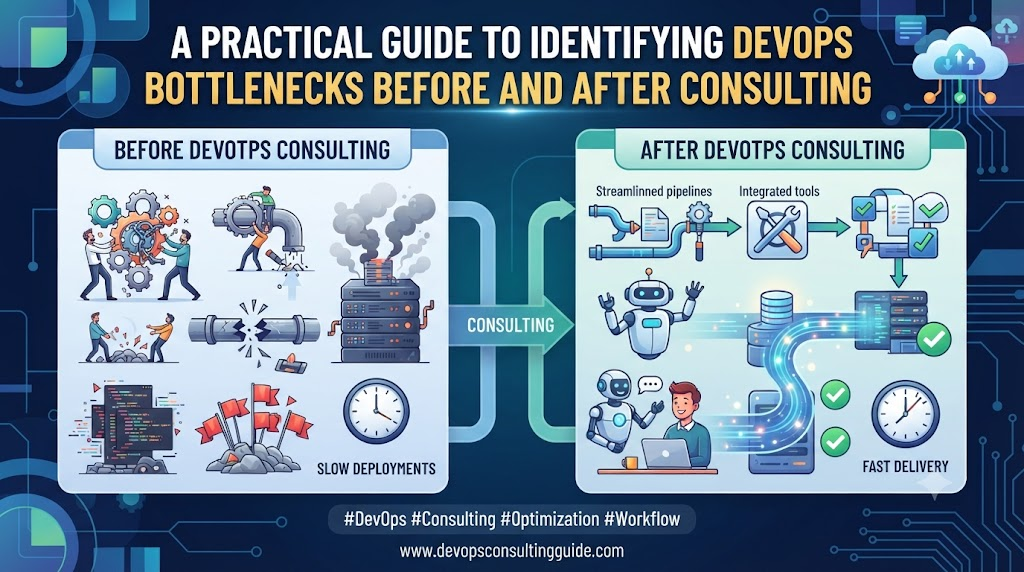
| Operational Area | Before Consulting | After Consulting |
|---|---|---|
| Deployment | Manual or inconsistent steps | Standardized and automated delivery pipelines |
| CI/CD | Slow or unreliable builds | Optimized, parallelized, and cached pipelines |
| Testing | Delayed manual verification | Greater test automation and shift-left validation |
| Infrastructure | Manual server provisioning | Declarative Infrastructure as Code |
| Monitoring | Limited reactive visibility | Comprehensive observability and tracing |
| Security | Late-stage vulnerability gates | Integrated automated security checks |
| Collaboration | Isolated functional silos | Cross-functional workflows and shared ownership |
Note: These outcomes represent potential structural improvements depending on an organization’s starting maturity and internal engagement.
Bottlenecks After DevOps Consulting
Consulting does not magically eliminate all friction permanently. Once an initial bottleneck is resolved, throughput increases, which invariably exposes the next constraint in the chain.
For example, when CI/CD build times drop from forty minutes to five minutes, the automated test suite—previously hidden behind slow builds—now becomes the new bottleneck. Similarly, automated infrastructure provisioning often shifts the primary challenge from server creation speed to cloud governance, cost management, and architecture compliance. Understanding this reality is central to sustaining long-term engineering health.
The Theory of Constraints in DevOps
Rooted in industrial engineering, the Theory of Constraints dictates that any manageable system is limited in achieving more of its goals by a small number of constraints. In a DevOps context, continuous improvement follows a continuous loop:
- Identify the primary constraint limiting delivery speed.
- Exploit the constraint by maximizing its current efficiency.
- Subordinate other workflows to align with the constraint.
- Elevate or eliminate the constraint through re-engineering or automation.
- Repeat the cycle to target the next emerging constraint.
Technical Bottleneck Deep Dive
CI/CD Optimization
Eliminating build and deployment friction requires tackling queue times, unoptimized dependency caching, and serial test execution. Implementing parallel stage execution, modular pipelines, and reliable artifact management significantly accelerates feedback loops.
Infrastructure and Cloud Management
Manual provisioning introduces severe configuration drift. Transitioning to Infrastructure as Code ensures reproducible environments, though teams must balance agility with strict cloud governance and cost visibility.
Testing and Quality Assurance
Slow, flaky test suites erode developer confidence. Modernizing test strategies through categorization, robust test data management, and early-stage execution helps maintain quality without sacrificing speed.
Observability and Security
Without deep tracing, log aggregation, and metric dashboards, troubleshooting production incidents becomes guesswork. Similarly, shifting security left through automated container scanning, Static Application Security Testing (SAST), and Policy as Code prevents late-stage compliance gridlock.
Measuring Improvement After Consulting
To evaluate whether consulting engagements deliver tangible value, organizations must track key engineering metrics against an established initial baseline:
- Deployment Frequency: How often code successfully ships to production.
- Lead Time for Changes: The duration required for a commit to reach production.
- Change Failure Rate: The percentage of deployments causing degradation or requiring immediate remediation.
- Mean Time to Recovery (MTTR): How quickly services return to normal following an incident.
Common Mistakes When Fixing DevOps Bottlenecks
- Purchasing expensive software tools before diagnosing the root process problem.
- Automating broken, inefficient workflows instead of redesigning them first.
- Tracking an overwhelming number of vanity metrics without clear operational context.
- Ignoring cultural resistance and developer feedback during tool rollouts.
- Expecting instant transformations without factoring in team learning curves.
Preparing Before DevOps Consulting
Organizations can maximize the value of external consulting engagements by preparing thoroughly:
- Documenting current team workflows and handoff points.
- Compiling historical deployment failure data and incident reports.
- Reviewing existing tooling stacks and licensing models.
- Gathering direct feedback from developers and operations engineers regarding daily friction points.
- Defining clear, measurable business objectives for the initiative.
Sustaining Improvements After Consulting
External consultants provide a roadmap, but internal teams must maintain momentum. Long-term success relies on regular pipeline reviews, ongoing infrastructure maintenance, continuous security audits, transparent knowledge sharing, and fostering a culture where identifying and resolving bottlenecks is a shared daily habit.
Role of DevOpsSchool
Building internal engineering capability is essential for long-term operational success. Understanding foundational practices, continuous integration, cloud architecture, Infrastructure as Code, container orchestration, and site reliability engineering requires structured learning and hands-on skill development.
Organizations looking to upskill engineering teams or deepen their technical expertise often explore professional training programs through providers like DevOpsSchool, where practitioners learn practical methodologies for streamlining modern software delivery pipelines.
Future of DevOps Bottleneck Identification
As software systems grow more complex, bottleneck analysis is evolving. Modern engineering teams increasingly leverage AI-assisted analytics, predictive monitoring, intelligent observability, and automated root-cause analysis platforms. While these technologies accelerate detection, human analysis remains irreplaceable for interpreting complex organizational context and architectural trade-offs.
Frequently Asked Questions
What are common DevOps bottlenecks? Common constraints include slow code reviews, manual testing phases, unoptimized CI/CD build queues, configuration drift in cloud environments, and communication silos between development and operations teams.
How can DevOps consulting identify bottlenecks? Consultants conduct current-state assessments, map out complete value streams from code commit to production, analyze delivery metrics, and perform root-cause analysis to pinpoint systemic friction points.
What should organizations measure before consulting? Organizations should establish baselines for deployment frequency, lead time for changes, change failure rates, mean time to recovery, and average build or test execution durations.
Can DevOps consulting eliminate all bottlenecks? No. Consulting removes major initial constraints and establishes continuous improvement frameworks, but new bottlenecks naturally emerge as delivery speed and organizational scale increase.
Why is continuous improvement important after consulting? Because software ecosystems, business requirements, and technology stacks constantly evolve, preventing bottlenecks from returning requires ongoing monitoring, regular pipeline audits, and active team feedback.
Final Thoughts
Identifying bottlenecks requires looking past surface-level symptoms to examine the complete software delivery lifecycle. While tools and automation are essential components of modern engineering, they cannot fix unaddressed structural or cultural friction.
By establishing clear baselines, partnering with experienced practitioners, adopting the principles of continuous improvement, and focusing on measurable outcomes, organizations can systematically remove delivery constraints, build resilient systems, and foster a sustainable engineering culture.

Best Cardiac Hospitals Near You
Discover top heart hospitals, cardiology centers & cardiac care services by city.
Advanced Heart Care • Trusted Hospitals • Expert Teams
View Best Hospitals