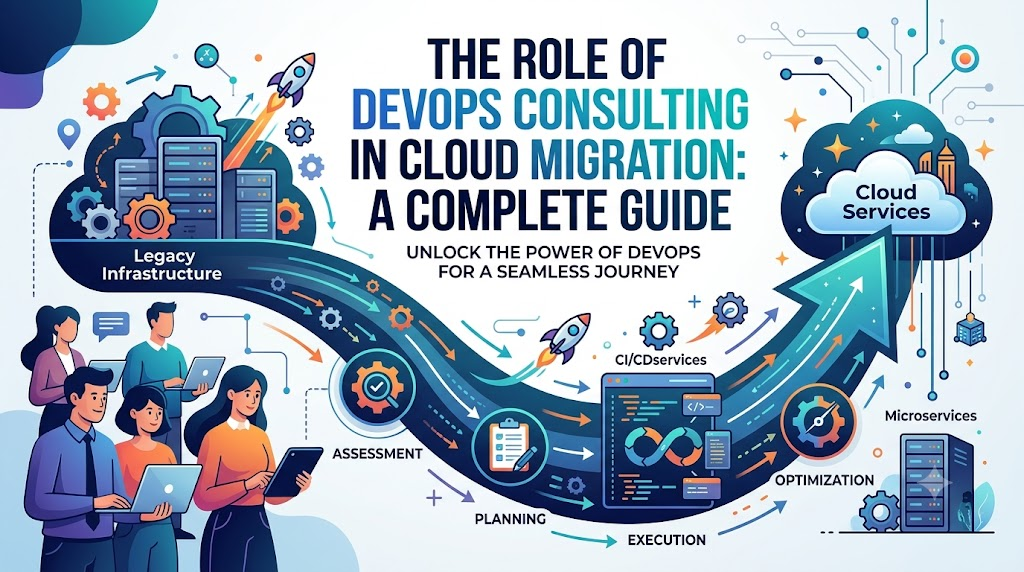
Migrating enterprise infrastructure to the cloud involves far more than simply copying servers to a new hosting environment; it demands a fundamental shift in deployment patterns, operational workflows, and security governance. Without disciplined planning, organizations often face unexpected downtime, unmapped legacy dependencies, severe cloud cost overruns, and persistent operational silos that follow them straight into the cloud. Engaging specialized DevOps consulting in cloud migration bridges these critical gaps by aligning cloud landing zones, automated Infrastructure as Code (IaC), robust CI/CD delivery pipelines, and proactive observability. By uniting modern automation with strategic workload sequencing, DevOps consultants help IT leaders turn high-risk lift-and-shift efforts into secure, repeatable, and scalable cloud adoption journeys.
What Is Cloud Migration?
Cloud migration refers to transferring digital assets—such as business applications, databases, microservices, networking configurations, and edge workloads—into cloud environments. These transitions take several forms depending on operational objectives:
- On-premises to Public Cloud: Transitioning workloads from enterprise data centers or colocation facilities to hyperscale providers like AWS, Microsoft Azure, or Google Cloud Platform.
- Cloud-to-Cloud (Multi-cloud): Migrating workloads between different public cloud platforms to prevent vendor lock-in, meet regional data residency laws, or access specialized managed services.
- Virtual Machines to Managed Services: Moving self-hosted services—such as relational databases or message brokers—to cloud-managed alternatives like Amazon RDS, Azure SQL Database, or Google Cloud Pub/Sub.
- Legacy Modernization & Containerization: Refactoring monolithic codebases into modular microservices deployed on managed Kubernetes platforms such as Amazon EKS, Azure AKS, or Google Cloud GKE.
The optimal cloud migration strategy depends on application interdependencies, recovery objectives (RPO/RTO), regulatory exposure, internal skill profiles, and operational budgets. Migration frameworks typically categorize these approaches using the “7 Rs”:
- Rehost (Lift and Shift): Moving workloads to cloud infrastructure without code or architectural changes.
- Replatform (Lift and Reshape): Making targeted optimizations—such as adopting a managed database service or running inside containers—without altering core business logic.
- Refactor / Re-architect: Modifying or rewriting application components using cloud-native paradigms (such as serverless computing or distributed microservices) to improve scalability and elasticity.
- Repurchase (Drop and Shop): Moving from a bespoke or self-hosted legacy application to a cloud-native Software-as-a-Service (SaaS) product.
- Relocate: Transferring virtualization platforms (e.g., hypervisor instances via VMware Cloud) directly to cloud hardware without modifying operating systems or virtual disks.
- Retain (Revisit): Keeping specific workloads in the on-premises environment due to heavy compliance constraints, active depreciation schedules, or high latency sensitivity.
- Retire: Decommissioning applications, legacy systems, and redundant data stores identified as obsolete during the initial discovery audit.
What Is DevOps Consulting?
DevOps consulting provides external technical, operational, and architectural guidance to help organizations bridge development, operations, and security silos. A DevOps consultant focuses on building repeatable delivery workflows, establishing resilient cloud architectures, and coaching internal staff to run and evolve modern platforms independently.
Depending on an organization’s maturity and engagement scope, DevOps consulting services may involve:
- Performing structured technical assessments of delivery pipelines, deployment patterns, and operational processes.
- Designing automated cloud architectures built on security, elasticity, and least privilege.
- Authoring and implementing Infrastructure as Code (IaC) to standardize environment provisioning.
- Constructing robust CI/CD pipelines that incorporate automated testing, image validation, and security compliance scans.
- Implementing observability frameworks covering centralized logging, distributed tracing, alerting, and telemetry.
- Mentoring internal engineering teams to take full ownership of post-migration operations.
A consulting engagement may be advisory, hands-on, or a hybrid model. The consultant’s role is to illuminate architectural trade-offs, install best practices, and accelerate engineering velocity—not to permanently replace internal platform and operations teams.
Why DevOps Consulting Is Important During Cloud Migration
Applying DevOps principles during a cloud migration prevents the migration process from turning into a chaotic, manual endeavor.
Better Migration Planning
Detailed workload discovery must precede the migration of any production database or microservice. DevOps consultants analyze network topologies, map cross-system communications, evaluate runtime dependencies, and rank workloads by business criticality and technical complexity. This produces an evidence-based migration sequence that minimizes inter-service latency issues and unexpected breaking changes.
Reduced Operational Disruption
Unrehearsed cutovers risk application downtime, corrupted database states, and lost revenue. Consultants design phased execution waves that rely on canary cutovers, blue/green deployments, automated database replication, and tested rollback procedures. While no framework can eliminate technical risk entirely, structured rehearsals and clear recovery thresholds significantly lower the likelihood of unrecoverable migration failures.
Improved Automation
Manual configuration within cloud management consoles leads to unrepeatable setups and configuration drift. DevOps practices mandate that all target environments—from virtual private clouds (VPCs) and subnets to identity policies and compute instances—are defined declaratively as code. This makes environments testable, versioned, and easily reproducible across staging and production tiers.
Stronger Collaboration
Migrations touch software engineers, systems administrators, database teams, networking engineers, information security officers, and business product owners. Consultants facilitate cross-functional alignment by establishing shared responsibilities, unified communication channels, transparent escalation paths, and automated pull-request validation steps that involve both development and operations stakeholders.
More Informed Technical Decisions
The cloud ecosystem offers thousands of managed services, networking models, and pricing structures. An experienced consultant helps teams navigate critical trade-offs: when to select serverless versus containerized architectures; whether to choose self-managed databases versus cloud-native managed solutions; and how to balance infrastructure flexibility against long-term vendor lock-in.
Better Long-Term Operational Readiness
A migration is not finished once DNS records cut over to new endpoints. The target cloud environment must be prepared for ongoing operations, including scheduled patching, automated backups, cross-region disaster recovery, granular identity auditing, and incident response procedures. Consulting engagements ensure these Day-2 operational processes are designed alongside the application architecture.
Key Responsibilities of a DevOps Consultant in Cloud Migration
A structured DevOps migration strategy applies technical controls across every layer of the migration process.
┌────────────────────────────────────────────────────────────────────────┐
│                   DevOps Migration Execution Phases                    │
└────────────────────────────────────────────────────────────────────────┘
  1. Discovery & Audit        ───► Workload Mapping & Dependency Graphing
  2. Foundation & Landing     ───► IAM, VPC Architecture, Compliance Guardrails
  3. Delivery Automation      ───► Infrastructure as Code (IaC) & CI/CD Pipelines
  4. Migration & Validation   ───► Phased Cutover, Functional & Load Testing
  5. Day-2 Operations         ───► Observability, FinOps, & Continuous Governance
1. Assessing the Existing Environment
Consultants start with an exhaustive discovery audit. This includes cataloging operating systems, software versions, database engines, traffic flows, firewall rules, and external API dependencies. Assessing operational delivery maturity reveals how features are currently tested, deployed, and monitored.
Failing to complete this discovery step risks identifying unmapped dependencies in the middle of a cutover, resulting in stalled services, broken data pipelines, and delayed launches.
2. Developing a Cloud Migration Roadmap
With dependency data in hand, consultants establish a migration roadmap that balances operational risk against business value. Applications are grouped into migration “waves.”
Low-risk, non-critical services are typically migrated first to validate cloud landing zones, test delivery pipelines, and establish deployment rhythms. Highly coupled, database-intensive, or strictly regulated workloads are assigned to later waves that incorporate dedicated data sync schedules and extended rollback windows.
3. Designing Cloud Infrastructure
Infrastructure design establishes network segmentation, routing tables, perimeter security, virtual private networks (VPNs) or direct interconnects, compute capacity, and storage tiers. Consultants structure account hierarchies (e.g., AWS Organizations, Azure Management Groups, or Google Cloud Resource Manager) to separate environments (development, staging, production) and enforce security boundaries.
Architectural decisions prioritize actual workload specifications, performance profiles, and recovery mandates over industry trends.
4. Implementing Infrastructure as Code
Using tools like HashiCorp Terraform, OpenTofu, AWS CloudFormation, or Azure Bicep, consultants translate architectural blueprints into declarative code. This ensures cloud infrastructure is:
- Version-Controlled: Every resource modification is tracked in Git, peer-reviewed, and auditable.
- Deterministic: Target environments remain identical, avoiding configuration drift between staging and production.
- Securely Managed: State files containing sensitive environment metadata are encrypted at rest, remotely locked, and decoupled from plain-text source repositories.
While Infrastructure as Code improves speed and repeatability, it introduces its own governance requirements, including automated static analysis (e.g., trivy, checkov), linting, and access-controlled deployment roles.
5. Building CI/CD Pipelines
Cloud environments require automated delivery mechanics. Consultants configure CI/CD pipelines (e.g., using GitHub Actions, GitLab CI/CD, or Jenkins) that automatically package code, build container images, run unit and integration test suites, and execute policy-as-code evaluations before releasing updates.
During migration, these pipelines deploy new cloud-native configurations; post-migration, they become the standard vehicle for continuous application updates.
6. Integrating Security and Compliance
Security must be woven into the migration process, not retrofitted after deployment. Consultants implement identity and access management (IAM) under the principle of least privilege, enforce role-based access control (RBAC), and integrate centralized secrets managers (such as HashiCorp Vault, AWS Secrets Manager, or Azure Key Vault) to eliminate hardcoded credentials.
Pipelines incorporate container image scanning, software composition analysis (SCA), and dynamic application security testing. While consultants help configure and implement these technical guardrails, legal accountability for regulatory compliance remains with the organization.
7. Enabling Monitoring and Reliability
Comprehensive observability provides visibility into system performance during cutover events. Consultants configure metric scrapers, log forwarders, and distributed tracing tools to track error rates, API latencies, CPU/memory saturation, and network throughput.
Where appropriate, teams establish Service Level Indicators (SLIs) and Service Level Objectives (SLOs) to track application availability. Real-time telemetry is paired with automated alerts routed to operational on-call schedules, ensuring anomalous behavior is identified before cascading into wide-scale outages.
8. Managing Knowledge Transfer
External consulting delivers little long-term value if an organization’s engineers cannot manage the new infrastructure once the contract ends. Consultants document system topologies, maintain runbooks for incident resolution, author pipeline guides, and run interactive pairing sessions with internal staff.
This educational transition equips internal teams to operate, debug, scale, and update their cloud platform independently.
The Cloud Migration Lifecycle with DevOps Consulting
A structured migration lifecycle moves through distinct phases to reduce technical debt and maintain operational stability.
| Phase | Core Objective | Primary Deliverables | Key Risks Mitigated |
| Phase 1: Discovery & Assessment | Catalog existing systems and identify technical constraints. | Application inventory, dependency maps, compliance audit. | Missing cross-service dependencies, unexpected data transfer blocks. |
| Phase 2: Strategy & Planning | Define workload prioritization and target landing patterns. | Migration wave plan, 7-Rs classification, recovery criteria. | Scope creep, mismatched resource allocations, unplanned downtime. |
| Phase 3: Landing Zone Setup | Construct core cloud networking, governance, and identity baselines. | VPCs, IAM policies, audit logging, organizational root accounts. | Permissive default permissions, unmonitored attack surfaces. |
| Phase 4: Automation & Pilot | Codify infrastructure provisioning and test delivery pipelines. | IaC repositories, CI/CD pipelines, migrated pilot service. | Pipeline failure during cutover, untracked configuration drift. |
| Phase 5: Migration & Validation | Execute wave-based migrations and verify system states. | Data synchronization jobs, functional testing, performance benchmarks. | Data corruption, dropped database transactions, latency spikes. |
| Phase 6: Production Cutover | Reroute live traffic and transition to new production endpoints. | DNS updates, traffic drain configurations, rollback checkpoints. | Routing failures, unmonitored post-launch errors, delayed rollback. |
| Phase 7: Day-2 Optimization | Refine resource utilization, tune alert models, and stabilize costs. | Rightsizing reports, FinOps dashboards, updated operational runbooks. | Unmonitored cloud spend, alert fatigue, orphan resources. |
DevOps Tools That Can Support Cloud Migration
Tool selection should reflect an organization’s internal skillset, runtime requirements, licensing terms, and integration surface. Adopting overly complex tools can create operational overhead that outweighs their benefits.
| Category | Example Tools or Technologies | Purpose During Migration |
| Infrastructure as Code | Terraform, OpenTofu, AWS CloudFormation, Azure Bicep | Declaratively define, version, and deploy cloud infrastructure across environments. |
| Configuration Management | Ansible | Automate OS configuration, software installation, and repeatable system configuration tasks. |
| CI/CD | GitHub Actions, GitLab CI/CD, Jenkins, Argo CD | Automate code builds, security scans, integration testing, and target environment deployments. |
| Containers | Docker, Podman | Package application runtimes and code into portable, immutable artifacts that execute consistently. |
| Container Orchestration | Kubernetes, Amazon EKS, Azure AKS, Google Cloud GKE | Automate scaling, healing, scheduling, and networking for containerized workloads. |
| Monitoring & Visualization | Prometheus, Grafana, Datadog, AWS CloudWatch | Ingest, aggregate, and display system metrics, operational thresholds, and health trends. |
| Security & Policy | HashiCorp Vault, Trivy, Checkov, SonarQube, OPA | Scan code and container layers for vulnerabilities; manage secrets; enforce policy as code. |
| Logging & Tracing | OpenTelemetry, Elasticsearch/Logstash/Kibana (ELK), Jaeger | Correlate logs, capture distributed system traces, and diagnose application-level exceptions. |
Benefits of DevOps Consulting in Cloud Migration
Bringing a structured DevOps focus to cloud migration projects offers several key advantages:
- Consistent Infrastructure Deployment: Codifying infrastructure into declarative templates removes the variability and human error inherent in manual console setups.
- Transparent Architecture and Dependencies: Deep-dive discovery maps hidden connections between monolithic databases and supporting services, avoiding downstream surprises.
- Rapid Rollback Capabilities: Establishing automated deployment mechanics and testing rollback scripts beforehand reduces the risk of unrecoverable errors during cutover windows.
- Integrated Security Posture: Hardening cloud perimeters, auditing access controls, and scanning container images before production rollout reduces the risk of credential leakage and compliance violations.
- Standardized Team Collaboration: Development, operations, and QA teams work against a unified Git-driven delivery workflow with clear operational ownership.
- Operational Readiness for Day 2: Provisioning monitoring, centralized logging, and incident alerting alongside infrastructure avoids running blind in production.
- Upskilling Internal Staff: Pair programming, architectural workshops, and runbook reviews build cloud-native fluency within in-house engineering teams.
These benefits depend on organizational readiness, management support, and consistent technical discipline. Consulting services cannot compensate for fundamentally incompatible software architectures or unaddressed organizational silos without active stakeholder commitment.
Common Cloud Migration Challenges and How DevOps Consulting Helps
Even well-funded cloud migration initiatives frequently face operational bottlenecks.
| Challenge | Potential Impact | Practical Response |
| Poor application discovery | Unmapped service dependencies trigger run-time errors and delayed cutovers. | Use automated network discovery tools and map detailed dependency matrices before scheduling migrations. |
| Manual infrastructure setup | Discrepancies between staging and production environments cause inconsistent deployments. | Model all VPCs, subnets, instances, and policies using tested, versioned Infrastructure as Code. |
| Weak rollback planning | Production issues during cutover require chaotic, unplanned troubleshooting while systems remain offline. | Script automated rollback sequences, establish strict cutover deadlines, and rehearse failback processes in staging. |
| Security gaps | Open firewall ports, excessive IAM permissions, and exposed API keys invite external breaches. | Implement least-privilege access, automate static analysis checks, and centralize secrets management. |
| Limited cloud expertise | Slower implementation, architectural anti-patterns, and ongoing operational missteps. | Pair internal engineers with experienced consultants for hands-on knowledge transfer throughout implementation. |
| Unclear ownership | Critical alerts go unnoticed; cross-team blockers cause missed delivery targets. | Define clear RACI matrices, establish dedicated project communication channels, and assign explicit service ownership. |
| Cost overruns | Provisioning oversized compute, memory, and storage instances leads to unexpectedly high monthly invoices. | Implement cloud budget alerts, configure allocation tags, and right-size capacity using actual workload metrics. |
| Poor observability | Engineering teams cannot determine whether application slowdowns stem from code, network latency, or database locks. | Standardize open-source or cloud-native metric collectors, distributed tracing, and structured log forwarders before launch. |
How to Choose the Right DevOps Consulting Partner
Selecting a DevOps consulting partner requires evaluating technical capabilities, governance maturity, and communication transparency. The right partner should align with your business realities rather than push a one-size-fits-all toolchain.
Key Evaluation Criteria
- Verifiable Technical Breadth: Look for deep architectural experience across your target cloud platforms and established infrastructure orchestration tools (such as Terraform, Kubernetes, and enterprise CI/CD systems).
- Focus on Knowledge Transfer: A qualified partner provides documentation, runbooks, and mentoring, with a clear focus on making your internal team self-sufficient.
- Commitment to Security and Governance: Avoid firms that treat security as an afterthought. Consultants must demonstrate deep familiarity with least-privilege IAM, network isolation, secrets encryption, and compliance baselines.
- Pragmatic Tool Selection: Be cautious of providers that insist on running every workload inside complex architectures (like microservices or Kubernetes) when simpler managed services or virtual machines would meet business requirements at a lower cost.
- Transparent Scoping and Deliverables: Ensure that project roadmaps, deliverables, milestone criteria, and transition phases are explicitly defined rather than left open-ended.
Questions to Ask Prospective Consultants
- “How do you map and validate application dependencies before drafting a migration plan?”
- “What specific criteria do you use to choose between rehosting, replatforming, and refactoring a legacy service?”
- “How do you test rollback plans, and what determines whether a cutover proceeds or is aborted?”
- “How do you integrate least-privilege access and secrets management into automated CI/CD workflows?”
- “What does your knowledge-transfer process look like, and how do you ensure our staff can operate the platform after your engagement concludes?”
- “How will our teams handle out-of-scope discoveries, architectural blockers, and change requests during the project?”
Measuring Cloud Migration Success
Evaluating cloud migration outcomes requires comparing operational and technical metrics against documented baselines. Rather than relying on generic ROI claims, track these concrete technical indicators:
- Migration Schedule Variance: Tracking workload transitions against projected wave completion timelines to detect process bottlenecks early.
- Service Availability and Error Rates: Monitoring HTTP 5xx responses, transaction error rates, and system uptime across production services before and after migration.
- Software Delivery Metrics: Tracking change failure rate, deployment frequency, mean time to recovery (MTTR), and build pipeline runtimes using standard DORA guidelines.
- Latency and Resource Performance: Measuring application response times, database query execution durations, and compute resource utilization under normal and peak traffic loads.
- Security & Vulnerability Trends: Tracking identified configuration vulnerabilities, unencrypted storage instances, excessive IAM permissions, and the time required to remediate them.
- Financial Performance Against Projections: Tracking monthly cloud invoices against pre-migration budgets, broken down by environment and business unit tags.
- Operational Autonomy: Evaluating the ability of internal engineering teams to triage incidents, resolve deployment errors, and execute routine updates without external intervention.
Cost Optimization After Cloud Migration
Deploying to the cloud does not guarantee lower infrastructure costs. Without deliberate post-migration governance (FinOps), on-demand pricing, oversized resources, and unmonitored services can quickly outpace on-premises budgets.
┌────────────────────────────────────────────────────────┐
│             Post-Migration Cost Levers                 │
├──────────────────────────┬─────────────────────────────┤
│ Compute & Storage        │ Rightsizing instances based │
│ Rightsizing              │ on actual utilization data  │
├──────────────────────────┼─────────────────────────────┤
│ Architectural Upgrades   │ Modernizing instances to    │
│                          │ ARM-based chips (Graviton)  │
├──────────────────────────┼─────────────────────────────┤
│ Commitment Discounts     │ Savings Plans & Reserved    │
│                          │ Instances for base capacity │
├──────────────────────────┼─────────────────────────────┤
│ Storage Tiering          │ Moving stale assets to      │
│                          │ cold/archive tiers          │
├──────────────────────────┼─────────────────────────────┤
│ Non-Production Schedules │ Automated shutdown of dev   │
│                          │ instances outside work hours│
└──────────────────────────┴─────────────────────────────┘
Effective cost control balances cost reduction against system availability, performance, and operational safety. Slashing database compute limits or removing multi-AZ redundancy to reduce expenses can trigger production outages under unexpected traffic spikes.
Sustainable cost optimization relies on continuous utilization reviews, comprehensive resource tagging, and performance monitoring.
Common Mistakes to Avoid
- Treating Cloud Migration as a Pure Hardware Swap: Moving poorly designed or inefficient on-premises processes directly into cloud infrastructure duplicates existing technical debt while incurring higher on-demand costs.
- Automating Broken Delivery Processes: Writing scripts around poorly understood, manual release processes simply produces fragile automated pipelines that break more quickly.
- Tool-First Decision Making: Selecting complex tools (such as service meshes or container orchestrators) before defining business requirements creates technical debt and complicates day-to-day operations.
- Deferring Security Configuration: Treating security and identity as post-launch line items often results in misconfigured public storage, leaked credentials, and costly emergency fixes.
- Skipping Migration Cutover Rehearsals: Assuming cutover scripts and database migrations will succeed in production without staging tests frequently leads to extended, unplanned downtime.
- Underestimating Data Transfer Latency: Moving large volumes of transactional data over networks without testing replication bandwidth and synchronization timeframes causes cutovers to miss agreed maintenance windows.
- Failing to Upskill Internal Teams: Leaving internal staff out of the architecture and automation process creates an ongoing reliance on external consultants for everyday operational tasks.
How DevOpsSchool Can Support Cloud and DevOps Learning
A successful cloud migration depends heavily on an engineering team’s ability to maintain modern infrastructure long after the initial cutover. Closing the technical skills gap internally is one of the most reliable ways to avoid project bottlenecks and operational debt.
Platforms such as DevOpsSchool provide structured educational resources, certification preparation, and hands-on training across core engineering domains:
- Infrastructure Automation & IaC: Learning to build, structure, and test reproducible cloud environments using Terraform, OpenTofu, and Ansible.
- CI/CD Pipeline Architecture: Building automated build, test, scan, and deployment workflows using platforms like GitHub Actions, GitLab CI/CD, and Jenkins.
- Cloud Architecture & Foundations: Understanding networking, identity (IAM), and operational governance across AWS, Microsoft Azure, and Google Cloud Platform.
- Containerization & Orchestration: Gaining practical experience packaging applications with Docker and managing scalable container workloads with Kubernetes.
- Monitoring & Observability: Configuring metrics collection, centralized logging, and alerting systems using tools like Prometheus and Grafana.
While structured training and certifications do not replace project-specific architectural design, building these baseline skills in-house equips teams to collaborate effectively with external consultants and run cloud-native systems with confidence.
Frequently Asked Questions
1. What is the role of DevOps consulting in cloud migration?
DevOps consulting helps organizations plan, automate, secure, and execute their cloud migration strategy. Consultants design landing zones, build Infrastructure as Code, automate CI/CD pipelines, configure observability systems, and mentor internal teams to operate effectively in the new environment.
2. How does DevOps help make cloud migration more efficient?
DevOps replaces manual, error-prone system deployments with automated, version-controlled workflows. Using declarative infrastructure templates, automated test suites, and standardized pipelines helps teams execute migration waves predictably while reducing the risk of configuration drift and cutover errors.
3. When should a company hire a DevOps consultant for cloud migration?
Hiring an external consultant is particularly valuable when an organization lacks in-house cloud engineering experience, is struggling with complex legacy application dependencies, needs to meet strict regulatory or security standards, or wants to build automated delivery pipelines alongside their cloud migration.
4. What does a DevOps consultant do during migration planning?
During planning, consultants conduct discovery audits, map application dependencies, evaluate network traffic patterns, categorize workloads using migration frameworks (e.g., the 7 Rs), design cloud landing zones, establish recovery criteria, and organize workloads into prioritized migration waves.
5. Which DevOps tools are useful for cloud migration?
Common tools include Terraform, OpenTofu, and Ansible for infrastructure provisioning and configuration; GitHub Actions, GitLab CI/CD, and Jenkins for deployment pipelines; Docker and Kubernetes for containerized workloads; and Prometheus, Grafana, and OpenTelemetry for system observability and monitoring.
6. How does Infrastructure as Code help during migration?
Infrastructure as Code (IaC) lets teams define cloud resources as version-controlled, auditable text files. This ensures development, staging, and production environments can be provisioned consistently, simplifying migration testing and eliminating manual configuration discrepancies.
7. Can DevOps consulting reduce cloud migration costs?
DevOps consulting can help curb unexpected expenses by sizing infrastructure according to actual demand, automating non-production shutdown schedules, setting up budget alerts, and building scalable architectures. However, consulting services carry their own costs and cannot guarantee ongoing savings without internal operational discipline.
8. How does DevOps consulting support cloud security?
Consultants help integrate security into the delivery lifecycle by configuring least-privilege IAM policies, automating container vulnerability scanning, managing secrets centrally, and enforcing policy-as-code checks within deployment pipelines.
9. What are the biggest risks in cloud migration?
The most common risks include poor dependency discovery, unexpected application downtime, data loss or corruption, unbudgeted resource costs, security misconfigurations, and an inability of internal teams to operate the new environment post-cutover.
10. What should organizations look for in a DevOps consulting partner?
Organizations should look for verifiable technical experience, strong security practices, clear communication around architectural trade-offs, a focus on knowledge transfer and documentation, and a pragmatic approach to tool selection that fits the company’s business requirements.
11. Why is post-migration optimization important?
Initial cloud deployments rarely achieve optimal performance, security, or cost efficiency right out of the gate. Post-migration optimization (Day 2 operations) helps teams right-size provisioned capacity, tune alert thresholds, eliminate orphaned resources, and continuously improve pipeline release speeds.
12. Does every cloud migration require Kubernetes?
No. While Kubernetes is well-suited for orchestrating complex, distributed container architectures, it introduces significant operational and maintenance complexity. Many workloads run more efficiently and cost-effectively on standard virtual machines, managed container services (like AWS ECS or Azure Container Apps), or serverless platforms.
Conclusion
Ultimately, successful cloud migration is an ongoing operational transformation rather than a one-time infrastructure cutover, requiring continuous alignment between architecture, automation, security, and team culture. By partnering with DevOps consultants to establish declarative infrastructure, integrated CI/CD guardrails, robust observability, and post-migration cost optimization, organizations can modernize legacy systems without sacrificing platform stability or fiscal control. True long-term resilience hinges on turning external guidance into lasting in-house capability—making hands-on upskilling, clear service ownership, and structured operational runbooks just as vital as the migration itself. Take the next step by auditing your internal cloud readiness, identifying critical workload dependencies, and building a phased migration roadmap that balances speed with sustainable operational excellence.

Best Cardiac Hospitals Near You
Discover top heart hospitals, cardiology centers & cardiac care services by city.
Advanced Heart Care • Trusted Hospitals • Expert Teams
View Best Hospitals