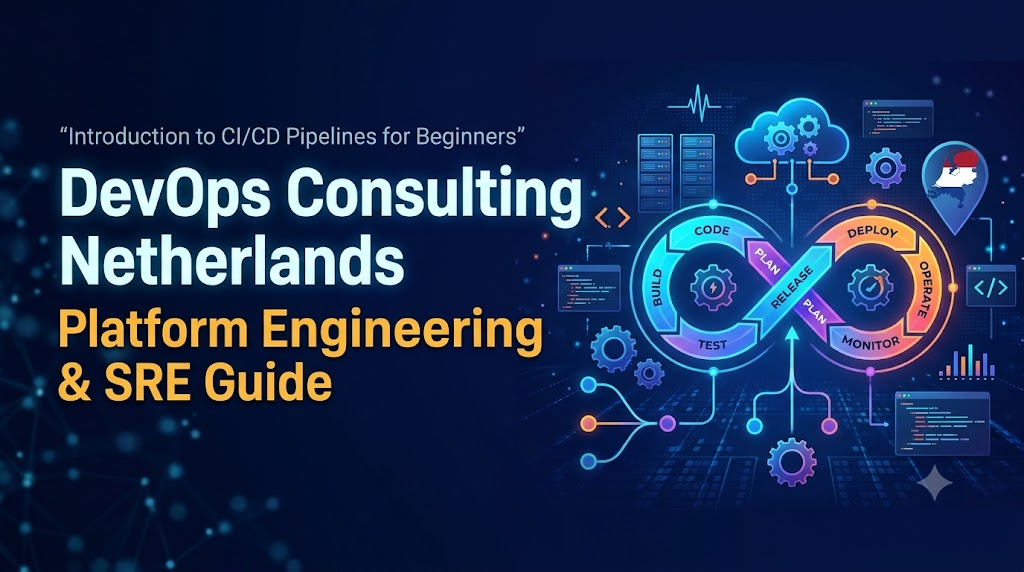
Spend an afternoon talking with engineering directors across Amsterdam, Rotterdam, or the Eindhoven technology belt, and you will hear a recurring story. Their teams write elegant, performant application code, yet getting that code deployed safely into production feels like an uphill slog through red tape and fragile infrastructure.
The Dutch technology sector moves fast, but it operates inside strict boundaries. Heightened EU regulatory directives—particularly NIS2 and DORA—require absolute transparency over software dependencies and operational resilience. At the same time, unpredictable multi-cloud invoices chew through margins, and finding senior systems engineers in Western Europe remains an ongoing struggle.
When release cycles start slipping, organizations often default to tactical patches: adding another validation script, spinning up a new observability tool, or scheduling more pre-release review meetings. Unfortunately, layering process on top of brittle systems only deepens the friction. Building a responsive, reliable software pipeline requires a clear architectural vision, standardized internal platforms, and automated security guardrails. For teams looking to build this maturity without halting feature development, bringing in specialized DevOps Consulting Netherlands provides the practical expertise needed to establish resilient, production-ready delivery foundations.
Uncovering the Hidden Friction in Modern Delivery
Release pipelines rarely collapse because of one major software bug. Instead, they grind to a crawl under the weight of accumulated operational drag. In most enterprise tech stacks, this friction shows up in four distinct ways:
[ Developer Pull Request ]
            │
            ├──► Context Switching: Engineers bogged down in YAML, networking, and bespoke scripts
            │
            ├──► Late-Stage Security: Audits and compliance reviews halting release candidates
            │
            ├──► Environment Drift: Unmanaged snowflake clusters across testing and production
            │
            └──► Opaque Cloud Bills: Idle nodes and unallocated resources eroding project margins
- Cognitive Overload for Product Teams: When feature engineers are forced to double as cloud network specialists and container troubleshooters, their attention is pulled away from core business applications.
- The Compliance Wall: Treating compliance as a late-stage audit gate creates painful bottlenecks. In a European market governed by strict operational standards, retrofitting controls right before a launch causes extensive delivery freezes.
- Cluster Complexity and Drift: Standing up a basic container cluster for a demo is easy. Keeping production clusters patched, consistent, and resilient over years of microservice sprawl is an entirely different operational discipline.
- Cloud Cost Blindspots: The convenience of instant cloud provisioning comes at a price. Without clear ownership tags, auto-scaling thresholds, and resource quotas, compute costs climb steadily without delivering clear business value.
Four Foundations of a High-Performance Delivery Platform
Moving past constant fire drills requires engineering organizations to shift their focus away from one-off infrastructure fixes toward building dependable, self-serve internal platforms.
+---------------------------------------------------------------------------------+
|                       The Resilient Platform Framework                          |
+---------------------+------------------------------+----------------------------+
| Core Discipline     | Primary Focus                | Tactical Approach          |
+---------------------+------------------------------+----------------------------+
| Platform Delivery   | Developer Autonomy           | Self-service paved paths   |
| Shift-Left Security | Continuous Compliance        | Policy-as-code automation  |
| Systematic SRE      | Predictable Availability     | Actionable SLOs & budgets  |
| Practical FinOps    | Direct Cost Accountability   | Rightsizing & attribution  |
+---------------------+------------------------------+----------------------------+
1. Self-Service Paved Paths
High-performing platform teams operate like internal product groups. Instead of responding to endless manual infrastructure tickets, they design pre-approved, automated deployment paths. This enables product engineers to scaffold services, deploy to staging, and manage runtime configurations independently within tested security boundaries.
2. Shifting to Automated Policy-as-Code
Security reviews should be continuous and programmatic, not a bureaucratic checkpoint at the end of a sprint. By moving DevSecOps controls directly into the CI/CD pipeline, every pull request is checked automatically. Container images are scanned, dependencies are verified, and configuration policies are validated on the spot—letting developers fix issues when it takes minutes, not weeks.
YAML
# Enforcing non-root container execution and resource boundary declarations
apiVersion: admission.k8s.io/v1
kind: ClusterPolicy
metadata:
  name: enforce-pod-hygiene
spec:
  rules:
    - name: check-security-context
      match:
        resources:
          kinds: ["Pod"]
      validate:
        message: "Containers must run without root privileges and define CPU/memory limits."
        pattern:
          spec:
            securityContext:
              runAsNonRoot: true
            containers:
              - resources:
                  limits:
                    cpu: "?*"
                    memory: "?*"
3. Data-Driven Reliability with SRE
High availability cannot rely on optimism. Site Reliability Engineering replaces subjective arguments about stability with objective metrics. By establishing concrete Service Level Indicators (SLIs) and Service Level Objectives (SLOs), leadership sets a clear “error budget.” When availability targets slip, team priorities shift automatically from new features to stabilizing the platform and paying down technical debt.
4. Active Cloud Governance via FinOps
Cloud cost management shouldn’t be confined to finance spreadsheets at the end of the quarter. Practicing FinOps brings cost awareness directly into the engineering workflow. Mapping compute allocation to specific business domains and tracking workload usage patterns makes infrastructure efficiency an everyday engineering metric.
Operating Kubernetes for Critical Production Workloads
For distributed systems, container orchestration remains the industry standard. However, running Kubernetes in demanding production environments requires strict operational governance to prevent configuration drift and cluster outages.
[ Git Repository ] ──► [ GitOps Engine (ArgoCD/Flux) ] ──► [ Live Cluster State ]
 (Desired State)                 (Continuous Reconciliation)          (Zero Cluster Drift)
To maintain an auditable, stable environment, engineering teams turn to declarative GitOps models. Storing all cluster manifests, network policies, and deployment rules in version-controlled Git repositories makes cluster state transparent, drift detection automated, and disaster recovery as simple as reverting a Git commit.
Guiding principles for production cluster stability:
- Declare compute boundaries universally: Workloads running without explicit CPU and memory reservations risk monopolizing nodes and triggering unexpected evictions under heavy load.
- Isolate internal services by default: Adopt zero-trust network policies within clusters so compromised microservices cannot communicate unrestricted with private backends.
- Autoscale based on application signals: Move beyond basic CPU thresholds by configuring event-driven autoscaling tools to scale pods according to real incoming traffic, such as message broker queue depths.
Scaling Your Platform Capabilities with DevOpsSchool.nl
Modernizing infrastructure while keeping existing business services online is a delicate balancing act. Attempting to refactor pipelines, adopt GitOps, and restructure security policies solely with internal staff can easily overwhelm teams already committed to tight product roadmaps.
This is where specialized external expertise creates tangible momentum. Supporting technology companies across the Netherlands and wider Europe, DevOpsSchool.nl provides strategic consulting, hands-on engineering, and enterprise upskilling built for modern cloud platforms.
Whether your organization needs seasoned Kubernetes Consulting Services to build zero-drift container environments, Site Reliability Engineering Consulting to establish clear operational SLOs, or DevSecOps Consulting Services to embed automated compliance checks across your delivery workflows, their advisors work shoulder-to-shoulder with your engineers.
Equally important, lasting speed comes from internal capability. Through targeted Corporate DevOps Training and comprehensive infrastructure workshops, DevOpsSchool.nl helps your engineering staff build the skills, habits, and confidence needed to maintain, run, and scale their platforms autonomously.
A 4-Stage Roadmap for Sustainable Platform Transformation
Overhauling your delivery stack doesn’t require a risky, all-at-once migration. Structuring the journey into distinct, measurable stages keeps delivery stable while unlocking tangible improvements along the way:
| Stage | Main Objective | Key Deliverables | Metric to Watch |
| Phase 1: Baseline Audit | Identify friction points | Toolchain inventory, CI/CD audit, security baseline | Lead Time to Change |
| Phase 2: Standardization | Establish paved paths | Declarative GitOps pipelines, baseline IaC templates | Deployment Frequency |
| Phase 3: Resiliency | Embed SRE & DevSecOps | Automated policy enforcement, production SLOs | Mean Time to Recovery (MTTR) |
| Phase 4: Optimization | Drive cost & team maturity | Team-level cost attribution, engineering upskilling | Infrastructure Cost per User |
Frequently Asked Questions
Why engage an external consultancy rather than relying solely on hiring new staff?
Recruiting experienced infrastructure and cloud engineers across Europe often takes months, during which critical delivery initiatives stall. Specialized consultants step in immediately to resolve complex architectural bottlenecks, stand up production-tested platforms, and mentor your existing team—delivering immediate progress while growing internal capabilities.
How does modern DevOps help satisfy European compliance rules like NIS2 and DORA?
Manual compliance assessments slow down release velocity and leave room for human error. Automated pipelines turn regulatory standards into executable code. By generating software bills of materials (SBOMs), signing container artifacts, and enforcing security policies automatically during every build, your platform produces an auditable verification trail without delaying deployments.
When should our team introduce FinOps into our workflows?
The moment multiple product teams are provisioning and managing cloud infrastructure independently. Introducing resource tagging standards, automated right-sizing, and cost attribution early prevents minor misconfigurations from compounding into significant, untracked monthly cloud spend.
Next Steps for Your Engineering Platform
Upgrading your delivery lifecycle isn’t about chasing every new open-source project; it’s about building a dependable environment where engineers can ship solid software quickly, safely, and predictably.
If your leadership team is currently evaluating its deployment strategy, planning a major container platform upgrade, or looking to build deep in-house engineering capabilities, explore the practical training and consulting pathways available at DevOpsSchool.nl to help chart your next step forward.

Best Cardiac Hospitals Near You
Discover top heart hospitals, cardiology centers & cardiac care services by city.
Advanced Heart Care • Trusted Hospitals • Expert Teams
View Best Hospitals