Introduction
Edge device management has become a cornerstone of modern infrastructure as processing power shifts away from centralized data centers and closer to where data is actually generated. Whether it is a fleet of industrial sensors, smart cameras, or retail kiosks, managing these distributed assets requires a specialized approach that differs significantly from traditional server management. These tools provide the necessary framework to deploy software, monitor health, and secure hardware that often operates in remote or “dirty” network environments with limited bandwidth and intermittent connectivity.
In the current landscape, the sheer scale of edge deployments makes manual intervention impossible. Organizations now require automated, “zero-touch” provisioning to get devices online and functional without sending a technician to the field. Furthermore, as edge devices increasingly handle sensitive data and run complex AI models, the management layer must provide robust security and life-cycle management for containers and firmware. The focus has shifted from simply “connecting” devices to orchestrating entire distributed ecosystems at scale.
Best for: Operations technology (OT) teams, IoT developers, manufacturing engineers, and logistics managers who need to oversee thousands of geographically dispersed hardware units.
Not ideal for: Organizations with all their hardware located in a single office or data center, or those who only manage standard mobile phones and laptops using traditional MDM.
Key Trends in Edge Device Management
- Containerization at the Edge: Using lightweight containers to deploy and update applications consistently across diverse hardware architectures.
- AI and Machine Learning Integration: Deploying and managing specialized AI models directly on edge hardware for real-time data processing and decision-making.
- Zero-Touch Provisioning: The ability for a device to automatically register, secure itself, and download its configuration the moment it is plugged into power and internet.
- Infrastructure as Code (IaC): Using declarative files to manage edge device configurations, ensuring consistency and version control across the entire fleet.
- Low-Bandwidth Optimization: Management protocols specifically designed to push updates and collect telemetry over weak cellular or satellite connections.
- Hardware-Root-of-Trust: Leveraging dedicated security chips on edge devices to ensure that only authorized firmware and software can run on the hardware.
- Predictive Maintenance: Using edge telemetry to predict when a physical device is likely to fail before it actually stops functioning.
- 5G and Private Networking: Integration with high-speed, low-latency private networks to enable real-time management of high-density device environments.
How We Selected These Tools
- Scalability and Fleet Management: We prioritized tools capable of managing thousands or even millions of devices from a single control plane.
- Support for Diverse Architectures: Evaluation included support for various CPU types (ARM, x86) and operating systems commonly found at the edge.
- Security and Compliance Features: Priority was given to platforms offering end-to-end encryption, secure boot, and robust identity management.
- Update Reliability: We looked for sophisticated over-the-air (OTA) update mechanisms that include automatic rollback features in case of failure.
- Offline Functionality: The ability for the device to continue operating and queuing data when connectivity to the management console is lost.
- Ecosystem and API Support: Selection was based on how easily these tools integrate into existing DevOps pipelines and cloud environments.
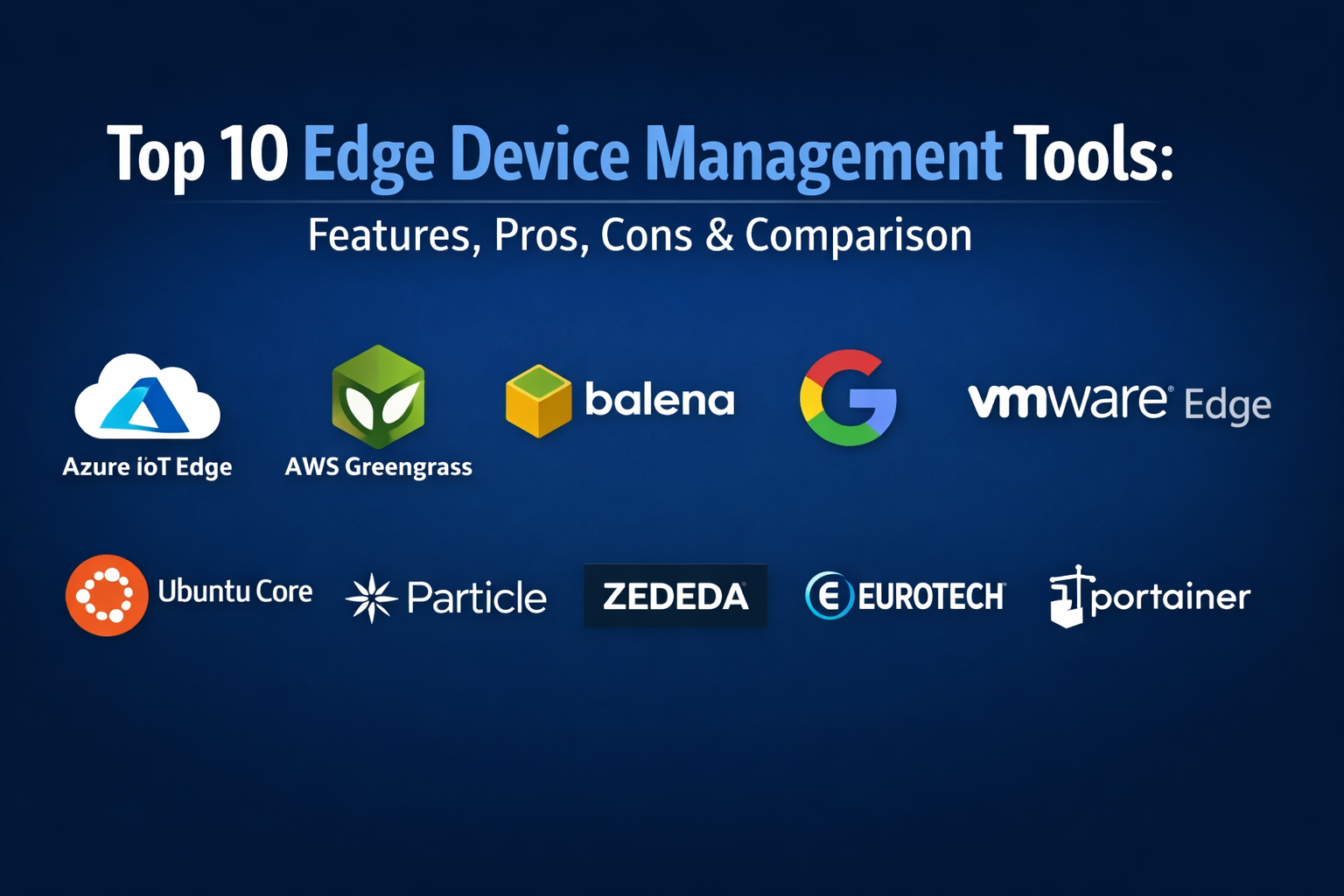
Top 10 Edge Device Management Tools
1. Azure IoT Edge
A fully managed service built on Azure that allows you to deploy cloud workloads—such as AI, Azure services, or custom logic—directly to your edge devices via standard containers.
Key Features
- Seamless deployment of Azure functions and Stream Analytics to edge hardware.
- Support for offline operation with automatic data synchronization upon reconnection.
- Integration with Azure Device Provisioning Service for zero-touch setup.
- Robust security through the Azure IoT Edge Security Daemon.
- Support for a wide range of hardware running Linux or Windows.
Pros
- Unmatched integration for organizations already using the Azure cloud ecosystem.
- Powerful capabilities for running complex AI models locally.
Cons
- Can be expensive as the number of messages and devices scales up.
- Steeper learning curve for those not familiar with the Azure portal.
Platforms / Deployment
Linux / Windows
Cloud / Hybrid
Security & Compliance
Integration with Azure Active Directory and hardware security modules.
ISO 27001 / SOC 2 compliant.
Integrations & Ecosystem
Deeply tied to the Microsoft ecosystem, including Azure DevOps, Power BI, and Microsoft Defender for IoT.
Support & Community
Comprehensive professional support through Microsoft enterprise agreements and a massive library of technical documentation.
2. AWS IoT Greengrass
AWS IoT Greengrass is an open-source edge runtime and cloud service that helps you build, deploy, and manage device software at the edge.
Key Features
- Modular design allowing you to add or remove software components as needed.
- Local messaging between devices even when the internet is disconnected.
- Simplified deployment of Lambda functions and Docker containers to the edge.
- Built-in components for machine learning inference and local data processing.
- Integration with AWS Fleet Indexing for advanced device searching and grouping.
Pros
- Highly flexible and customizable due to its modular architecture.
- Industry-leading security features and broad community support.
Cons
- Management console can be complex to navigate for beginners.
- Dependency on AWS services for the best management experience.
Platforms / Deployment
Linux / Windows / FreeRTOS
Cloud / Hybrid
Security & Compliance
Uses AWS IAM for identity and X.509 certificates for device authentication.
GDPR / HIPAA compliant.
Integrations & Ecosystem
Integrates perfectly with the entire AWS suite, including S3, Kinesis, and SageMaker.
Support & Community
Excellent enterprise support and a large community of IoT developers and enthusiasts.
3. Balena (balenaCloud)
Balena provides a complete toolset for developing, deploying, and managing fleets of connected Linux devices using container technology.
Key Features
- Seamless “git push” workflow for deploying code to an entire fleet of devices.
- Robust over-the-air (OTA) update system with atomic rollbacks.
- Built-in device dashboard for real-time monitoring and remote terminal access.
- Support for various hardware including Raspberry Pi, Jetson Nano, and Intel NUC.
- Multi-container support for running complex microservices at the edge.
Pros
- Exceptional developer experience and very fast deployment cycles.
- Reliable updates even over unstable or low-bandwidth connections.
Cons
- Monthly subscription costs can become significant for large fleets.
- Requires the use of balenaOS for the most seamless experience.
Platforms / Deployment
balenaOS (Linux-based)
Cloud
Security & Compliance
Encrypted communication and secure boot support for various boards.
Not publicly stated.
Integrations & Ecosystem
Connects well with GitHub, GitLab, and various monitoring tools via API.
Support & Community
Strong developer-focused community and responsive professional support.
4. Google Distributed Cloud Edge
Google’s solution for bringing its cloud infrastructure and services closer to where data is generated, focusing on high-performance workloads like AI and telecommunications.
Key Features
- Fully managed hardware and software stack delivered as a service.
- Built on Anthos for consistent management across cloud and edge.
- Optimized for running Google’s advanced AI and analytics at the edge.
- High-performance networking capabilities for low-latency applications.
- Centralized management through the Google Cloud Console.
Pros
- Best-in-class AI and machine learning capabilities at the edge.
- Consistent operational model between the cloud and remote locations.
Cons
- High entry cost due to the managed hardware model.
- Less flexible for “small-scale” IoT projects compared to competitors.
Platforms / Deployment
Google Managed Hardware
Cloud
Security & Compliance
Inherits Google Cloud’s high-security standards and compliance certifications.
SOC 2 / ISO 27001 compliant.
Integrations & Ecosystem
Native integration with BigQuery, Vertex AI, and Cloud Monitoring.
Support & Community
Enterprise-grade support and a strong presence in the telecommunications sector.
5. VMware Edge Compute Stack
A platform that provides an edge-optimized runtime for both containers and virtual machines, allowing enterprises to run legacy and modern apps side-by-side at the edge.
Key Features
- Support for both VM-based and container-based workloads.
- Edge-optimized version of vSphere for resource-constrained hardware.
- Integration with VMware Tanzu for managing Kubernetes at the edge.
- Centralized visibility across all edge locations and data centers.
- Zero-touch provisioning and lifecycle management.
Pros
- Ideal for enterprises already using VMware in their data centers.
- Unique ability to run legacy virtualized applications at the edge.
Cons
- Can be “heavy” for very small, low-power IoT sensors.
- Licensing can be complex and expensive for large-scale deployments.
Platforms / Deployment
Linux / ESXi-based
Hybrid
Security & Compliance
Uses VMware’s proven security stack, including micro-segmentation.
Not publicly stated.
Integrations & Ecosystem
Deep integration with VMware Workspace ONE and vRealize.
Support & Community
Massive enterprise support network and a global ecosystem of certified partners.
6. Canonical Ubuntu Frame & Snaps
Canonical provides a secure, reliable way to manage edge devices using the Ubuntu Core operating system and “Snaps” for application delivery.
Key Features
- Transactional updates with automatic rollbacks for high reliability.
- Strict isolation of applications (Snaps) for enhanced security.
- Specialized display server (Ubuntu Frame) for digital signage and kiosks.
- Ten years of security maintenance for Ubuntu Core versions.
- Dedicated App Store for private enterprise software distribution.
Pros
- Highly secure and lightweight operating system designed for the edge.
- Predictable and long-term support cycles.
Cons
- Management through the “Snap Store” may not fit every developer’s workflow.
- Requires a shift to the Snap packaging format.
Platforms / Deployment
Ubuntu Core / Linux
Local / Cloud
Security & Compliance
Kernel-level security and mandatory access control.
Not publicly stated.
Integrations & Ecosystem
Integrates well with standard Linux tools and various IoT cloud platforms.
Support & Community
Excellent community support and professional services via Canonical.
7. Particle
Particle offers an integrated IoT platform that includes hardware, connectivity, and a management cloud specifically for cellular-connected edge devices.
Key Features
- Fully integrated hardware, cellular SIM, and cloud management.
- Over-the-air firmware updates specifically optimized for cellular data.
- Device vitals and diagnostic tools for troubleshooting remote units.
- Support for edge logic through a simple-to-use IDE.
- Robust fleet management tools for grouping and updating devices.
Pros
- Easiest “out-of-the-box” experience for cellular-connected projects.
- Eliminates the need to manage separate cellular contracts.
Cons
- Can lead to vendor lock-in as it works best with Particle hardware.
- Pricing is tied to both the platform and cellular data usage.
Platforms / Deployment
Particle Hardware / Linux
Cloud
Security & Compliance
End-to-end encryption from the device to the cloud.
SOC 2 compliant.
Integrations & Ecosystem
Strong web-hooks and integrations with Azure, AWS, and Google Cloud.
Support & Community
Very active developer community and a wealth of hardware-specific documentation.
8. Zededa
Zededa provides a cloud-native orchestration solution for the distributed edge, focusing on hardware virtualization and security.
Key Features
- Open-source EVE-OS runtime for complete hardware abstraction.
- Ability to run any combination of legacy apps (VMs) and modern apps (containers).
- Zero Trust security model with remote attestation of hardware.
- App marketplace for easy deployment of edge services.
- Visual management console for overseeing thousands of nodes.
Pros
- Hardware-agnostic, allowing you to use any computer as an edge node.
- Strong focus on the security and integrity of the physical device.
Cons
- Newer platform with a smaller community compared to tech giants.
- Requires an understanding of virtualization concepts.
Platforms / Deployment
EVE-OS (Linux-based)
Cloud
Security & Compliance
Zero-trust architecture with dedicated security features.
Not publicly stated.
Integrations & Ecosystem
Integrates with major clouds and provides a marketplace for industrial apps.
Support & Community
Professional support for enterprise deployments and active in the Linux Foundation.
9. Eurotech Everyware Cloud
An industrial-grade IoT integration platform that provides device management, data management, and diagnostics for rugged edge computers.
Key Features
- Remote configuration and firmware updates for industrial gateways.
- Advanced diagnostic tools for monitoring the health of remote hardware.
- Support for a wide range of industrial communication protocols.
- Role-based access control for managing large teams of operators.
- Visual dashboard for real-time monitoring of device telemetry.
Pros
- Built specifically for the rigors of industrial and transportation environments.
- Long-term stability and reliability in harsh conditions.
Cons
- More focused on OT (Operations) than modern software development.
- Can feel less “modern” than developer-first platforms like Balena.
Platforms / Deployment
Linux
Cloud / On-premises
Security & Compliance
Enterprise-grade security and compliance for industrial sectors.
Not publicly stated.
Integrations & Ecosystem
Strong support for industrial standards like MQTT and OPC-UA.
Support & Community
Excellent support for industrial customers and a strong history in the OT space.
10. Portainer (Edge Agent)
Portainer provides a lightweight way to manage Kubernetes and Docker environments at the edge, offering a visual interface for complex container orchestration.
Key Features
- Simple visual management of containers and clusters across edge sites.
- Lightweight edge agent designed for low-resource hardware.
- Centralized control over remote container deployments.
- Support for “edge groups” to push updates to specific subsets of devices.
- Secure communication between the agent and the central controller.
Pros
- Makes managing Kubernetes and Docker much more accessible for teams.
- Lightweight enough to run on very small devices.
Cons
- Primarily focused on containers; less help with firmware or OS updates.
- Requires some knowledge of container orchestration.
Platforms / Deployment
Linux / Windows
Cloud / Self-hosted
Security & Compliance
RBAC and secure tunnel connections for all edge agents.
Not publicly stated.
Integrations & Ecosystem
Works with any standard Docker or Kubernetes environment.
Support & Community
Strong community edition and professional support for business users.
Comparison Table
| Tool Name | Best For | Platform(s) Supported | Deployment | Standout Feature | Public Rating |
| 1. Azure IoT Edge | Azure Ecosystem | Linux, Windows | Hybrid | Azure Service Sync | N/A |
| 2. AWS Greengrass | AWS Ecosystem | Linux, Windows, RTOS | Hybrid | Modular Runtime | N/A |
| 3. Balena | Developers | balenaOS (Linux) | Cloud | Git-push Workflow | N/A |
| 4. Google Edge | High-end AI | Managed Hardware | Cloud | Managed AI Stack | N/A |
| 5. VMware Edge | Mixed Workloads | Linux, ESXi | Hybrid | VM + Container | N/A |
| 6. Ubuntu Core | Security & Kiosks | Linux | Local/Cloud | Atomic Updates | N/A |
| 7. Particle | Cellular IoT | Particle, Linux | Cloud | Integrated Connectivity | N/A |
| 8. Zededa | Virtualization | EVE-OS (Linux) | Cloud | Zero-Trust Hardware | N/A |
| 9. Eurotech | Industrial / OT | Linux | Hybrid | Industrial Protocols | N/A |
| 10. Portainer | Container Ops | Linux, Windows | Self-hosted | Visual Container Mgmt | N/A |
Evaluation & Scoring
| Tool Name | Core (25%) | Ease (15%) | Integrations (15%) | Security (10%) | Perf (10%) | Support (10%) | Value (15%) | Total |
| 1. Azure IoT | 10 | 7 | 10 | 9 | 9 | 9 | 8 | 8.85 |
| 2. AWS Greengrass | 10 | 7 | 10 | 9 | 9 | 9 | 8 | 8.85 |
| 3. Balena | 9 | 10 | 8 | 8 | 9 | 8 | 7 | 8.40 |
| 4. Google Edge | 8 | 6 | 9 | 9 | 10 | 8 | 6 | 7.55 |
| 5. VMware Edge | 9 | 6 | 9 | 9 | 8 | 9 | 6 | 7.80 |
| 6. Ubuntu Core | 8 | 8 | 8 | 10 | 9 | 7 | 9 | 8.35 |
| 7. Particle | 7 | 10 | 7 | 8 | 8 | 8 | 8 | 7.85 |
| 8. Zededa | 8 | 7 | 7 | 10 | 8 | 7 | 7 | 7.55 |
| 9. Eurotech | 8 | 6 | 7 | 8 | 8 | 8 | 6 | 7.15 |
| 10. Portainer | 7 | 9 | 8 | 7 | 8 | 7 | 9 | 7.85 |
The scoring emphasizes the importance of a complete ecosystem for large-scale operations. Azure and AWS lead because they offer an “all-in-one” experience that handles everything from data storage to advanced analytics. For teams focused purely on software development speed, Balena and Portainer score high for ease of use. Tools like Ubuntu Core and Zededa are prioritized for their extreme security and hardware-level integrity, which are critical for high-stakes edge deployments.
Which Edge Device Management Tool Is Right for You?
Solo / Freelancer
If you are starting a small project or prototype, Balena or Portainer are excellent starting points. They offer low barriers to entry and allow you to get containers running on inexpensive hardware like a Raspberry Pi very quickly.
SMB
Small to medium-sized businesses should look at Azure IoT Edge or AWS IoT Greengrass if they already use those clouds. If the focus is on a specific hardware product, Particle offers a great “everything-in-one-box” solution that handles connectivity for you.
Mid-Market
For companies with growing industrial or retail fleets, Ubuntu Core provides a reliable and secure foundation. It is particularly good for static installations like kiosks where security and long-term stability are the top priorities.
Enterprise
Enterprises with a mix of legacy and modern applications should consider the VMware Edge Compute Stack. For those building the future of industrial automation or telecommunications, Google Distributed Cloud Edge or Zededa offer the most robust hardware orchestration.
Budget vs Premium
Portainer and Ubuntu Core are excellent budget-friendly options that don’t sacrifice power. Google Edge and VMware represent premium investments for organizations that require fully managed or highly specialized infrastructure.
Feature Depth vs Ease of Use
Balena and Particle are the winners for ease of use, getting you online in minutes. AWS Greengrass and Azure IoT Edge offer the most depth, but require a significant investment in learning the cloud ecosystem.
Integrations & Scalability
The major cloud providers (AWS, Azure, Google) are the clear winners for scalability, as their backends are designed to handle millions of simultaneous connections without breaking a sweat.
Security & Compliance Needs
If you are operating in a highly regulated or hostile security environment, Zededa and Ubuntu Core are the strongest contenders. Their focus on the “Root of Trust” and immutable operating systems makes them very difficult to compromise.
Frequently Asked Questions (FAQs)
1. What is the difference between IoT management and Edge management?
IoT management often focuses on simple sensors and data collection, while Edge management involves running complex applications, containers, and AI models directly on the remote hardware.
2. Can I manage edge devices over a cellular connection?
Yes, most of these tools are optimized for cellular data, using lightweight protocols and delta updates to minimize the amount of data transferred.
3. What happens if an edge device loses internet connectivity?
Most modern edge tools are designed to work offline. They will continue to run their local applications and queue any generated data until the connection is restored.
4. What is “Zero-Touch Provisioning”?
It is a process where a device is automatically configured and secured as soon as it is powered on and connected to the internet, without any manual setup by a technician.
5. Why are containers used at the edge?
Containers allow developers to package their applications with all necessary dependencies, ensuring the code runs exactly the same way on a remote device as it did on their laptop.
6. Do I need specialized hardware for edge management?
While some tools work on any PC, many edge projects use specialized, ruggedized hardware designed to withstand heat, dust, and vibration in industrial settings.
7. How do over-the-air (OTA) updates work?
The management tool pushes a new software version to the device. If the installation fails for any reason, the device will automatically “roll back” to the previous working version.
8. Can I run AI models on an edge device?
Yes, tools like Azure IoT Edge and AWS Greengrass are specifically designed to deploy and run machine learning models for tasks like image recognition or predictive maintenance.
9. Is edge management more secure than cloud management?
It offers different security benefits. By processing data locally, you don’t have to send sensitive information over the internet, which can reduce the “attack surface” of your organization.
10. How much do these tools cost?
Pricing varies from free open-source agents to monthly per-device subscription fees. Large cloud providers typically charge based on the number of messages or data transferred.
Conclusion
Managing the distributed edge is no longer a niche requirement but a fundamental part of the modern enterprise’s digital transformation. The right choice depends entirely on your specific hardware mix, your team’s technical expertise, and whether you are building a new system from scratch or managing legacy industrial equipment. As the line between the cloud and the edge continues to blur, the most successful organizations will be those that choose a management tool that offers both the security to protect their remote assets and the flexibility to deploy new innovations at speed. By centralizing the orchestration of your distributed fleet today, you are laying the groundwork for a more responsive and intelligent physical infrastructure.

Best Cardiac Hospitals Near You
Discover top heart hospitals, cardiology centers & cardiac care services by city.
Advanced Heart Care • Trusted Hospitals • Expert Teams
View Best Hospitals