Introduction
Federated Learning (FL) represents a paradigm shift in how machine learning models are trained, moving away from centralized data silos toward a distributed approach. In a world where data privacy and residency regulations are becoming increasingly stringent, federated learning allows organizations to train high-quality models without ever moving raw data from its original location. This “bringing the code to the data” methodology ensures that sensitive information—whether it is medical records on a smartphone or financial transactions in a regional bank branch—remains local while contributing to a collective global intelligence.
As we progress through the current era of decentralized technology, the ability to collaborate on artificial intelligence without compromising security is a competitive necessity. Federated learning platforms provide the orchestration layer required to manage thousands of distributed clients, handle intermittent connectivity, and aggregate model updates securely. This technology is becoming the standard for industries that handle highly regulated data, enabling a level of cross-organizational collaboration that was previously considered legally and technically impossible.
Best for: Data scientists, machine learning engineers, and Chief Technology Officers in healthcare, telecommunications, and finance who need to train models on sensitive, distributed datasets.
Not ideal for: Small startups with centralized, non-sensitive data, or projects where the overhead of distributed orchestration outweighs the benefits of data privacy.
Key Trends in Federated Learning Platforms
- Vertical Federated Learning: Platforms are now supporting scenarios where different organizations hold different features (attributes) about the same set of users, allowing for deeper collaborative insights.
- Privacy-Preserving Computation: Integration of Secure Multi-Party Computation (SMPC) and Differential Privacy (DP) to ensure that even model updates cannot be reverse-engineered to reveal raw data.
- Edge Computing Synergy: A massive push toward training models directly on IoT devices and mobile hardware to reduce latency and bandwidth costs.
- Blockchain for Incentivization: Using decentralized ledgers to track and reward data providers for their contributions to a global model fairly and transparently.
- AutoML in Federated Settings: The introduction of automated feature engineering and hyperparameter tuning specifically designed for non-independent and identically distributed (non-IID) data.
- Hybrid Cloud Orchestration: Tools that allow seamless model training across multiple cloud providers and on-premises data centers simultaneously.
- Standardization of Protocols: A shift toward industry-standard communication protocols to ensure interoperability between different federated learning frameworks.
- Model Integrity Verification: New methods for detecting “poisoning attacks” where a single malicious client attempts to degrade the performance of the global model.
How We Selected These Tools
- Privacy Framework Integration: We prioritized platforms that offer built-in support for advanced privacy techniques like differential privacy and encryption.
- Scalability and Robustness: Each tool was evaluated based on its ability to manage hundreds or thousands of distributed clients without system failure.
- Developer Experience: We looked for platforms with high-quality APIs, clear documentation, and support for popular ML libraries like PyTorch and TensorFlow.
- Community and Ecosystem Support: Priority was given to platforms with active development cycles and strong backing from either major tech companies or open-source foundations.
- Deployment Flexibility: We selected tools that can run across diverse environments, from mobile devices and edge sensors to enterprise servers.
- Ease of Orchestration: The selection includes platforms that simplify the complex task of synchronizing model versions across a distributed network.
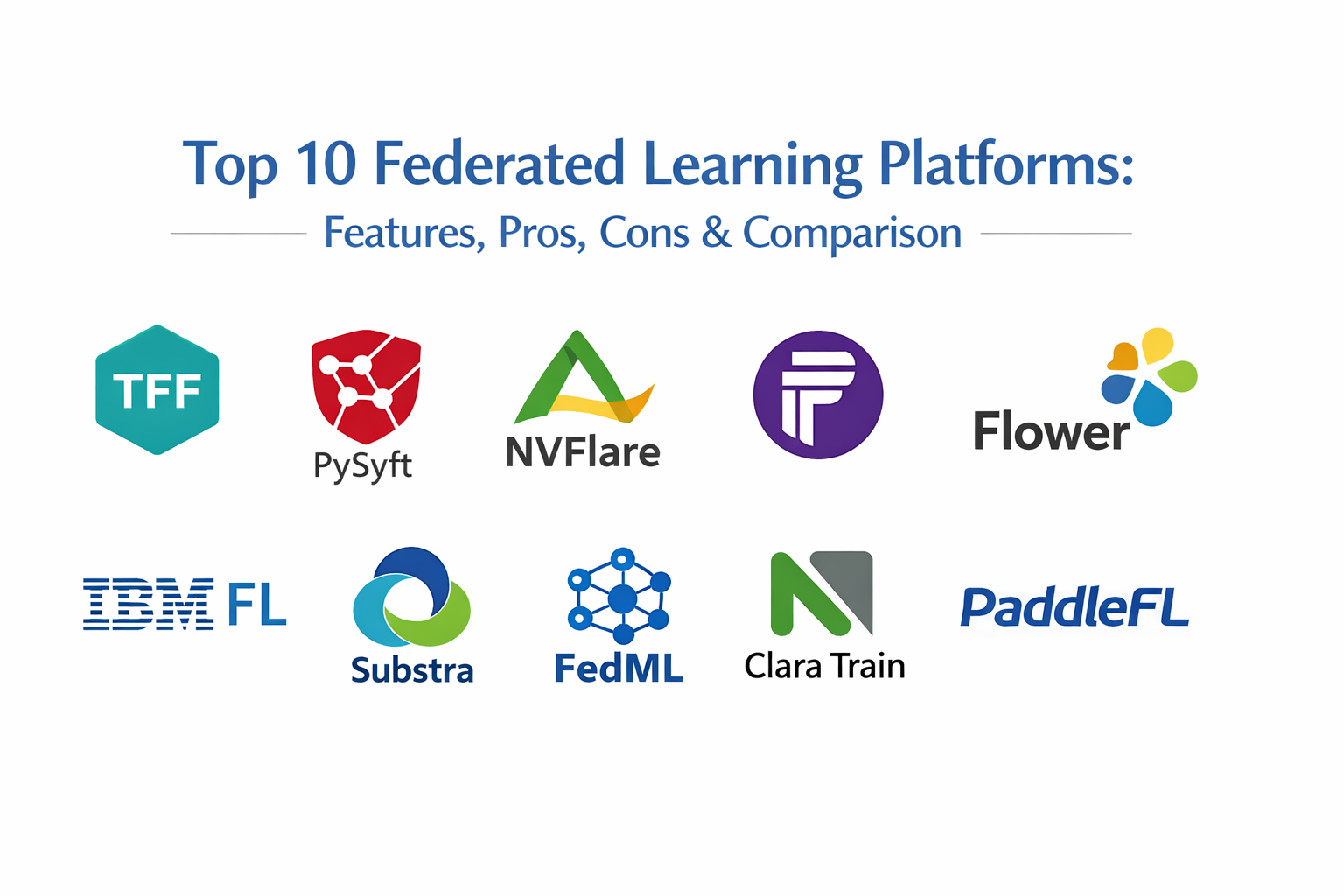
Top 10 Federated Learning Platforms
1. TensorFlow Federated (TFF)
An open-source framework for machine learning and other computations on decentralized data. Developed by Google, it is designed to enable users to simulate and implement federated learning on local data sources without moving them to a central server.
Key Features
- High-level interfaces for expressing federated training and evaluation tasks.
- Low-level interfaces for designing new federated algorithms.
- Deep integration with the broader TensorFlow ecosystem.
- Support for a wide variety of aggregation strategies.
- Extensive simulation capabilities for testing models before real-world deployment.
Pros
- Backed by Google’s extensive research and production experience.
- Excellent documentation and a massive library of pre-existing models.
Cons
- Primarily limited to the TensorFlow library.
- Can have a steep learning curve for those unfamiliar with functional programming concepts.
Platforms / Deployment
Windows / macOS / Linux / Android / iOS
Local / Cloud / Edge
Security & Compliance
Support for differential privacy and secure aggregation.
Not publicly stated.
Integrations & Ecosystem
Integrates perfectly with TensorFlow, Keras, and Google Cloud Platform services.
Support & Community
One of the largest communities in the federated learning space with frequent updates and deep academic roots.
2. PySyft (OpenMined)
A powerful library for secure and private deep learning. It extends popular frameworks like PyTorch and Keras with the tools needed to perform computations on data that the researcher cannot see.
Key Features
- Support for Secure Multi-Party Computation and Differential Privacy.
- Federated learning capabilities for both PyTorch and TensorFlow.
- Remote execution of commands on data residing in other environments.
- Robust identity and access management for data owners.
- Peer-to-peer communication protocols for decentralized training.
Pros
- Framework agnostic, working well with multiple deep learning libraries.
- Strong focus on the philosophical and legal aspects of data privacy.
Cons
- As a community-driven project, the API can change frequently.
- Performance can lag behind more specialized enterprise tools.
Platforms / Deployment
Windows / macOS / Linux
Cloud / Hybrid
Security & Compliance
Native support for SMPC, DP, and end-to-end encryption.
Not publicly stated.
Integrations & Ecosystem
Compatible with PyTorch, TensorFlow, and various data science notebooks.
Support & Community
Backed by OpenMined, a massive global community of privacy-conscious developers and researchers.
3. NVIDIA Flare (NVFlare)
NVIDIA’s Federated Learning Application Runtime is an open-source framework that allows researchers and developers to securely collaborate on machine learning models in a distributed fashion.
Key Features
- Controller-worker architecture for flexible workflow management.
- Built-in support for medical imaging and healthcare-specific workflows.
- Advanced security features including mutual TLS and secure provisioning.
- Support for any machine learning library through a flexible API.
- High-performance aggregation designed for GPU acceleration.
Pros
- Highly optimized for NVIDIA hardware and data center environments.
- Very stable and designed with enterprise-grade production in mind.
Cons
- Best performance requires NVIDIA GPU infrastructure.
- Smaller community compared to general-purpose open-source tools.
Platforms / Deployment
Windows / Linux
Local / Cloud / Hybrid
Security & Compliance
Mutual TLS, secure provisioning, and RBAC support.
Not publicly stated.
Integrations & Ecosystem
Integrates with NVIDIA AI Enterprise and major healthcare imaging standards.
Support & Community
Professional support via NVIDIA and a growing ecosystem of healthcare and research partners.
4. FATE (Federated AI Technology Enabler)
An industrial-grade federated learning framework that supports a wide range of federated algorithms including logistic regression, tree-based models, and deep learning.
Key Features
- Support for both horizontal and vertical federated learning scenarios.
- Visual workflow designer for managing complex training pipelines.
- Integrated secure computation protocols using homomorphic encryption.
- Robust multi-party collaboration management system.
- Support for big data ecosystems like Spark.
Pros
- One of the few platforms that truly masters vertical federated learning.
- Highly suitable for financial institutions and large-scale industrial use.
Cons
- Complex installation and configuration process.
- Documentation can be difficult to navigate for beginners.
Platforms / Deployment
Linux
Local / Cloud
Security & Compliance
Homomorphic encryption and secret sharing protocols.
Not publicly stated.
Integrations & Ecosystem
Integrates with Spark, Pulsar, and other big data processing tools.
Support & Community
Strong backing from the Linux Foundation and major Asian tech giants.
5. Flower (flwr)
A friendly and customizable federated learning framework that aims to make distributed training as easy as centralized training. It is designed to work across a vast range of devices and libraries.
Key Features
- Framework-agnostic design supporting PyTorch, TensorFlow, Scikit-learn, and more.
- Scalable to millions of clients including mobile and edge devices.
- Simple, clean API that reduces the complexity of federated orchestration.
- Support for custom aggregation strategies and client selection logic.
- Highly efficient communication protocol for low-bandwidth environments.
Pros
- Extremely easy to set up and get running.
- Works seamlessly on mobile devices (Android/iOS) and Raspberry Pi.
Cons
- Fewer built-in “enterprise” security features compared to FATE or NVFlare.
- Rapid development means some experimental features may be unstable.
Platforms / Deployment
Windows / macOS / Linux / Android / iOS
Cloud / Edge / Mobile
Security & Compliance
Basic support for secure communication and privacy add-ons.
Not publicly stated.
Integrations & Ecosystem
Works with virtually any Python-based machine learning library.
Support & Community
Very active and welcoming community with excellent starter templates and examples.
6. IBM Federated Learning
A specialized library from IBM Research that provides a robust environment for training models on distributed data sources without the need for data movement.
Key Features
- Support for a wide array of machine learning models and libraries.
- Advanced fusion algorithms for aggregating model updates.
- Enterprise-grade security and access control mechanisms.
- Support for non-IID data handling and bias detection.
- Integration with IBM Cloud and Watson services.
Pros
- Backed by IBM’s deep expertise in enterprise AI and security.
- High focus on model fairness and explainability in a distributed setting.
Cons
- Can be costly when used within the full IBM ecosystem.
- Less “community-driven” than open-source alternatives like Flower.
Platforms / Deployment
Windows / Linux
Cloud / Hybrid
Security & Compliance
Enterprise identity management and secure aggregation protocols.
Not publicly stated.
Integrations & Ecosystem
Designed to fit into the IBM Watson and IBM Cloud Pak for Data ecosystem.
Support & Community
Professional enterprise support provided by IBM.
7. Substra
An open-source federated learning software designed for secure and collaborative AI projects, with a strong emphasis on traceability and auditability.
Key Features
- Built-in ledger for tracking all actions and model updates for auditing.
- Secure execution environment for distributed model training.
- Advanced permission management for complex multi-partner collaborations.
- Support for hybrid cloud and multi-cloud deployments.
- Python-based SDK for easy integration into existing workflows.
Pros
- Exceptional for regulated industries that require a clear “paper trail” of AI training.
- Clean and intuitive interface for managing collaborations.
Cons
- Focuses heavily on the orchestration layer, requiring external libraries for the ML logic.
- Smaller overall market share compared to the big tech frameworks.
Platforms / Deployment
Linux / macOS
Cloud / Hybrid
Security & Compliance
Audit logs, secure sandboxing, and strict permissioning.
Not publicly stated.
Integrations & Ecosystem
Works well with Docker and Kubernetes for scalable orchestration.
Support & Community
Strong focus on the European research and healthcare ecosystem.
8. FedML
A comprehensive federated learning platform that provides an open-source library and a cloud-based service for managing distributed machine learning at scale.
Key Features
- Support for diverse hardware including smartphones, IoT, and high-end servers.
- Lightweight communication library for efficient data exchange.
- MLOps capabilities specifically designed for federated workflows.
- Support for diverse applications such as computer vision, NLP, and graph neural networks.
- One-click deployment to edge devices and mobile hardware.
Pros
- Covers the entire lifecycle from research simulation to production deployment.
- Very efficient at handling training on resource-constrained edge devices.
Cons
- Some of the most advanced management features are behind a paid cloud tier.
- Can feel overwhelming due to the sheer number of supported configurations.
Platforms / Deployment
Windows / macOS / Linux / Android / iOS
Cloud / Edge / Mobile
Security & Compliance
Secure communication protocols and privacy-preserving algorithms.
Not publicly stated.
Integrations & Ecosystem
Integrates with PyTorch, TensorFlow, and various cloud providers.
Support & Community
Active community with a strong presence in both academia and industry.
9. Clara Train (NVIDIA)
While part of the broader Clara platform, its federated learning capabilities are specifically tuned for the medical imaging and genomics industries.
Key Features
- Domain-specific pre-trained models for medical imaging.
- Automated 3D segmentation and annotation tools.
- Secure federated learning for hospital-to-hospital collaboration.
- Integration with DICOM and other medical data standards.
- Hardware acceleration for medical-grade AI workloads.
Pros
- The absolute leader for federated learning in a clinical environment.
- High-performance processing of large 3D medical datasets.
Cons
- Very niche focus; not suitable for general-purpose applications.
- Requires significant NVIDIA hardware investment.
Platforms / Deployment
Linux
Local / Cloud
Security & Compliance
HIPAA-ready security protocols and secure data handling.
Not publicly stated.
Integrations & Ecosystem
Deeply integrated with medical hardware and hospital imaging systems.
Support & Community
Professional support for healthcare institutions and research labs.
10. PaddleFL
Based on the PaddlePaddle deep learning platform, this tool provides a comprehensive suite of federated learning strategies and components for industrial use.
Key Features
- Support for a variety of aggregation strategies like FedAvg and beyond.
- Built-in differential privacy and secure multi-party computation.
- High-performance execution on diverse hardware types.
- Support for vertical federated learning in industrial scenarios.
- Extensive set of pre-built industrial application templates.
Pros
- Highly efficient for large-scale production in manufacturing and finance.
- Strong integration with the broader PaddlePaddle ecosystem.
Cons
- Documentation and community are primarily focused on the Asian market.
- Less Western adoption compared to TensorFlow or PyTorch-based tools.
Platforms / Deployment
Windows / Linux / Android
Local / Cloud / Edge
Security & Compliance
SMPC and DP support.
Not publicly stated.
Integrations & Ecosystem
Seamlessly integrates with the PaddlePaddle deep learning framework.
Support & Community
Strong corporate backing and a large user base in the industrial sector.
Comparison Table
| Tool Name | Best For | Platform(s) Supported | Deployment | Standout Feature | Public Rating |
| 1. TFF | Research & Google Ecosystem | Win, Mac, Linux, Mobile | Cloud/Edge | Functional API | N/A |
| 2. PySyft | Privacy Advocates | Win, Mac, Linux | Hybrid | SMPC Support | N/A |
| 3. NVFlare | High-Performance Enterprise | Win, Linux | Hybrid | GPU Optimization | N/A |
| 4. FATE | Vertical Federated Learning | Linux | Local/Cloud | Industrial Strength | N/A |
| 5. Flower | Fast Setup & Mobile | Win, Mac, Linux, Mobile | Cloud/Edge | Framework Agnostic | N/A |
| 6. IBM FL | Regulated Enterprises | Win, Linux | Hybrid | Fusion Algorithms | N/A |
| 7. Substra | Auditable Collaboration | Linux, Mac | Hybrid | Built-in Ledger | N/A |
| 8. FedML | Edge & MLOps | Win, Mac, Linux, Mobile | Cloud/Edge | One-click Deploy | N/A |
| 9. Clara Train | Medical Institutions | Linux | Local/Cloud | Healthcare Models | N/A |
| 10. PaddleFL | Industrial Manufacturing | Win, Linux, Mobile | Local/Cloud | Multi-party Strategy | N/A |
Evaluation & Scoring
| Tool Name | Core (25%) | Ease (15%) | Integrations (15%) | Security (10%) | Perf (10%) | Support (10%) | Value (15%) | Total |
| 1. TFF | 10 | 5 | 10 | 9 | 8 | 10 | 9 | 8.55 |
| 2. PySyft | 9 | 6 | 8 | 10 | 7 | 8 | 10 | 8.20 |
| 3. NVFlare | 9 | 7 | 8 | 9 | 10 | 9 | 7 | 8.30 |
| 4. FATE | 10 | 4 | 9 | 10 | 8 | 7 | 6 | 7.75 |
| 5. Flower | 8 | 10 | 10 | 7 | 8 | 9 | 10 | 8.80 |
| 6. IBM FL | 9 | 6 | 8 | 9 | 8 | 8 | 6 | 7.60 |
| 7. Substra | 7 | 7 | 7 | 10 | 7 | 7 | 7 | 7.25 |
| 8. FedML | 9 | 8 | 9 | 8 | 9 | 8 | 8 | 8.50 |
| 9. Clara Train | 8 | 5 | 7 | 10 | 10 | 8 | 6 | 7.40 |
| 10. PaddleFL | 9 | 6 | 7 | 9 | 9 | 7 | 8 | 7.90 |
The scoring above is based on the platform’s ability to solve the complex coordination and security challenges inherent in federated learning. Flower and FedML score highly due to their incredible ease of use and ability to deploy across virtually any hardware. TensorFlow Federated remains a leader for its deep feature set and academic rigor. Specialized tools like Clara Train and FATE score lower on general “Ease” and “Value” but are the undisputed champions for their specific high-stakes domains like healthcare and vertical finance.
Which Federated Learning Platform Is Right for You?
Solo / Freelancer
For researchers or solo developers, Flower is the best starting point. Its simplicity and ability to run on a local machine or a few mobile devices make it perfect for learning the core concepts of federated learning without a massive infrastructure investment.
SMB
Small to medium businesses should look at FedML or PySyft. These platforms provide a good balance between privacy-preserving technology and a manageable operational overhead, allowing small teams to build secure collaborative models effectively.
Mid-Market
Organizations in this tier often benefit from TensorFlow Federated or NVFlare. These tools offer the stability and scalability needed to move from a pilot project to a production environment while integrating with existing cloud and hardware infrastructure.
Enterprise
For large corporations, IBM Federated Learning or FATE are the strongest contenders. They provide the industrial-strength security, auditing, and complex multi-party support required for high-stakes enterprise collaborations.
Budget vs Premium
Flower and PySyft are the leaders for budget-conscious projects, offering world-class technology for free. IBM and NVIDIA provide premium, supported experiences that are worth the investment for mission-critical deployments.
Feature Depth vs Ease of Use
FATE and TFF offer the most depth in terms of algorithms and customization but are harder to master. Flower focuses on ease of use, making it the most accessible tool for those who want to get a project running quickly.
Integrations & Scalability
FedML and TFF are designed to scale to millions of devices, making them the choice for consumer-facing mobile applications. NVFlare offers the best scalability for high-performance data center workloads.
Security & Compliance Needs
If auditability and traceability are your primary concerns, Substra is the correct choice. For organizations needing the highest level of mathematical privacy protection, PySyft and FATE offer the most robust SMPC and encryption tools.
Frequently Asked Questions (FAQs)
1. What is the main difference between federated learning and centralized learning?
In centralized learning, all data is moved to a single server. In federated learning, the data stays on the local device, and only model updates (mathematical summaries) are sent to a central server.
2. Does federated learning actually protect privacy?
Yes, it significantly improves privacy by keeping raw data local. However, it is often combined with other techniques like differential privacy to ensure that model updates do not inadvertently leak information.
3. Is federated learning slower than traditional training?
Yes, it is generally slower due to the overhead of coordinating multiple devices and the potential for slower network connections between the clients and the server.
4. Can I use federated learning with small datasets?
Yes, federated learning is particularly useful when many small, distributed datasets can be combined to train a single high-quality model that none of the participants could build alone.
5. What is “Secure Aggregation”?
It is a process where the central server combines model updates from many clients in such a way that it only sees the final combined result and never the individual updates from a single client.
6. Do I need a lot of bandwidth for federated learning?
Bandwidth requirements depend on the size of the model. However, many platforms use compression and efficient communication protocols to minimize the data sent over the network.
7. Can federated learning work on mobile phones?
Absolutely. Many frameworks like TFF and Flower are specifically designed to run on Android and iOS devices, often training only when the phone is plugged in and on Wi-Fi.
8. What is Vertical Federated Learning?
This is a scenario where multiple organizations have different information about the same individuals—for example, a bank and an insurance company collaborating to predict credit risk.
9. Is federated learning only for deep learning?
No, many platforms support a wide range of algorithms including logistic regression, decision trees, and other statistical methods.
10. How do I handle clients that go offline during training?
Most platforms have built-in “fault tolerance” that allows the training process to continue even if some participants lose their connection or run out of battery.
Conclusion
Federated learning is no longer just an academic curiosity; it is a vital technology for a future where data privacy and AI innovation must coexist. By allowing models to learn from the world’s data without ever compromising its security, these platforms are opening doors to medical breakthroughs, safer financial systems, and more intelligent personal technology. Choosing the right platform depends on your specific hardware, the sensitivity of your data, and the complexity of your models. As the ecosystem matures, the move toward decentralized intelligence will likely become the standard for every organization that values the privacy of its users.

Best Cardiac Hospitals Near You
Discover top heart hospitals, cardiology centers & cardiac care services by city.
Advanced Heart Care • Trusted Hospitals • Expert Teams
View Best Hospitals