Introduction
Industrial IoT (IIoT) analytics platforms have become the brain of the modern factory, transforming raw sensor data into actionable business intelligence. Simply collecting data is no longer enough; the value lies in the ability to process that data at the edge or in the cloud to predict equipment failure, optimize energy consumption, and improve overall equipment effectiveness (OEE). These platforms serve as a bridge between operational technology (OT) on the factory floor and information technology (IT) in the corporate office, providing a unified view of global operations.
As we move further into the era of smart manufacturing, the focus has shifted toward high-speed data ingestion and real-time streaming analytics. Modern IIoT platforms are now expected to handle millions of data points per second from diverse sources—ranging from legacy PLCs and CNC machines to modern wireless vibration sensors. The goal is to move away from reactive maintenance and toward a prescriptive model where the software not only identifies a problem but also suggests the optimal path for remediation.
Best for: Plant managers, reliability engineers, data scientists, and digital transformation officers in manufacturing, energy, oil and gas, and heavy infrastructure sectors.
Not ideal for: Small-scale retail businesses, simple home automation projects, or organizations that do not have a significant physical asset base to monitor and optimize.
Key Trends in Industrial IoT Analytics Platforms
- Edge-to-Cloud Continuum: Processing is increasingly moving to the “edge” to reduce latency and bandwidth costs, with only summarized data being sent to the cloud for long-term trend analysis.
- No-Code Machine Learning: Platforms are introducing visual, drag-and-drop tools that allow process engineers to build predictive models without needing a deep background in data science.
- Digital Twin Synchronization: The creation of real-time virtual replicas of physical assets is becoming standard, allowing for “what-if” simulations and remote troubleshooting.
- Sustainability and Carbon Tracking: New modules are being added specifically to monitor energy efficiency and track the carbon footprint of individual production lines.
- Unified Namespace (UNS) Architecture: A shift toward a centralized data structure where all industrial data is mapped to a common hierarchy, making it easier for different applications to consume.
- 5G and Private Wireless Integration: Enhanced connectivity allows for thousands of more sensors to be deployed per square mile, providing a much higher resolution of data.
- Cyber-Physical Security: Integration of deep packet inspection to ensure that the data flowing from the factory floor hasn’t been tampered with by external actors.
- Augmented Reality (AR) Overlays: Analytics results are being pushed directly to wearable devices, allowing technicians to see real-time performance metrics overlaid on the physical machine.
How We Selected These Tools
- Connectivity and Protocol Support: We prioritized platforms that can natively speak industrial protocols like OPC-UA, MQTT, Modbus, and Profinet.
- Analytical Sophistication: Each tool was evaluated on its ability to perform complex calculations, from simple threshold alerts to advanced neural network predictions.
- Scalability and Performance: We selected platforms that have a proven track record of managing thousands of assets across multiple global sites without performance degradation.
- User Interface and Visualization: Priority was given to tools that offer intuitive dashboards that can be customized for different roles, from operators to executives.
- Security and Governance: The selection includes platforms with robust encryption, role-based access control (RBAC), and compliance with industrial standards like IEC 62443.
- Ecosystem and API Openness: The ability to export data to third-party ERP, MES, and CMMS systems was a critical requirement for a modern industrial stack.
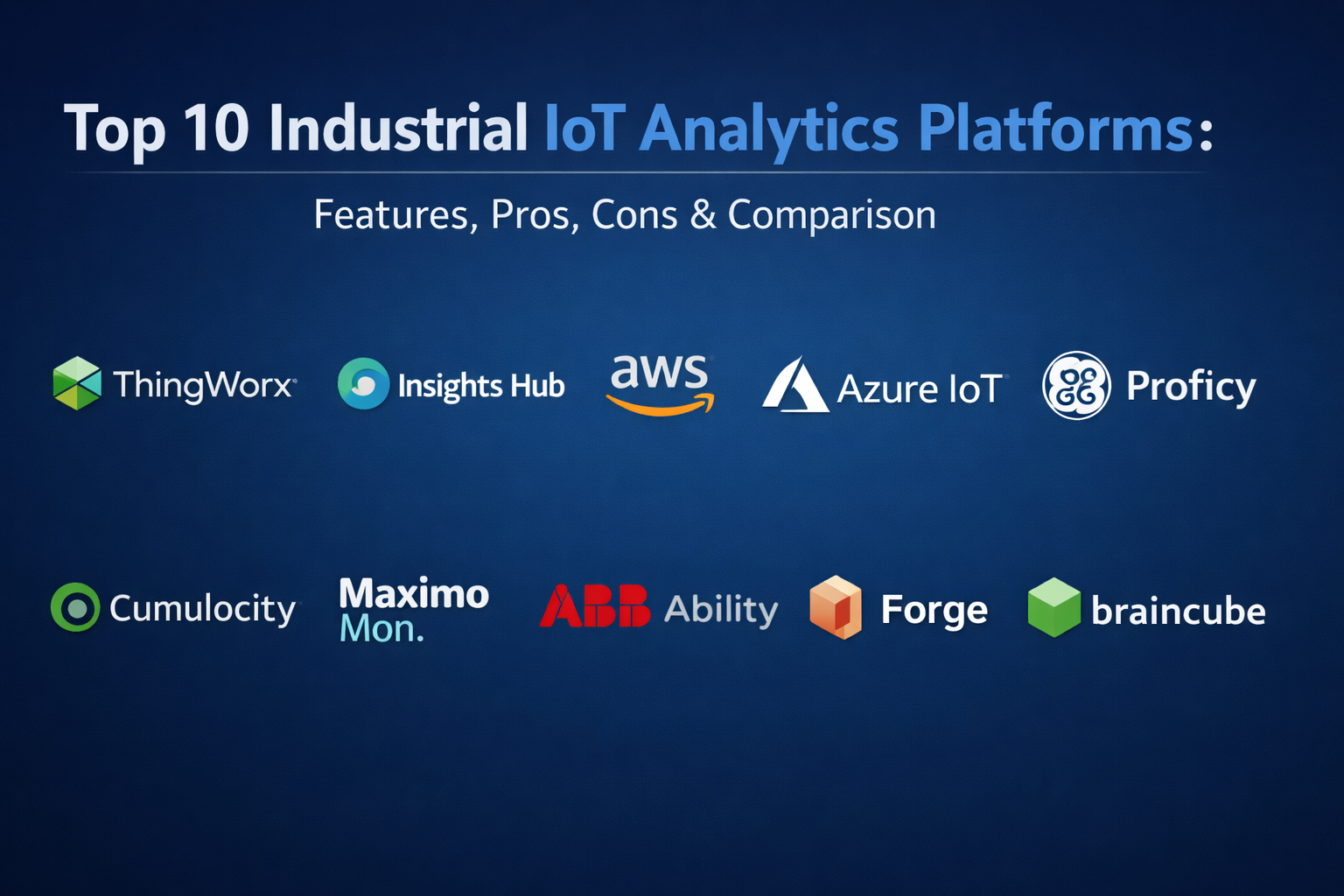
Top 10 Industrial IoT Analytics Platforms
1. PTC ThingWorx
ThingWorx is widely recognized as a leader in the IIoT space, offering an end-to-end platform for connecting, building, and deploying industrial applications. It excels in creating a digital thread that connects data from product design all the way through to service and maintenance.
Key Features
- Asset Advisor for real-time monitoring of equipment health and performance.
- Powerful model-based development environment for rapid application building.
- Seamless integration with Vuforia for augmented reality visualizations.
- Sophisticated orchestration engine to trigger actions across multiple enterprise systems.
- Deep connectivity via Kepware, supporting hundreds of industrial drivers.
Pros
- One of the most mature and feature-complete platforms on the market.
- Excellent visualization capabilities for complex industrial processes.
Cons
- Higher total cost of ownership compared to niche competitors.
- Can require significant consulting hours for complex global deployments.
Platforms / Deployment
Windows / Linux
Cloud / On-premises / Hybrid
Security & Compliance
Role-based access control and encrypted communication channels.
Not publicly stated.
Integrations & Ecosystem
Integrates with major CAD, PLM, and ERP systems. It has a massive marketplace of pre-built extensions and industrial connectors.
Support & Community
Extensive documentation and a large ecosystem of global system integrators and certified partners.
2. Siemens Insights Hub
Formerly known as MindSphere, Insights Hub is Siemens’ cloud-based, open IoT operating system. It leverages Siemens’ deep expertise in industrial automation to provide highly specialized analytics for manufacturing and process industries.
Key Features
- Pre-configured “Mindsphere” applications for OEE tracking and energy management.
- Advanced predictive maintenance using high-frequency vibration data.
- Open API environment for developers to build and sell their own industrial apps.
- Integrated closed-loop digital twin technology.
- Powerful edge management for local data processing and filtering.
Pros
- Native integration with Siemens PLCs and industrial hardware.
- Strong focus on industrial domain-specific analytics.
Cons
- Can feel locked into the Siemens ecosystem for the best experience.
- Learning curve for the administrative console can be steep.
Platforms / Deployment
Linux / Web
Cloud (AWS / Azure / Alibaba Cloud)
Security & Compliance
IEC 62443 aligned security and full data encryption.
ISO 27001 compliant.
Integrations & Ecosystem
Strong connectivity to the Siemens TIA Portal and various third-party cloud services and enterprise applications.
Support & Community
Professional support through Siemens industrial global services and a strong user community in the manufacturing sector.
3. AWS IoT SiteWise
AWS IoT SiteWise is a managed service that makes it easy to collect, store, organize, and monitor data from industrial equipment at scale. It is designed for organizations that want to build their IIoT stack on top of the world’s largest cloud provider.
Key Features
- SiteWise Edge for local data collection and processing on local hardware.
- Automated asset modeling to create digital representations of equipment.
- Built-in library of common industrial mathematical functions.
- Integration with Amazon Lookout for Equipment for anomaly detection.
- Highly scalable storage optimized for time-series industrial data.
Pros
- Seamless integration with the broader AWS ecosystem (Lambda, S3, SageMaker).
- Pay-as-you-go pricing model that is highly attractive for scaling.
Cons
- Requires a strong understanding of cloud architecture to implement effectively.
- Dashboarding capabilities are functional but less “polished” than dedicated industrial suites.
Platforms / Deployment
Linux (Edge) / Web
Cloud
Security & Compliance
AWS Identity and Access Management (IAM) and encryption at rest and in transit.
SOC 2 / ISO 27001 / HIPAA compliant.
Integrations & Ecosystem
Part of the massive AWS ecosystem, allowing for easy data export to data lakes and AI/ML services.
Support & Community
Backed by AWS premium support and a vast network of cloud-focused IIoT consultants.
4. Microsoft Azure IoT Central
Azure IoT Central is a highly capable, ready-to-use IIoT app platform that simplifies the creation of IoT solutions. It provides the heavy lifting for managing devices and data, allowing teams to focus on the analytics.
Key Features
- Template-based application creation for common industrial scenarios.
- Seamless integration with Azure Digital Twins for complex modeling.
- Built-in data export to Power BI for executive-level reporting.
- Advanced edge computing capabilities via Azure IoT Edge.
- Real-time rule engine for instant alerting based on sensor thresholds.
Pros
- Excellent user interface that is accessible to non-developers.
- Best-in-class integration with Microsoft’s business intelligence tools.
Cons
- Can become expensive as the number of managed messages increases.
- Some advanced customization requires moving to the more complex Azure IoT Hub.
Platforms / Deployment
Linux / Windows (Edge) / Web
Cloud
Security & Compliance
Azure Active Directory integration and comprehensive security monitoring.
ISO 27001 / GDPR compliant.
Integrations & Ecosystem
Tightest integration with Microsoft 365, Dynamics 365, and Power Platform.
Support & Community
Professional Microsoft support and an extensive library of learning paths via Microsoft Learn.
5. GE Digital Proficy Operations Analytics
GE Digital’s suite is built on decades of experience in the aviation and power industries. Their analytics platform is designed for high-stakes environments where asset reliability is a critical safety and financial concern.
Key Features
- CSense for advanced process optimization and troubleshooting.
- SmartSignal for predictive analytics and early warning of equipment failure.
- High-performance HMI/SCADA integration for real-time plant floor visibility.
- Historical data analysis optimized for years of industrial records.
- Specialized modules for water, utility, and manufacturing industries.
Pros
- Exceptional depth in predictive maintenance for large rotating equipment.
- Proven reliability in mission-critical infrastructure.
Cons
- The user interface can feel more “industrial” and less modern than cloud-native apps.
- Primarily targeted at very large enterprise customers.
Platforms / Deployment
Windows / Linux
On-premises / Cloud / Hybrid
Security & Compliance
Enterprise-grade security designed for critical infrastructure.
Not publicly stated.
Integrations & Ecosystem
Strongest integration within GE’s own hardware and software ecosystem and major enterprise asset management (EAM) tools.
Support & Community
High-touch professional services and a dedicated global support network for heavy industry.
6. Software AG Cumulocity IoT
Cumulocity is an independent, open IIoT platform known for its ease of use and rapid deployment capabilities. It is a “low-code” platform that allows companies to start seeing data insights in days rather than months.
Key Features
- Visual “Streaming Analytics” engine for building real-time logic.
- Multi-tenant architecture designed for large organizations and service providers.
- Over 300 pre-integrated industrial devices and protocols.
- Extensive white-labeling capabilities for OEMs.
- Lightweight edge footprints that run on standard gateway hardware.
Pros
- Fast time-to-value with a very intuitive administration interface.
- Truly vendor-neutral, making it easy to connect any hardware.
Cons
- Advanced ML features often require integration with third-party tools.
- Less “brand name” recognition compared to Siemens or PTC.
Platforms / Deployment
Linux / Web
Cloud / On-premises / Hybrid
Security & Compliance
End-to-end encryption and strong multi-tenancy isolation.
ISO 27001 compliant.
Integrations & Ecosystem
Excellent API documentation and a strong focus on connecting to ERP and CRM systems.
Support & Community
Strong corporate support and an active developer portal with detailed documentation.
7. IBM Maximo Monitor
Maximo Monitor is part of the broader IBM Maximo Application Suite. It uses AI to provide remote monitoring at scale, focusing on improving the lifecycle and uptime of critical enterprise assets.
Key Features
- AI-driven anomaly detection that filters out “noise” from industrial sensors.
- Hierarchical view of global assets from a single dashboard.
- Direct integration with Maximo Manage for automated work order creation.
- Customizable visual alerts and communication workflows.
- Advanced statistical process control (SPC) for quality monitoring.
Pros
- The best-in-class integration with maintenance management (CMMS/EAM).
- Strong AI capabilities powered by IBM Watson.
Cons
- Most effective when used as part of the full Maximo suite.
- The licensing model can be complex for smaller deployments.
Platforms / Deployment
Linux / Red Hat OpenShift
Cloud / Hybrid
Security & Compliance
Enterprise identity management and IBM’s robust cloud security framework.
Not publicly stated.
Integrations & Ecosystem
Deeply connected to the IBM Cloud and enterprise systems used in utilities and facilities management.
Support & Community
Enterprise-grade support and a large network of specialized Maximo consultants.
8. ABB Ability Genix
ABB Ability Genix is an industrial analytics and AI suite that combines operational data with engineering and information data to provide deep insights into industrial performance.
Key Features
- Contextualized data integration across OT, IT, and ET (Engineering Tech).
- Pre-built analytics for asset integrity and process performance.
- Cognitive capabilities for predicting complex failure modes.
- Visual data exploration for identifying hidden correlations.
- Industrial-grade data lake for high-volume storage.
Pros
- Exceptional at combining disparate data sources into a single “truth.”
- Strong focus on sustainability and energy optimization.
Cons
- Highly complex platform that requires a significant implementation period.
- Best suited for massive industrial plants and refineries.
Platforms / Deployment
Linux / Web
Cloud / Hybrid
Security & Compliance
Complies with high-end industrial security and data sovereignty standards.
Not publicly stated.
Integrations & Ecosystem
Native integration with ABB control systems and broad support for industrial open standards.
Support & Community
Backed by ABB’s extensive global service network and technical expertise.
9. Honeywell Forge
Honeywell Forge is an enterprise performance management platform that uses advanced analytics to help industrial companies improve the efficiency and safety of their operations.
Key Features
- Specialized modules for buildings, plants, and aerospace.
- Real-time cybersecurity monitoring of connected industrial assets.
- Predictive maintenance specifically for Honeywell and third-party control systems.
- Workforce productivity tools that connect mobile workers to live data.
- Advanced energy optimization for reducing utility costs.
Pros
- Deep domain expertise in building management and process control.
- Strong focus on “connected worker” scenarios.
Cons
- The platform is highly modular, which can lead to complex licensing.
- Interface is professional but has a steeper learning curve for beginners.
Platforms / Deployment
Windows / Linux / Web
Cloud / Hybrid
Security & Compliance
Built-in cybersecurity layer for protecting OT environments.
Not publicly stated.
Integrations & Ecosystem
Strongest in environments already utilizing Honeywell’s vast array of industrial sensors and controllers.
Support & Community
High-level professional support and a long history of serving the global industrial sector.
10. Braincube
Braincube is a specialized IIoT platform focused on manufacturing intelligence. It uses a “digital twin” of the production process to help manufacturers find the “sweet spot” for optimal production.
Key Features
- Automated data contextualization to align sensor data with production batches.
- Advanced statistical tools for identifying the root cause of quality issues.
- Edge-to-cloud data pipeline optimized for manufacturing speed.
- Self-service analytics designed for plant floor engineers.
- Pre-built dashboards for OEE and waste reduction.
Pros
- Unmatched at finding the optimal settings for complex manufacturing lines.
- Highly focused on tangible ROI through quality improvement.
Cons
- Less focus on general IoT connectivity compared to AWS or PTC.
- Not designed for simple building or fleet management.
Platforms / Deployment
Linux / Web
Cloud / Hybrid
Security & Compliance
Standard encryption and secure data handling for proprietary manufacturing data.
Not publicly stated.
Integrations & Ecosystem
Connects to major MES and ERP systems to provide a complete picture of production costs and quality.
Support & Community
Focused customer success teams and deep expertise in manufacturing process optimization.
Comparison Table
| Tool Name | Best For | Platform(s) Supported | Deployment | Standout Feature | Public Rating |
| 1. ThingWorx | AR & Rapid App Dev | Win, Linux | Hybrid | Vuforia AR Link | N/A |
| 2. Insights Hub | Siemens Hardware | Linux, Web | Cloud | PLC Native Integration | N/A |
| 3. AWS SiteWise | Cloud-Scale Data | Linux, Web | Cloud | AWS Ecosystem Sync | N/A |
| 4. Azure IoT | MS Ecosystem | Win, Linux, Web | Cloud | Power BI Integration | N/A |
| 5. GE Proficy | Heavy Industry | Win, Linux | Hybrid | SmartSignal AI | N/A |
| 6. Cumulocity | Rapid Low-Code | Linux, Web | Hybrid | Visual Logic Engine | N/A |
| 7. Maximo Mon. | Asset Maintenance | Linux, Web | Hybrid | IBM Watson AI | N/A |
| 8. ABB Ability | Contextual Data | Linux, Web | Hybrid | OT/IT/ET Fusion | N/A |
| 9. Forge | Connected Worker | Win, Linux, Web | Hybrid | OT Cyber Security | N/A |
| 10. Braincube | Manufacturing ROI | Linux, Web | Hybrid | Digital Twin Process | N/A |
Evaluation & Scoring
| Tool Name | Core (25%) | Ease (15%) | Integrations (15%) | Security (10%) | Perf (10%) | Support (10%) | Value (15%) | Total |
| 1. ThingWorx | 10 | 7 | 9 | 9 | 9 | 9 | 7 | 8.60 |
| 2. Insights Hub | 9 | 6 | 9 | 9 | 9 | 8 | 7 | 8.15 |
| 3. AWS SiteWise | 8 | 5 | 10 | 10 | 10 | 9 | 9 | 8.40 |
| 4. Azure IoT | 9 | 7 | 10 | 10 | 9 | 9 | 9 | 8.85 |
| 5. GE Proficy | 9 | 5 | 8 | 9 | 8 | 8 | 7 | 7.70 |
| 6. Cumulocity | 7 | 10 | 9 | 8 | 8 | 8 | 8 | 8.20 |
| 7. Maximo Mon. | 9 | 7 | 9 | 9 | 8 | 8 | 7 | 8.15 |
| 8. ABB Ability | 9 | 5 | 8 | 9 | 9 | 8 | 6 | 7.55 |
| 9. Forge | 8 | 6 | 8 | 10 | 8 | 8 | 7 | 7.75 |
| 10. Braincube | 7 | 8 | 8 | 8 | 9 | 8 | 8 | 7.85 |
The scoring above represents how these platforms perform in a diverse industrial environment. Azure IoT and ThingWorx lead because of their exceptional balance between modern cloud capabilities and deep industrial protocol support. Cumulocity is the winner for “Ease of Use,” making it ideal for teams that need to deploy quickly. Specialized tools like GE Proficy or ABB Ability may have lower overall scores due to their complexity or cost, but they are often the only choice for the high-stakes predictive maintenance required in energy and aviation.
Which Industrial IoT Analytics Platform Is Right for You?
Solo / Freelancer
If you are a consultant or independent developer, Blender (for 3D viz) combined with AWS IoT SiteWise or Azure IoT Central is the best route. These cloud-based tools allow you to build proof-of-concepts with low upfront costs and high scalability.
SMB
Small to medium-sized manufacturers should look at Software AG Cumulocity. Its low-code environment means you can manage it without a massive IT team, and its vendor-neutral approach allows you to connect whatever machines you already have on your floor.
Mid-Market
For growing companies that have a mix of legacy and modern equipment, PTC ThingWorx offers a robust platform that can grow with you. Its ability to integrate with CAD and AR makes it a strong choice for companies that want to lead in digital innovation.
Enterprise
Global enterprises with massive asset bases should focus on Siemens Insights Hub or IBM Maximo Monitor. These tools provide the high-level oversight and deep AI integration needed to manage assets across multiple continents while maintaining strict security standards.
Budget vs Premium
AWS SiteWise and Azure IoT are the budget-friendly “pay-as-you-go” options. ThingWorx and GE Digital are premium, high-investment platforms that deliver deep, industry-specific value that cloud-only tools can rarely match.
Feature Depth vs Ease of Use
GE Proficy and Houdini-style procedural tools like Braincube offer the most depth for process optimization but are hard to learn. Azure IoT Central is the easiest to get running for basic monitoring.
Integrations & Scalability
If your primary goal is to scale data across a global data lake, AWS and Azure are unbeatable. If you need your analytics to talk directly to your maintenance team, IBM Maximo is the standard.
Security & Compliance Needs
For critical infrastructure or defense-related manufacturing, Honeywell Forge and GE Digital provide the most hardened OT-specific security layers, ensuring that your industrial control systems remain isolated from web-based threats.
Frequently Asked Questions (FAQs)
1. What is the difference between IoT and IIoT?
IoT generally refers to consumer devices like smart thermostats. IIoT (Industrial IoT) focuses on high-precision sensors and critical infrastructure where failure can result in significant financial loss or safety hazards.
2. Can these platforms work with legacy machinery?
Yes, most platforms use industrial gateways that convert old protocols (like Modbus or serial data) into modern languages like MQTT or OPC-UA, allowing 30-year-old machines to be monitored.
3. Do I need to move all my data to the cloud?
No, most modern IIoT platforms support “Edge” computing, which allows you to process sensitive data locally and only send necessary alerts or summaries to the cloud.
4. How does predictive maintenance actually work?
The software analyzes patterns in data (like vibration or temperature) and uses machine learning to identify the “signature” of a machine that is about to fail, often weeks before it happens.
5. Is the data coming off my machines secure?
When configured correctly with platforms like Azure or Honeywell, data is encrypted from the sensor all the way to the dashboard, following strict industrial cybersecurity standards.
6. What is a “Digital Twin”?
It is a virtual model that mimics the behavior of a physical asset. When the physical machine changes (e.g., gets hotter), the digital twin updates to reflect that state in real-time.
7. How much do these platforms typically cost?
Costs vary from a few hundred dollars a month for cloud-based monitoring to millions of dollars for enterprise-wide deployments with specialized AI models and onsite hardware.
8. Can IIoT help with energy savings?
Absolutely. By monitoring power consumption in relation to production output, these platforms can identify “energy hogs” and suggest optimal schedules to reduce peak demand charges.
9. What is OEE?
Overall Equipment Effectiveness (OEE) is a standard metric that measures the availability, performance, and quality of a machine to determine how close it is to its full productive potential.
10. Do I need a data scientist to use these tools?
While helpful for complex models, many modern platforms like Cumulocity or ThingWorx are designed for “citizen data scientists”—engineers who know the machines but aren’t programmers.
Conclusion
Selecting an Industrial IoT analytics platform is a strategic decision that determines the speed and success of your digital transformation journey. The ideal choice depends heavily on your existing hardware ecosystem, the technical skill of your team, and the specific problems you are trying to solve—whether that is reducing downtime, improving quality, or saving energy. As the industry moves toward a more open, interoperable future, the most successful organizations will be those that choose platforms capable of breaking down data silos and providing a clear, real-time view of their entire operational landscape. By investing in a robust IIoT foundation today, you are ensuring that your production environment remains competitive and resilient in the face of an increasingly digital future.

Best Cardiac Hospitals Near You
Discover top heart hospitals, cardiology centers & cardiac care services by city.
Advanced Heart Care • Trusted Hospitals • Expert Teams
View Best Hospitals