Introduction
In the rapidly expanding world of the Internet of Things (IoT), the ability to oversee thousands or even millions of connected devices is no longer a luxury—it is a foundational requirement. IoT device management platforms provide the centralized control plane necessary to onboard, monitor, update, and secure a diverse fleet of hardware across various geographic locations. These platforms bridge the gap between physical sensors and digital insights, ensuring that every edge device remains functional, secure, and running the latest firmware without requiring manual, on-site intervention.
The complexity of IoT ecosystems has scaled significantly. Managing these environments now involves handling massive data streams, navigating fragmented connectivity standards, and ensuring robust security at the edge. A high-quality management platform acts as the nervous system for these deployments, allowing organizations to automate the lifecycle of their devices—from initial zero-touch provisioning to the eventual decommissioning of legacy hardware.
Best for: Industrial manufacturers, smart city planners, logistics providers, and enterprise IT teams who need to maintain large-scale, distributed sensor networks and edge computing assets.
Not ideal for: Small-scale hobbyist projects with fewer than five devices, or organizations that only use “plug-and-play” consumer smart home gadgets that do not require professional-grade telemetry or security.
Key Trends in IoT Device Management Platforms
- Zero-Touch Provisioning: The shift toward automated onboarding where devices automatically connect to the management platform upon power-up without manual configuration.
- AI-Driven Predictive Maintenance: Using machine learning at the platform level to analyze battery health and signal strength to predict device failure before it happens.
- Edge Computing Integration: Platforms are increasingly moving processing power to the device itself, managing containers and microservices at the edge rather than just simple sensors.
- Enhanced Security Orchestration: Automated rotation of security certificates and real-time anomaly detection to identify and quarantine compromised hardware.
- Digital Twin Evolution: Creating high-fidelity virtual replicas of physical devices within the platform to simulate performance and test firmware updates safely.
- Multi-Protocol Interoperability: Support for a vast range of communication standards like Matter, LoRaWAN, NB-IoT, and 5G within a single unified dashboard.
- Low-Code/No-Code Dashboards: Allowing non-technical operators to build monitoring views and alert triggers using drag-and-drop interfaces.
- Sustainability Tracking: Built-in tools to monitor the energy consumption and carbon footprint of global device fleets to meet corporate ESG goals.
How We Selected These Tools
- Scalability Performance: We prioritized platforms capable of handling millions of concurrent connections and high-frequency data ingestion.
- Security Frameworks: Evaluation was based on the presence of robust encryption, identity management, and secure boot integration features.
- OTA (Over-The-Air) Reliability: A critical factor was the platform’s ability to push firmware updates reliably across unstable network conditions.
- Ecosystem Compatibility: We selected tools that support a wide variety of hardware chipsets and communication protocols.
- Operational Visibility: The quality of real-time monitoring, logging, and diagnostic tools was a major consideration in the ranking.
- Developer Experience: We looked for platforms with well-documented APIs and SDKs that allow for rapid integration with existing enterprise software.
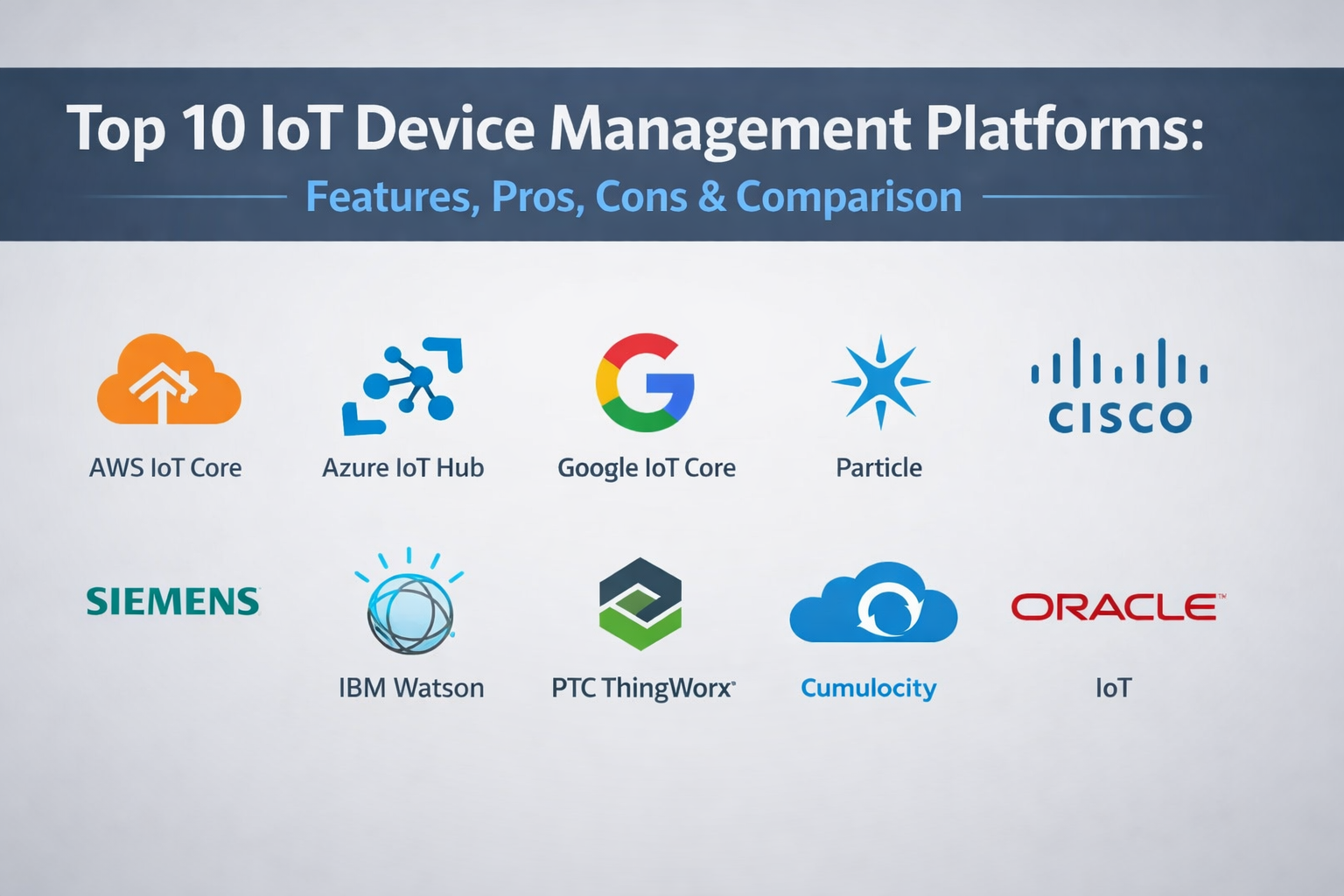
Top 10 IoT Device Management Platforms
1. AWS IoT Core
As a part of the Amazon Web Services ecosystem, IoT Core provides a highly scalable and secure environment for connecting billions of devices and trillions of messages. It is designed to integrate seamlessly with the broader AWS cloud for data storage and analytics.
Key Features
- Device Gateway that allows devices to securely and efficiently communicate with AWS.
- Registry for organizing devices and associating metadata for easier fleet management.
- Device Shadow service for persisting the last known state of a device even when it is offline.
- Rules Engine for transforming and routing messages to other AWS services like Lambda or S3.
- Secure identity and access management using X.509 certificates.
Pros
- Unmatched scalability that grows effortlessly with your device fleet.
- Deep integration with the world’s most comprehensive cloud ecosystem.
Cons
- Complexity in pricing can make it difficult to predict monthly costs.
- The learning curve for the full AWS security model is quite steep.
Platforms / Deployment
Cloud
Hybrid (via AWS IoT Greengrass)
Security & Compliance
Mutual authentication, encryption, and fine-grained access control.
SOC 1/2/3, ISO 27001, and HIPAA compliant.
Integrations & Ecosystem
Integrates with the entire AWS suite, including SageMaker for AI and Kinesis for data streaming. It also supports a vast number of hardware partner kits.
Support & Community
Professional support tiers ranging from developer to enterprise, backed by the largest community of cloud professionals in the world.
2. Azure IoT Hub
Microsoft’s flagship IoT offering focuses on high-security communication and device management. It is the preferred choice for enterprises already utilizing the Microsoft Azure cloud and its various industrial automation tools.
Key Features
- Device Provisioning Service (DPS) for true zero-touch, just-in-time provisioning.
- Standardized “IoT Plug and Play” for rapid device integration without custom code.
- End-to-end security via Azure Sphere and Defender for IoT.
- Support for multiple protocols including MQTT, AMQP, and HTTPS.
- Integration with Azure Digital Twins for complex environment modeling.
Pros
- Excellent integration with enterprise identity systems like Azure AD.
- Strong focus on industrial security and long-term device stability.
Cons
- Can be expensive for very high-frequency messaging scenarios.
- The management interface is deeply tied to the broader Azure Portal.
Platforms / Deployment
Cloud
Hybrid (via Azure IoT Edge)
Security & Compliance
Per-device authentication and per-device security credentials.
ISO 27001, FedRAMP, and GDPR compliant.
Integrations & Ecosystem
Strongest integration with Microsoft Power BI for visualization and Azure DevOps for lifecycle management.
Support & Community
Enterprise-grade support through Microsoft agreements and extensive documentation for developers.
3. Google Cloud IoT Core (Legacy/Partner Migration)
While Google shifted its primary focus toward partner-led IoT solutions, the ecosystem remains a powerful choice for organizations prioritizing big data and advanced machine learning within their IoT strategy.
Key Features
- Global load balancing to handle massive device connections across regions.
- Protocol bridge with native support for MQTT and HTTP.
- Tight integration with BigQuery for massive-scale data analytics.
- Pub/Sub messaging for reliable delivery of device telemetry.
- IAM integration for secure device-to-cloud communication.
Pros
- Best-in-class data analytics and machine learning integration.
- Fast, reliable global network backbone.
Cons
- Current roadmap relies heavily on third-party partner management.
- Smaller hardware partner ecosystem compared to AWS or Azure.
Platforms / Deployment
Cloud
Security & Compliance
Industry-standard security via public-key authentication.
Not publicly stated for all recent migrations.
Integrations & Ecosystem
Seamlessly connects to Google Cloud’s AI and data visualization tools like Looker.
Support & Community
Professional support via Google Cloud and a strong community of data scientists.
4. Particle
Particle is an all-in-one IoT platform that provides everything from hardware and connectivity to the device management software. It is favored by startups and mid-market companies for its simplicity and rapid time-to-market.
Key Features
- Integrated cellular connectivity management within the same platform.
- Reliable Over-the-Air (OTA) firmware updates with automatic rollbacks.
- Web-based IDE and console for immediate device interaction.
- Device vitals monitoring for tracking battery, signal, and memory.
- Standardized hardware modules that are pre-certified for global use.
Pros
- The fastest path from a prototype to a connected product.
- Simplifies the complexity of managing global cellular SIM cards.
Cons
- Proprietary hardware can lead to vendor lock-in.
- Less flexibility for custom, non-Particle hardware.
Platforms / Deployment
Cloud
Hardware-Integrated
Security & Compliance
Fully encrypted communication and secure boot on hardware.
SOC 2 compliant.
Integrations & Ecosystem
Direct integrations with AWS, Azure, and various webhooks for custom data routing.
Support & Community
Very active developer community and specialized enterprise support plans.
5. Cisco IoT Operations Dashboard
Designed for industrial environments, Cisco’s platform excels at managing edge networking hardware and industrial sensors in ruggedized locations like oil rigs or factories.
Key Features
- Unified management for Cisco industrial gateways and connected sensors.
- Secure Equipment Access for remote troubleshooting of connected machines.
- Edge Intelligence for extracting and transforming data before it hits the cloud.
- Cloud-based zero-touch deployment for rapid site bring-up.
- Advanced security monitoring integrated with Cisco Talos.
Pros
- Unbeatable for managing networking hardware in harsh environments.
- Strong focus on operational technology (OT) requirements.
Cons
- Expensive hardware requirements for the full feature set.
- Can be overly complex for simple sensor-only deployments.
Platforms / Deployment
Cloud
On-Premises (Hybrid)
Security & Compliance
Enterprise-grade networking security and RBAC.
Not publicly stated.
Integrations & Ecosystem
Works seamlessly with Cisco’s vast networking and security portfolio.
Support & Community
Global 24/7 technical support and a massive network of industrial partners.
6. Siemens MindSphere (Siemens Xcelerator)
A leader in the Industrial IoT (IIoT) space, this platform is built specifically for manufacturers looking to connect their production machinery and optimize industrial processes.
Key Features
- Industrial-grade connectivity for a wide variety of PLC and SCADA systems.
- Advanced analytics apps specifically for predictive maintenance and quality.
- Digital Twin functionality for modeling entire factory floors.
- Open API for developing custom industrial applications.
- Secure data exchange between the factory floor and the enterprise.
Pros
- Deep domain expertise in manufacturing and heavy industry.
- Robust security protocols designed for sensitive industrial data.
Cons
- Requires a significant investment and specialized knowledge to implement.
- Interface is more “engineering-focused” than “developer-focused.”
Platforms / Deployment
Cloud
Hybrid (Edge)
Security & Compliance
Multi-layered security including hardware-based security modules.
ISO 27001 and IEC 62443 compliant.
Integrations & Ecosystem
Strongest integration with Siemens’ own hardware and industrial software suite.
Support & Community
Global industrial support and a specialized ecosystem of IIoT developers.
7. IBM Watson IoT Platform
IBM’s platform leverages the power of cognitive computing to provide deep insights from IoT data. It is well-suited for large enterprises managing complex assets in logistics and facilities management.
Key Features
- AI-powered data filtering to find meaningful signals in noisy sensor data.
- Blockchain integration for secure, transparent tracking of device history.
- Advanced risk management dashboards for identifying security gaps.
- Support for complex data schemas and hierarchical device structures.
- Real-time data visualization and alerting engine.
Pros
- Strongest choice for organizations needing blockchain-verified device data.
- Excellent for large-scale asset management and logistics.
Cons
- The platform can feel fragmented compared to more modern competitors.
- The future roadmap is often subject to IBM’s internal strategic shifts.
Platforms / Deployment
Cloud
Hybrid
Security & Compliance
Enterprise-grade encryption and secure identity management.
ISO 27001 and GDPR compliant.
Integrations & Ecosystem
Integrates with IBM Maximo for asset management and various IBM cloud services.
Support & Community
Professional IBM support and a long-standing community of enterprise users.
8. PTC ThingWorx
ThingWorx is an enterprise-level platform that focuses on rapid application development for industrial IoT. It is highly regarded for its ability to create complex visual dashboards and AR experiences from IoT data.
Key Features
- Model-based development environment for defining “things” and their behaviors.
- ThingWorx Navigate for democratizing IoT data across the organization.
- Native Augmented Reality (AR) integration via Vuforia.
- Powerful connectivity via Kepware for hundreds of industrial protocols.
- Automated anomaly detection and predictive analytics.
Pros
- Unbeatable for creating high-end visual dashboards and AR tools.
- Highly flexible for modeling complex industrial systems.
Cons
- Very high cost of ownership for small and medium-sized businesses.
- The platform requires specialized training to use effectively.
Platforms / Deployment
Cloud
On-Premises / Hybrid
Security & Compliance
Robust role-based access control and secure connectivity.
Not publicly stated.
Integrations & Ecosystem
Strongest in the industrial space, connecting with PLM and ERP systems.
Support & Community
Excellent corporate support and a highly specialized professional community.
9. Software AG Cumulocity IoT
Cumulocity is an independent IoT platform known for its “open” approach, allowing for extreme flexibility in choosing hardware and connectivity providers without being locked into a major cloud vendor.
Key Features
- Truly vendor-neutral approach with support for over 100 protocols.
- Simple web-based configuration for onboarding and managing devices.
- Streaming Analytics engine for real-time decision making at the edge.
- White-labeling options for companies building their own IoT products.
- Multi-tenancy support for managing different clients or departments.
Pros
- One of the easiest professional platforms to set up and use.
- Gives you total freedom to choose your cloud and hardware.
Cons
- Smaller ecosystem of third-party apps compared to AWS or Azure.
- Can be more expensive as an independent subscription.
Platforms / Deployment
Cloud
On-Premises / Edge
Security & Compliance
End-to-end encryption and secure device certificates.
Not publicly stated.
Integrations & Ecosystem
Integrates well with enterprise software via Software AG’s integration platform.
Support & Community
Very responsive support and a growing community of independent developers.
10. Oracle IoT Intelligent Applications
Oracle’s IoT offering is focused on providing “ready-to-use” applications for specific business processes like supply chain, production, and fleet monitoring.
Key Features
- Specialized apps for Asset Monitoring, Production Monitoring, and Fleet Monitoring.
- Built-in digital twin capability for visualizing asset health.
- Direct integration with Oracle ERP and Supply Chain Management (SCM).
- Real-time data stream processing with built-in KPIs.
- Predictive machine learning models tailored for industrial use cases.
Pros
- The best choice for organizations already running Oracle ERP or SCM.
- Offers “out-of-the-box” value without needing heavy development.
Cons
- Less flexible for custom IoT projects outside of the supported use cases.
- Pricing and licensing can be complex for enterprise customers.
Platforms / Deployment
Cloud
Security & Compliance
Strong enterprise security and identity management via Oracle Cloud.
ISO 27001 and SOC compliant.
Integrations & Ecosystem
Deeply integrated with Oracle Cloud Infrastructure and Business Applications.
Support & Community
Comprehensive Oracle support and a large global enterprise network.
Comparison Table
| Tool Name | Best For | Platform(s) Supported | Deployment | Standout Feature | Public Rating |
| 1. AWS IoT Core | Massive Scale | All major RTOS/Linux | Cloud/Hybrid | Ecosystem Depth | N/A |
| 2. Azure IoT Hub | Industrial Safety | All major RTOS/Linux | Cloud/Hybrid | Digital Twins | N/A |
| 3. Google IoT Core | Data Analytics | Linux/RTOS | Cloud | BigQuery Link | N/A |
| 4. Particle | Rapid Prototyping | Proprietary/Linux | Cloud/Hardware | Integrated SIM | N/A |
| 5. Cisco Dashboard | Rugged Hardware | Industrial Gateways | Hybrid | Remote Access | N/A |
| 6. Siemens Mind | Factory Floor | PLC/SCADA | Hybrid | Industrial Apps | N/A |
| 7. IBM Watson | Verified Data | All major RTOS/Linux | Hybrid | Blockchain Link | N/A |
| 8. PTC ThingWorx | Visual Dashboards | Industrial Gateways | Hybrid | AR Integration | N/A |
| 9. Cumulocity | Vendor Neutrality | 100+ Protocols | Cloud/Edge | Open Flexibility | N/A |
| 10. Oracle IoT | SCM Integration | All major RTOS/Linux | Cloud | Pre-built Apps | N/A |
Evaluation & Scoring
| Tool Name | Core (25%) | Ease (15%) | Integrations (15%) | Security (10%) | Perf (10%) | Support (10%) | Value (15%) | Total |
| 1. AWS IoT Core | 10 | 5 | 10 | 10 | 10 | 9 | 8 | 8.60 |
| 2. Azure IoT Hub | 10 | 6 | 10 | 10 | 9 | 9 | 8 | 8.65 |
| 3. Google IoT | 8 | 7 | 9 | 9 | 9 | 7 | 8 | 8.15 |
| 4. Particle | 7 | 10 | 8 | 8 | 8 | 9 | 8 | 8.10 |
| 5. Cisco Dashboard | 8 | 7 | 8 | 10 | 9 | 9 | 6 | 7.85 |
| 6. Siemens Mind | 9 | 5 | 8 | 9 | 9 | 8 | 6 | 7.60 |
| 7. IBM Watson | 8 | 5 | 8 | 9 | 8 | 7 | 7 | 7.35 |
| 8. PTC ThingWorx | 9 | 6 | 8 | 8 | 9 | 8 | 5 | 7.35 |
| 9. Cumulocity | 8 | 9 | 9 | 8 | 8 | 8 | 8 | 8.25 |
| 10. Oracle IoT | 8 | 7 | 9 | 9 | 8 | 8 | 7 | 8.00 |
The scoring indicates that while AWS and Azure are the powerhouse leaders for massive, enterprise-wide deployments due to their security and sheer performance, they come with a higher learning curve. For organizations that need a faster start or hardware-software unity, Particle and Cumulocity score exceptionally high on ease of use. Industrial-specific tools like Siemens and PTC may have lower value scores for general users, but their core functionality is essential for high-end manufacturing environments.
Which IoT Device Management Tool Is Right for You?
Solo / Freelancer
If you are an independent developer building your first connected product, Particle is the standout choice. It removes the friction of managing hardware and connectivity separately, allowing you to focus purely on the application logic.
SMB
Small and medium businesses that need flexibility without overwhelming complexity should consider Cumulocity IoT. It offers a user-friendly interface and supports a wide range of hardware, preventing you from being locked into a single ecosystem as you grow.
Mid-Market
For companies that are scaling fast and already have a presence in the cloud, AWS IoT Core or Azure IoT Hub are the logical next steps. They provide the professional security and global reach needed to support thousands of devices.
Enterprise
Large-scale enterprises with heavy industrial requirements should look at Siemens MindSphere or PTC ThingWorx. These platforms are designed to handle the rigorous demands of the factory floor and integrate directly with existing corporate ERP systems.
Budget vs Premium
AWS and Azure offer a “pay-as-you-go” model that can be very budget-friendly for small fleets. PTC ThingWorx and Siemens are premium investments meant for high-value industrial assets where the ROI comes from process optimization.
Feature Depth vs Ease of Use
AWS offers the most depth but requires significant expertise. Cumulocity and Particle offer the best ease of use, making them ideal for teams that don’t have a dedicated department of IoT engineers.
Integrations & Scalability
If your goal is to feed sensor data into a massive data lake for AI research, AWS and Google Cloud provide the most seamless scalability. If you need to manage rugged networking hardware, Cisco is the primary choice.
Security & Compliance Needs
For highly regulated industries like healthcare or defense, Azure IoT Hub and AWS IoT Core provide the most extensive list of compliance certifications and the most robust hardware-to-cloud security frameworks.
Frequently Asked Questions (FAQs)
1. What exactly does an IoT device management platform do?
It provides a central location to register devices, monitor their health, update their software, and secure their data communication without needing to physically touch the hardware.
2. Why is Over-the-Air (OTA) updating so important?
Since IoT devices are often placed in hard-to-reach areas, OTA updates allow you to fix security bugs or add new features remotely, ensuring the fleet stays secure and functional.
3. Do these platforms work with any hardware?
Most professional platforms support standard protocols like MQTT, which means they can work with any hardware that can communicate over the internet, though some offer better “plug-and-play” support for specific kits.
4. What is a “Digital Twin” in IoT?
A digital twin is a virtual model of a physical device that updates in real-time based on sensor data, allowing you to simulate “what-if” scenarios without risking the physical asset.
5. How do these platforms secure devices?
They use a combination of unique digital certificates for every device, encrypted communication channels (TLS), and secure boot processes to ensure that only authorized hardware can connect.
6. Can I manage devices across different countries?
Yes, most cloud-based IoT platforms are designed to handle global deployments, though managing the cellular connectivity for those devices often requires a platform like Particle or Cisco.
7. What is “Edge Computing” in the context of IoT management?
Edge computing means the platform can push software “containers” to the device, allowing it to process data locally rather than sending every single data point to the cloud, which saves bandwidth and reduces latency.
8. Is there a free way to start managing IoT devices?
Most major platforms like AWS and Azure offer a “Free Tier” that allows you to connect a small number of devices and send a limited amount of data each month for free.
9. What happens if my device goes offline?
A good platform uses a “Device Shadow” or “Digital Twin” to remember the last settings you sent to the device and will automatically sync those settings the next time the device reconnects.
10. Do I need to know how to code to manage an IoT fleet?
For basic monitoring and configuration, many platforms offer no-code dashboards, but setting up complex automation and custom logic usually requires knowledge of languages like Python or JavaScript.
Conclusion
Navigating the landscape of IoT device management requires a clear understanding of your fleet’s scale, security needs, and industrial context. The market has matured to offer specialized solutions for every scenario, from the hyper-scalable cloud environments of AWS and Azure to the industrial-first platforms of Siemens and PTC. The right platform will not only simplify your current operations but will also provide the technological foundation to scale your IoT initiatives into the future. By prioritizing security, ease of onboarding, and long-term reliability, you can ensure that your connected assets remain a powerful driver of business value rather than an operational burden.

Best Cardiac Hospitals Near You
Discover top heart hospitals, cardiology centers & cardiac care services by city.
Advanced Heart Care • Trusted Hospitals • Expert Teams
View Best Hospitals