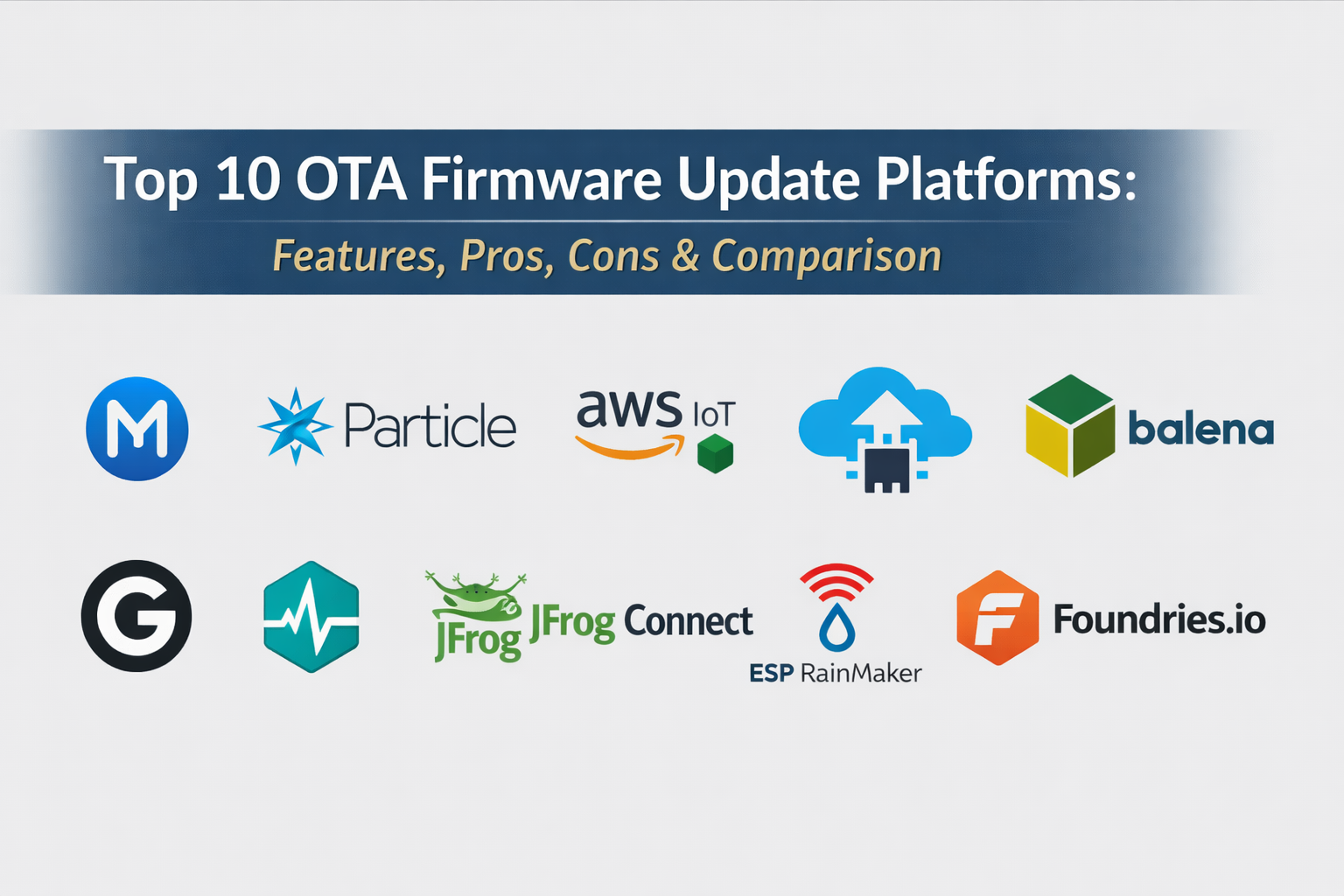
Introduction
Over-the-Air (OTA) firmware update platforms have become the critical nervous system for the Internet of Things (IoT) and connected hardware. In a world where devices are deployed in the millions across inaccessible locations—from deep-sea sensors to orbiting satellites—the ability to patch security vulnerabilities and add new features remotely is no longer a luxury; it is a fundamental requirement. These platforms provide the infrastructure to manage, schedule, and execute binary transfers to embedded systems, ensuring that hardware remains functional and secure long after it leaves the factory floor.
Managing updates at scale introduces significant challenges, including delta-update management to save bandwidth, rollback mechanisms to prevent “bricking” devices, and end-to-end encryption to thwart malicious actors. Modern platforms have evolved to handle these complexities with sophisticated orchestration layers that allow for “canary” deployments—testing an update on a small group before a global rollout. This ensures that the physical world remains as agile and up-to-date as the world of software.
Best for: IoT product managers, embedded systems engineers, automotive manufacturers, and industrial automation firms who need to maintain large fleets of connected devices with high reliability.
Not ideal for: Simple, non-connected hardware projects or hobbyist builds where manual flashing via USB or JTAG is feasible and security is not a primary concern.
Key Trends in OTA Firmware Update Platforms
- Differential (Delta) Updates: To minimize data costs and power consumption, platforms now calculate only the binary differences between versions, sending tiny patches instead of the full firmware.
- Security-at-the-Edge: Modern OTA systems are integrating hardware-based roots of trust (HSMs) to ensure that only digitally signed and verified code can be executed.
- AI-Driven Predictive Maintenance: Platforms are beginning to use machine learning to analyze device health telemetry and predict when an update might be necessary to prevent hardware failure.
- Low-Power Wide-Area Network (LPWAN) Optimization: Specialized protocols are being developed to deliver updates over extremely low-bandwidth and high-latency networks like LoRaWAN and NB-IoT.
- Containerization for Embedded Systems: The shift toward running micro-containers on IoT devices allows for updating specific application components without rebooting the entire system.
- A/B Partitioning and Atomic Updates: To eliminate the risk of a “half-finished” update, devices now use dual-partition schemes that only switch to the new code once it is fully verified.
- Zero-Touch Provisioning: The integration of OTA capabilities into the manufacturing process so that devices automatically check for the latest firmware the moment they are powered on by the end user.
- Compliance with Evolving IoT Regulations: New global standards are forcing platforms to provide detailed “Software Bill of Materials” (SBOM) for every firmware version deployed.
How We Selected These Tools
- Fleet Orchestration Capabilities: We prioritized platforms that allow for granular targeting, such as updating devices by region, hardware version, or battery level.
- Reliability and Rollback Safety: Selection was based on the presence of robust safety features like automated rollbacks and “power-fail-safe” update mechanisms.
- End-to-End Security: We looked for platforms that offer comprehensive security, including mutual TLS authentication and code-signing integration.
- Bandwidth Efficiency: Evaluation included the efficiency of the platform’s delivery protocol and its ability to handle differential updates.
- Developer Experience: We selected tools that offer well-documented SDKs and simple integration paths for common microcontrollers and microprocessors.
- Scalability and Infrastructure: Priority was given to platforms that have a proven track record of managing hundreds of thousands of concurrent device connections.
Top 10 OTA Firmware Update Platforms
1. Mender.io
Mender is a leading open-source OTA update manager designed specifically for embedded Linux and high-end microcontrollers. It focuses on robustness and ease of use, providing a complete end-to-end solution for large-scale device fleets.
Key Features
- Robust A/B image updates that ensure a device always has a working version to fall back on.
- Support for both full image and lightweight application-level updates.
- Granular fleet management with the ability to group devices and schedule phased rollouts.
- Built-in delta update generation to reduce bandwidth and storage requirements.
- Comprehensive API and CLI for integrating OTA into existing CI/CD pipelines.
Pros
- Exceptional reliability with a “no-brick” guarantee for Linux-based systems.
- Strong open-source community and transparent development process.
Cons
- The full feature set can be expensive for very large deployments.
- Requires a bit more initial setup compared to “plug-and-play” cloud-native IoT hubs.
Platforms / Deployment
Linux / FreeRTOS / Bare Metal
Cloud / Self-hosted
Security & Compliance
Mutual TLS, Code Signing, and RBAC support.
Not publicly stated.
Integrations & Ecosystem
Integrates deeply with Yocto Project and Azure IoT. It also offers a robust API for custom dashboard integrations.
Support & Community
Very active community forum and professional support tiers for enterprise customers.
2. Particle
Particle offers an integrated IoT platform-as-a-service that combines hardware, connectivity, and a powerful OTA update engine. It is designed for companies that want a “one-stop shop” for IoT development.
Key Features
- Seamless cloud-to-device binary delivery with a single click in the console.
- “Product-level” updates that allow for targeting specific hardware batches.
- Integrated cellular connectivity management alongside firmware updates.
- Intelligent “vitals” monitoring to check device health before and after updates.
- Support for updating both the application code and the underlying system firmware.
Pros
- Incredibly fast “time-to-market” for new IoT products.
- Simplifies the complexity of managing cellular connections and firmware updates in one place.
Cons
- Highly dependent on Particle’s proprietary hardware and cloud infrastructure.
- Scaling can become costly as the number of devices increases.
Platforms / Deployment
Particle Hardware (STM32, Nordic)
Cloud
Security & Compliance
Encrypted communication and protected bootloaders.
SOC 2 compliant.
Integrations & Ecosystem
Strong integrations with Google Cloud and Azure for data forwarding.
Support & Community
Excellent documentation and a very helpful developer community.
3. AWS IoT Core (Jobs)
Amazon’s IoT offering provides a highly scalable “Jobs” feature that manages the orchestration of OTA updates for millions of devices globally, leveraging the power of the AWS cloud.
Key Features
- Scalable job scheduling with sophisticated rate-limiting to prevent network congestion.
- Native integration with FreeRTOS for seamless microcontroller updates.
- Automated code-signing via AWS Certificate Manager.
- Detailed logging and monitoring through CloudWatch.
- Ability to execute custom scripts on the device as part of the update process.
Pros
- Virtually infinite scalability backed by Amazon’s global infrastructure.
- Low cost for organizations already using the AWS ecosystem.
Cons
- Requires deep knowledge of the AWS ecosystem to set up correctly.
- The “Jobs” framework is more of a toolkit than a finished OTA product.
Platforms / Deployment
FreeRTOS / Linux / Android
Cloud
Security & Compliance
SigV4 signing, IAM roles, and AWS IoT Device Defender.
SOC 2 / ISO 27001 / HIPAA compliant.
Integrations & Ecosystem
Part of the massive AWS ecosystem, connecting to Lambda, S3, and Kinesis.
Support & Community
Professional support tiers and an immense library of technical documentation.
4. Azure IoT Hub (ADU)
Microsoft Azure’s “Device Update” (ADU) provides a comprehensive service for publishing, distributing, and managing updates for IoT devices at any scale.
Key Features
- Support for a wide range of operating systems, including Linux and Azure RTOS.
- Advanced update manifest system to handle complex multi-component updates.
- Integration with Azure Active Directory for secure administrative access.
- Detailed reporting on update success rates and failure reasons.
- Support for disconnected or “nested” IoT edge devices.
Pros
- Exceptional integration for enterprises using the Microsoft stack.
- Handles complex device topologies, including devices behind gateways.
Cons
- Can be overwhelming for smaller teams due to its enterprise-grade complexity.
- Pricing can be difficult to predict for high-frequency updates.
Platforms / Deployment
Linux / Azure RTOS / Bare Metal
Cloud
Security & Compliance
Microsoft Defender for IoT and Azure Key Vault integration.
SOC 2 / GDPR / FedRAMP compliant.
Integrations & Ecosystem
Seamlessly connects with Azure Digital Twins and Power BI for fleet analytics.
Support & Community
Extensive enterprise support and a large network of certified partners.
5. Balena (balenaCloud)
Balena provides a unique container-based approach to IoT management. It allows developers to deploy and update applications on a fleet of devices using a simple “git push” workflow.
Key Features
- Container-based updates that allow for updating software without rebooting.
- Dual-root file system to ensure the device remains reachable even if an update fails.
- Real-time remote terminal access for debugging devices in the field.
- Support for over 100 different single-board computers and modules.
- “Public Fleet” feature for sharing firmware with a global community.
Pros
- Makes updating IoT devices feel as easy as deploying a web application.
- Excellent for rapid prototyping and iterative development cycles.
Cons
- The overhead of a container engine may be too high for low-power microcontrollers.
- Subscription-based pricing model can scale quickly.
Platforms / Deployment
Linux (balenaOS)
Cloud
Security & Compliance
Encrypted device-to-cloud tunnels and secure boot support.
Not publicly stated.
Integrations & Ecosystem
Strong focus on developer tools, including a powerful CLI and SDK.
Support & Community
Vibrant community and high-quality technical blog.
6. Golioth
Golioth is a modern, developer-first IoT cloud that focuses on providing a clean API for firmware updates, data collection, and device management.
Key Features
- Native support for Zephyr RTOS, one of the fastest-growing embedded OSs.
- Simple, version-controlled firmware image management.
- Built-in support for canary deployments and targeted rollouts.
- Lightweight CoAP protocol usage for bandwidth-constrained devices.
- Real-time tracking of firmware versions across the entire fleet.
Pros
- Extremely clean and intuitive interface for developers.
- Focuses on modern embedded standards like Zephyr and CoAP.
Cons
- A newer player in the market with fewer legacy hardware integrations.
- Currently focused more on RTOS than full Linux-based systems.
Platforms / Deployment
Zephyr / ESP-IDF / Linux
Cloud
Security & Compliance
Hardware-backed identity and DTLS encryption.
Not publicly stated.
Integrations & Ecosystem
Connects easily to external data sinks and third-party cloud services.
Support & Community
Personalized support and a growing community of embedded experts.
7. Memfault
Memfault is an “IoT Reliability Platform” that combines OTA updates with deep observability and crash reporting, allowing teams to find and fix bugs before they impact the fleet.
Key Features
- Integrated core dump analysis to debug firmware crashes in the field.
- “Cohort” management for testing updates on specific device groups.
- Minimalist SDK designed to run on the smallest of microcontrollers.
- Automated tracking of battery life and connectivity metrics post-update.
- Support for multi-stage updates and differential patches.
Pros
- The only platform that truly combines “observability” with “updates.”
- Highly efficient for resource-constrained MCU-based products.
Cons
- Primarily focused on the developer side; less of a pure “delivery” tool.
- Pricing is based on advanced metrics, which can be high for simple projects.
Platforms / Deployment
RTOS (Zephyr, FreeRTOS, etc.) / Android / Linux
Cloud
Security & Compliance
Secure transport and signed artifact verification.
SOC 2 compliant.
Integrations & Ecosystem
Strong partnerships with silicon vendors like Nordic and Silicon Labs.
Support & Community
Excellent documentation and a reputation for high-quality engineering support.
8. JFrog Connect (formerly Upswift)
JFrog Connect provides a dedicated platform for managing Linux and IoT devices, focusing on the bridge between traditional DevOps and embedded hardware.
Key Features
- Full remote micro-update system for specific files or folders.
- Integrated remote control and file system browser for live troubleshooting.
- Robust rollback mechanism for failed container or binary updates.
- Detailed hardware monitoring and alert system.
- Visual workflow builder for creating complex update sequences.
Pros
- Brings “DevOps” best practices to the world of hardware.
- Very strong features for remote debugging and maintenance.
Cons
- Focused almost exclusively on Linux-based systems.
- May be more complex than needed for simple firmware-only updates.
Platforms / Deployment
Linux
Cloud
Security & Compliance
End-to-end encryption and secure SSH tunneling.
SOC 2 / ISO 27001 compliant.
Integrations & Ecosystem
Deeply integrated with the wider JFrog Artifactory platform.
Support & Community
Enterprise-grade support and a strong presence in the industrial IoT sector.
9. ESP RainMaker (by Espressif)
Designed specifically for the widely used ESP32 family of chips, RainMaker provides a complete cloud solution, including OTA updates, without the need for managing servers.
Key Features
- Fully managed OTA service integrated into the Espressif ecosystem.
- Support for creating mobile apps that can initiate and monitor updates.
- Automated provisioning of cloud resources.
- Native support for the Matter smart home standard.
- Simple integration using the ESP-IDF development framework.
Pros
- The best and most seamless experience for users of ESP32 hardware.
- Completely free for small fleets, making it great for early-stage startups.
Cons
- Restricted to Espressif hardware only.
- Less control over the underlying cloud infrastructure.
Platforms / Deployment
ESP32 (ESP-IDF)
Cloud (Managed)
Security & Compliance
Flash encryption and secure boot support.
Not publicly stated.
Integrations & Ecosystem
Connects natively with Alexa and Google Home for smart home products.
Support & Community
Massive global community and direct support from the silicon manufacturer.
10. Foundries.io (FoundriesFactory)
Foundries.io provides a “subscription-based Linux” platform that includes an integrated OTA update system based on industry standards like TUF (The Update Framework).
Key Features
- Built on the TUF standard for the highest level of security in update delivery.
- Secure boot and hardware root-of-trust integration as standard.
- Continuous integration and build system for the entire Linux image.
- Micro-platform updates that keep the base OS secure automatically.
- Support for both ARM and x86 hardware architectures.
Pros
- Exceptional security architecture that follows the latest academic standards.
- Reduces the burden of maintaining a secure custom Linux distribution.
Cons
- Requires a long-term subscription model.
- High learning curve for teams not familiar with advanced Linux build systems.
Platforms / Deployment
Linux
Cloud / Hybrid
Security & Compliance
TUF (The Update Framework), SBOM generation, and CVE tracking.
Not publicly stated.
Integrations & Ecosystem
Deeply integrated with secure hardware elements from vendors like NXP and ST.
Support & Community
High-end professional support and a focus on long-term industrial maintenance.
Comparison Table
| Tool Name | Best For | Platform(s) Supported | Deployment | Standout Feature | Public Rating |
| 1. Mender | Linux Fleets | Linux, RTOS | Hybrid | A/B Image Safety | N/A |
| 2. Particle | Integrated Hardware | Particle HW Only | Cloud | End-to-End PaaS | N/A |
| 3. AWS IoT Jobs | AWS Ecosystem | FreeRTOS, Linux | Cloud | Global Scalability | N/A |
| 4. Azure Device Update | Microsoft Stack | Linux, Azure RTOS | Cloud | Enterprise Control | N/A |
| 5. Balena | Container Updates | Linux | Cloud | Docker-style IoT | N/A |
| 6. Golioth | Zephyr RTOS Users | Zephyr, Linux | Cloud | Developer-First API | N/A |
| 7. Memfault | Debugging + Updates | RTOS, Android | Cloud | Crash Observability | N/A |
| 8. JFrog Connect | Linux DevOps | Linux | Cloud | Remote Management | N/A |
| 9. ESP RainMaker | ESP32 Ecosystem | ESP32 Only | Cloud | Manufacturer Native | N/A |
| 10. Foundries.io | High Security Linux | Linux | Cloud | TUF Security Std | N/A |
Evaluation & Scoring
| Tool Name | Core (25%) | Ease (15%) | Integrations (15%) | Security (10%) | Perf (10%) | Support (10%) | Value (15%) | Total |
| 1. Mender | 10 | 7 | 9 | 10 | 9 | 8 | 8 | 8.70 |
| 2. Particle | 8 | 10 | 7 | 8 | 9 | 9 | 7 | 8.15 |
| 3. AWS IoT Jobs | 9 | 5 | 10 | 9 | 10 | 9 | 9 | 8.55 |
| 4. Azure Device Up | 9 | 6 | 10 | 9 | 9 | 9 | 8 | 8.40 |
| 5. Balena | 8 | 9 | 8 | 8 | 7 | 9 | 7 | 8.05 |
| 6. Golioth | 8 | 9 | 8 | 9 | 9 | 8 | 8 | 8.35 |
| 7. Memfault | 9 | 8 | 9 | 9 | 9 | 9 | 7 | 8.55 |
| 8. JFrog Connect | 8 | 7 | 9 | 8 | 8 | 8 | 7 | 7.75 |
| 9. ESP RainMaker | 7 | 10 | 6 | 8 | 9 | 7 | 10 | 8.10 |
| 10. Foundries.io | 9 | 5 | 8 | 10 | 9 | 8 | 7 | 7.95 |
The scoring above is based on the platform’s ability to provide a complete, secure, and reliable update pipeline. Mender leads the scoring for its specialized focus on reliability and open-source flexibility. AWS and Azure score high on scalability and ecosystem integration, which is vital for large enterprise deployments. Memfault and Golioth represent the new wave of developer-centric tools that score high on performance and ease of use, making them ideal for modern embedded teams.
Which OTA Firmware Update Platform Is Right for You?
Solo / Freelancer
If you are working on a single project or a small batch of devices, ESP RainMaker (for ESP32 users) or the free tier of Golioth provide the best balance of speed and zero infrastructure management.
SMB
Small to medium businesses looking for a fast “go-to-market” strategy should consider Particle. It removes the need to design your own cloud backend or manage cellular contracts, letting you focus entirely on your application code.
Mid-Market
For companies with an established engineering team, Mender or Memfault are excellent choices. They offer deep visibility and control over the update process without the heavy lock-in of the major cloud providers.
Enterprise
Large-scale organizations with complex global compliance needs should look toward AWS IoT Jobs or Azure Device Update. These tools offer the scalability and security certifications required for industrial, automotive, and medical applications.
Budget vs Premium
Blender (in the software world) and Mender (in the OTA world) represent great value for those willing to do some manual setup. Foundries.io is a premium service that costs more but significantly reduces the long-term maintenance burden of secure Linux.
Feature Depth vs Ease of Use
Particle and RainMaker are the easiest to use but offer less flexibility in hardware choice. Houdini-level control (in terms of complexity) is found in AWS IoT and Foundries.io, where the features are limitless but the learning curve is steep.
Integrations & Scalability
If your data already lives in the cloud, using your provider’s native tool (AWS/Azure) is the most scalable path. For teams using a specific OS like Zephyr, Golioth is the most integrated choice.
Security & Compliance Needs
For projects where security is the absolute top priority (e.g., critical infrastructure), Foundries.io or Mender with hardware root-of-trust integration are the most robust choices available.
Frequently Asked Questions (FAQs)
1. What does OTA stand for in the context of firmware?
OTA stands for Over-the-Air, which refers to the wireless delivery of new software, firmware, or configuration settings to devices like smartphones and IoT sensors.
2. Is OTA updating safe for critical hardware?
Yes, provided the platform uses A/B partitioning and automated rollback mechanisms. These features ensure that if an update fails, the device can return to a known working state.
3. How do updates work on low-power devices?
Low-power devices often use protocols like CoAP or MQTT instead of HTTP. Updates are typically sent as small binary “deltas” to minimize the time the radio is active and consuming battery.
4. What is a differential or delta update?
Instead of sending the entire 1MB firmware file, a delta update only sends the few kilobytes of code that actually changed, which the device then “patches” into its current version.
5. Can I update a device if it is behind a firewall?
Most OTA platforms use an “outbound” connection model where the device checks the cloud for updates, allowing it to work through most standard firewalls without special configuration.
6. What happens if the power fails during an update?
Modern OTA platforms are “power-fail-safe.” They write the new firmware to a secondary partition and only “commit” the change once the entire file is verified and the device has successfully rebooted.
7. How do I prevent someone from sending malicious firmware to my devices?
This is prevented through digital signatures. The device will only accept a firmware file if it is signed with a private key that only the legitimate manufacturer possesses.
8. Do I need to write my own cloud server for OTA?
No, the platforms listed above provide the entire cloud infrastructure, including binary storage, device tracking, and deployment orchestration.
9. Is OTA possible over cellular networks?
Yes, but bandwidth costs are a major concern. Using differential updates and compressing the binary are essential strategies for cellular IoT deployments.
10. What is the “bricking” of a device?
Bricking occurs when a firmware update fails in such a way that the device can no longer boot or connect to the internet, essentially turning it into a “brick” that requires physical repair.
Conclusion
The transition from manual to automated OTA updates represents a coming-of-age for the hardware industry. As devices become more complex and security threats more persistent, the ability to manage firmware remotely is the only way to ensure long-term product viability. Choosing an OTA platform is a strategic decision that affects not only your development speed but also your operational costs and customer trust. By selecting a platform that aligns with your hardware architecture and security requirements, you are building a resilient foundation for the next generation of connected technology. The best platform is one that remains invisible to the user while silently keeping their devices safe and capable.

Best Cardiac Hospitals Near You
Discover top heart hospitals, cardiology centers & cardiac care services by city.
Advanced Heart Care • Trusted Hospitals • Expert Teams
View Best Hospitals