Introduction
Smart City IoT platforms serve as the central nervous system of modern urban environments, orchestrating a complex web of sensors, data streams, and automated responses. These platforms bridge the gap between physical infrastructure—such as streetlights, water pipes, and traffic signals—and digital intelligence. By aggregating massive amounts of real-time data, they allow municipal leaders to optimize energy consumption, reduce traffic congestion, and enhance public safety. In the current era of rapid urbanization, these tools have transitioned from experimental pilots to essential infrastructure for resilient, sustainable living.
Selecting a platform for a city-scale deployment requires a focus on interoperability and long-term scalability. Unlike a single enterprise office, a smart city involves thousands of disparate device types operating across varied communication protocols like LoRaWAN, 5G, and NB-IoT. A robust platform must not only ingest this data but also provide the security frameworks necessary to protect sensitive citizen information and critical utility grids from cyber threats.
Best for: Municipal governments, urban planners, public utility providers, and large-scale infrastructure developers who need to unify multi-domain urban services into a single operational dashboard.
Not ideal for: Single-purpose localized projects, small-scale indoor building management, or organizations without the technical resources to manage high-density sensor networks and complex data privacy regulations.
Key Trends in Smart City IoT Platforms
- Edge Computing Integration: Shifting data processing from the cloud to the street level to enable millisecond response times for autonomous traffic and emergency systems.
- Digital Twin Synchronization: Creating 3D digital replicas of city assets that reflect real-time sensor data for predictive maintenance and urban planning simulations.
- Universal Protocol Support: A move toward platforms that can natively communicate with any hardware, regardless of the manufacturer or wireless standard.
- AI-Driven Predictive Analytics: Using machine learning to forecast grid failures, water leaks, or traffic bottlenecks before they actually occur.
- Citizen-Centric Data Openness: Providing filtered, anonymous data to the public via open APIs to encourage third-party app development and transparency.
- Zero Trust Security Architectures: Implementing rigorous identity verification for every sensor and gateway to prevent unauthorized access to city infrastructure.
- 5G and NB-IoT Adoption: Leveraging high-bandwidth and low-power wide-area networks to support millions of simultaneous connections across a single city.
- Sustainability KPI Tracking: Built-in modules specifically designed to measure and report on carbon emissions, air quality, and energy waste in real-time.
How We Selected These Tools
- Proven Large-Scale Deployment: We prioritized platforms with successful, documented implementations in major global cities.
- Multi-Domain Capability: Selection was based on the ability to manage diverse sectors like transport, energy, waste, and safety simultaneously.
- Security and Data Privacy: We evaluated the depth of encryption, identity management, and compliance with international data protection standards.
- Interoperability and Openness: Preference was given to tools that support open standards and offer robust API ecosystems for third-party integration.
- Vendor Stability and Support: We looked for established providers with the long-term financial and technical resources to support multi-decade city projects.
- Real-Time Analytical Power: The ability to process “big data” instantly and turn it into actionable insights for city operators was a critical factor.
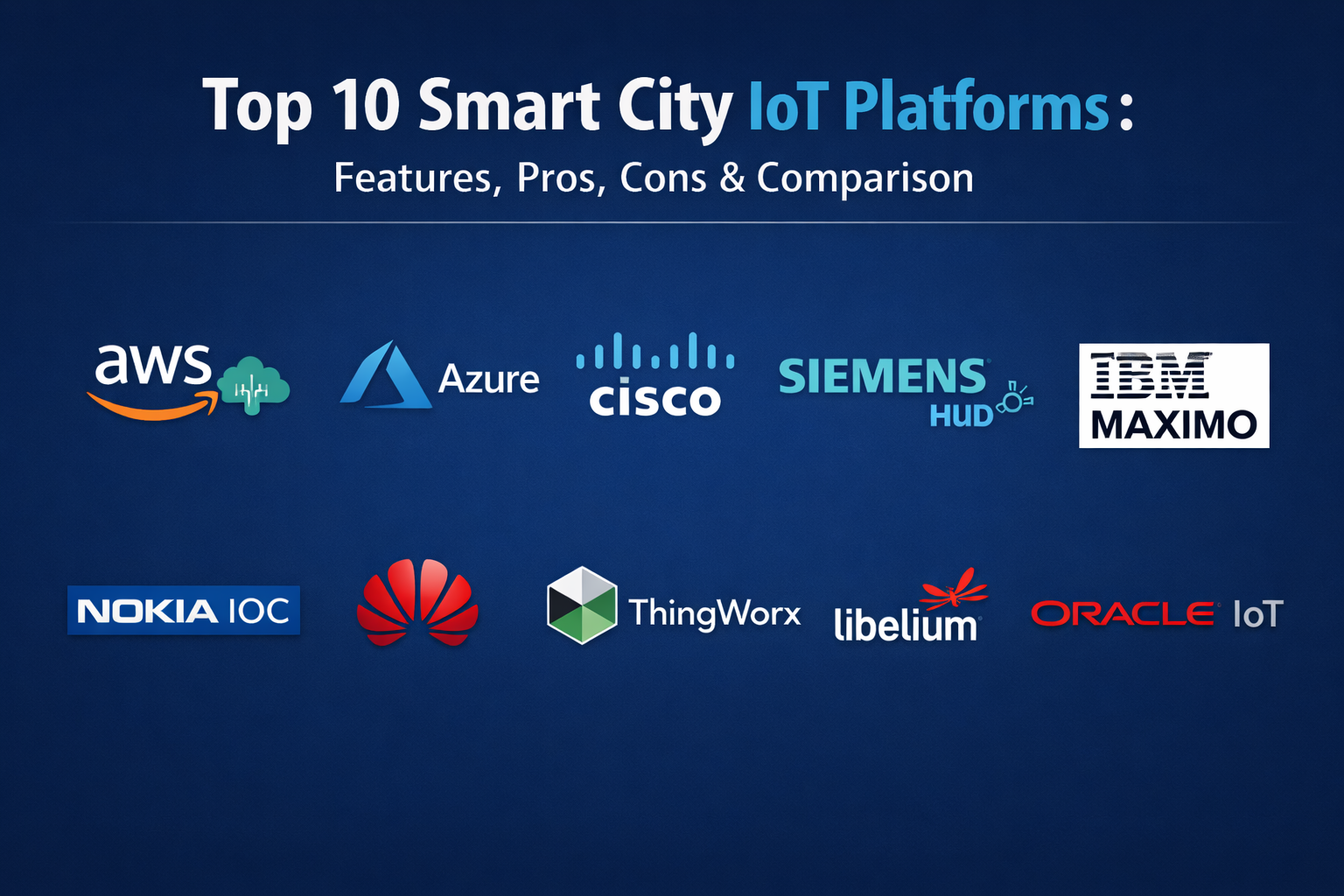
Top 10 Smart City IoT Platforms
1. AWS IoT Core for Cities
Amazon’s specialized IoT framework for municipalities leverages the massive scale of the AWS cloud to connect trillions of messages across city-wide sensor networks. It is designed for cities that want to build custom, highly scalable urban applications without managing their own server infrastructure.
Key Features
- Serverless architecture that scales automatically based on the number of active city sensors.
- AWS IoT Greengrass for local data processing at the edge (e.g., in traffic lights).
- Device Defender for continuous auditing of security policies across the fleet.
- Seamless integration with Amazon Timestream for storing and analyzing time-series urban data.
- Robust support for multiple communication protocols including MQTT and LoRaWAN.
Pros
- Infinite scalability that can grow from a single neighborhood to a mega-city.
- Lower upfront cost due to the pay-as-you-go pricing model.
Cons
- Requires significant AWS-specific technical expertise to configure properly.
- Can lead to vendor lock-in within the Amazon ecosystem.
Platforms / Deployment
Cloud
Global
Security & Compliance
End-to-end encryption with X.509 certificates and fine-grained IAM policies.
SOC 2 / ISO 27001 / HIPAA compliant.
Integrations & Ecosystem
Integrates with the entire AWS suite, including SageMaker for AI and QuickSight for city dashboards. It supports a massive partner network for specialized city sensors.
Support & Community
Extensive documentation and enterprise-grade support tiers. The AWS Partner Network includes thousands of specialized smart city integrators.
2. Microsoft Azure IoT Central
Azure IoT Central provides a ready-made UI and API surface that simplifies the connection and management of smart city assets. It is the go-to choice for cities already invested in the Microsoft software ecosystem.
Key Features
- Ready-made templates for smart lighting, waste management, and water monitoring.
- Azure Digital Twins integration for modeling relationships between city spaces and devices.
- High-availability architecture with built-in disaster recovery for critical city services.
- Integrated job scheduler for managing firmware updates across thousands of devices.
- Seamless data export to Power BI for executive-level urban reporting.
Pros
- Very fast deployment time due to the use of pre-configured application templates.
- Strongest integration with existing corporate and government productivity tools.
Cons
- Customization can be limited compared to more open-ended PaaS solutions.
- Data retention in the core platform is limited to a rolling 30-day window.
Platforms / Deployment
Cloud
Global
Security & Compliance
Built on Azure’s secure-by-design foundation with enterprise-grade MFA.
More certifications than any other cloud provider, including CJIS for public safety.
Integrations & Ecosystem
Connects deeply with Microsoft 365, Dynamics 365, and the broader Azure data and AI portfolio.
Support & Community
Professional support through Microsoft enterprise agreements and the extensive Microsoft Learn portal.
3. Cisco Kinetic for Cities
Cisco’s platform focuses on the “network” layer of the smart city, unifying disparate data from parking, lighting, and safety systems into a single AI-powered dashboard. It excels in optimizing urban mobility and public safety.
Key Features
- Real-time normalization of data from different hardware vendors.
- Policy automation engine for triggering city-wide responses (e.g., changing lights for emergency vehicles).
- Deep integration with Cisco’s world-class networking and Wi-Fi infrastructure.
- Specialized modules for smart parking and air quality indexing.
- Open APIs for local developers to build custom citizen-facing apps.
Pros
- Exceptional reliability and security at the network hardware level.
- Proven track record in large-scale urban mobility projects.
Cons
- Often requires an investment in Cisco hardware for the best experience.
- The interface is more technical and targeted toward IT operators.
Platforms / Deployment
Cloud / Hybrid
Global
Security & Compliance
Ruggedized hardware security and encrypted data tunnels.
Not publicly stated.
Integrations & Ecosystem
Strongest in the connectivity layer, integrating with street-level hardware and municipal network backbones.
Support & Community
High-level professional support and a long history of serving municipal governments worldwide.
4. Siemens Insights Hub
Formerly known as MindSphere, this industrial-grade platform is optimized for the “built environment.” It is particularly strong in managing the energy grids and heavy infrastructure found in modern smart districts.
Key Features
- City Graph technology for modeling the relationships between people, spaces, and devices.
- Advanced analytics for optimizing energy consumption in large public buildings.
- Digital twin capabilities for simulating the impact of new infrastructure on the power grid.
- Open urban platform architecture that supports both cloud and edge execution.
- Specialized tools for managing electric vehicle (EV) charging infrastructure.
Pros
- Deep expertise in heavy engineering and energy management.
- Excellent for large-scale industrial or campus-style smart city projects.
Cons
- Higher entry cost compared to general-purpose cloud IoT tools.
- Complexity of the platform requires specialized training.
Platforms / Deployment
Cloud / Edge
Global
Security & Compliance
Industrial-grade security standards with secure device onboarding.
Not publicly stated.
Integrations & Ecosystem
Integrates with Siemens’ vast portfolio of industrial hardware and Microsoft Azure services.
Support & Community
Professional support provided by Siemens Advanta and a global network of engineering partners.
5. IBM Maximo for Civil Infrastructure
IBM focuses on the longevity and safety of the city’s physical assets. This platform combines IoT data with asset management to predict failures in bridges, roads, and tunnels before they become dangerous.
Key Features
- Continuous monitoring of structural health using vibration and tilt sensors.
- AI-powered image recognition for identifying cracks and defects in concrete and steel.
- Integration with environmental data to predict the impact of weather on infrastructure.
- Comprehensive work-order management for scheduling municipal maintenance crews.
- Support for massive-scale civil engineering projects with 30+ years of history.
Pros
- The undisputed leader for long-term asset lifecycle management.
- Essential for cities with aging infrastructure and limited maintenance budgets.
Cons
- Not designed for “fast” consumer-facing IoT like smart home integration.
- Can be very complex to implement across multiple city departments.
Platforms / Deployment
Cloud / On-premise
Global
Security & Compliance
Role-based access controls and enterprise-grade data encryption.
Not publicly stated.
Integrations & Ecosystem
Integrates with IBM Watson for advanced AI and various financial systems for budget tracking.
Support & Community
World-class enterprise support and a massive community of infrastructure managers.
6. Nokia Integrated Operations Center
Nokia’s platform is built around the “communications” mission of the city. It leverages Nokia’s heritage in 5G and private wireless networks to create a highly responsive situational awareness dashboard for city operators.
Key Features
- Real-time visibility of assets and services through a unified operations center.
- High-bandwidth 5G connectivity for real-time video analytics in public safety.
- Mission-critical private wireless support for first responders.
- Advanced device management for over 80,000 different models of hardware.
- Integrated emergency response tools that shorten reaction times.
Pros
- Unmatched performance for low-latency, mission-critical urban services.
- Excellent for cities that need to build their own private, secure network.
Cons
- Primarily focused on the networking and safety aspects of a city.
- Most effective when paired with Nokia’s specialized hardware.
Platforms / Deployment
Cloud / Private Cloud
Global
Security & Compliance
Government-grade security with resilient, fail-safe architecture.
Not publicly stated.
Integrations & Ecosystem
Focuses on the network and device layer, integrating with cellular and optical infrastructure.
Support & Community
Trusted by government and public sector networks globally with high-touch support.
7. Huawei OceanConnect
This platform focuses on massive-scale connectivity and AI collaboration between the cloud and the edge. It is a dominant player in large-scale urban digital transformation across Asia and Europe.
Key Features
- Seamless collaboration between central cloud and edge cloud for rapid video analysis.
- 3T+1M security framework for protecting the entire IoT architecture.
- Support for NB-IoT and 5G mMTC scenarios for high-density sensor networks.
- Open ecosystem with pre-integrated support for thousands of smart city devices.
- Advanced AI capabilities for intelligent traffic warning and pedestrian safety.
Pros
- Extremely efficient at handling massive numbers of simultaneous connections.
- Very strong in the field of intelligent video surveillance and traffic management.
Cons
- Limited availability and support in certain North American markets.
- Documentation and community support are primarily focused on specific regions.
Platforms / Deployment
Cloud / Edge
Global / Regional
Security & Compliance
Comprehensive security for chipsets, operating systems, and data transmission.
Not publicly stated.
Integrations & Ecosystem
Extensive ecosystem of partners in the telecommunications and smart hardware sectors.
Support & Community
Strong professional support through Huawei’s global service centers.
8. PTC ThingWorx
ThingWorx is an industrial-first platform that has successfully transitioned into the smart city space. It excels at rapid application development, allowing cities to build custom dashboards and AR experiences in weeks.
Key Features
- Model-driven design environment for rapid urban application development.
- Low-code/No-code “Mashup Builder” for creating city operator dashboards.
- Augmented Reality (AR) integration for assisting maintenance crews in the field.
- Real-time anomaly detection for identifying unusual sensor behavior.
- Robust device management for provisioning and updating remote hardware.
Pros
- One of the fastest platforms for building custom, visual city applications.
- Excellent for integrating IoT data with 3D models and AR workflows.
Cons
- Enterprise licensing model can be expensive for smaller municipalities.
- Higher learning curve for the initial “Thing” modeling framework.
Platforms / Deployment
Cloud / On-premise / Hybrid
Global
Security & Compliance
Built-in security model with role-based access and data encryption.
Not publicly stated.
Integrations & Ecosystem
Strongest in the industrial space, integrating with ERP, CRM, and CAD systems.
Support & Community
Professional support with a strong focus on manufacturing and utility sectors.
9. Libelium Waspmote & Smart Cities PRO
Libelium provides a specialized, modular hardware-software platform. It is unique in offering factory-calibrated sensors specifically for noise, air quality, and waste management.
Key Features
- Modular sensor boards with over 120 different urban sensor options.
- Low-power architecture designed for solar-powered or battery-operated motes.
- Factory-calibrated gas and noise sensors for high-accuracy urban monitoring.
- Over-The-Air (OTA) programming for updating sensors across the city without physical access.
- Support for 15 wireless technologies including LoRaWAN, Sigfox, and 4G.
Pros
- The best “plug-and-play” solution for specific environmental monitoring.
- Incredible power efficiency for remote, off-grid city sensors.
Cons
- More of a specialized hardware-platform solution than a general-purpose cloud.
- Scaling to millions of devices may require integration with a larger cloud backend.
Platforms / Deployment
Local / Cloud Gateway
Global
Security & Compliance
Encrypted wireless communication and secure OTA updates.
Not publicly stated.
Integrations & Ecosystem
Integrates with almost all major cloud platforms including AWS, Azure, and IBM.
Support & Community
Very active developer community and specialized engineering support.
10. Oracle IoT Cloud
Oracle’s platform is designed to connect city data directly with enterprise business processes. It is the preferred choice for cities that need to manage complex supply chains and large-scale public works.
Key Features
- Direct integration with Oracle ERP and Supply Chain Management systems.
- “Predictive Twin” simulations for forecasting the impact of city growth.
- Automated business process triggers based on real-time IoT events.
- Advanced security for data streaming from millions of connected devices.
- Built-in machine learning models for asset health and maintenance.
Pros
- Unbeatable for cities that need to link IoT data to financial and procurement systems.
- Strongest data management and analytics capabilities for large datasets.
Cons
- The platform can feel very enterprise-heavy for smaller city projects.
- Best used when the organization is already committed to the Oracle software stack.
Platforms / Deployment
Cloud
Global
Security & Compliance
Enterprise-grade identity management and comprehensive data isolation.
Not publicly stated.
Integrations & Ecosystem
Designed for the Oracle ecosystem but offers robust APIs for external connectivity.
Support & Community
Highly professional enterprise support and a large network of government-focused partners.
Comparison Table
| Tool Name | Best For | Platform(s) Supported | Deployment | Standout Feature | Public Rating |
| 1. AWS IoT Core | Custom Scalability | Windows, Linux, Mobile | Cloud | Serverless Scale | N/A |
| 2. Azure IoT | Fast Deployment | Windows, Linux, Mobile | Cloud | App Templates | N/A |
| 3. Cisco Kinetic | Network & Mobility | Windows, Linux, Mobile | Hybrid | Data Normalization | N/A |
| 4. Siemens Hub | Energy & Buildings | Windows, Linux, Mobile | Cloud/Edge | City Graph | N/A |
| 5. IBM Maximo | Asset Maintenance | Windows, Linux, Mobile | Hybrid | Structural Health | N/A |
| 6. Nokia IOC | Public Safety | Windows, Linux, Mobile | Private Cloud | Mission-Critical 5G | N/A |
| 7. Huawei OC | High-Density Video | Windows, Linux, Mobile | Cloud/Edge | Cloud-Edge AI | N/A |
| 8. ThingWorx | Rapid UI & AR | Windows, Linux, Mobile | Hybrid | Mashup Builder | N/A |
| 9. Libelium | Env. Monitoring | Windows, Linux, Mobile | Local/Cloud | Calibrated Sensors | N/A |
| 10. Oracle IoT | Financial & ERP | Windows, Linux, Mobile | Cloud | Business Triggers | N/A |
Evaluation & Scoring
| Tool Name | Core (25%) | Ease (15%) | Integrations (15%) | Security (10%) | Perf (10%) | Support (10%) | Value (15%) | Total |
| 1. AWS IoT Core | 10 | 5 | 10 | 9 | 9 | 9 | 9 | 8.80 |
| 2. Azure IoT | 9 | 8 | 10 | 9 | 8 | 9 | 8 | 8.75 |
| 3. Cisco Kinetic | 8 | 7 | 9 | 10 | 8 | 8 | 7 | 8.15 |
| 4. Siemens Hub | 9 | 6 | 9 | 9 | 8 | 8 | 6 | 7.85 |
| 5. IBM Maximo | 9 | 5 | 8 | 9 | 8 | 9 | 7 | 7.95 |
| 6. Nokia IOC | 8 | 6 | 7 | 10 | 9 | 8 | 7 | 7.85 |
| 7. Huawei OC | 9 | 7 | 8 | 8 | 10 | 7 | 8 | 8.25 |
| 8. ThingWorx | 8 | 9 | 8 | 8 | 8 | 7 | 7 | 7.90 |
| 9. Libelium | 7 | 8 | 7 | 8 | 7 | 8 | 9 | 7.60 |
| 10. Oracle IoT | 8 | 6 | 10 | 9 | 8 | 8 | 7 | 7.85 |
The scoring above is based on the platform’s ability to handle the extreme diversity of a smart city. AWS and Azure score the highest because they provide a “blank canvas” for building any city service with nearly unlimited scale and excellent value. Cisco and Nokia score higher on security and performance because they manage the hardware layer that city life depends on. Specialized tools like Libelium score well on value and ease of use for their specific niche, even if they aren’t meant to be the master platform for an entire metropolis.
Which Smart City IoT Platform Tool Is Right for You?
Solo / Freelancer
If you are an independent urban consultant or academic, Blender (for visualization) paired with AWS IoT Core‘s free tier is the best way to experiment with smart city data without upfront costs.
SMB
Small urban developers or specialized “smart campus” projects should look at Azure IoT Central. Its pre-built templates for lighting and waste allow a small team to deploy a professional-grade system in a matter of days.
Mid-Market
For mid-sized cities or regional utility districts, Cisco Kinetic or PTC ThingWorx offer a great balance of rapid application building and reliable network infrastructure that doesn’t require a massive internal software team.
Enterprise
For mega-cities and national infrastructure providers, AWS IoT Core or IBM Maximo are the standard. These platforms provide the industrial-strength reliability and long-term support required for multi-decade city transformations.
Budget vs Premium
Libelium and Azure IoT are the budget-friendly options that provide high-quality results. Siemens and IBM are premium solutions that offer a level of civil engineering depth that is indispensable for high-stakes urban projects.
Feature Depth vs Ease of Use
Azure IoT Central is the easiest to use due to its template-based approach. AWS IoT Core and Houdini-style logic in ThingWorx provide the most depth but require significantly more effort to implement correctly.
Integrations & Scalability
Oracle and AWS are the winners for scalability and business-process integration. If your city needs to link sensor data directly to its procurement and financial systems, Oracle is the clear choice.
Security & Compliance Needs
For cities with strict public safety requirements and mission-critical networks, Nokia and Cisco provide the ruggedized hardware and secure connectivity necessary for zero-fail operations.
Frequently Asked Questions (FAQs)
1. What is a Smart City IoT platform?
It is a centralized software system that connects urban infrastructure like streetlights, traffic sensors, and utility meters, allowing them to communicate and be managed from a single dashboard.
2. Is citizen data safe on these platforms?
Modern platforms use enterprise-grade encryption and anonymization, but security ultimately depends on how the city configures its data protection policies and access controls.
3. Do these platforms require a 5G network?
Not necessarily. While 5G is great for real-time video, many smart city sensors use low-power technologies like LoRaWAN or NB-IoT, which can transmit data over long distances with very little battery.
4. What is a “Digital Twin” in a smart city context?
It is a virtual 3D model of the city that is updated in real-time by IoT sensors, allowing city planners to test “what if” scenarios before making physical changes to the city.
5. How do these tools help with environmental goals?
By monitoring air quality, water leaks, and energy waste in real-time, platforms allow cities to take immediate action to reduce their carbon footprint and conserve resources.
6. Can a city use more than one platform?
Yes, many cities use a “platform of platforms” approach, where specialized systems (like IBM for bridges) feed data into a master dashboard (like AWS or Azure).
7. How much does a smart city platform cost?
Costs vary wildly, from pay-as-you-go cloud fees starting at a few hundred dollars to multi-million dollar enterprise contracts for large-scale urban centers.
8. What happens if the internet goes down?
Modern platforms use “Edge Computing” to ensure that critical functions, like traffic signal timing or emergency alerts, continue to work locally even if the cloud connection is lost.
9. Why is “interoperability” so important?
Cities have equipment from hundreds of different manufacturers. An interoperable platform ensures that all these devices can talk to each other regardless of who built them.
10. How long does it take to build a smart city?
It is a continuous process. Most cities start with a single pilot (like smart lighting) and slowly expand to other domains over several years as budget and technology allow.
Conclusion
Choosing a Smart City IoT platform is a generational decision that defines how a city will function and serve its citizens for decades to come. The goal is to move beyond simple data collection and toward a truly responsive, intelligent urban environment. As we have seen, the “best” platform is entirely dependent on whether your priority is structural safety, energy optimization, or rapid deployment. By selecting a platform that prioritizes security, open standards, and scalability, municipal leaders can ensure their city remains resilient in the face of growth and change. The future of urban life is connected, and the platform you choose today is the foundation for that digital reality.

Best Cardiac Hospitals Near You
Discover top heart hospitals, cardiology centers & cardiac care services by city.
Advanced Heart Care • Trusted Hospitals • Expert Teams
View Best Hospitals