Introduction
In the current digital era, the pressure on enterprises to innovate rapidly is unprecedented. Businesses are no longer just fighting for market share; they are fighting for technical relevance in a world dominated by cloud-native applications and microservices. However, the journey toward digital transformation is rarely smooth. Enterprises frequently encounter bottlenecks in software delivery, inconsistent infrastructure management, and the daunting complexity of migrating legacy systems to the cloud.
This is where the expertise of DevOps Consultants becomes a critical differentiator. These professionals provide the strategic roadmap and technical hands-on guidance necessary to bridge the gap between development and operations. By implementing proven methodologies, they help organizations move away from manual processes toward automated, reliable, and scalable ecosystems. Whether you are looking to refine your deployment pipelines or perform a total infrastructure overhaul, partnering with experienced firms like DevOpsSchool ensures that your transformation is rooted in industry best practices. This article explores the tangible benefits of bringing in external expertise to foster long-term enterprise growth and operational excellence.
What Do DevOps Consultants Do?
A DevOps consultant acts as a bridge between a company’s business goals and its technical execution. Their primary role is to audit existing workflows, identify friction points, and implement strategies that improve the velocity and quality of software delivery.
- CI/CD Transformation: They design and implement robust pipelines that automate testing and deployment, ensuring code moves from development to production with minimal human intervention.
- Cloud-Native Modernization: They guide enterprises in migrating monolithic applications to containerized environments using technologies like Kubernetes.
- Automation Strategy: They replace manual, error-prone tasks with Infrastructure as Code (IaC) using tools like Terraform or Ansible.
- Observability & Monitoring: They establish centralized logging and monitoring frameworks to ensure that system performance issues are caught before they impact the end user.
Why Enterprises Hire DevOps Consultants
Enterprises often hit a “scaling wall.” As teams grow and applications become more complex, the old ways of managing IT—such as siloed departments and manual server provisioning—stop working.
- Bridging the Expertise Gap: Hiring a full team of senior DevOps architects is costly and time-consuming. Consultants provide immediate access to battle-tested expertise.
- Accelerating Transformation: Internal teams are often bogged down by “keep the lights on” (KTLO) tasks. Consultants bring a fresh perspective and a singular focus on modernization.
- Risk Mitigation: Migrating to the cloud or restructuring a CI/CD pipeline is high-risk. Consultants bring experience from dozens of similar projects, significantly reducing the likelihood of costly outages or security vulnerabilities.
Core Responsibilities of DevOps Consultants
The scope of a consultant’s work is expansive and tailored to the unique pain points of the client.
- Infrastructure Automation: Establishing “Everything as Code” to ensure consistency across staging and production environments.
- Kubernetes Implementation: Helping teams navigate the steep learning curve of container orchestration to maximize resource utilization.
- Team Enablement: A key part of the job is training internal staff. A good consultant doesn’t just build the system; they ensure the client’s team is empowered to maintain it.
- Security Automation: Integrating security checks directly into the pipeline (DevSecOps), ensuring compliance is a continuous process rather than an afterthought.
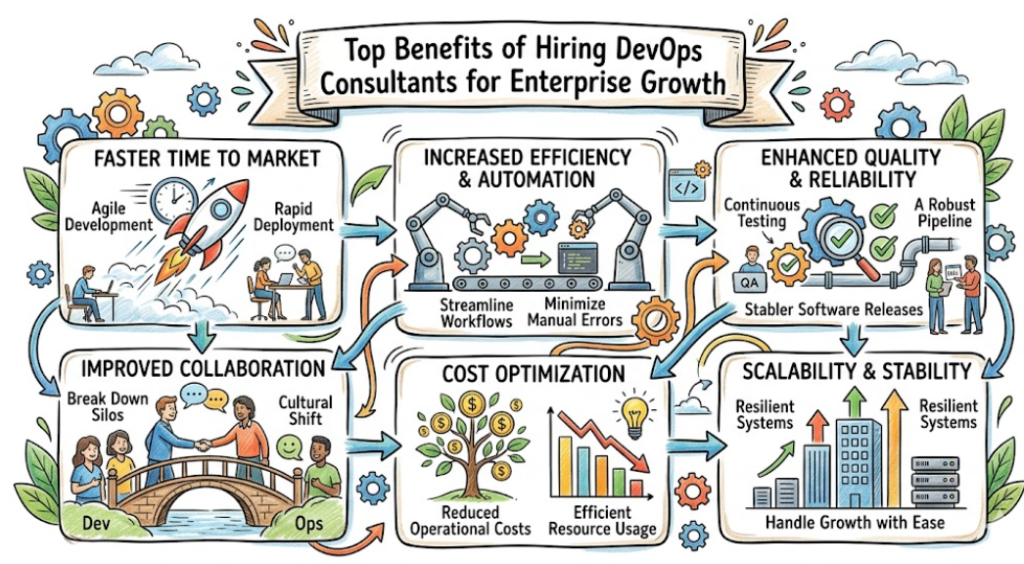
Top Benefits of Hiring DevOps Consultants for Enterprise Growth
Benefit 1: Faster Software Delivery
By automating the path to production, consultants enable “Continuous Delivery.” This means new features reach customers in hours rather than weeks, keeping the business competitive.
Benefit 2: Improved Scalability
Consultants leverage cloud-native architectures that allow systems to auto-scale based on demand. This ensures that peak traffic periods do not result in service degradation.
Benefit 3: Better Automation Across Operations
Manual configuration is the enemy of growth. Consultants standardize environments, ensuring that every deployment is predictable and repeatable.
Benefit 4: Enhanced System Reliability
Through Site Reliability Engineering (SRE) practices, consultants implement self-healing infrastructure, reducing downtime and the frequency of manual interventions.
Benefit 5: Reduced Operational Costs
By optimizing cloud resource consumption—often through “right-sizing” infrastructure—consultants help businesses significantly reduce their monthly cloud bills.
Benefit 6: Stronger Security & Compliance
Consultants automate security scanning, ensuring that vulnerabilities are identified early in the development lifecycle rather than after a data breach.
Popular Tools Used by DevOps Consultants
| Tool | Purpose | Enterprise Usage | Difficulty Level |
| Jenkins/GitLab CI | CI/CD Orchestration | High | Moderate |
| Kubernetes | Container Orchestration | Very High | High |
| Terraform | Infrastructure as Code | High | Moderate |
| Prometheus/Grafana | Monitoring/Observability | High | Moderate |
| Ansible | Configuration Management | Moderate | Low |
DevOps Consultant vs Internal DevOps Team
| Feature | DevOps Consultant | Internal DevOps Team |
| Expertise Level | Specialized, broad industry exposure | Depth in specific company context |
| Transformation Speed | High (focused on delivery) | Moderate (balanced with maintenance) |
| Cost Structure | Project-based or retainer | Full salary + benefits + training |
| Scalability Support | Highly scalable for temporary spikes | Limited by headcount |
FAQs
1. What do DevOps consultants do? They analyze your current infrastructure and culture, then implement automated processes, CI/CD pipelines, and cloud-native architectures to increase efficiency.
2. Why do enterprises hire DevOps consultants? Primarily to accelerate digital transformation, reduce operational costs, and bridge the gap in specialized technical skills.
3. Is Kubernetes knowledge important for consultants? Yes, it is the industry standard for container orchestration and a core requirement for modern cloud-native enterprises.
4. How does DevOps consulting improve scalability? By moving away from static servers to dynamic, auto-scaling environments that adjust resources based on real-time traffic.
5. What industries benefit most? Finance, Healthcare, and E-commerce benefit significantly due to their high requirements for security, compliance, and uptime.
6. Is DevOps consulting a good career? Extremely. As organizations continue to digitize, the demand for experts who understand both development and operations remains high.
7. What tools do DevOps consultants use? Common tools include Terraform, Kubernetes, Docker, Jenkins, Prometheus, and various cloud provider services (AWS/Azure/GCP).
8. How long does transformation take? It varies, but meaningful shifts in automation and CI/CD maturity can typically be seen within 3 to 6 months.
Final Thoughts
The decision to bring in DevOps consultants is essentially a decision to prioritize sustainable growth over short-term “firefighting.” In an enterprise environment, the complexity of modern software stacks means that relying solely on legacy IT processes is no longer viable. By focusing on automation, observability, and robust cloud-native architecture, you create a foundation that allows your engineers to focus on building value for your customers rather than debugging infrastructure.

Best Cardiac Hospitals Near You
Discover top heart hospitals, cardiology centers & cardiac care services by city.
Advanced Heart Care • Trusted Hospitals • Expert Teams
View Best Hospitals