Introduction
Software Asset Management tools help organizations control software spend, maintain license compliance, and reduce audit risk by tracking what is installed, what is used, what is purchased, and what is allowed. In simple terms, SAM software connects three messy realities into one governed view: deployments, entitlements, and usage. When these three do not match, you overpay, fail audits, or carry hidden security risk from unknown software.
This matters now because software models have shifted from one-time purchases to subscriptions, consumption-based licenses, and vendor-specific rules that change often. At the same time, work is distributed and devices are everywhere. Without SAM, teams struggle with renewals, duplicate subscriptions, shelfware, and audit pressure. Real-world use cases include vendor audit readiness, license compliance for major publishers, SaaS subscription optimization, software request approvals, usage-based reclaiming, and forecasting renewals. When evaluating SAM tools, consider discovery coverage, normalization and application recognition, license rule library depth, reconciliation accuracy, SaaS visibility, contract and entitlement workflows, reporting quality, integrations, security controls, and overall governance model.
Best for: IT asset managers, IT finance, procurement, compliance teams, security teams, and service desk leaders who need reliable software inventory, licensing governance, and measurable cost optimization.
Not ideal for: very small teams with minimal software procurement and no audit risk. If you only need a basic list of installed applications, a discovery tool may be enough, but it will not handle entitlement rules and compliance workflows.
Key Trends in Software Asset Management Tools
- Shift from “installed software” tracking to subscription and SaaS governance
- Increased focus on usage-based optimization and reclaiming shelfware
- Stronger license normalization and recognition to reduce messy data
- More integration with procurement and finance for renewals and forecasting
- Higher expectations for evidence-ready compliance reporting
- Tighter connections to service desk workflows for software request approvals
- Greater focus on risk: unapproved apps, vulnerable versions, and shadow IT visibility
- Automation for reclamation, downgrade decisions, and renewal workflows (Varies / Not publicly stated)
- Multi-cloud and hybrid visibility becoming more important for licensing scope
- Vendor rule complexity increasing the need for specialized SAM expertise
How We Selected These Tools
- Strong credibility and adoption in software license compliance and audit readiness
- Practical capability for entitlement management and reconciliation
- Quality of normalization, application recognition, and data governance workflows
- Support for SaaS discovery and subscription optimization patterns
- Integration ecosystem for discovery sources, procurement, service desk, and identity tools
- Fit across segments: mid-market to enterprise
- Balanced list including SAM-first vendors and ITSM ecosystems with strong SAM modules
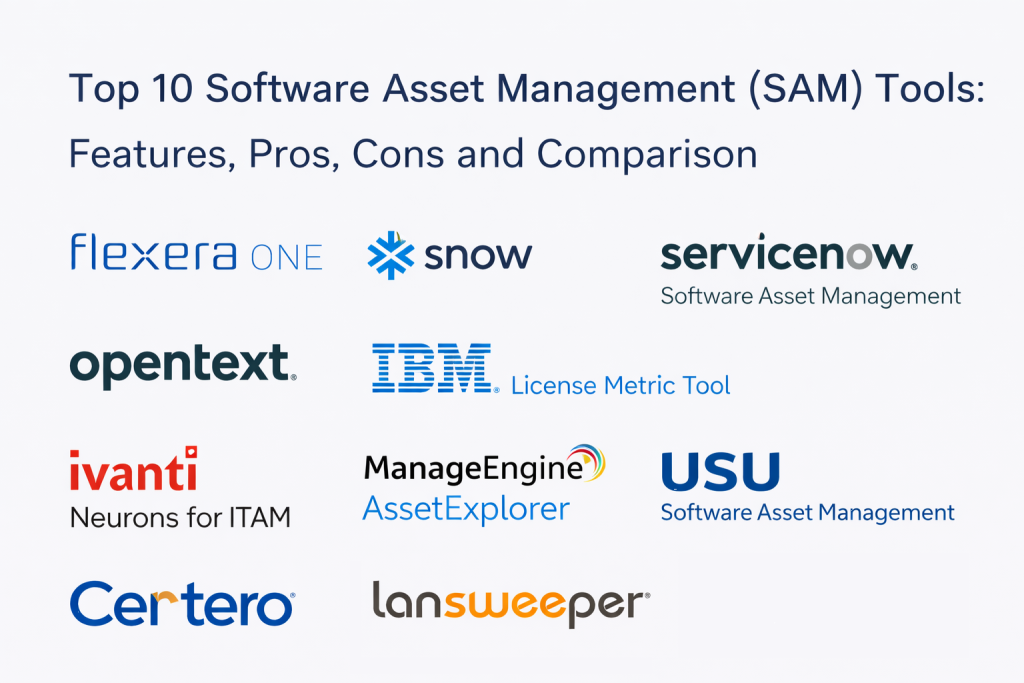
Top 10 Software Asset Management Tools
1 — Flexera One
Flexera One is widely recognized for enterprise software asset management, license compliance, and spend optimization. It fits organizations that face complex licensing rules, frequent audits, and the need to link deployments to entitlements cleanly.
Key Features
- License entitlement management and compliance workflows
- Normalization and application recognition capabilities (Varies / Not publicly stated)
- Discovery and inventory reconciliation from multiple sources (Varies / Not publicly stated)
- SaaS subscription visibility and optimization patterns (Varies / Not publicly stated)
- Audit readiness reporting and evidence workflows
- Spend visibility and renewal planning support (Varies / Not publicly stated)
Pros
- Strong for audit readiness and compliance governance
- Useful cost optimization insights for shelfware reduction
- Good integration model for enterprise environments
Cons
- Requires disciplined data ownership for best results
- Full value depends on integration scope and rule configuration
- Packaging complexity can vary based on needs
Platforms / Deployment
- Platforms: Web
- Deployment: Cloud
Security and Compliance
Not publicly stated
Integrations and Ecosystem
Flexera One typically integrates with discovery tools, procurement systems, and service workflows to reconcile usage and entitlements.
- Inventory and discovery source integrations (Varies / Not publicly stated)
- Procurement and contract data alignment patterns
- APIs for data enrichment and automation
- Reporting exports for compliance governance
Support and Community
Enterprise-oriented support is common. Documentation is available; best outcomes come with strong SAM ownership and a clear governance model.
2 — Snow Software
Snow Software focuses on software inventory, usage intelligence, and compliance governance. It fits organizations that want usage-based optimization and strong reporting for audits and renewals.
Key Features
- Software inventory, usage tracking, and reconciliation
- License compliance workflows and audit reporting
- SaaS usage visibility and optimization insights (Varies / Not publicly stated)
- Application recognition and normalization (Varies / Not publicly stated)
- Dashboards for usage, compliance, and optimization opportunities
- Governance workflows for exceptions and approvals (Varies / Not publicly stated)
Pros
- Strong usage intelligence for optimization decisions
- Practical compliance reporting for audits
- Good for organizations focused on reclaiming unused licenses
Cons
- Value depends on accurate inventory inputs
- Implementation requires consistent processes
- Capabilities can vary by scope and configuration
Platforms / Deployment
- Platforms: Web
- Deployment: Cloud (Varies / Not publicly stated for other modes)
Security and Compliance
Not publicly stated
Integrations and Ecosystem
Snow often connects to multiple inventory sources and procurement systems to keep reconciliation accurate.
- Discovery and inventory integrations (Varies / Not publicly stated)
- Procurement and contract data synchronization patterns
- APIs for enrichment and automation workflows
- BI exports for governance reporting (Varies / Not publicly stated)
Support and Community
Support varies by plan. Many teams rely on established playbooks and partner support for rule setup and sustainable governance.
3 — ServiceNow Software Asset Management
ServiceNow Software Asset Management is used by organizations that want software governance tightly connected to IT service workflows, approvals, and broader service management processes.
Key Features
- Software request workflows and approvals linked to service catalog
- License compliance workflows (Varies / Not publicly stated)
- Entitlement and contract tracking patterns (Varies / Not publicly stated)
- Reconciliation patterns between installs, usage, and entitlements (Varies / Not publicly stated)
- Reporting dashboards for compliance and renewals
- Role-based governance and workflow approvals
Pros
- Strong linkage between SAM and service operations
- Useful for governed request and approval workflows
- Scales well in large ITSM environments
Cons
- Can be heavy for smaller organizations
- Full value depends on integration and data quality
- Total cost can increase as modules expand
Platforms / Deployment
- Platforms: Web
- Deployment: Cloud (Varies / Not publicly stated for other modes)
Security and Compliance
Not publicly stated
Integrations and Ecosystem
ServiceNow SAM commonly integrates with discovery sources, procurement systems, and identity data to keep entitlements and deployments aligned.
- Inventory and discovery data integrations (Varies / Not publicly stated)
- Procurement workflows for entitlement accuracy
- APIs for automation and reporting exports
- Service desk linkage for request governance
Support and Community
Strong enterprise support and a large ecosystem of partners. Documentation is extensive; governance success depends on process ownership.
4 — OpenText Asset Management
OpenText Asset Management is used for enterprise asset and software governance, often in organizations that want strong lifecycle control and policy-driven tracking.
Key Features
- Software asset tracking and lifecycle governance (Varies / Not publicly stated)
- Contract and entitlement record management patterns (Varies / Not publicly stated)
- Discovery and inventory alignment workflows (Varies / Not publicly stated)
- Compliance reporting and audit support outputs
- Workflow controls for approvals and changes (Varies / Not publicly stated)
- Integration patterns for enterprise systems (Varies / Not publicly stated)
Pros
- Suitable for organizations with structured governance requirements
- Useful reporting for audits and renewals
- Can support broader asset lifecycle programs
Cons
- Implementation scope can be significant
- Feature depth depends on configuration and licensing
- SaaS optimization capabilities may vary
Platforms / Deployment
- Platforms: Web
- Deployment: Cloud / Self-hosted (Varies / Not publicly stated)
Security and Compliance
Not publicly stated
Integrations and Ecosystem
OpenText Asset Management typically integrates with inventory sources and procurement systems to maintain clean asset records.
- Inventory and discovery feed integrations (Varies / Not publicly stated)
- Procurement and contract system alignment patterns
- APIs for data sync and automation (Varies / Not publicly stated)
Support and Community
Enterprise support is common. Documentation is available; many organizations rely on partner delivery for complex governance setups.
5 — IBM License Metric Tool
IBM License Metric Tool is designed to help organizations measure and report IBM software usage for licensing compliance. It fits organizations that run IBM software and need audit-ready measurement.
Key Features
- Usage measurement and reporting for IBM licensing metrics
- Compliance reporting outputs for audits (Varies / Not publicly stated)
- Discovery patterns for IBM software deployments (Varies / Not publicly stated)
- Evidence-friendly reporting for licensing governance
- Administration tools for multi-environment coverage (Varies / Not publicly stated)
- Export and reporting workflows (Varies / Not publicly stated)
Pros
- Strong fit for IBM-focused license compliance needs
- Evidence-style reporting aligns with audit requirements
- Useful for organizations with complex IBM deployments
Cons
- Primarily focused on IBM licensing scope
- Broader SAM coverage needs additional tools
- Configuration and data coverage must be managed carefully
Platforms / Deployment
- Platforms: Web (Varies / N/A)
- Deployment: Varies / N/A
Security and Compliance
Not publicly stated
Integrations and Ecosystem
IBM License Metric Tool often integrates with infrastructure inventory sources and reporting workflows.
- Inventory feed alignment patterns (Varies / Not publicly stated)
- Export workflows for governance reporting
- Integration scope depends on environment
Support and Community
Support quality varies by contract. Documentation exists; organizations often rely on licensing specialists for configuration and interpretation.
6 — Ivanti Neurons for ITAM
Ivanti Neurons for ITAM is used by organizations that want software inventory, lifecycle governance, and optimization insights connected to endpoint and service workflows.
Key Features
- Software inventory and entitlement tracking (Varies / Not publicly stated)
- Discovery and reconciliation patterns (Varies / Not publicly stated)
- Contract and renewal tracking workflows (Varies / Not publicly stated)
- Reporting for compliance and software governance
- Integration with service workflows for request control
- Automation patterns for reclamation and lifecycle actions (Varies / Not publicly stated)
Pros
- Practical governance for software lifecycle visibility
- Works well when connected to service workflows
- Useful reporting for compliance and renewals
Cons
- Feature depth varies by edition and configuration
- SaaS optimization scope depends on setup
- Integration planning is important for best results
Platforms / Deployment
- Platforms: Web
- Deployment: Cloud (Varies / Not publicly stated for other modes)
Security and Compliance
Not publicly stated
Integrations and Ecosystem
Ivanti Neurons for ITAM often integrates with directory services, endpoint tools, and service management workflows.
- Directory-based ownership mapping patterns
- Inventory feed integrations (Varies / Not publicly stated)
- APIs for automation and enrichment
- Exports for compliance reporting (Varies / Not publicly stated)
Support and Community
Support varies by contract. Documentation exists; many teams benefit from partner-guided rollout for sustainable governance.
7 — ManageEngine AssetExplorer
ManageEngine AssetExplorer is often chosen by SMB and mid-market teams that want practical software inventory and basic license tracking with manageable administration.
Key Features
- Software inventory and installed application visibility
- License tracking patterns (Varies / Not publicly stated)
- Contract and renewal tracking workflows (Varies / Not publicly stated)
- Reporting for compliance and inventory changes
- Asset and user mapping fields for governance
- Integrations with related IT operations tools (Varies / Not publicly stated)
Pros
- Practical for mid-market software governance needs
- Often easier to deploy than heavier enterprise SAM suites
- Useful reporting for renewals and compliance basics
Cons
- Advanced license rule coverage may be limited
- SaaS optimization depth may be limited
- Value depends on discovery coverage and process discipline
Platforms / Deployment
- Platforms: Web
- Deployment: Cloud / Self-hosted (Varies / Not publicly stated)
Security and Compliance
Not publicly stated
Integrations and Ecosystem
AssetExplorer commonly integrates with inventory sources and related IT tools for better data accuracy.
- Inventory imports and synchronization (Varies / Not publicly stated)
- APIs for custom governance workflows (Varies / Not publicly stated)
- Exports for reporting and audits (Varies / Not publicly stated)
Support and Community
Documentation is practical. Support tiers vary; many teams can implement standard workflows without heavy consulting.
8 — USU Software Asset Management
USU Software Asset Management is used by organizations that want license compliance, contract governance, and cost optimization, often with strong process-driven reporting.
Key Features
- License compliance and entitlement management workflows
- Discovery and inventory reconciliation patterns (Varies / Not publicly stated)
- Contract, renewal, and vendor governance workflows (Varies / Not publicly stated)
- Normalization and application recognition patterns (Varies / Not publicly stated)
- Audit support reporting and evidence outputs
- Optimization insights for cost and renewals (Varies / Not publicly stated)
Pros
- Strong compliance focus for audit readiness
- Useful contract governance and renewal visibility
- Suitable for organizations with structured SAM processes
Cons
- Implementation value depends on data quality and integrations
- Feature depth varies by scope and licensing
- SaaS optimization capabilities should be validated in a pilot
Platforms / Deployment
- Platforms: Web
- Deployment: Cloud (Varies / Not publicly stated for other modes)
Security and Compliance
Not publicly stated
Integrations and Ecosystem
USU SAM typically integrates with discovery tools and procurement systems to reconcile deployments and entitlements.
- Inventory and discovery feed integrations (Varies / Not publicly stated)
- Procurement and contract system alignment patterns
- APIs for automation and reporting exports (Varies / Not publicly stated)
Support and Community
Support is typically enterprise-oriented. Documentation exists; many organizations rely on SAM specialists for rule configuration and governance setup.
9 — Certero
Certero is used for software asset management and compliance governance, often focused on reducing audit risk and improving licensing visibility for major publishers.
Key Features
- Software inventory and license compliance workflows
- Normalization and recognition patterns (Varies / Not publicly stated)
- Reconciliation between installs and entitlements (Varies / Not publicly stated)
- Reporting for audits and renewal planning
- Contract tracking and vendor governance workflows (Varies / Not publicly stated)
- Automation patterns for reclamation and cleanup (Varies / Not publicly stated)
Pros
- Strong compliance reporting for audit readiness
- Practical governance workflows for SAM teams
- Useful for organizations prioritizing licensing control
Cons
- Feature depth depends on licensing scope and publisher needs
- SaaS optimization should be validated based on environment
- Integrations and discovery coverage drive real value
Platforms / Deployment
- Platforms: Web
- Deployment: Cloud / Self-hosted (Varies / Not publicly stated)
Security and Compliance
Not publicly stated
Integrations and Ecosystem
Certero often integrates with discovery sources and procurement data to keep compliance views accurate.
- Discovery feed integrations (Varies / Not publicly stated)
- Procurement and entitlement imports
- APIs for enrichment and automation (Varies / Not publicly stated)
Support and Community
Support varies by contract. Documentation is available; SAM outcomes improve when governance roles and reporting cycles are clearly defined.
10 — Lansweeper
Lansweeper is widely used for discovery and inventory visibility. While it is not always a full SAM suite, it can be a strong foundational data source for software governance, especially for installed software coverage.
Key Features
- Software inventory and installed application visibility
- Discovery across networks and endpoints
- Reporting for software presence and changes
- Asset tagging and ownership tracking patterns (Varies / Not publicly stated)
- Export and integration patterns for SAM workflows (Varies / Not publicly stated)
- Scalable scanning options for distributed environments (Varies / Not publicly stated)
Pros
- Strong discovery coverage and inventory visibility
- Useful as a foundational inventory source for SAM
- Practical reporting for software footprint analysis
Cons
- Advanced license rule management may be limited
- SaaS usage optimization depth may be limited
- Compliance depends on entitlements and rule handling outside discovery
Platforms / Deployment
- Platforms: Web, Windows (Varies / N/A)
- Deployment: Cloud / Self-hosted (Varies / Not publicly stated)
Security and Compliance
Not publicly stated
Integrations and Ecosystem
Lansweeper commonly integrates with service desks, reporting tools, and data pipelines to support broader governance.
- Service workflow integration patterns (Varies / Not publicly stated)
- Exports for BI and compliance reporting
- APIs for enrichment and automation (Varies / Not publicly stated)
Support and Community
Support varies by plan. Community adoption is strong, especially for reporting templates and discovery best practices.
Comparison Table
| Tool Name | Best For | Platform(s) Supported | Deployment | Standout Feature | Public Rating |
|---|---|---|---|---|---|
| Flexera One | Enterprise license compliance and audits | Web | Cloud | Strong entitlement and compliance governance | N/A |
| Snow Software | Usage-based optimization and reporting | Web | Cloud (Varies / Not publicly stated) | Strong usage intelligence for reclaiming licenses | N/A |
| ServiceNow Software Asset Management | SAM linked to governed service workflows | Web | Cloud (Varies / Not publicly stated) | Request and approval control tied to ITSM | N/A |
| OpenText Asset Management | Policy-driven enterprise software governance | Web | Cloud / Self-hosted (Varies / Not publicly stated) | Structured lifecycle and governance reporting | N/A |
| IBM License Metric Tool | IBM licensing measurement and reporting | Web (Varies / N/A) | Varies / N/A | IBM licensing evidence and metrics tracking | N/A |
| Ivanti Neurons for ITAM | Software governance tied to endpoint context | Web | Cloud (Varies / Not publicly stated) | Lifecycle visibility connected to service workflows | N/A |
| ManageEngine AssetExplorer | Practical SAM basics for mid-market | Web | Cloud / Self-hosted (Varies / Not publicly stated) | Software inventory with renewals tracking | N/A |
| USU Software Asset Management | Compliance and contract-driven SAM | Web | Cloud (Varies / Not publicly stated) | Strong governance and contract visibility | N/A |
| Certero | Audit readiness and licensing control | Web | Cloud / Self-hosted (Varies / Not publicly stated) | Compliance reporting and reconciliation workflows | N/A |
| Lansweeper | Discovery-first software footprint visibility | Web, Windows (Varies / N/A) | Cloud / Self-hosted (Varies / Not publicly stated) | Strong installed software discovery and reporting | N/A |
Evaluation and Scoring of Software Asset Management Tools
Scoring model
- Each criterion uses a 1–10 score
- Weighted total is a comparative score from 0–10
- Scores reflect typical positioning and capability breadth
- Your best choice depends on publisher mix, audit pressure, and data quality discipline
Weights used
- Core features – 25%
- Ease of use – 15%
- Integrations and ecosystem – 15%
- Security and compliance – 10%
- Performance and reliability – 10%
- Support and community – 10%
- Price and value – 15%
| Tool Name | Core (25%) | Ease (15%) | Integrations (15%) | Security (10%) | Performance (10%) | Support (10%) | Value (15%) | Weighted Total (0–10) |
|---|---|---|---|---|---|---|---|---|
| Flexera One | 9 | 6 | 8 | 7 | 8 | 7 | 6 | 7.35 |
| Snow Software | 8 | 7 | 7 | 7 | 7 | 7 | 7 | 7.20 |
| ServiceNow Software Asset Management | 9 | 6 | 8 | 8 | 8 | 8 | 5 | 7.40 |
| OpenText Asset Management | 7 | 6 | 7 | 7 | 7 | 6 | 5 | 6.35 |
| IBM License Metric Tool | 7 | 6 | 6 | 6 | 7 | 6 | 6 | 6.35 |
| Ivanti Neurons for ITAM | 8 | 7 | 7 | 7 | 7 | 7 | 7 | 7.20 |
| ManageEngine AssetExplorer | 7 | 8 | 6 | 6 | 7 | 7 | 9 | 7.35 |
| USU Software Asset Management | 8 | 6 | 7 | 7 | 7 | 7 | 6 | 6.95 |
| Certero | 8 | 6 | 7 | 7 | 7 | 6 | 6 | 6.80 |
| Lansweeper | 6 | 8 | 7 | 6 | 8 | 7 | 8 | 7.05 |
How to interpret the scores
- Use the weighted total to shortlist tools, not to declare a universal winner
- If audits are your biggest risk, prioritize Core features plus Integrations
- If adoption is your main challenge, prioritize Ease plus Support
- If cost reduction is key, prioritize Value and validate reclaim workflows
Which Software Asset Management Tool Is Right for You?
Solo / Freelancer
If you only manage a few devices, full SAM is usually too heavy. Focus on maintaining a clean software list and subscription inventory. Lansweeper can help with footprint visibility, while simpler tracking may be enough for entitlement control.
SMB
SMBs need practical inventory plus basic license tracking and renewal reminders. ManageEngine AssetExplorer can work well for straightforward governance. Lansweeper is helpful when discovery coverage and software footprint clarity are the main needs.
Mid-Market
Mid-market teams often face growing subscription sprawl and audit pressure. Snow Software can fit when usage-based optimization matters. Ivanti Neurons for ITAM can work well when you want software governance connected to endpoint context and service workflows. USU Software Asset Management can fit teams that want structured contract and compliance governance.
Enterprise
Enterprise environments typically require strong entitlement reconciliation, publisher rules, and evidence-ready reporting. Flexera One is strong for complex licensing and audit readiness. ServiceNow Software Asset Management is valuable when approvals and service workflows must be governed in the same platform. IBM License Metric Tool is important when IBM licensing measurement is a core requirement. Certero can fit organizations focusing on compliance-driven SAM governance with reconciliation needs.
Budget vs Premium
If budget is tight, prioritize accurate discovery and clean entitlement records first, then scale into deeper compliance workflows. Premium tools become worthwhile when audit risk and licensing waste exceed the cost of governance.
Feature Depth vs Ease of Use
Flexera One and ServiceNow Software Asset Management provide deep governance but require maturity. ManageEngine AssetExplorer is often easier for mid-size teams. Snow Software balances usage intelligence with practical governance when properly implemented.
Integrations and Scalability
Most SAM success comes from how well you connect inventory sources, procurement data, and usage signals. Validate integration paths during a pilot, especially for discovery coverage, contract imports, and reporting accuracy.
Security and Compliance Needs
SAM systems can become a compliance evidence source. Confirm role-based access, audit logs, and data retention capabilities. Also validate how exceptions are approved and recorded, because that is often reviewed during audits.
Frequently Asked Questions
- What is the difference between SAM and ITAM?
SAM focuses specifically on software licenses, entitlements, usage, and compliance. ITAM covers both hardware and software lifecycle, including procurement and retirement workflows. - What do I need before implementing SAM?
Accurate inventory sources, clean procurement and entitlement records, and a clear ownership model. Without these, the SAM tool becomes a reporting system built on unreliable inputs. - How do SAM tools help reduce software costs?
They identify unused licenses, duplicate subscriptions, and shelfware, then support reclaiming and renewal decisions. Savings come when teams take action based on the reports. - How do I prepare for a vendor audit?
Reconcile entitlements with deployments, document exceptions, maintain evidence reports, and run monthly compliance checks so issues are found early instead of during audit pressure. - Do SAM tools work for SaaS subscriptions too?
Many do, but the depth varies. Validate SaaS discovery, usage visibility, and reclaim workflows during a pilot based on your SaaS portfolio. - What is software normalization and why does it matter?
Normalization converts messy software names into consistent recognized products and versions. Without it, you cannot reliably match installs to entitlements. - How long does SAM take to show value?
Basic visibility can appear quickly, but reliable compliance and cost optimization usually require a few cycles of cleanup and governance. Results depend on data quality and stakeholder cooperation. - What are common mistakes in SAM programs?
Relying on one inventory source, ignoring normalization, skipping procurement alignment, and treating SAM as a one-time project. SAM is an ongoing operating model. - Can discovery tools alone replace SAM?
No. Discovery shows what is installed, but SAM reconciles that against entitlements and licensing rules. Discovery is necessary but not sufficient for compliance. - How do I pilot SAM tools before choosing one?
Pick a few major publishers, import real entitlements, connect one or two inventory sources, run normalization, and produce a compliance report. Then validate how exceptions and approvals are tracked.
Conclusion
Software Asset Management tools are most valuable when they reduce audit risk, improve compliance confidence, and create measurable cost savings by removing waste. Flexera One is strong for enterprise licensing complexity and audit readiness. Snow Software is valuable for usage-driven optimization and reporting. ServiceNow Software Asset Management fits organizations that want compliance governance tightly connected to service requests and approvals. USU Software Asset Management and Certero can be strong for structured compliance and contract governance. IBM License Metric Tool is important when IBM licensing measurement is a core need. For teams earlier in their SAM journey, ManageEngine AssetExplorer and Lansweeper can provide practical foundation visibility. A smart next step is to shortlist two or three tools, run a pilot with real entitlements and inventory data, validate compliance reporting, then expand in phases once data quality and governance are stable.

Best Cardiac Hospitals Near You
Discover top heart hospitals, cardiology centers & cardiac care services by city.
Advanced Heart Care • Trusted Hospitals • Expert Teams
View Best Hospitals