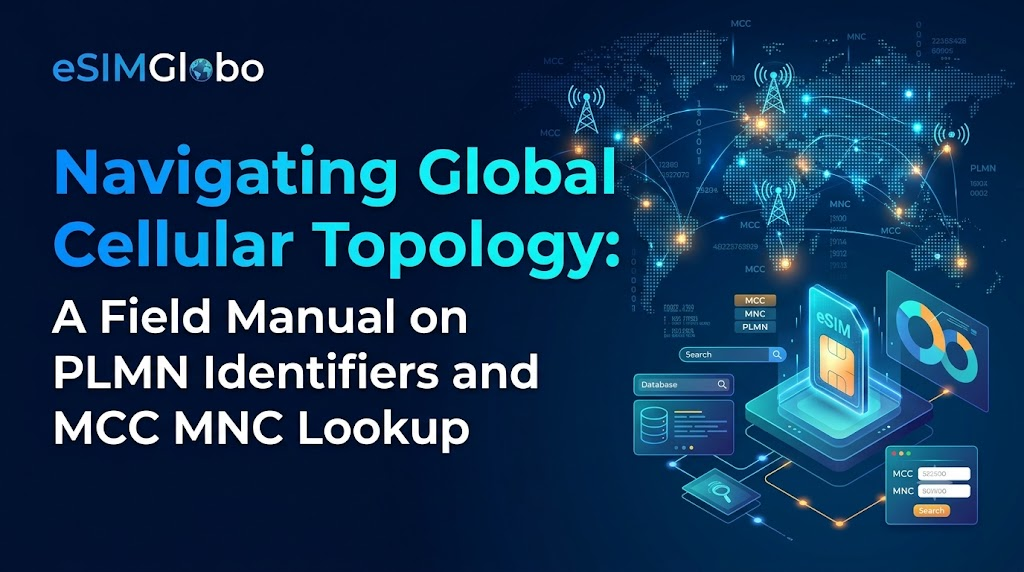
To the everyday smartphone owner, mobile connectivity feels like ambient magic. You touch down in Zurich, Singapore, or Toronto, toggle off flight mode, and within moments a local connection locks into place. A colorful carrier brand appears in the status bar, and notifications flood in. Yet underneath that slick UI layer, baseband modems do not read marketing trade names. Cellular hardware doesn’t know or care about consumer-facing brand campaigns. Instead, mobile infrastructure speaks an exacting, deterministic protocol governed by the International Telecommunication Union (ITU). Every cell tower in operation broadcasts an unvarying numeric fingerprint that encodes its geographic boundary, regulatory licensee, and operational routing identity. For telecommunications researchers, roaming settlement analysts, and embedded systems developers, executing an MCC MNC lookup is the primary method for translating these low-level digits into verified carrier intelligence. It turns an anonymous radio beacon into an actionable institutional profile.
However, finding dependable carrier records across dozens of jurisdictions can be an exercise in frustration. Crowdsourced wikis rot quickly, regulatory filings are often buried in regional PDF gazettes, and retail rebrands frequently mask the true infrastructure holder. Independent discovery platforms like eSIMGlobo streamline this investigative workload by synthesizing global carrier data directly against primary ITU E.212 releases and verified national records.
The Core Framework: Deconstructing ITU-T E.212
The global cellular routing schema is codified under ITU-T Recommendation E.212, which defines the international identification plan for public networks and individual user endpoints.
+========================================================================+
|             International Mobile Subscriber Identity (IMSI)            |
+====================================+===================================+
|     Public Land Mobile Network     |  Mobile Subscription              |
|              (PLMN ID)             |  Identification Number (MSIN)     |
+------------------+-----------------+-----------------------------------+
|  Mobile Country  |  Mobile Network | Device-specific subscriber token  |
|    Code (MCC)    |    Code (MNC)   | provisioned by the core carrier   |
|    [3 Digits]    |  [2-3 Digits]   |                                   |
+------------------+-----------------+-----------------------------------+
1. Mobile Country Code (MCC)
The MCC is a three-digit decimal block assigned by the ITU to delineate an individual country, a dependency, or a shared international operating scope.
Inspecting any verified Mobile Country Code list reveals clear administrative boundaries:
228designates Switzerland334covers Mexico425represents Israel505identifies Australia
Alongside regional borders, the ITU reserves special non-geographic blocks. The primary global scope is MCC 901, which serves international maritime vessels, trans-oceanic satellite arrays, cross-border commercial avionics, and global connectivity platforms operating beyond sovereign borders.
2. Mobile Network Code (MNC)
The MNC is a two- or three-digit sequence assigned by national communications authorities (or directly by the ITU for shared international blocks) to designate a specific licensed network within that territory.
Structural conventions vary across the map: European and Asian markets almost exclusively deploy two-digit MNCs, while North American networks predominantly issue three-digit allocations.
Under the Radio Hood: How Terminals Resolve a Connection
When a mobile handset powers up or drives into an unfamiliar sector, its baseband processor executes a strict sequence of radio-level handshakes:
- Broadcast Acquisition: The client terminal tunes across ambient frequency bands and decodes the System Information Block Type 1 (SIB1) emitted by the local radio node (eNodeB for LTE or gNodeB for 5G).
- PLMN Extraction: The device isolates the broadcast PLMN ID embedded in the SIB header.
- Home Network Matching: The baseband contrasts the broadcast PLMN against its Home PLMN (HPLMN), permanently stamped into the SIM card’s IMSI.
- Roaming Policy Evaluation: If the detected code differs from the home network, the modem consults internal priority lists (such as the Operator Controlled PLMN selector) to determine whether a valid roaming agreement permits network attachment.
- Core Authentication Transit: The serving visited base station dispatches an authentication challenge across international IPX signaling carrier links via Diameter (LTE) or HTTP/2 (5G Core) back to the subscriber’s Home Subscriber Server (HSS) or Unified Data Management (UDM) platform.
 [User Terminal / Asset Node]
             │
             ▼ (Decodes SIB1 broadcast from local tower)
 [Serving Radio Base Station]
             │
             ▼ (Evaluates Visited vs. Home PLMN)
 [IPX Transit Broker / Signaling Gateway]
             │
             ▼ (Directs auth vectors via E.212 address)
 [Home Core Database / HSS / UDM]
A manual or programmatic MCC MNC lookup mirrors this resolution mechanism in reverse. It allows an analyst or developer to take an unverified network string, cross-reference an authoritative telecom operator database, and confirm the legal entity authorized to transmit over that spectrum.
High-Impact Use Cases Across Engineering Workflows
┌─────────────────────────────────┬────────────────────────────────────────────┐
│ Engineering Discipline          │ Operational Role of MCC/MNC Intelligence   │
├─────────────────────────────────┼────────────────────────────────────────────┤
│ Global Industrial IoT           │ Multi-IMSI profile switching & cost gates  │
│ A2P SMS Delivery & Anti-Fraud   │ Fake tower & gray-route traffic screening  │
│ Remote SIM Provisioning (eSIM)  │ OTA profile distribution & profile mapping │
│ Roaming Settlement Audits       │ Reconciling wholesale TAP3 & BCE records   │
│ Spectrum Allocation Research    │ Analyzing spectrum transfers & assignments │
└─────────────────────────────────┴────────────────────────────────────────────┘
1. Enterprise IoT and Fleet Telematics
Sensors fixed to cargo containers, international logistics trucks, and shipping vessels pass across national frontiers every day. Modern IoT hardware relies on Multi-IMSI firmware that monitors incoming PLMN strings in real time. Detecting a border crossing allows the device to swap active subscriber profiles automatically, circumventing punitive permanent-roaming tariffs and keeping data expenses stable.
2. A2P SMS Delivery and Fraud Mitigation
Banking institutions and cloud platforms dispatching time-sensitive one-time passcodes (OTPs) run into persistent risks from illicit SIM boxes, artificial traffic inflation, and message interception. Security firewalls rely on verified carrier datasets to guarantee that critical messages terminate through direct wholesale routes rather than unsecured virtual intermediaries.
3. Remote SIM Provisioning (eUICC Ecosystems)
The widespread adoption of consumer and industrial eSIM architectures makes network assignment entirely software-configurable. Managing these over-the-air rollouts requires precise network-code mapping so Local Profile Assistants (LPAs) download profiles that align with target carrier infrastructure.
Reality vs. Records: Practical Pitfalls in Carrier Intelligence
Engineers working with raw telecom feeds frequently encounter blind spots caused by the gap between regulatory filings and commercial operations:
- Spectrum Assignee vs. Retail Alias: An ITU E.212 entry names the legal entity awarded transmission or spectrum rights. It does not reflect consumer marketing labels. A single infrastructure holder may operate multiple consumer-facing brands or wholesale capacity to numerous third parties under a single PLMN.
- MNOs vs. MVNO Topologies: Mobile Network Operators (MNOs) own and manage physical radio towers and spectrum assets. Mobile Virtual Network Operators (MVNOs) lease that capacity. While a “Full MVNO” running its own switching core may hold a dedicated MNC, “Light MVNOs” typically broadcast using their host carrier’s PLMN ID.
- Legacy Assignments and Inactive Codes: Telecommunications mergers and acquisitions regularly leave retired network codes lingering in equipment configurations decades after a legacy company has been dissolved or rebranded.
- The Rise of Borderless Networks: The rollout of Low Earth Orbit (LEO) satellite direct-to-cell systems and borderless connectivity arrays relies heavily on non-geographic codes (like MCC
901). Platforms that assume every MCC maps to a physical country border will misclassify this traffic.
Navigating Carrier Intelligence on eSIMGlobo
Building reliable telecommunications applications requires access to clean, verified reference records. eSIMGlobo functions as an independent global telecom provider directory built to make carrier identity research transparent, accessible, and structured.
Rather than scraping unverified forum lists, eSIMGlobo indexes its repository against official ITU E.212 bulletins and verified regulatory updates.
- Targeted Lookups: Visitors can easily perform an isolated PLMN code lookup or research spectrum allocations by exploring mobile network codes by country.
- Traceable Architecture: Carrier entries are cataloged alongside contextual references, making it straightforward to distinguish licensed infrastructure holders from commercial marketing labels.
- Planned Platform Capabilities: To support developer and enterprise workflows, eSIMGlobo’s planned roadmap includes an MVNO directory, an eSIM provider directory, structured bulk data exports, and a dedicated MCC MNC lookup API to enable programmatic database queries directly inside production code.
Whether you are auditing cross-border data routes, setting up telematics equipment, or researching global carrier assignments, you can consult the searchable mobile network operator directory on eSIMGlobo to find verified telecommunications records.
Data Hygiene: Rules of Thumb for Systems Builders
When integrating telecom lookup tables into software stacks, following these operational guidelines helps avoid downstream bugs:
- Rely on Primary Regulatory Sources: Always cross-reference carrier lookups with official filings from bodies such as the FCC (US), Ofcom (UK), BNetzA (Germany), or the ITU’s regular Operational Bulletins.
- Never Equate Assignment with Radio Coverage: A registered network code simply confirms an administrative grant of spectrum or signaling rights. It does not prove that physical base stations are active, that consumer SIMs are in circulation, or that commercial roaming is permitted.
- Store All Codes as Strings: Always save MCC and MNC fields as text strings rather than integers. Storing these values numerically strips essential leading zeros (e.g., turning
08into8), corrupting database queries and causing joins to fail. - Support Non-Geographic Scopes: Build database models flexible enough to accommodate international codes (like MCC
901) alongside traditional ISO 3166-1 geographic country definitions.
Frequently Asked Questions
What is the core distinction between an MCC and an MNC?
An MCC (Mobile Country Code) is a three-digit sequence assigned by the ITU to designate a country, sovereign territory, or global shared network. An MNC (Mobile Network Code) is a two- or three-digit sequence allocated by national authorities to identify an individual mobile operator within that jurisdiction.
What purpose does a PLMN code serve?
A Public Land Mobile Network (PLMN) code is the complete identifier formed by concatenating an MCC and an MNC. It serves as the globally unique technical fingerprint for a carrier network and forms the initial routing prefix of every SIM card’s IMSI.
Does an allocated PLMN code prove an operator is active?
No. Code assignment reflects an administrative grant from a telecom authority. It does not verify that physical towers are active, that retail plans exist, or that commercial roaming is available.
Can an MVNO have its own independent MCC MNC code?
Full MVNOs that operate independent core switching platforms (such as HLR/HSS and mobile packet cores) can apply for and receive dedicated MNCs. Lighter virtual operators generally share the PLMN ID of their host Mobile Network Operator.
Where can engineers verify mobile network code assignments?
Network code assignments can be confirmed via official ITU E.212 documentation, national spectrum regulatory gazettes, and curated research platforms like eSIMGlobo that aggregate and source carrier assignment data.
Conclusion
The global mobile ecosystem works because it rests on a predictable, standardized numbering hierarchy. While marketing slogans and corporate takeovers change how networks present themselves to consumers, the ITU E.212 standard provides the steady technical bedrock that keeps data moving across borders. Navigating this space effectively requires clean, verifiable reference data. By pairing regulatory gazettes with independent reference tools like eSIMGlobo, telecommunications engineers, systems developers, and connectivity specialists can cut through marketing ambiguity and accurately track the infrastructure powering global wireless networks.

Best Cardiac Hospitals Near You
Discover top heart hospitals, cardiology centers & cardiac care services by city.
Advanced Heart Care • Trusted Hospitals • Expert Teams
View Best Hospitals