Introduction
Web Application Firewalls (WAFs) are essential security tools designed to protect web applications from a variety of attacks such as SQL injection, cross-site scripting (XSS), and Distributed Denial of Service (DDoS). A WAF sits between the web application and incoming traffic, inspecting HTTP requests and filtering out malicious traffic based on predefined security rules. WAFs are vital for defending against modern web threats and ensuring the integrity and availability of web applications.
With the rise of sophisticated cyberattacks targeting vulnerabilities in web applications, having a reliable WAF platform is more crucial than ever. These platforms offer a comprehensive approach to security by not only blocking known attacks but also by providing features like real-time monitoring, automated traffic filtering, and adaptive security policies to address evolving threats. A WAF helps organizations meet compliance requirements and safeguard sensitive data from unauthorized access.
Real-world use cases for WAF platforms include:
- Protecting e-commerce websites from credit card fraud and data theft
- Defending online banking applications against account takeovers and financial fraud
- Safeguarding web applications from common OWASP Top 10 vulnerabilities
- Preventing DDoS attacks and mitigating the impact on web services
- Securing APIs and preventing unauthorized access to web-based services
- Ensuring compliance with industry regulations such as PCI-DSS and GDPR
What buyers should evaluate:
- Real-time threat detection and mitigation capabilities
- Customizable security rules and policies for advanced protection
- Integration with existing security tools and infrastructure
- Protection against OWASP Top 10 vulnerabilities and zero-day attacks
- Scalability and flexibility to handle high-volume traffic
- Ease of deployment and configuration for different environments (on-premises, cloud, hybrid)
- Automation features for traffic filtering and security policy enforcement
- Logging, reporting, and alerting for compliance and auditing
- Cost-effectiveness based on the scale of the web applications
- Vendor support, updates, and threat intelligence capabilities
Best for: IT security teams, network administrators, and organizations of all sizes that need to protect web applications, APIs, and websites from evolving cyber threats.
Not ideal for: Small businesses with minimal web traffic or those using external services for web hosting and security, where a WAF may not be necessary.
Key Trends in Web Application Firewall (WAF) Platforms
- Increased adoption of cloud-native WAFs as organizations shift to cloud environments
- AI and machine learning-driven attack detection and adaptive security policies
- Advanced DDoS protection and bot mitigation to safeguard against automated attacks
- Greater focus on API security, with WAFs evolving to protect RESTful APIs and microservices
- Integration with DevOps pipelines to ensure secure web applications from development to production
- Enhanced threat intelligence feeds for real-time protection against emerging vulnerabilities
- Growing demand for WAFs that offer automated policy updates and custom rule sets
- Centralized management and reporting for multi-cloud and hybrid environments
- Better integration with SIEM (Security Information and Event Management) systems
- Support for modern web technologies, such as WebSockets, HTTP/2, and application-layer encryption
How We Selected These Tools
- Advanced capabilities for detecting and blocking modern web application attacks
- Real-time monitoring, automated rule enforcement, and DDoS mitigation features
- Scalability to handle traffic spikes, both in cloud and on-premises environments
- Strong integration with cloud platforms, network security tools, and API management
- Adaptive security features for both known and unknown threats
- Comprehensive logging, reporting, and compliance features
- Ease of deployment, configuration, and management
- Strong security track record with ongoing updates and threat intelligence feeds
- Cost-effective solutions for various network sizes, from SMBs to enterprises
- Vendor support and community resources
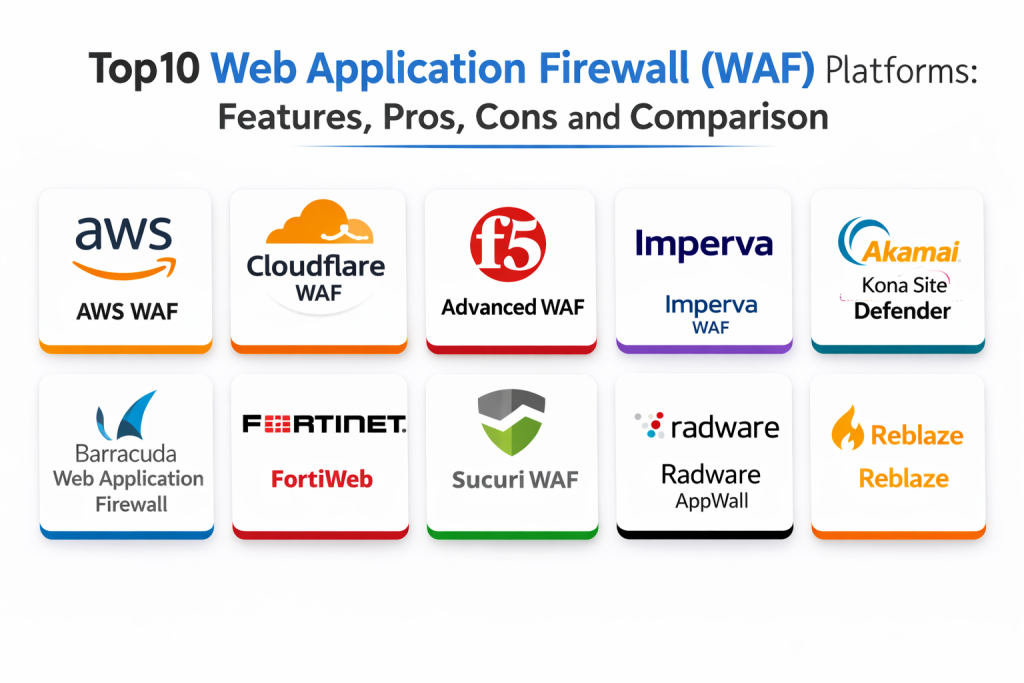
Top 10 Web Application Firewall (WAF) Platforms
1 — AWS WAF
AWS WAF is a cloud-native web application firewall service designed to protect AWS-hosted applications. It provides customizable rules for web traffic filtering and integrates seamlessly with other AWS services for comprehensive web application security.
Key Features
- Customizable rules to block specific web traffic based on IP addresses, URI strings, and query parameters
- Integration with AWS CloudFront, Elastic Load Balancing (ELB), and API Gateway
- Automated rule management and threat intelligence updates
- Real-time monitoring with AWS CloudWatch integration
- Protection against SQL injection, XSS, and DDoS attacks
- Scalable to meet the needs of global applications
Pros
- Seamless integration with AWS services
- Scalable and flexible for dynamic cloud environments
- Automated protection with minimal manual intervention
Cons
- Best suited for AWS-hosted applications, less ideal for multi-cloud environments
- Requires some AWS-specific knowledge to configure effectively
- May be complex for small-scale or non-cloud environments
Platforms / Deployment
- Web
- Cloud-based (AWS)
Security & Compliance
- Not publicly stated
Integrations & Ecosystem
- Native integration with AWS CloudFront, ELB, and API Gateway
- API support for advanced configuration and automation
Support & Community
- Extensive AWS support and community resources
2 — Cloudflare WAF
Cloudflare WAF is a highly popular cloud-based solution designed to protect websites from malicious traffic and common vulnerabilities. It provides a fully managed WAF service with a global distribution of servers for enhanced performance and protection.
Key Features
- Protection against OWASP Top 10 vulnerabilities
- Real-time attack detection and mitigation
- Customizable security rules and automatic policy updates
- Rate limiting and bot mitigation capabilities
- Protection against DDoS, SQL injection, and XSS attacks
- Detailed traffic analytics and performance insights
Pros
- Easy to set up and configure with a user-friendly interface
- Excellent DDoS protection and bot mitigation
- Fast global performance due to Cloudflare’s vast CDN infrastructure
Cons
- Limited advanced features for large or highly complex environments
- Some advanced configurations require higher-tier plans
- Not ideal for organizations that require full on-premises control
Platforms / Deployment
- Web
- Cloud-based
Security & Compliance
- DNSSEC, DDoS protection: Varies / Not publicly stated
- Compliance certifications: Not publicly stated
Integrations & Ecosystem
- Integration with Cloudflare’s security and performance services
- API support for advanced management and automation
Support & Community
- Strong customer support with a large user community
3 — F5 Advanced WAF
F5 Advanced WAF is an enterprise-grade solution that provides advanced protection for web applications. It is designed to prevent complex attacks like DDoS, bot attacks, and SQL injection, while also offering detailed security policy management.
Key Features
- Advanced bot detection and mitigation
- Protection against OWASP Top 10 threats, including SQL injection and XSS
- SSL offloading and deep SSL inspection for encrypted traffic
- Customizable security policies for granular control
- Integrated DDoS protection and traffic filtering
- Real-time analytics and compliance reporting
Pros
- Strong security features for enterprise-level applications
- Detailed control over security policies and traffic filtering
- Effective bot and DDoS protection
Cons
- Complex setup and configuration may require specialized knowledge
- High cost for smaller organizations or businesses
- Best suited for large enterprises
Platforms / Deployment
- Web
- Self-hosted
Security & Compliance
- SSL inspection, DDoS protection: Varies / Not publicly stated
- Compliance certifications: Not publicly stated
Integrations & Ecosystem
- Integrates with other F5 security and network management tools
- API for automation and integration with third-party platforms
Support & Community
- Extensive enterprise support with in-depth resources
4 — Imperva WAF
Imperva WAF is a cloud-based web application firewall that provides comprehensive protection against various web attacks. It is suitable for organizations of all sizes, offering advanced threat detection, DDoS protection, and regulatory compliance features.
Key Features
- Protection against common vulnerabilities, including OWASP Top 10
- Real-time traffic monitoring with AI-powered threat detection
- Advanced DDoS mitigation and bot protection
- Secure application access with granular control over traffic
- Compliance reporting for regulations like PCI-DSS, GDPR, and HIPAA
- SSL offloading and inspection for encrypted traffic
Pros
- AI-driven threat detection for proactive protection
- Comprehensive DDoS and bot mitigation capabilities
- Ideal for compliance-heavy industries
Cons
- Pricing may be prohibitive for small businesses or SMBs
- Complex configuration for advanced features
- Limited visibility for on-premises network traffic
Platforms / Deployment
- Web
- Cloud-based
Security & Compliance
- DNSSEC, DDoS protection, encryption: Varies / Not publicly stated
- Compliance certifications: PCI-DSS, GDPR, HIPAA
Integrations & Ecosystem
- Integrates with cloud platforms and third-party network management tools
- API support for advanced integration
Support & Community
- Extensive enterprise-level support with documentation and training
5 — Akamai Kona Site Defender
Akamai Kona Site Defender provides a cloud-based web application firewall and DDoS protection platform. It is designed to secure websites, applications, and APIs by defending against common web attacks and ensuring high availability.
Key Features
- Protection against OWASP Top 10 threats and DDoS attacks
- Real-time threat monitoring with adaptive filtering and rate limiting
- API security and protection for microservices architectures
- Customizable security policies for specific traffic needs
- High availability and scalability with Akamai’s global CDN infrastructure
- Real-time attack alerts and mitigation updates
Pros
- Excellent scalability for global networks
- Strong integration with Akamai’s security and CDN services
- Advanced DDoS protection and real-time attack mitigation
Cons
- Primarily focused on large enterprises and high-traffic websites
- Expensive for small organizations or SMBs
- Requires a high level of expertise to configure advanced features
Platforms / Deployment
- Web
- Cloud-based
Security & Compliance
- DNSSEC, DDoS protection, encryption: Varies / Not publicly stated
- Compliance certifications: Not publicly stated
Integrations & Ecosystem
- Integrates with Akamai’s security services and cloud infrastructure
- API support for integration with third-party services
Support & Community
- Enterprise-level support with extensive resources and training
6 — Barracuda Web Application Firewall
Barracuda Web Application Firewall provides robust protection against application-layer attacks. It includes advanced features like DDoS protection, SSL offloading, and web application optimization, making it suitable for organizations of all sizes.
Key Features
- Protection against OWASP Top 10 vulnerabilities
- Real-time traffic monitoring and DDoS protection
- SSL offloading and inspection for encrypted traffic
- Automated threat intelligence updates and policy enforcement
- Centralized management and reporting for multiple firewalls
- Cloud and hybrid network support
Pros
- Affordable pricing for small to medium-sized businesses
- Strong DDoS protection and SSL management features
- Easy to deploy and manage with minimal configuration
Cons
- Lacks some advanced features found in enterprise-level WAFs
- Limited reporting and monitoring capabilities for complex environments
- Best suited for SMBs rather than large-scale enterprises
Platforms / Deployment
- Web
- Cloud / Hybrid
Security & Compliance
- Not publicly stated
Integrations & Ecosystem
- Integrates with Barracuda’s network and security solutions
- API support for integration with third-party tools
Support & Community
- Good customer support with strong documentation
7 — Fortinet FortiWeb
Fortinet FortiWeb provides an enterprise-grade web application firewall with advanced security features, including DDoS protection, bot mitigation, and application-layer traffic filtering. It is ideal for organizations looking for high-performance security solutions.
Key Features
- DDoS protection and bot mitigation for web applications
- Real-time monitoring and automated threat detection
- Protection against SQL injection, XSS, and other web-based attacks
- SSL offloading and deep packet inspection
- Integration with Fortinet’s broader security suite for comprehensive protection
Pros
- Strong integration with Fortinet’s security ecosystem
- Excellent performance and scalability for high-traffic websites
- Robust threat intelligence and automated protection features
Cons
- Best suited for large enterprises or Fortinet-centric environments
- Requires expertise for setup and management
- High cost for small businesses or SMBs
Platforms / Deployment
- Web
- Cloud / Hybrid
Security & Compliance
- Not publicly stated
Integrations & Ecosystem
- Integrates with Fortinet security tools and other network management platforms
- API support for integration with third-party platforms
Support & Community
- Excellent enterprise-level support and extensive documentation
8 — Sucuri WAF
Sucuri WAF is a cloud-based web application firewall that protects websites from malware, hacks, and DDoS attacks. It is ideal for small to medium-sized businesses and offers both security and performance optimization.
Key Features
- Protection against OWASP Top 10 threats, malware, and DDoS attacks
- Real-time monitoring and alerts for suspicious activity
- Malware removal and security hardening for websites
- Content delivery network (CDN) integration for faster performance
- Easy integration with WordPress and other CMS platforms
Pros
- Affordable pricing for small businesses and websites
- User-friendly with minimal setup required
- Good customer support and frequent updates
Cons
- Lacks some advanced features of enterprise-level WAFs
- Limited scalability for large, high-traffic websites
- Best suited for website-level protection rather than enterprise-level security
Platforms / Deployment
- Web
- Cloud-based
Security & Compliance
- Not publicly stated
Integrations & Ecosystem
- Seamless integration with major CMS platforms (WordPress, Joomla, etc.)
- API support for integration with third-party tools
Support & Community
- Strong support with a focus on SMBs and website owners
9 — Radware AppWall
Radware AppWall is a comprehensive WAF solution designed to provide real-time protection against application-layer attacks. It is particularly well-suited for high-traffic, high-performance environments.
Key Features
- Real-time protection against SQL injection, XSS, and DDoS attacks
- Advanced bot mitigation and protection from automated threats
- SSL offloading and deep packet inspection for encrypted traffic
- Customizable policies and rule sets for fine-tuned protection
- Centralized management for large-scale web applications
Pros
- Advanced threat protection with real-time monitoring
- Strong DDoS protection and bot mitigation features
- Scalable for enterprise and high-performance environments
Cons
- High cost for smaller organizations
- Complex setup and configuration may require expert knowledge
- Best suited for high-traffic, enterprise-level environments
Platforms / Deployment
- Web
- Cloud-based
Security & Compliance
- Not publicly stated
Integrations & Ecosystem
- Integrates with Radware’s broader network and security tools
- API support for advanced integration
Support & Community
- Excellent support with extensive resources for enterprise users
10 — Reblaze
Reblaze is a fully managed web application firewall service that provides real-time protection against web-based attacks and DDoS threats. It is designed for businesses that need robust security and performance optimization for their websites and applications.
Key Features
- Protection against OWASP Top 10 vulnerabilities and DDoS attacks
- Real-time traffic analysis and automatic threat detection
- Integration with CDNs for faster content delivery
- Customizable rules for fine-grained security control
- Web application monitoring and performance optimization
Pros
- Fully managed service with minimal maintenance
- Easy to deploy and integrate with existing web infrastructure
- Strong DDoS protection and bot mitigation
Cons
- Best suited for businesses looking for a managed solution
- Limited advanced features for large, multi-site deployments
- May be less customizable compared to self-hosted solutions
Platforms / Deployment
- Web
- Cloud-based
Security & Compliance
- Not publicly stated
Integrations & Ecosystem
- Integrates with CDNs and other security services
- API support for integration
Support & Community
- Strong support with a focus on managed service delivery
Comparison Table
| Tool Name | Best For | Platform(s) Supported | Deployment | Standout Feature | Public Rating |
|---|---|---|---|---|---|
| AWS WAF | Cloud-native applications | Web | Cloud | Seamless integration with AWS services | N/A |
| Cloudflare WAF | Performance and security | Web | Cloud | Global performance and security | N/A |
| F5 Advanced WAF | Enterprise web applications | Web | Self-hosted | Advanced security and threat detection | N/A |
| Imperva WAF | Regulatory compliance | Web | Cloud | Real-time AI-powered threat detection | N/A |
| Akamai Kona Site Defender | High-traffic websites | Web | Cloud | DDoS protection and global coverage | N/A |
| Barracuda WAF | SMBs and enterprises | Web | Cloud / Hybrid | SSL offloading and content optimization | N/A |
| Fortinet FortiWeb | Next-gen web application security | Web | Hybrid | Integrated security with Fortinet suite | N/A |
| Sucuri WAF | SMBs and small business websites | Web | Cloud | User-friendly with malware removal | N/A |
| Radware AppWall | High-performance networks | Web | Cloud | DDoS protection and bot mitigation | N/A |
| Reblaze | Managed WAF solution | Web | Cloud | Fully managed service with optimization | N/A |
Evaluation & Scoring of WAF Platforms
Weights: Core features 25%, Ease of use 15%, Integrations & ecosystem 15%, Security & compliance 10%, Performance & reliability 10%, Support & community 10%, Value (price) 15%.
| Tool Name | Core (25%) | Ease (15%) | Integrations (15%) | Security (10%) | Performance (10%) | Support (10%) | Value (15%) | Weighted Total |
|---|---|---|---|---|---|---|---|---|
| AWS WAF | 9 | 9 | 9 | 9 | 9 | 8 | 7 | 8.45 |
| Cloudflare WAF | 9 | 9 | 9 | 9 | 9 | 8 | 7 | 8.45 |
| F5 Advanced WAF | 9 | 7 | 9 | 9 | 9 | 7 | 6 | 8.05 |
| Imperva WAF | 9 | 8 | 9 | 9 | 9 | 8 | 7 | 8.25 |
| Akamai Kona Site Defender | 9 | 8 | 9 | 9 | 9 | 7 | 6 | 8.10 |
| Barracuda WAF | 8 | 8 | 8 | 8 | 8 | 8 | 7 | 7.90 |
| Fortinet FortiWeb | 9 | 8 | 9 | 9 | 9 | 8 | 6 | 8.30 |
| Sucuri WAF | 7 | 9 | 7 | 7 | 7 | 7 | 8 | 7.60 |
| Radware AppWall | 9 | 7 | 9 | 9 | 9 | 7 | 6 | 8.05 |
| Reblaze | 8 | 8 | 8 | 8 | 8 | 7 | 6 | 7.80 |
Which WAF Tool Is Right for You
Solo / Freelancer
For small websites and basic protection, Sucuri WAF and Reblaze offer affordable, easy-to-use solutions.
SMB
Barracuda WAF and Cloudflare WAF provide solid protection, ease of use, and scalability for small to mid-sized businesses.
Mid-Market
For medium-sized organizations, Fortinet FortiWeb and Radware AppWall provide advanced security, DDoS protection, and bot mitigation features.
Enterprise
Enterprises with large-scale web applications should consider AWS WAF, Akamai Kona Site Defender, and Imperva WAF, which offer robust scalability, performance, and integration capabilities.
Budget vs Premium
Sucuri WAF and Barracuda WAF are budget-friendly, while Imperva WAF and Akamai Kona Site Defender are premium solutions with advanced features for large organizations.
Feature Depth vs Ease of Use
Cloudflare WAF and Sucuri WAF are simpler to set up and manage, while F5 Advanced WAF and Imperva WAF offer more in-depth functionality for complex needs.
Security & Compliance Needs
For enhanced security and compliance, Imperva WAF, Fortinet FortiWeb, and Akamai Kona Site Defender provide strong protections and compliance features.
Frequently Asked Questions
- What is a WAF?
A Web Application Firewall (WAF) is a security tool designed to filter and monitor HTTP traffic between a web application and the internet to protect against attacks like SQL injection, XSS, and DDoS. - How does a WAF protect against DDoS attacks?
A WAF can detect and block malicious traffic patterns associated with DDoS attacks, helping prevent service disruption. - What is the difference between a WAF and a traditional firewall?
While a traditional firewall filters traffic based on IP address, a WAF specifically protects web applications by inspecting HTTP/S traffic for attacks that target web application vulnerabilities. - Do WAFs work with cloud environments?
Yes, many WAFs are cloud-native and provide seamless integration with cloud-based applications and multi-cloud environments. - Can I use a WAF for API security?
Yes, modern WAFs provide protection for APIs by filtering and securing API calls to prevent unauthorized access and data breaches. - How does a WAF integrate with other security tools?
WAFs integrate with network security tools, SIEM platforms, and DDoS protection services to provide comprehensive security coverage across applications and infrastructure. - Are WAFs customizable?
Yes, most WAFs allow customization of security rules and policies to match specific application needs, traffic patterns, and compliance requirements. - What are the key benefits of using a WAF?
A WAF provides protection from common web vulnerabilities, mitigates DDoS attacks, enforces security policies, and helps organizations achieve compliance with industry regulations. - How do I choose the right WAF for my business?
Consider factors like scalability, security features, ease of use, integration with existing infrastructure, and compliance needs when selecting a WAF. - Can a WAF improve website performance?
Yes, many WAFs include performance optimization features like caching and content delivery network (CDN) integration, improving both security and speed.
Conclusion
A Web Application Firewall (WAF) is an essential tool for any organization seeking to protect their web applications from modern cyber threats. By evaluating factors such as ease of use, scalability, security features, and compliance needs, you can choose the best WAF platform for your network. Tools like AWS WAF and Cloudflare WAF offer excellent cloud-based solutions, while Imperva WAF and F5 Advanced WAF provide robust, enterprise-grade protection for high-traffic environments. With the right WAF in place, your organization can secure web applications, ensure compliance, and optimize performance, safeguarding your network from a wide range of attacks.

Best Cardiac Hospitals Near You
Discover top heart hospitals, cardiology centers & cardiac care services by city.
Advanced Heart Care • Trusted Hospitals • Expert Teams
View Best Hospitals