Introduction
Pharmacovigilance (PV) software refers to a specialized category of health technology designed to monitor the safety of pharmaceutical products after they have been released to the market. These platforms serve as a centralized database for collecting, managing, and reporting adverse events—unintended side effects—associated with drugs, biologics, and medical devices. By using advanced algorithms and data management protocols, PV software ensures that pharmaceutical companies can identify safety signals early, protecting patient health while remaining compliant with strict global regulations.
In the current medical landscape, the volume of safety data is growing at an unprecedented rate. Data is no longer just coming from clinical trials; it now flows in from social media, patient apps, and electronic health records. Modern pharmacovigilance tools have evolved to handle this “big data” challenge by incorporating artificial intelligence and machine learning to automate the intake and processing of cases. This automation is critical for meeting the short reporting timelines required by authorities like the FDA and EMA.
Real-World Use Cases
- Case Intake & Triage: Automatically capturing adverse event reports from diverse sources such as emails, phone calls, and digital forms.
- Regulatory Reporting: Generating and submitting Individual Case Safety Reports (ICSRs) to global health authorities in standardized formats like E2B(R3).
- Signal Detection: Analyzing vast datasets to find patterns that might indicate a new, previously unknown side effect of a medication.
- Aggregate Reporting: Compiling long-term safety data into periodic reports such as PSURs (Periodic Safety Update Reports) for regulatory review.
- Literature Monitoring: Scanning thousands of medical journals and publications automatically to identify mentions of adverse events related to a company’s products.
Evaluation Criteria for Buyers
- The ability of the software to automatically scale as the number of products and adverse event cases increases.
- The level of AI integration for automating manual data entry and “auto-narrative” generation.
- The software’s track record with regulatory inspections and its adherence to 21 CFR Part 11 and GxP standards.
- The ease with which the system can be configured to meet the specific workflows of a particular company or CRO.
- The availability of real-time dashboards for monitoring compliance metrics and submission deadlines.
- The quality of the vendor’s technical support and the frequency of regulatory updates.
- The total cost of implementation, including data migration from legacy systems and user training.
Best for: Global pharmaceutical companies, Contract Research Organizations (CROs), and biotech startups that need to manage drug safety data and ensure regulatory compliance.
Not ideal for: General healthcare providers or pharmacies that do not hold marketing authorizations for drugs and only need to report events through standard government portals.
Key Trends in Pharmacovigilance Software
- The widespread adoption of Generative AI to assist in writing medical narratives and summarizing complex case histories.
- A move toward “Touchless Case Processing,” where low-risk cases are handled by AI from intake to submission without human intervention.
- The integration of signal detection tools directly into the safety database rather than using separate, disconnected systems.
- Increased focus on “Multivigilance,” allowing a single platform to manage drug, vaccine, medical device, and cosmetic safety data.
- The transition to cloud-native SaaS models that offer automatic updates for new E2B(R3) or regional regulatory requirements.
- Enhanced real-time collaboration tools that allow global teams and external partners to work on the same safety case simultaneously.
- The use of Natural Language Processing (NLP) to translate and extract safety data from local languages into English for global reporting.
- Deepening interoperability between safety systems and other domains like Clinical (EDC) and Quality (QMS) through advanced APIs.
How We Selected These Tools
Our selection of the top ten pharmacovigilance tools is based on a detailed review of the global life sciences market. We prioritized software that is currently being used by leading pharmaceutical laboratories and regulatory agencies, as these tools have been “battle-tested” during official inspections. A primary factor in our evaluation was the level of innovation, specifically how well each vendor has integrated AI and automation into their core workflow. We also looked for platforms that provide end-to-end coverage, from the moment an adverse event is reported to the final regulatory submission. Finally, we ensured the list includes a balance of enterprise-grade systems for global giants and agile, cost-effective solutions for small biotechs and CROs.
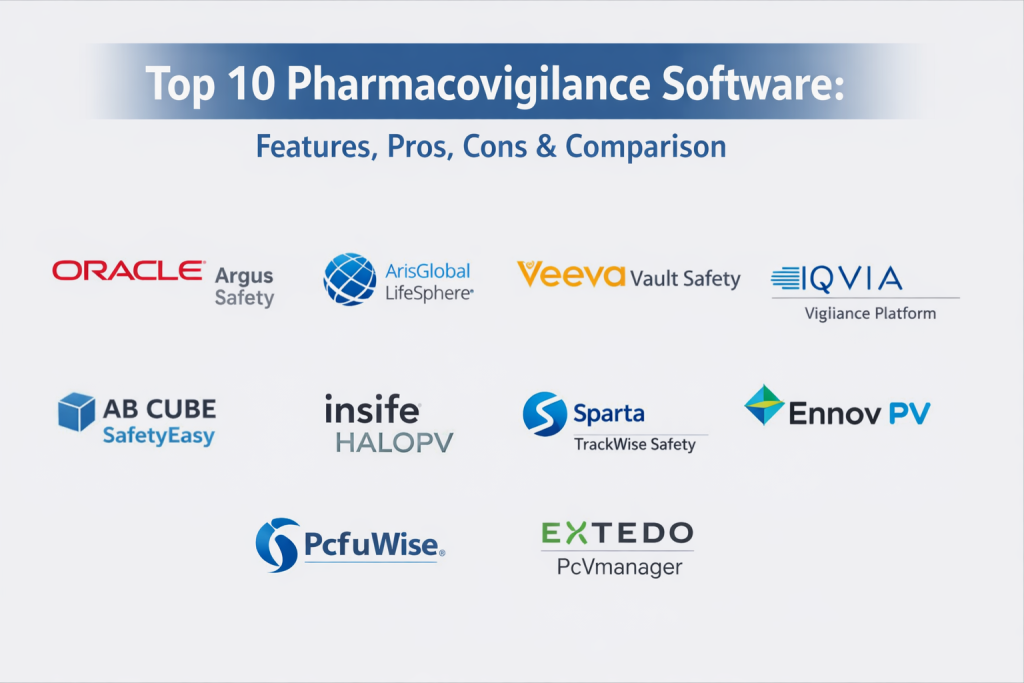
Top 10 Pharmacovigilance Software Tools
1. Oracle Argus Safety
Argus is widely considered the industry standard for large-scale pharmaceutical safety operations. It is a comprehensive platform designed to handle millions of cases annually while maintaining strict compliance. Its deep functionality and history make it the most trusted choice for global enterprises that require a robust, highly auditable environment for their safety data.
Key Features
- Advanced end-to-end case processing from initial intake to final regulatory submission.
- Integrated signal detection and risk management through the Argus Insight module.
- Support for complex global reporting rules and various product types including drugs and biologics.
- A highly sophisticated business rule engine for automating complex workflows.
- Seamless integration with clinical data systems and regulatory gateways.
Pros
- Exceptional scalability for massive global organizations.
- A proven track record with regulatory inspectors worldwide.
Cons
- The user interface can feel complex and dated to modern users.
- Significant cost and time required for implementation and upgrades.
Platforms / Deployment
Windows / Web — Cloud / Hybrid
Security & Compliance
ISO 27001, SOC 2, and 21 CFR Part 11 compliant.
Integrations & Ecosystem
Argus features deep integration with the Oracle Health Sciences suite and supports standard E2B exchange with nearly all other major safety partners and health authorities.
Support & Community
It has the largest professional user base in the world, with extensive third-party consulting and training resources available globally.
2. ArisGlobal LifeSphere Safety
LifeSphere is a leader in the new generation of AI-powered safety platforms. It focuses heavily on “cognitive automation,” using machine learning to handle the heavy lifting of data entry and medical coding. This approach is designed to significantly reduce the manual workload for safety teams, allowing them to focus on medical assessment rather than administrative tasks.
Key Features
- AI-powered case intake that uses natural language processing to extract data from forms.
- A unified global safety database that supports drugs, devices, and vaccines.
- Real-time signal management and interactive safety dashboards.
- Automated narrative generation for faster case report completion.
- Cloud-native architecture that ensures users are always on the latest version.
Pros
- High level of automation that leads to significant efficiency gains.
- Modern and intuitive user interface designed for efficiency.
Cons
- Best performance is achieved when using the full LifeSphere ecosystem.
- Smaller pool of independent consultants compared to legacy systems.
Platforms / Deployment
Web / Browser-based — Cloud
Security & Compliance
SOC 2 Type II, HIPAA, and GDPR compliant.
Integrations & Ecosystem
It offers seamless interoperability with third-party systems through a robust API framework and integrates well with clinical and regulatory suites.
Support & Community
Strong official support and a growing community of users focused on digital transformation in the life sciences.
3. Veeva Vault Safety
Veeva has disrupted the market by offering a safety solution built on its unified Vault platform. This allows safety data to flow seamlessly between clinical, regulatory, and quality departments. It is highly praised for its clean user experience and its true SaaS model, which eliminates the need for companies to manage their own IT infrastructure.
Key Features
- A single cloud platform that connects safety with clinical and quality data.
- Intuitive “low-touch” case processing workflows.
- Real-time oversight of all adverse event reporting through interactive dashboards.
- Automated distribution of safety reports to partners and health authorities.
- Integrated literature management for streamlined screening.
Pros
- Excellent user experience and very fast user adoption.
- Eliminates data silos between different departments.
Cons
- Premium pricing that reflects its position as a high-end market leader.
- May have more features than a very small startup needs.
Platforms / Deployment
Web / iOS / Android — Cloud
Security & Compliance
ISO 27001 certified and fully 21 CFR Part 11 compliant.
Integrations & Ecosystem
It is designed to work perfectly within the Veeva Development Cloud but also offers open APIs for connecting to other specialized tools.
Support & Community
Very active user community with frequent customer events and a strong focus on customer success.
4. IQVIA Vigilance Platform
IQVIA leverages its vast domain expertise in clinical research to provide a safety platform built for automation. It uses safety-specific AI to streamline operations and reduce the complexity of managing a global pharmacovigilance organization. It is particularly strong for companies that want a single, integrated platform for both human and device vigilance.
Key Features
- AI-based automation for case intake, triage, and data validation.
- An intuitive interface designed for case processing and signal detection teams.
- Real-time analytics and drill-down queries for rapid data analysis.
- Multi-lingual support for global operations and local affiliates.
- Integrated safety surveillance and risk management tools.
Pros
- Simplifies the entire PV process through a modern SaaS approach.
- Strong data security and PII management built into the core.
Cons
- Can be complex to set up for smaller, non-enterprise users.
- Pricing details are generally not made public.
Platforms / Deployment
Web — Cloud
Security & Compliance
Full GxP and GDPR compliance with role-based access controls.
Integrations & Ecosystem
Integrates seamlessly with IQVIA’s broader technology suite and existing clinical data streams.
Support & Community
Backed by the largest PV outsourcing and systems service partner in the world.
5. Ennov PV
Ennov provides a highly flexible and configurable safety suite that is particularly popular in Europe. It is known for being a process-driven system that can manage adverse events for pharmaceuticals, medical devices, and even veterinary products in a single database.
Key Features
- A purpose-built workflow engine that ensures SOP compliance.
- Every data field maps directly to ICH E2B standards for easy reporting.
- Integrated signal detection and data analysis tools.
- Support for both human and veterinary pharmacovigilance.
- Search engine style querying for fast data retrieval.
Pros
- Highly configurable to fit unique business processes.
- Available as both cloud-based and on-premises deployment.
Cons
- Lower brand recognition in North America compared to the top three.
- Interface is functional but less “modern” than some SaaS competitors.
Platforms / Deployment
Web / Mobile — Cloud / On-premise
Security & Compliance
21 CFR Part 11 and GAMP 5 compliant.
Integrations & Ecosystem
Easy integration with standard AS2 gateway software and third-party reporting tools.
Support & Community
Long-standing experience in the life sciences with high levels of customer satisfaction.
6. AB Cube SafetyEasy PV
SafetyEasy is a pioneer in SaaS vigilance applications, offering a very fast “go-live” time. It is positioned as an agile and cost-effective solution for small to mid-sized pharmaceutical laboratories and CROs that need to be up and running quickly with a fully validated system.
Key Features
- AI-powered case intake that can extract data from various form types.
- A unified database for PV, medical devices, and even nutrivigilance.
- One-click submission through a dedicated EMA-certified gateway.
- Built-in signal detection modules based on standard statistical methods.
- Automated MedDRA and WHO Drug Dictionary coding.
Pros
- Typical implementation time is very short, often just a few weeks.
- Cost-effective with transparent pricing for smaller organizations.
Cons
- Limited customization compared to larger enterprise suites.
- May lack the high-concurrency power needed for massive global firms.
Platforms / Deployment
Web — Cloud
Security & Compliance
SOC 2, HIPAA, and GDPR compliant.
Integrations & Ecosystem
Features a dedicated API for connecting to other business systems and safety partners.
Support & Community
Responsive customer support and a simplified onboarding process for new teams.
7. Insife HALOPV
HALOPV is a comprehensive suite consisting of 19 integrated modules. It is unique for its “integrated universe” approach, allowing companies to activate or deactivate modules like literature monitoring or signal detection as their needs grow. It is highly regarded for its integration friendliness, even working alongside other safety databases like Argus.
Key Features
- A modular structure covering everything from case intake to PSMF management.
- AI-enabled capabilities for automated translation and data extraction.
- Deep integration with literature sources like PubMed for automatic screening.
- Advanced signal management using statistical methods like PRR and ROR.
- Built-in management of KPIs and CAPAs for quality oversight.
Pros
- Highly comprehensive and flexible modular pricing.
- Can be used as an automation “layer” on top of existing databases.
Cons
- The 19-module structure can be overwhelming to configure initially.
- The brand is relatively newer in the established PV market.
Platforms / Deployment
Web — Cloud
Security & Compliance
Fully GxP compliant with a complete validation package provided.
Integrations & Ecosystem
Strongest in its class for REST API support and interoperability with other safety systems.
Support & Community
Highly innovative company with an active community focused on “next-generation” PV technology.
8. Sparta Systems TrackWise Safety
TrackWise is famous in the quality management world, and its safety module provides a unique “closed-loop” system for companies that want their safety and quality processes in one place. It is ideal for manufacturers who want to link product complaints directly to adverse event cases.
Key Features
- Deep integration between quality management (QMS) and drug safety.
- AI-powered auto-categorization and summarization of quality events.
- Robust workflow automation built on industrial-standard architecture.
- Advanced reporting and analytics for identifying manufacturing-related safety trends.
- Configurable dashboards for cross-functional collaboration.
Pros
- Best choice for linking manufacturing quality to patient safety.
- Facilitates easy cross-functional record keeping.
Cons
- Setup is complex and usually requires expensive professional services.
- Can be overkill for a company that only needs a safety database.
Platforms / Deployment
Web / Client OS — Cloud / On-premise
Security & Compliance
ISO 27001 and extensive GxP validation support.
Integrations & Ecosystem
Part of the Honeywell Forge platform, it integrates extensively with manufacturing and supply chain tools.
Support & Community
Strong support for enterprise clients but lacks a large independent user community.
9. EXTEDO PcVmanager
EXTEDO is a leader in regulatory submission management, and its PcVmanager tool is designed specifically for teams that want their safety database to be perfectly aligned with their regulatory filings. It is a pragmatic, “out-of-the-box” solution that is very popular with companies filing in multiple global regions.
Key Features
- Case management and E2B (R2/R3) reporting within a single interface.
- Tightly integrated with EXTEDO’s world-class eCTD submission tools.
- Pre-configured templates for US, EU, and Japanese reporting requirements.
- Simplified signal detection and literature management modules.
- Supports both drug and medical device vigilance.
Pros
- Seamless transition from a safety case to a regulatory submission.
- Fast configuration for companies entering new global territories.
Cons
- Lacks the advanced AI/ML automation of some newer SaaS competitors.
- May require external tools for high-end data visualization.
Platforms / Deployment
Web — Cloud / On-premise
Security & Compliance
Standard GxP and 21 CFR Part 11 compliance.
Integrations & Ecosystem
The strongest integration with regulatory information management (RIM) systems in the industry.
Support & Community
Emphasizes professional services and high-quality training for new regulatory teams.
10. AB Cube SafetyEasy (Device / Multivigilance Focus)
While listed as a suite, the specialized version of SafetyEasy for multivigilance is notable for its ability to handle complex combination products where a drug and a device are used together. This specialized focus makes it a go-to for medical device manufacturers who are expanding into pharmaceuticals.
Key Features
- Specialized modules for Materiovigilance (devices) and Cosmetovigilance.
- Support for HL7 eMDR standards required for medical device reporting.
- A unified database that eliminates the need for separate systems for different product types.
- Automated duplicate case detection and medical dictionary management.
- Direct gateway connections to the FDA and EudraVigilance.
Pros
- Excellent for companies with a diverse portfolio beyond just drugs.
- Reduces operational costs by consolidating multiple vigilance types.
Cons
- Interface can feel a bit industrial compared to consumer-grade SaaS.
- Smaller specialized user group compared to the drug-only platforms.
Platforms / Deployment
Web — Cloud
Security & Compliance
FDA 21 CFR Part 11 and GAMP 5 compliant.
Integrations & Ecosystem
Supports bi-directional data exchange with clinical partners via standardized APIs.
Support & Community
Focused expertise in the niche areas of device and combination product safety.
Comparison Table (Top 10)
| Tool Name | Best For | Platform(s) Supported | Deployment | Standout Feature | Public Rating |
| 1. Oracle Argus | Global Enterprises | Web, Windows | Hybrid | Scale & Compliance | 4.4/5 |
| 2. LifeSphere Safety | AI-Driven Automation | Web | Cloud | Cognitive Intake | 4.5/5 |
| 3. Veeva Vault Safety | Unified Ecosystems | Web, Mobile | Cloud | Cross-Platform Sync | 4.6/5 |
| 4. IQVIA Vigilance | Full-Service PV | Web | Cloud | AI Operations | 4.3/5 |
| 5. Ennov PV | European Mid-Market | Web, Mobile | Hybrid | Configurability | 4.4/5 |
| 6. SafetyEasy PV | SMBs & CROs | Web | Cloud | Implementation Speed | 4.2/5 |
| 7. HALOPV | Modular Innovation | Web | Cloud | 19-Module Universe | 4.5/5 |
| 8. TrackWise Safety | Safety + Quality | Web | Hybrid | Closed-loop QMS | 4.1/5 |
| 9. PcVmanager | Regulatory Focus | Web | Hybrid | RIM Integration | 4.2/5 |
| 10. SafetyEasy Device | Multivigilance | Web | Cloud | Device/Combo Support | 4.0/5 |
Evaluation & Scoring of Pharmacovigilance Software
| Tool Name | Core (25%) | Ease (15%) | Integrations (15%) | Security (10%) | Perf (10%) | Support (10%) | Value (15%) | Total |
| Argus Safety | 10 | 4 | 9 | 10 | 10 | 9 | 5 | 8.0 |
| Vault Safety | 9 | 10 | 10 | 9 | 9 | 9 | 6 | 8.3 |
| LifeSphere | 9 | 8 | 9 | 9 | 9 | 8 | 7 | 8.4 |
| IQVIA Vigilance | 8 | 7 | 8 | 9 | 8 | 10 | 6 | 7.6 |
| Ennov PV | 8 | 7 | 7 | 8 | 8 | 8 | 8 | 7.6 |
| SafetyEasy PV | 7 | 9 | 7 | 8 | 7 | 8 | 9 | 7.5 |
| HALOPV | 8 | 8 | 10 | 8 | 8 | 8 | 8 | 8.1 |
| TrackWise | 7 | 5 | 8 | 9 | 8 | 7 | 6 | 6.7 |
| PcVmanager | 8 | 7 | 9 | 8 | 7 | 7 | 7 | 7.4 |
| SafetyEasy Dev | 7 | 8 | 7 | 8 | 7 | 7 | 8 | 7.2 |
The scoring indicates that LifeSphere Safety and Veeva Vault Safety are currently leading the market in terms of modern architecture and overall value. Oracle Argus remains the powerhouse for core features and pure scalability, while tools like SafetyEasy provide the highest value for organizations with tighter budgets or faster timelines.
Which Pharmacovigilance Software Tool Is Right for You?
Solo / Freelancer
For an independent consultant or a very small startup, SafetyEasy PV is usually the most practical choice. Its rapid deployment and transparent pricing allow you to be compliant without the massive overhead of enterprise software.
SMB (Small to Medium Business)
Small biotechs or mid-sized CROs should look toward Ennov PV or HALOPV. These tools offer a professional feature set with the flexibility to grow as your product portfolio expands.
Mid-Market
Organizations at this level are often looking for a balance between power and ease of use. LifeSphere Safety provides high-end AI automation that can help a mid-sized team handle increasing case volumes without significantly growing their headcount.
Enterprise
For global pharmaceutical giants, Oracle Argus Safety or Veeva Vault Safety are the primary choices. Argus offers the proven scalability for millions of cases, while Veeva offers the best-in-class integration with clinical and regulatory data.
Budget vs Premium
If the budget is the main driver, SafetyEasy or the Houdini Indie equivalent in the PV world (HALOPV) offer great value. Veeva and Oracle are premium investments that offer long-term stability and deep support.
Feature Depth vs Ease of Use
Argus has the most features but is difficult to learn. Veeva Vault Safety provides almost equal power but with a user interface that feels as intuitive as a modern consumer app.
Integrations & Scalability
If your primary concern is moving data between clinical, quality, and safety, Veeva is the clear winner. For pure scalability in terms of raw data volume and processing speed, Argus remains at the top.
Security & Compliance Needs
All tools listed meet basic GxP requirements. However, Oracle and Veeva offer the most robust enterprise security frameworks and have the highest level of success during rigorous regulatory audits.
Frequently Asked Questions (FAQs)
1. What is E2B(R3) and why is it important?
It is the international standard for transmitting individual case safety reports electronically. All modern PV software must support this format to ensure data can be shared with health authorities.
2. Is cloud-based PV software safe?
Yes, modern cloud-native safety platforms are hosted in highly secure, SOC 2 and ISO 27001 certified data centers that often exceed the security of on-premise servers.
3. How long does it take to implement a new safety database?
Implementation can take anywhere from two weeks for a simple SaaS tool to over a year for a global enterprise migration in a system like Argus.
4. Can these tools handle medical device reporting?
Many of the tools listed, such as Ennov, SafetyEasy, and TrackWise, have specific modules designed to handle device-specific reporting like eMDR.
5. Do I need an IT team to manage these systems?
True SaaS platforms like Veeva or LifeSphere require very little IT management, as the vendor handles updates, security, and validation.
6. What is “Signal Detection”?
It is the process of looking for patterns in the safety data that suggest a new risk or a change in the frequency of a known side effect for a drug.
7. Can these systems automatically translate cases?
Several modern tools like LifeSphere and IQVIA include AI-powered translation modules that can convert local language reports into English for global review.
8. What is a “Validated” system?
A validated system has been formally tested and documented to prove that it consistently performs according to its intended use and meets regulatory requirements.
9. Can I migrate data from my old system?
Yes, most vendors provide tools and services for “legacy data migration,” although this is often the most complex part of a new system implementation.
10. How do these tools help during a regulatory audit?
They provide clear audit trails, showing exactly who entered data, who reviewed it, and when it was submitted, making it easy to prove compliance.
Conclusion
The selection of a pharmacovigilance software is a foundational decision that directly affects both patient safety and regulatory standing. As the volume of medical data continues to rise, the shift toward AI-powered automation and unified cloud platforms is no longer a luxury but a necessity for staying competitive. Whether you choose a legacy powerhouse like Oracle Argus for its unmatched scale or a modern leader like Veeva for its unified data flow, the goal remains the same: ensuring that safety insights are identified and reported with speed and accuracy. In this rapidly evolving field, the most successful organizations will be those that view their safety software not just as a database, but as a strategic tool for proactive risk management. By investing in the right platform and the training required to master it, companies can ensure they are not only meeting today’s regulatory requirements but are also prepared for the technological advancements of the future. The “best” tool is ultimately the one that aligns with your operational complexity while providing the agility to adapt to a changing global landscape.

Best Cardiac Hospitals Near You
Discover top heart hospitals, cardiology centers & cardiac care services by city.
Advanced Heart Care • Trusted Hospitals • Expert Teams
View Best Hospitals