Introduction
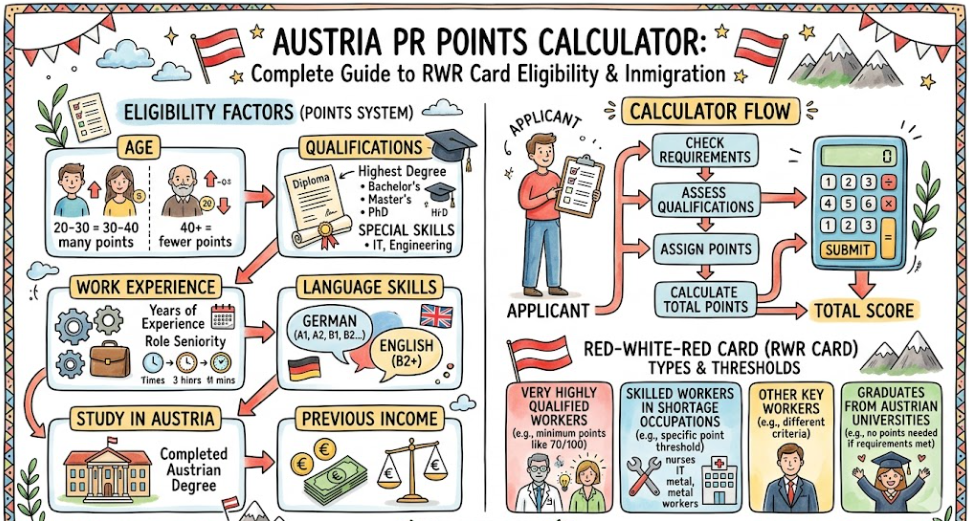
Moving to a new country is a major life decision. You want clarity, confidence, and a reliable roadmap. Austria is currently experiencing a significant demand for skilled talent across various sectors, from engineering and IT to healthcare. To manage this influx, the government uses a point-based system to identify candidates who will thrive in the local economy.
The Austria PR Points Calculator is an essential tool in your arsenal. It allows you to estimate your likelihood of success before you commit to the formal application process. By understanding the weightage of your age, education, and professional background, you can tailor your approach to meet the specific requirements of the Red-White-Red Card.
This guide is designed to walk you through every aspect of the points system. We will break down the complexities into simple, actionable steps, helping you assess your eligibility and plan your future in Austria with precision.
What Is an Austria PR Points Calculator?
In simple terms, the Austria PR Points Calculator is an orientation tool that mimics the official scoring criteria used by the Austrian Public Employment Service (AMS).
Why Austria Uses a Points-Based System
Austria values merit and specific skill sets. The system ensures that the immigration process is transparent and objective. Instead of subjective selection, the authorities look at objective data:
- Qualifications: What you have learned.
- Experience: What you have done.
- Language: How well you can integrate.
- Age: Your potential for long-term contribution.
The Role of the Red-White-Red (RWR) Card
The RWR Card is the permit that allows qualified workers from outside the EU to live and work in Austria. Your score on the calculator determines whether you meet the minimum threshold to qualify for this card.
Important: Meeting the minimum score is an indicator of eligibility, but it is not a guarantee of visa approval. Official points are awarded by the authorities during your actual application review.
How the Austria Immigration Points System Works
Your total score is a composite of several key factors. Think of it as a puzzle; every piece helps complete the picture of your professional value to Austria.
Age Points
Youthful potential is valued. Younger applicants often receive higher points, as they are viewed as having a longer career trajectory ahead of them in the Austrian labor market.
Education Points
Your academic background is a primary driver of your score. Whether you hold a diploma, a Bachelor’s, a Master’s, or a PhD, each level is weighted to reflect the expertise you bring. Specialized degrees, particularly in MINT (Mathematics, Informatics, Natural Sciences, and Technology) subjects, often unlock higher brackets.
Language Skills
Communication is vital for integration. Proficiency in German is highly valued, but the system also recognizes English fluency. Being able to demonstrate language capability—supported by official certifications—is one of the fastest ways to boost your total score.
Work Experience
Experience is measured by your time in the workforce. Having relevant, skilled experience increases your points. Furthermore, having experience in shortage occupations—fields where Austria currently lacks enough local talent—provides a massive advantage.
Salary & Job Offer
A binding job offer from an Austrian employer is often a requirement. The system also considers the salary package offered; higher salary brackets often correlate with “Key Worker” status, which carries significant weight.
Adaptability Factors
These include prior research, publications, or any existing ties to Austria, such as having completed part of your education within the country.
Austria Red-White-Red Card Explained
The Red-White-Red Card system is divided into specific pathways. Understanding which category you fit into is crucial.
- Very Highly Qualified Workers: Targeted at individuals with top-tier education and specific skills. This route often allows you to enter Austria on a Job Seeker Visa to find work locally.
- Skilled Workers in Shortage Occupations: For professionals in fields like engineering, IT, and healthcare where Austria is actively hiring.
- Other Key Workers: For qualified individuals who have a firm job offer and do not fall into the specific shortage list but are nonetheless essential to their employer.
- Start-up Founders: For entrepreneurs bringing innovation and capital to the Austrian market.
Each category has a minimum points requirement. For instance, “Very Highly Qualified” workers generally require a higher point threshold compared to “Other Key Workers.”
Austria PR Points Calculator Breakdown
To get a clear picture, refer to this generalized breakdown. Note that exact point values can be updated by regulatory bodies, so always verify your final estimate against official sources.
| Factor | Description | Points Impact |
| Age | Points decrease as you move into older age brackets. | High Impact |
| Education | Based on degree level (Bachelor vs. Master vs. PhD). | High Impact |
| Language | German (A1/A2/B1/B2) and English levels. | Medium/High Impact |
| Experience | Duration of professional practice. | High Impact |
| Job Offer | Existence of a contract and salary level. | Essential Requirement |
| Bonus | Shortage occupation relevance, specific awards, or research. | Variable Impact |
Step-by-Step Example of Austria PR Score Calculation
Let’s look at three realistic profiles to see how the points add up.
Example 1: Software Engineer (Shortage Occupation Route)
- Age: Under 30.
- Education: Master’s degree in Computer Science.
- Language: English fluent, German A1.
- Experience: Extensive experience in backend development.
- Result: This candidate likely scores high on Education and Experience, easily hitting the minimum threshold for the Shortage Occupation category.
Example 2: Nurse/Healthcare Worker
- Age: Under 40.
- Education: Vocational training/Diploma in Nursing.
- Language: German A2.
- Experience: Several years in clinical environments.
- Result: Highly competitive. Their ability to speak German and their professional training in a shortage occupation makes them a strong candidate.
Example 3: Student Transitioning to Work Visa
- Profile: Completed a Bachelor’s degree in Austria.
- Pathway: Transitioning from a student permit to a work-based permit.
- Result: Having studied in Austria provides bonus points for “Adaptability,” which significantly aids the transition to an RWR Card.
Austria PR Eligibility Requirements
Beyond points, you must satisfy general conditions:
- Educational Qualifications: Must be recognized by Austrian authorities (nostrification may be required).
- Language Proficiency: A1 for basic integration; higher levels are better.
- Financial Proof: Demonstrating you can support yourself initially.
- Health Insurance: Must have coverage compliant with Austrian law.
- Work Contract: For most RWR pathways, you need a confirmed job offer with a salary that meets the minimum threshold.
Benefits of Using an Austria PR Points Calculator
- Fast Eligibility Checking: Instantly see where you stand.
- Immigration Planning: If you are short on points, you have time to improve (e.g., learn German).
- Reduced Rejection Risk: By gauging your score accurately, you avoid applying for streams where you do not meet the minimums.
- Strategic Focus: It helps you identify whether you should focus on gaining more experience or improving your language certifications.
Step-by-Step Guide to Calculate Austria PR Points
- Gather Educational Documents: Ensure all degrees are documented and ready for translation/validation.
- Assess Language Levels: Take an official language test (e.g., ÖSD or Goethe-Institut) to get a certificate.
- Calculate Work Experience: Total your time in the workforce.
- Verify Job Offer: Ensure your prospective employer is eligible to sponsor.
- Calculate Bonus Points: Check if your profession is on the official shortage list.
- Final Tally: Use the Austria PR Points Calculator to estimate your score.
How to Increase Austria PR Score
If your score is slightly below the required threshold, don’t worry. You can improve it:
- Learn German: Moving from A1 to A2 or B1 often adds significant points.
- Enhance Qualifications: Obtaining a higher degree or specialized certification can boost your score.
- Get Certified: Professional certifications in your field (e.g., IT, Project Management) can validate your expertise.
- Target Shortage Occupations: Ensure your job hunt focuses on roles that Austria is actively looking to fill.
Common Mistakes to Avoid
- Overestimating Qualifications: Assuming a degree is automatically recognized without proper verification.
- Ignoring German Language Benefits: Underestimating how much language points help your overall profile.
- Using Outdated Criteria: Immigration rules change; ensure you are using current points tables.
- Missing Documents: Incomplete documentation is the number one cause of processing delays.
Real-Life Case Studies
1. The Young IT Professional
An applicant with a strong coding background but low German skills. By taking an intensive 3-month German course, they raised their language points and crossed the eligibility threshold, securing their permit.
2. The Married Couple
One partner qualified as a key worker. The other focused on improving their language skills, which helped the primary applicant meet the family-reunification and total scoring criteria more effectively.
3. The Healthcare Worker
An experienced nurse who initially missed the threshold. By securing a recognized certification in their specific clinical specialization, they gained the extra points needed to qualify under the Shortage Occupation stream.
FAQs (Frequently Asked Questions)
- What is the Austria PR points calculator?It is an orientation tool to estimate your eligibility for the Red-White-Red Card based on age, education, language, and experience.
- How many points are needed for Austria PR?The requirement varies by visa pathway (e.g., 55 for Shortage Occupations vs. 70 for Very Highly Qualified).
- What is the Red-White-Red Card?It is the official immigration permit for qualified non-EU workers to live and work in Austria.
- Is German language mandatory?For most categories, yes. It is essential for integration and adds significant points to your application.
- Can I move to Austria without a job offer?“Very Highly Qualified” workers may enter on a Job Seeker Visa to find work, but most other categories require a job offer first.
- Does age affect eligibility?Yes, younger applicants receive more points.
- Can students settle permanently in Austria?Yes, students can transition to an RWR Card after completing their studies, provided they find eligible employment.
- How accurate are online calculators?They are excellent for orientation but should be treated as estimates. Official scoring happens at the AMS.
- Are professional certificates useful?Yes, they provide evidence of “special qualifications” which can boost your score.
- What is a “Shortage Occupation”?A role where the Austrian labor market lacks sufficient local workers. These lists are updated annually.
- Do I need a university degree?It depends on the route, but a degree is highly beneficial for the scoring system.
- Can I calculate points if I am already in Austria?Yes, the criteria remain the same regardless of your current location.
Conclusion
The journey to Austria is a goal worth the effort. By using the Austria PR Points Calculator as a guide, you are already ahead of most applicants. You have the ability to plan, optimize, and prepare for success. Focus on the areas you can control—like language proficiency and professional certifications—and you will significantly increase your chances of starting a new chapter in the heart of Europe.

Best Cardiac Hospitals Near You
Discover top heart hospitals, cardiology centers & cardiac care services by city.
Advanced Heart Care • Trusted Hospitals • Expert Teams
View Best Hospitals