Introduction
In the current hyper-competitive business landscape, digital transformation is no longer a luxury; it is a fundamental requirement for survival. Organizations are under immense pressure to release software faster, maintain high availability, and deliver superior customer experiences while managing increasingly complex infrastructure. However, the path to modernization is often fraught with technical debt, siloed teams, and a lack of clear architectural direction.
This is where DevOps consulting becomes a critical catalyst for success. By partnering with experts who understand the intersection of culture, process, and technology, enterprises can navigate the complexities of cloud-native adoption and automation. Whether you are aiming to modernize legacy systems or build a robust platform engineering team, the right DevOps transformation strategy is essential. Organizations looking to jumpstart this journey often rely on the expertise found at DevOpsSchool to align their technical capabilities with overarching business objectives.
What Is DevOps Consulting?
DevOps consulting is the practice of engaging experienced professionals to guide an organization’s transition toward faster, more reliable, and automated software delivery. It is not merely about buying tools; it is about reshaping how teams build, deploy, and manage applications.
Consultants typically focus on:
- Process Assessment: Identifying bottlenecks in current CI/CD pipelines.
- Cloud-Native Transformation: Transitioning from monolithic architectures to microservices.
- Infrastructure Strategy: Moving toward Infrastructure as Code (IaC) to reduce manual configuration errors.
- Cultural Alignment: Breaking down silos between Development and Operations teams to foster shared responsibility.
Understanding Digital Transformation
Digital transformation is the integration of digital technology into all areas of a business, fundamentally changing how you operate and deliver value to customers. It involves moving away from legacy, hardware-bound processes toward agile, cloud-integrated workflows.
Key pillars include:
- Modernization: Refactoring aging software to run efficiently on modern platforms.
- Cloud Adoption: Leveraging the elasticity and scalability of public and private clouds.
- Data-Driven Operations: Using real-time monitoring and analytics to make informed decisions.
- Customer Experience: Faster feature releases that directly respond to user feedback.
Why Organizations Need DevOps Consulting
Many enterprises attempt to implement DevOps practices internally but face significant hurdles. Without external guidance, organizations often fall into “the tool trap,” where they purchase expensive software without changing the underlying operational culture.
Common drivers for seeking consulting include:
- Deployment Latency: Weeks or months required to push a single code update.
- Infrastructure Complexity: Maintaining high-cost, fragile data centers.
- Security Gaps: Manual security checks creating a “bottleneck of death” before releases.
- Scalability Constraints: The inability to handle sudden traffic spikes during peak business hours.
How DevOps Consulting Accelerates Digital Transformation
CI/CD Automation
Consultants implement automated pipelines that allow developers to commit code with the confidence that it will be tested, scanned for vulnerabilities, and deployed consistently.
Infrastructure as Code (IaC)
By treating infrastructure configuration as version-controlled code, consultants help organizations eliminate manual environment provisioning, ensuring consistency across Dev, Test, and Production.
Kubernetes Modernization
Transitioning to container orchestration allows enterprises to manage microservices at scale, ensuring high availability and efficient resource utilization.
Platform Engineering
This is the modern evolution of DevOps. Consultants help build Internal Developer Platforms (IDPs) that provide “golden paths,” allowing developers to self-serve infrastructure without needing deep operational expertise.
DevOps Consulting Lifecycle
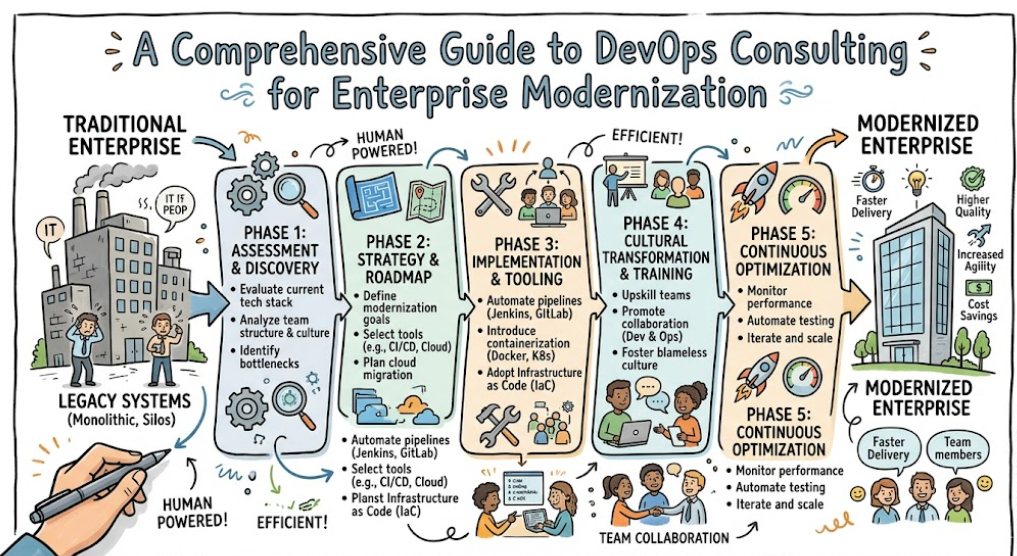
| Stage | Objective | Activities | Business Outcome |
| Assessment | Current state analysis | Gap analysis, tool review | Clear roadmap |
| Strategy | Goal alignment | Architecture design | Defined KPIs |
| Implementation | Execution | CI/CD, IaC, Kubernetes | Speed to market |
| Optimization | Continuous feedback | Performance tuning | Reduced costs |
Cloud-Native Transformation with DevOps
Cloud-native transformation is about building applications specifically for the cloud. DevOps consulting provides the framework to manage these applications through:
- Containers: Decoupling applications from underlying OS environments.
- Microservices: Enabling independent scaling of application features.
- Multi-Cloud Strategies: Preventing vendor lock-in by using abstracting technologies like Terraform or Crossplane.
DevOps Consulting for Different Industries
- Banking & Finance: Focuses on compliance-as-code and secure, automated audit trails.
- Healthcare: Prioritizes data security, privacy, and high-availability systems for patient care.
- E-Commerce: Centers on scalability, load balancing, and rapid deployment of marketing features.
- SaaS Platforms: Emphasizes multi-tenancy support and rapid feature iteration to maintain market advantage.
Benefits of DevOps Consulting
- Faster Delivery: Shorter time-to-market for new features.
- Reduced Downtime: Automated rollbacks and proactive monitoring.
- Cost Optimization: Better resource allocation through cloud-native best practices.
- Increased Reliability: Fewer “human-in-the-loop” errors through extensive automation.
DevOps Consulting vs Traditional IT Consulting
| Feature | DevOps Consulting | Traditional IT Consulting |
| Approach | Automation-first | Manual-process-first |
| Speed | Continuous/Rapid | Project-based/Slow |
| Cloud Focus | Native & Scalable | Lift & Shift |
| Collaboration | Shared responsibility | Departmental silos |
Real-World DevOps Consulting Examples
- Cloud Migration: A legacy retail firm migrates from an on-premise data center to AWS using Kubernetes, reducing infrastructure costs by 40% and increasing deployment frequency.
- SRE Transformation: An enterprise SaaS provider implements Site Reliability Engineering (SRE) principles to achieve “five-nines” (99.999%) availability.
Common Challenges in DevOps Transformation
- Resistance to Change: Staff may fear that automation will make them redundant. Consultants focus on upskilling and shifting roles toward higher-value engineering work.
- Legacy Debt: Trying to “automate the mess.” Consultants advise on which parts of the legacy stack to re-architect versus which to replace.
Role of Leadership in DevOps Transformation
Success requires top-down buy-in. Leaders must provide the budget and, more importantly, the mandate to change processes. They must treat “failure” as a learning opportunity within a controlled environment, fostering a culture of psychological safety.
DevOps Consulting Tools & Technologies
| Tool | Purpose | Enterprise Usage | Difficulty |
| Jenkins/GitLab CI | CI/CD | Pipeline Automation | Medium |
| Kubernetes | Orchestration | Container Management | High |
| Terraform | IaC | Infrastructure Provisioning | Medium |
| Prometheus/Grafana | Observability | Real-time Monitoring | Medium |
Platform Engineering & DevOps Consulting
Platform engineering shifts the focus from managing individual pipelines to providing a robust, self-service platform for developers. Consultants help organizations create an Internal Developer Platform (IDP) that abstracts away the complexity of cloud infrastructure.
DevOps Consulting Career Opportunities
As organizations accelerate their digital transformation, the demand for skilled consultants has skyrocketed. Roles include:
- DevOps Consultant: Strategy and assessment.
- Cloud Architect: Designing secure, scalable cloud environments.
- Platform Engineer: Building the internal developer experience.
- SRE Consultant: Reliability and performance optimization.
DevOps Certifications & Learning Paths
Practical, hands-on experience is the gold standard. While certifications provide a foundational structure, they must be paired with real-world project work. The ecosystem at DevOpsSchool offers a structured way to gain these essential skills.
| Certification | Level | Focus Area | Best For |
| CKA | Advanced | Kubernetes | Architects |
| Terraform Associate | Intermediate | Infrastructure | DevOps Engineers |
| Cloud Pro Certs | Expert | Cloud Native | Leaders |
Common Mistakes Organizations Make
- The “DevOps Team” Silo: Creating a separate DevOps team that just builds tickets for developers. DevOps is a practice, not a department.
- Ignoring Culture: Trying to automate bad processes. Automation amplifies whatever process you have.
- Lack of Metrics: Failing to track DORA metrics (Deployment Frequency, Lead Time for Changes, MTTR, Change Failure Rate).
Future of DevOps Consulting
The future lies in AI-assisted operations, where machine learning models predict infrastructure issues before they happen, and FinOps, where DevOps practices are applied to controlling cloud costs as rigorously as we control deployment quality.
FAQs
- What is DevOps consulting? A professional service aimed at streamlining software delivery through cultural change and automation.
- How does it support digital transformation? It provides the bridge between legacy infrastructure and modern, cloud-native scalability.
- Is it only for large enterprises? No, startups benefit by avoiding technical debt early on.
- How long does it take? It is a journey, not a project; initial improvements are seen in weeks, but cultural maturity takes longer.
- What tools are used? Kubernetes, Terraform, CI/CD platforms, and monitoring tools like Prometheus.
- Does it improve security? Yes, by implementing DevSecOps and shifting security left into the pipeline.
- What industries benefit most? Any industry relying on software to deliver value.
- What skills are required for consultants? A mix of coding, systems architecture, cloud management, and communication.
- Can we do it in-house? It is possible but often slower and prone to repeating common mistakes.
- What is a “Golden Path”? A standardized, approved workflow for developers to deploy apps.
- How do we measure success? Through DORA metrics and improved business KPIs.
- Is it expensive? It is an investment that usually pays for itself through increased efficiency and reduced downtime.
- Do we need to switch clouds? Not necessarily; experts help optimize the cloud you are already on.
- How do we handle resistance? By showing quick wins and demonstrating how automation makes work easier for staff.
- Where should we start? Start with an assessment of your most painful manual process.
Final Thoughts
DevOps consulting is not about a quick fix or a magic piece of software. It is a commitment to a culture of continuous improvement, automation, and architectural excellence. As organizations navigate the complexities of the cloud-native era, the guidance of seasoned professionals becomes a strategic asset. By focusing on platform engineering, robust automation, and a culture of shared ownership, businesses can ensure they are not just surviving, but thriving in the digital economy.

Best Cardiac Hospitals Near You
Discover top heart hospitals, cardiology centers & cardiac care services by city.
Advanced Heart Care • Trusted Hospitals • Expert Teams
View Best Hospitals