Introduction
A bioinformatics workflow manager is a specialized software system designed to coordinate the execution of complex sequences of data processing steps, often called pipelines. In the field of genomics and computational biology, a single analysis can involve dozens of different tools, each with its own specific input requirements and dependencies. Workflow managers automate this entire chain, ensuring that data flows correctly from one tool to the next while managing the underlying computational resources, whether they are on a personal computer, a high-performance computing (HPC) cluster, or the cloud.
The importance of these systems has reached a critical point. With the massive increase in data from next-generation sequencing and single-cell technologies, manual data handling is no longer possible. Modern research requires “reproducibility,” which means another scientist should be able to run the exact same analysis and get the same result. Workflow managers solve this by “freezing” the environment using containers and tracking every parameter used in the process. This creates a reliable, auditable trail that is essential for both academic discovery and clinical diagnostics.
Real-World Use Cases
- Processing raw DNA sequencing data to identify genetic variants associated with rare diseases.
- Automating the assembly of complex genomes for agricultural research and crop improvement.
- Managing large-scale RNA-Seq pipelines to understand gene expression patterns in cancer cells.
- Coordinating metagenomic analyses to study microbial communities in environmental samples.
- Executing standardized clinical pipelines that must meet strict regulatory and audit requirements.
Evaluation Criteria for Buyers
- The ability to move the same workflow between a laptop, a local cluster, and various cloud providers without rewriting code.
- How easily the system can parallelize tasks and handle thousands of samples simultaneously.
- Support for industry-standard container technologies like Docker and Singularity to ensure identical execution environments.
- The complexity of the specialized language used to write the workflows and the time needed for a team to learn it.
- Whether the system can automatically restart a failed pipeline from the last successful step without repeating work.
- The availability of pre-built, community-vetted pipelines for common tasks like variant calling.
- How well the system tracks the origin and processing history of every data file.
Best for: Computational biologists, bioinformaticians, genomic researchers, and clinical lab managers who need to scale data analysis and ensure scientific reproducibility.
Not ideal for: Scientists performing one-off, simple calculations on small spreadsheets, or those who prefer manual “point-and-click” tools for every individual step of their research.
Key Trends in Bioinformatics Workflow Managers
- Integration of AI agents that can automatically suggest pipeline optimizations or fix minor code errors during execution.
- A major shift toward “cloud-native” designs that allow pipelines to scale up and down based on the exact amount of data being processed.
- The widespread adoption of standardized workflow languages that allow different organizations to share pipelines seamlessly.
- Enhanced focus on data provenance and “FAIR” (Findable, Accessible, Interoperable, and Reusable) data principles.
- The rise of hybrid workflows that combine traditional high-performance computing with specialized AI hardware.
- Improved user interfaces that allow non-programmers to monitor and manage complex command-line pipelines through a web browser.
- Native support for “versioned” datasets, ensuring that even if a database changes, the original analysis remains reproducible.
- Increased automation of quality control steps, with pipelines automatically stopping if data quality falls below a certain threshold.
How We Selected These Tools
The selection of these top ten workflow managers is based on their adoption within the global bioinformatics community and their technical reliability in high-stakes research. We prioritized tools that have a proven track record in major genomic consortia and large-scale public health projects. A significant factor was “portability”—the ability of the tool to function across diverse computing environments. We also looked for active maintenance, ensuring that these tools are compatible with the latest security standards and hardware. Finally, we ensured a balance between code-heavy engines for developers and accessible platforms for researchers without deep programming backgrounds.
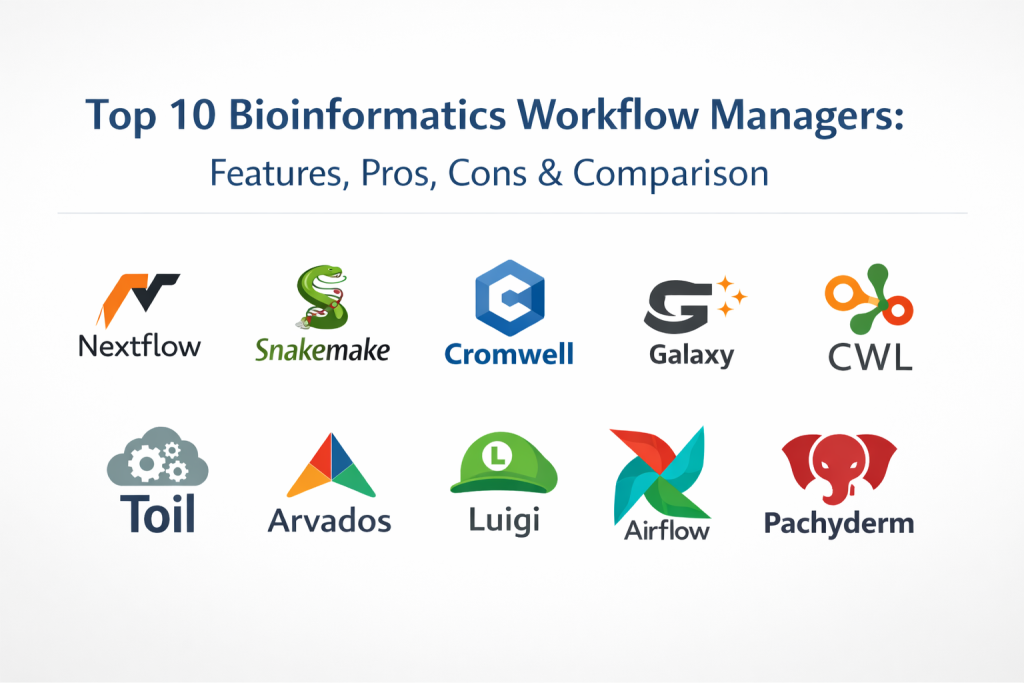
Top 10 Bioinformatics Workflow Managers Tools
1. Nextflow
Nextflow is currently the most popular choice for scalable bioinformatics. It uses a unique “dataflow” model where tasks are triggered as soon as their required data is available. This allows for massive parallelization and makes it exceptionally good at running on cloud platforms. It is the engine behind the massive nf-core project, which provides a library of high-quality, peer-reviewed pipelines.
Key Features
- Sophisticated dataflow programming model for automatic parallel execution.
- First-class support for Docker, Singularity, and Conda environments.
- Native integration with major cloud providers and HPC schedulers like Slurm.
- Powerful “resume” feature that intelligently skips already completed tasks.
- Strong modularity that allows for easy code reuse across different projects.
Pros
- Unrivaled scalability for large-scale genomic datasets.
- Massive library of community-vetted pipelines through nf-core.
Cons
- Requires learning a Groovy-based domain-specific language.
- Configuration for specific HPC environments can be complex.
Platforms / Deployment
Windows / macOS / Linux — Hybrid / Cloud
Security & Compliance
Supports encrypted data channels and enterprise-level authentication in managed versions.
Integrations & Ecosystem
Nextflow integrates with virtually all major bioinformatics tools and databases. Its ecosystem is dominated by nf-core, a global community that maintains dozens of production-ready pipelines.
Support & Community
It boasts one of the largest and most active communities in the field, with extensive documentation and a dedicated Slack channel for real-time help.
2. Snakemake
Snakemake is a Python-based workflow manager that is widely loved for its readability and simplicity. It uses a “rule-based” approach where you define the desired output file, and the software works backward to determine which tools need to run. Because it is built on Python, it is very accessible to the majority of bioinformaticians who already use that language.
Key Features
- Python-native syntax that is easy for researchers to read and write.
- Automatic dependency resolution by looking at input and output filenames.
- Excellent support for Conda, allowing for automated software installation.
- Integrated reporting that generates a visual summary of the entire analysis.
- Built-in support for cloud execution and cluster scheduling.
Pros
- Very short learning curve for anyone with basic Python knowledge.
- Exceptionally clean and readable workflow files.
Cons
- Managing very large, complex pipelines can lead to “rule clutter.”
- Scaling to massive cloud environments is not as “native” as Nextflow.
Platforms / Deployment
Windows / macOS / Linux — Self-hosted / Cloud
Security & Compliance
Varies / N/A.
Integrations & Ecosystem
It integrates perfectly with the vast Python data science ecosystem. The Snakemake Workflow Catalog provides a wide range of community-contributed pipelines for various omics analyses.
Support & Community
Very strong academic community with excellent documentation and a long history of use in published research.
3. Cromwell (WDL)
Cromwell is the execution engine for the Workflow Description Language (WDL). It was developed primarily by the Broad Institute to handle the massive processing needs of the GATK (Genome Analysis Toolkit). It is a “clinical-grade” tool designed for reliability, auditability, and massive throughput in cloud environments like Google Cloud.
Key Features
- Designed specifically to execute WDL, a highly readable workflow language.
- Battle-tested in some of the world’s largest genomic processing projects.
- Strong focus on reproducibility and strict data provenance.
- Flexible backend system that supports local, HPC, and cloud execution.
- Built-in support for “call caching” to avoid redundant computations.
Pros
- The gold standard for high-throughput, standardized genomics pipelines.
- WDL is arguably the most readable workflow language for non-programmers.
Cons
- Setting up the Cromwell server can be technically demanding.
- The community ecosystem is more focused on enterprise/clinical use than general research.
Platforms / Deployment
Windows / macOS / Linux — Cloud / Hybrid
Security & Compliance
Highly secure, often used in environments requiring HIPAA compliance and strict audit trails.
Integrations & Ecosystem
It is the native engine for platforms like Terra.bio and is deeply integrated with the GATK ecosystem for variant discovery.
Support & Community
Backed by the Broad Institute, offering professional-grade documentation and support for large-scale users.
4. Galaxy
Galaxy is a web-based platform designed to make bioinformatics accessible to everyone, regardless of their ability to write code. It provides a graphical interface where users can drag and drop tools to create a pipeline. It is an essential tool for training and for researchers who need to perform complex analyses without becoming software engineers.
Key Features
- Comprehensive web-based graphical user interface for tool and workflow management.
- Transparent tracking of every tool version and parameter used in an analysis.
- Built-in tools for sharing workflows and data libraries with collaborators.
- Interactive visualization tools for exploring results within the browser.
- Large public servers (UseGalaxy.org) that provide free compute for researchers.
Pros
- No programming skills required to run sophisticated bioinformatics.
- Ideal for teaching and collaborative projects across different labs.
Cons
- Less flexible for highly custom or cutting-edge tool development.
- Can be slower than command-line tools for processing very large datasets.
Platforms / Deployment
Web / Windows / macOS / Linux — Cloud / Self-hosted
Security & Compliance
Managed public servers have standard security; private instances can be configured for high-level compliance.
Integrations & Ecosystem
Galaxy has a massive “Tool Shed” containing thousands of wrappers for existing bioinformatics software. It is a cornerstone of the global bioinformatics training community.
Support & Community
Incredible community support with an extensive library of tutorials (Galaxy Training Network) and a worldwide network of public servers.
5. Common Workflow Language (CWL)
CWL is not a single piece of software, but an industry-standard specification for describing workflows. The goal is to make pipelines completely “portable”—a CWL workflow written today should work on any engine that supports the standard. It is favored by organizations that want to avoid being locked into a single software vendor.
Key Features
- A strict, community-driven standard for workflow and tool descriptions.
- Focuses on absolute portability across different execution engines.
- Heavy emphasis on using containers for every single step of a process.
- Explicitly defines all inputs and outputs to prevent “hidden” dependencies.
- Supported by many different executors, including Toil and Arvados.
Pros
- Future-proofs your work by adhering to an open, multi-vendor standard.
- Excellent for large-scale international research consortia.
Cons
- The language (YAML/JSON) is very verbose and harder to write by hand.
- Requires an external engine (like Toil) to actually run the workflow.
Platforms / Deployment
Varies by executor — Hybrid / Cloud
Security & Compliance
The standard itself supports metadata for compliance; implementation depends on the engine used.
Integrations & Ecosystem
Compatible with any tool that can be containerized. It is widely used in national-level genomic initiatives where interoperability is key.
Support & Community
Very strong community focused on standards and interoperability, backed by major academic and industrial partners.
6. Toil
Toil is an open-source workflow engine designed for massive scalability, specifically on cloud platforms like AWS and Azure. It is unique because it supports multiple workflow languages, including CWL and WDL, making it a versatile “bridge” for organizations that use different standards.
Key Features
- Supports execution of CWL, WDL, and Python-native workflows.
- Highly efficient “leader-worker” architecture for distributed computing.
- Built-in support for cloud autoscaling to manage compute costs.
- Robust fault tolerance that can survive spot instance interruptions.
- Optimized for high-throughput processing of thousands of samples.
Pros
- One of the best engines for cost-effective, large-scale cloud processing.
- Flexibility to run workflows written in different languages.
Cons
- Smaller community than Nextflow or Snakemake.
- Documentation can be more technical and geared toward developers.
Platforms / Deployment
Linux / macOS — Cloud / Hybrid
Security & Compliance
Not publicly stated.
Integrations & Ecosystem
It integrates deeply with cloud storage (S3, Azure Blobs) and has been used extensively in large-scale cancer genomics projects.
Support & Community
Developed and maintained primarily by the UCSC Genomics Institute, offering strong academic support.
7. Arvados
Arvados is an enterprise-grade platform that combines workflow management with sophisticated data management. It is designed for large organizations that need to store petabytes of genomic data while maintaining a complete, searchable history of every analysis ever performed.
Key Features
- Integrated “Keep” storage system that tracks data provenance automatically.
- Uses CWL as its primary workflow description language.
- High-performance “Crunch” compute engine for executing containers.
- Advanced metadata search allows you to find data based on how it was processed.
- Strong focus on multi-user environments and shared resources.
Pros
- Exceptional for managing both the data and the workflows in one place.
- Designed for long-term storage and auditability of massive datasets.
Cons
- High complexity for initial setup and administration.
- Overkill for individual researchers or small labs.
Platforms / Deployment
Linux — Self-hosted / Cloud
Security & Compliance
Built for high-security environments; supports RBAC and detailed audit logs.
Integrations & Ecosystem
Provides a complete API and SDK for integrating with internal lab systems and data warehouses.
Support & Community
Professional support is available through commercial partners, with a solid open-source core.
8. Luigi
Luigi is a Python-based engine developed by Spotify and adapted by many in the bioinformatics community for managing complex pipelines. It is particularly good at handling long-running tasks that have complex dependencies on other data files and external databases.
Key Features
- Simple Python syntax for defining tasks and their requirements.
- A visual dashboard for monitoring the status of all running workflows.
- Built-in failure handling and dependency resolution.
- Excellent at integrating diverse data sources beyond just flat files.
- Highly extensible, allowing for custom task types and backends.
Pros
- Very reliable for pipelines that interact with many different systems.
- Familiar and comfortable for general Python developers.
Cons
- Lacks some of the “bioinformatics-specific” features of Nextflow (like nf-core).
- Not as naturally “container-first” as newer engines.
Platforms / Deployment
Windows / macOS / Linux — Self-hosted
Security & Compliance
Not publicly stated.
Integrations & Ecosystem
Strong integration with standard databases and data processing tools used in general data science.
Support & Community
Backed by a large general-purpose engineering community, though the bioinformatics niche is smaller.
9. Apache Airflow
While Airflow is a general-purpose tool for “data engineering,” it has become increasingly popular in bioinformatics for orchestrating high-level pipelines. It is particularly useful for organizations that need to connect bioinformatics steps with other business processes, like clinical reporting or patient database updates.
Key Features
- Uses Python to define Directed Acyclic Graphs (DAGs) for workflows.
- Powerful scheduling and monitoring interface.
- Massive library of “operators” for connecting to every imaginable service.
- Highly scalable architecture capable of managing thousands of concurrent tasks.
- Strong support for logging and error alerting.
Pros
- Best-in-class monitoring and management UI.
- Perfect for complex, multi-system orchestration beyond just biology.
Cons
- Has significant overhead for simple bioinformatics tasks.
- Requires a permanent server infrastructure to run the scheduler.
Platforms / Deployment
Linux / macOS — Cloud / Self-hosted
Security & Compliance
Supports enterprise identity providers and detailed access controls.
Integrations & Ecosystem
Integrates with almost every modern data tool and cloud service.
Support & Community
One of the largest open-source communities in the world for data orchestration.
10. Pachyderm
Pachyderm is a “data-centric” workflow manager built on top of Kubernetes. Its standout feature is its ability to track versions of data files just like programmers track versions of code. If a data file changes, Pachyderm can automatically re-run only the parts of the pipeline affected by that change.
Key Features
- Data versioning (git-for-data) is built into the core of the system.
- Container-native execution using Kubernetes.
- Incremental processing to save time and compute costs.
- Complete data lineage and provenance tracking for every output.
- Highly scalable for processing massive, evolving datasets.
Pros
- Unique ability to handle data versioning and incremental updates.
- Very strong reproducibility and audit capabilities.
Cons
- Requires a deep understanding of Kubernetes to manage.
- Can be complex to set up for smaller, simpler research projects.
Platforms / Deployment
Kubernetes — Cloud / Hybrid
Security & Compliance
Designed for enterprise and regulated environments; supports advanced security features.
Integrations & Ecosystem
Deeply integrated with the Kubernetes ecosystem and modern data science platforms.
Support & Community
Professional support is available through HPEDetermined AI, with an active open-source community.
Comparison Table (Top 10)
| Tool Name | Best For | Platform(s) Supported | Deployment | Standout Feature | Public Rating |
| 1. Nextflow | Scalable Genomics | Windows, macOS, Linux | Hybrid | Dataflow Model | 4.7/5 |
| 2. Snakemake | Python Users | Windows, macOS, Linux | Self-hosted | Rule-based Logic | 4.6/5 |
| 3. Cromwell | Clinical Genomics | Windows, macOS, Linux | Cloud | WDL Standard | 4.5/5 |
| 4. Galaxy | Non-programmers | Web, Windows, Linux | Cloud | Drag-and-drop UI | 4.6/5 |
| 5. CWL | Interoperability | Varies by executor | Hybrid | Open Standard | N/A |
| 6. Toil | Multi-engine Cloud | Linux, macOS | Cloud | Support for CWL/WDL | 4.3/5 |
| 7. Arvados | Data Management | Linux | Hybrid | Built-in Provenance | 4.2/5 |
| 8. Luigi | Python Pipelines | Windows, macOS, Linux | Self-hosted | Task Dependency | 4.0/5 |
| 9. Airflow | Enterprise Orchestration | Linux, macOS | Cloud | Monitoring UI | 4.5/5 |
| 10. Pachyderm | Data Versioning | Kubernetes | Hybrid | Git-for-Data | 4.4/5 |
Evaluation & Scoring of Bioinformatics Workflow Managers
| Tool Name | Core (25%) | Ease (15%) | Integrations (15%) | Security (10%) | Perf (10%) | Support (10%) | Value (15%) | Total |
| 1. Nextflow | 10 | 6 | 10 | 8 | 10 | 10 | 8 | 8.9 |
| 2. Snakemake | 9 | 9 | 8 | 6 | 8 | 9 | 9 | 8.4 |
| 3. Cromwell | 10 | 5 | 9 | 10 | 9 | 8 | 7 | 8.3 |
| 4. Galaxy | 8 | 10 | 8 | 7 | 6 | 10 | 9 | 8.3 |
| 5. CWL | 9 | 4 | 10 | 7 | 8 | 9 | 7 | 7.7 |
| 6. Toil | 8 | 6 | 8 | 7 | 9 | 7 | 8 | 7.6 |
| 7. Arvados | 8 | 4 | 7 | 9 | 8 | 7 | 6 | 7.0 |
| 8. Luigi | 7 | 7 | 7 | 6 | 7 | 7 | 7 | 6.9 |
| 9. Airflow | 7 | 6 | 9 | 9 | 7 | 8 | 6 | 7.2 |
| 10. Pachyderm | 8 | 4 | 7 | 9 | 9 | 7 | 7 | 7.3 |
Scoring follows professional standards for high-throughput data analysis. A high “Core” score indicates the system provides the fundamental requirements for scientific reproducibility and containerization. “Ease” reflects how quickly a research team can implement their first pipeline, while “Value” considers both software costs and the potential for compute cost-savings.
Which Bioinformatics Workflow Managers Tool Is Right for You?
Solo / Freelancer
For an individual researcher, Snakemake is the most practical choice because of its Python roots and easy learning curve. If you have zero interest in coding, Galaxy provides the most powerful alternative via its web interface.
SMB (Small to Medium Business)
Small biotech firms should look at Nextflow due to the massive library of nf-core pipelines that allow a small team to perform like a much larger one. Snakemake is also a strong contender for internal research pipelines.
Mid-Market
Mid-sized organizations often require the robust, standardized workflows provided by Cromwell or the high-end scalability of Toil for cloud-heavy projects. These tools provide the necessary balance between power and production readiness.
Enterprise
Large pharmaceutical companies and major diagnostic labs typically require Nextflow (often with Tower/Nextflow.io for management) or Arvados. These tools offer the administrative controls and data management features needed for massive teams.
Budget vs Premium
All these tools have free, open-source versions. “Premium” refers to the managed platforms that run these engines, such as Pachyderm Enterprise or Nextflow Tower, which reduce the internal burden of infrastructure management.
Feature Depth vs Ease of Use
Galaxy is the easiest to use but has the least depth for custom coding. Nextflow and Snakemake offer deep customization but require a dedicated learning period. Houdini-like procedural control in bioinformatics is best achieved through Nextflow.
Integrations & Scalability
Nextflow and Cromwell lead in cloud scalability. Airflow leads in high-level integration with non-biological systems, making it a good choice for connecting a lab to the rest of a company.
Security & Compliance Needs
Organizations working with sensitive human patient data should prioritize Cromwell or Arvados, as these tools are designed with clinical audit trails and data governance as primary requirements.
Frequently Asked Questions (FAQs)
1. What exactly is a bioinformatics workflow manager?
It is a system that automates the running of multiple data analysis tools in a specific order, ensuring data moves correctly and results are reproducible.
2. Do I really need to learn a new language to use these?
Many require a basic understanding of a specialized language like WDL or a Groovy-based DSL, but platforms like Galaxy allow you to work entirely through a visual interface.
3. Are these tools capable of running in the cloud?
Yes, most modern managers are designed to be “cloud-native,” meaning they can automatically start and stop virtual machines to run your analysis.
4. Can I use these for small-scale projects?
Absolutely. Tools like Snakemake are perfect for small, single-user projects and help ensure that your work is organized and reproducible from day one.
5. How does a workflow manager help with reproducibility?
By using containers and tracking every parameter, these tools ensure that anyone else can run your analysis and get the exact same results.
6. Is it hard to switch from one manager to another?
There is a learning curve when switching languages, but the underlying concepts of inputs, outputs, and tasks remain the same across all platforms.
7. Which tool is best for clinical settings?
Cromwell (using WDL) is often preferred in clinical and regulated environments due to its origins in the Broad Institute and focus on auditability.
8. Do these tools cost money to use?
All ten tools listed are open-source and free to use. However, you will still have to pay for the underlying computer power (like AWS or Google Cloud).
9. Can these tools handle data from single-cell sequencing?
Yes, the modern versions of all these managers are highly optimized for the massive data volumes produced by single-cell and spatial omics technologies.
10. Where should a beginner start?
If you know Python, start with Snakemake. If you don’t want to code, start with Galaxy. If you want the most popular industry tool, start with Nextflow.
Conclusion
Choosing the right bioinformatics workflow manager is one of the most important technical decisions a research team can make. It is the difference between a project that is disorganized and unrepeatable and one that is scalable, efficient, and scientifically sound. Whether you prioritize the Pythonic simplicity of Snakemake, the web-based accessibility of Galaxy, or the enterprise-grade power of Nextflow, each of these ten tools provides a robust path toward modern data analysis. The key is to select the tool that matches your team’s existing skills while offering the room to grow as your data needs expand. As the industry continues to move toward more complex multi-omics and AI-driven analyses, the ability to automate and reproduce your work will only become more vital. By mastering these workflow managers, you are not just learning a piece of software; you are adopting a professional standard that ensures your scientific discoveries can stand the test of time. The future of biology is digital, and these tools are the engines that will drive the next generation of breakthroughs in medicine and biotechnology.

Best Cardiac Hospitals Near You
Discover top heart hospitals, cardiology centers & cardiac care services by city.
Advanced Heart Care • Trusted Hospitals • Expert Teams
View Best Hospitals