Introduction
Healthcare Electronic Medical Record (EMR) systems are digital versions of a patient’s paper charts. These platforms are secure, real-time records that make information available instantly and securely to authorized users. While an EMR contains the medical and treatment history of patients in one practice, modern systems have evolved into comprehensive Health IT suites that manage everything from clinical documentation and e-prescribing to complex revenue cycle management and patient engagement.
In the current medical landscape, EMR systems are the central nervous system of any healthcare facility. The shift toward value-based care and the increasing need for interoperability—the ability for different systems to talk to one another—has made these tools indispensable. Beyond mere record-keeping, today’s systems leverage artificial intelligence to reduce physician burnout, automate repetitive billing tasks, and provide predictive analytics that can literally save lives by identifying at-risk patients before a crisis occurs.
Real-World Use Cases
- Coordinating care for chronic disease patients by sharing real-time data between primary care doctors and specialists.
- Utilizing built-in AI “scribes” to listen to patient encounters and automatically draft clinical SOAP notes.
- Managing large-scale vaccination programs or public health screenings with integrated population health tools.
- Streamlining the billing process by automatically scrubbing insurance claims for errors before submission to reduce denials.
- Providing patients with immediate access to their lab results and prescription refills through secure mobile portals.
Evaluation Criteria for Buyers
- The ability to share data seamlessly across different hospitals and external clinical networks.
- How much the software simplifies or complicates the daily charting process for clinicians.
- The strength of integrated billing, coding, and insurance verification features.
- The availability of robust patient portals, telehealth, and automated reminder systems.
- Adherence to strict security standards like HIPAA and evidence of robust encryption.
- Specialized workflows for different medical fields (e.g., Cardiology, Oncology, or Pediatrics).
- The availability of high-quality onboarding, 24/7 technical support, and user communities.
Best for: Large health systems, community hospitals, and ambulatory practices seeking to digitize patient records and optimize clinical workflows.
Not ideal for: Facilities that only require a basic digital filing system without clinical intelligence, or very small practices with no budget for specialized hardware and training.
Key Trends in Healthcare EMR Systems
- The integration of ambient AI assistants that record and summarize patient visits in real time to reduce manual typing.
- A massive push toward “interoperability-first” design, using FHIR and OpenUSD-like standards to bridge data gaps between competing systems.
- The migration of legacy on-premise servers to secure, high-uptime cloud environments for better remote access.
- Enhanced predictive analytics that use machine learning to flag potential sepsis or cardiac events in hospital wards.
- The expansion of “Hospital at Home” features, allowing EMRs to integrate data from wearable patient monitoring devices.
- A shift toward subscription-based pricing models that include continuous updates and cybersecurity monitoring.
- The development of specialty-specific modules that remove unnecessary clicks for doctors in niche fields like dermatology or ophthalmology.
- Increased focus on “Patient-Centered Design” where the patient portal is as robust as the physician’s interface.
How We Selected These Tools
The selection of the top ten EMR systems is based on an extensive review of the healthcare technology market. We focused on platforms that have achieved significant market share and have a proven track record in both clinical and financial performance. A primary factor was the “Meaningful Use” certification and compliance with current health data regulations. We also looked for systems that have successfully integrated modern AI and cloud technologies to solve the growing issue of provider burnout. The list is balanced to serve various segments, including massive enterprise health networks, mid-market community hospitals, and specialized ambulatory clinics.
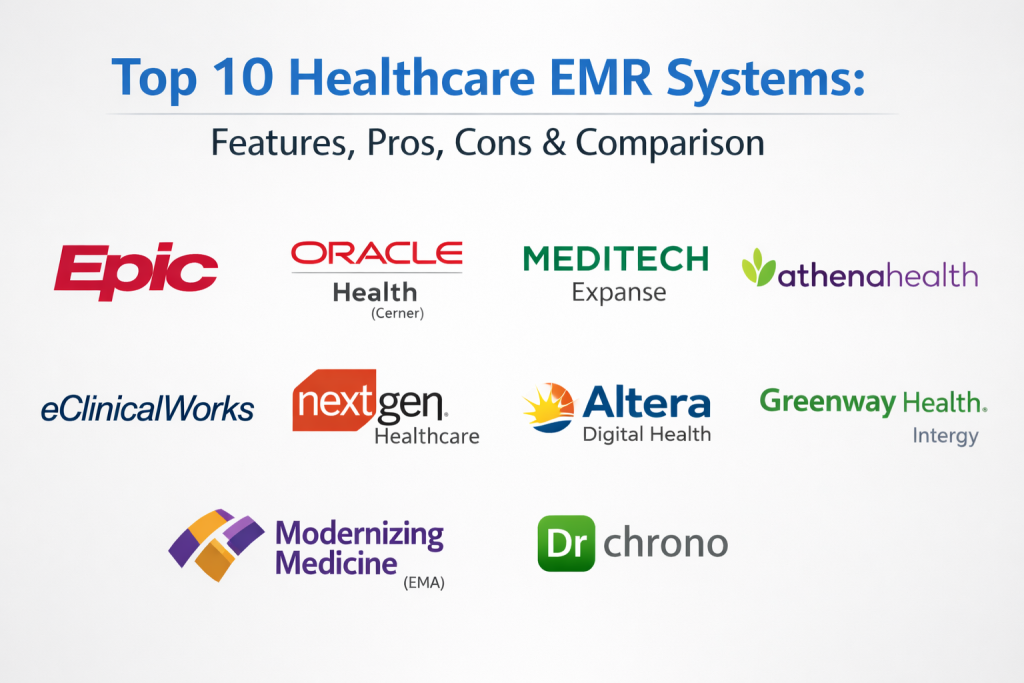
Top 10 Healthcare EMR Systems
1. Epic
Epic is widely considered the leading EMR for large, complex healthcare organizations. It is known for its “One Patient, One Record” philosophy, ensuring that a patient has a single, continuous chart across all departments and even across different organizations using the software.
Key Features
- The MyChart portal, which is the most widely used patient engagement tool in the industry.
- Care Everywhere, a robust network for sharing patient records with other health systems.
- Integrated AI tools for summarizing long patient charts and drafting clinical messages.
- Specialized modules for every imaginable hospital department, from oncology to transplant.
- Comprehensive revenue cycle management that links clinical care directly to billing.
Pros
- Unrivaled for enterprise-wide data consistency and interoperability.
- Highly rated by clinicians for its robust and reliable feature set once mastered.
Cons
- Extremely high implementation costs and long training periods.
- The interface can feel overwhelming due to the sheer depth of available features.
Platforms / Deployment
Web / Windows / iOS / Android — Hybrid
Security & Compliance
Enterprise-grade security with full SSO/MFA and SOC 2 compliance.
Integrations & Ecosystem
Epic features an extensive “App Orchard” that allows third-party developers to build specialized tools that plug directly into the EMR. It has deep integrations with all major laboratory and imaging systems.
Support & Community
One of the strongest professional communities in healthcare, supported by deep official training and a massive network of certified consultants.
2. Oracle Health (Cerner)
Now part of the Oracle ecosystem, the Cerner Millennium platform is a powerhouse for hospitals and health systems. It focuses on providing a unified view of the patient and is particularly strong in its data analytics and population health management capabilities.
Key Features
- PowerChart, an intuitive clinical interface for reviewing and documenting patient care.
- HealtheIntent, a world-class population health platform that aggregates data from various sources.
- Built-in voice recognition and AI-driven documentation to speed up charting.
- Robust clinical decision support that alerts doctors to potential medication errors.
- Extensive support for academic medical centers and large research institutions.
Pros
- Strong focus on hospital-scale workflows and multi-facility coordination.
- Backed by Oracle’s massive cloud infrastructure for high performance and security.
Cons
- Users often report that the interface requires “too many clicks” for simple tasks.
- Customization can be a slow and complex process for smaller teams.
Platforms / Deployment
Web / Windows / iOS / Android — Cloud / Hybrid
Security & Compliance
Leverages Oracle’s high-security cloud protocols and full HIPAA compliance.
Integrations & Ecosystem
Integrates with a vast range of third-party apps and devices, including advanced connections to pharmacy and lab networks globally.
Support & Community
Provides 24/7 global support and a large user network particularly strong in the hospital sector.
3. MEDITECH Expanse
MEDITECH Expanse is a modernized, web-based EMR designed to provide a seamless experience across the entire continuum of care. It is a favorite for community and mid-sized hospitals that want a modern, mobile-first experience without the enterprise complexity of its larger rivals.
Key Features
- A fully web-based and mobile-responsive interface that works on tablets and smartphones.
- Traverse Exchange, a network that allows for free-flowing information between different care settings.
- Precision medicine tools that integrate genomic data directly into the patient chart.
- Surveillance tools that use predictive analytics to monitor at-risk patients in real time.
- Personalized home screens for different roles, such as nurses, doctors, and pharmacists.
Pros
- Very cost-effective compared to Epic or Oracle for mid-sized facilities.
- Modern, intuitive design that significantly reduces the learning curve.
Cons
- Not as many third-party “app store” options as the larger players.
- Some users find the reporting tools less flexible than enterprise-level systems.
Platforms / Deployment
Web / iOS / Android — Cloud / Hybrid
Security & Compliance
Full HIPAA compliance with robust role-based access controls.
Integrations & Ecosystem
Focuses on “MaaS” (MEDITECH as a Service) for cloud hosting and provides standard HL7 and FHIR connections for external integrations.
Support & Community
Known for having high customer satisfaction and a dedicated, long-term user base in the community hospital segment.
4. athenahealth (athenaOne)
athenahealth provides a completely cloud-native suite called athenaOne. It is unique because it combines EMR software with managed services, where athenahealth’s own staff helps clinics manage their billing and administrative tasks.
Key Features
- A unified cloud platform for EMR, practice management, and patient engagement.
- Automatic updates that ensure every user is always on the latest, most compliant version.
- A high-performing billing engine that handles claim submissions and follow-ups.
- Built-in telehealth and patient communication tools like automated text reminders.
- An intuitive “athenaNet” dashboard for tracking practice performance in real time.
Pros
- Excellent for ambulatory practices that want to outsource their billing headaches.
- Frequent cloud updates mean the system is always evolving with new regulations.
Cons
- The cost is often a percentage of practice revenue, which can be expensive as you grow.
- Less focused on complex inpatient (hospital) workflows.
Platforms / Deployment
Web / iOS / Android — Cloud
Security & Compliance
Native cloud security with continuous monitoring and full HIPAA certification.
Integrations & Ecosystem
The “athenahealth Marketplace” offers hundreds of pre-integrated third-party apps for everything from patient intake to advanced clinical specialties.
Support & Community
Offers a strong coaching-based support model and a very active community of ambulatory care professionals.
5. eClinicalWorks
eClinicalWorks is one of the most widely used EMRs for multi-specialty ambulatory practices. It is known for its broad feature set and its focus on using AI to streamline every aspect of the patient encounter.
Key Features
- The Grid Cloud architecture, which provides high speed and 24/7 data availability.
- Sunoh.ai, a conversational AI tool that turns patient-doctor talk into clinical notes.
- V12, a modernized user interface that is cleaner and faster than older versions.
- Comprehensive telehealth features integrated directly into the clinician workflow.
- Population health tools that help track quality measures and HEDIS scores.
Pros
- One of the most feature-rich systems available for the price point.
- Excellent integration between clinical charting and back-office billing.
Cons
- The sheer number of features can make the learning curve quite steep.
- Some users report that customization options for specific workflows are limited.
Platforms / Deployment
Web / Windows / macOS / iOS / Android — Cloud / Hybrid
Security & Compliance
Secure private cloud infrastructure with full HIPAA and SOC 2 auditing.
Integrations & Ecosystem
Deeply integrated with national laboratories, pharmacies, and imaging centers across the United States.
Support & Community
Strong customer support and a massive annual user conference that fosters a large community of experts.
6. NextGen Healthcare
NextGen is a highly configurable EMR designed for medium-to-large ambulatory groups. It is particularly well-regarded for its ability to handle complex, multi-site practices and its strong focus on government regulatory compliance.
Key Features
- Ambient Assist, an AI tool that converts spoken conversation into structured SOAP notes.
- Highly customizable templates for over 25 different medical specialties.
- Integrated revenue cycle management and financial reporting for large groups.
- A robust patient experience platform including a portal and mobile self-check-in.
- MIPS/MACRA reporting tools that help practices maximize their government incentives.
Pros
- Unmatched configurability for practices with very specific workflow needs.
- Strong, reliable reporting for large-scale administrative and financial management.
Cons
- The interface can feel “dated” compared to newer web-native platforms.
- Connectivity and performance can occasionally lag in very complex configurations.
Platforms / Deployment
Web / Windows / iOS / Android — Hybrid / Cloud
Security & Compliance
Full HIPAA compliance and robust auditing features for regulatory oversight.
Integrations & Ecosystem
Offers a wide range of APIs and pre-built connections for lab, pharmacy, and third-party healthcare apps.
Support & Community
Very professional support network with a long history of serving large ambulatory medical groups.
7. Altera Digital Health (Sunrise)
Formerly part of Allscripts, Altera’s Sunrise platform is an enterprise-grade solution built for large hospitals. It is known for its clinician-led design and its ability to handle the intense, high-stakes environment of emergency departments and acute care.
Key Features
- A modular design that allows hospitals to add features for pharmacy, radiology, and surgery.
- Sunrise Clinical Manager, a robust hub for all inpatient and outpatient data.
- Advanced clinical decision support based on evidence-based medicine.
- Integrated financial and clinical data for better administrative oversight.
- Mobile tools that allow doctors and nurses to update charts at the bedside.
Pros
- Extremely robust for large-scale, high-volume hospital environments.
- The modular structure allows for a very tailored enterprise implementation.
Cons
- Can be too complex and expensive for smaller community clinics.
- Often requires dedicated on-site IT teams or consultants to maintain.
Platforms / Deployment
Web / Windows / iOS / Android — Hybrid / Cloud
Security & Compliance
Standard hospital-grade security with advanced encryption and access controls.
Integrations & Ecosystem
Strong support for industry-standard integrations and deep links to third-party medical devices.
Support & Community
A technical and mature community of large-scale health system administrators and IT professionals.
8. Greenway Health (Intergy)
Greenway’s Intergy platform is a cloud-based EMR and practice management solution built for high-functioning ambulatory practices. It is known for its specialty-specific content and its focus on improving a practice’s financial health through better data.
Key Features
- Over 500 customizable templates covering various medical and surgical specialties.
- Advanced practice analytics that help identify gaps in patient care and revenue.
- Alayered security approach that ensures data is safe while being shared.
- Integrated “Reminders” that flag overdue screenings or follow-up appointments.
- Seamless billing and revenue cycle tools that automate routine office tasks.
Pros
- Excellent for multi-specialty clinics needing deep specialty-specific documentation.
- Very strong financial and operational reporting for practice owners.
Cons
- Some users find the documentation process to be “tedious” or click-heavy.
- Training for new features can be time-consuming for smaller staff teams.
Platforms / Deployment
Web / Windows / iOS / Android — Cloud
Security & Compliance
HIPAA-compliant cloud hosting with a focus on layered data protection.
Integrations & Ecosystem
The Greenway Marketplace provides a curated list of third-party apps that integrate directly with Intergy.
Support & Community
A helpful user community and professional support team focused on the ambulatory market.
9. Modernizing Medicine (EMA)
EMA is a specialty-specific EMR created “by doctors, for doctors.” It is unique because it uses an adaptive learning engine that remembers each individual doctor’s preferences, significantly speeding up the documentation process over time.
Key Features
- An adaptive learning engine that anticipates a doctor’s common diagnoses and plans.
- A native iPad application that is widely considered the best in the industry.
- Built-in specialty knowledge for fields like Dermatology, Ophthalmology, and Orthopedics.
- Visual documentation where doctors can “draw” directly on anatomical diagrams.
- Automated coding that suggests the correct billing codes based on the clinical note.
Pros
- Incredibly fast charting for specialists who use the iPad-based interface.
- The system actually gets faster the more you use it as it learns your style.
Cons
- Not a general-purpose hospital EMR; it is strictly for specific specialties.
- The mobile app can occasionally experience performance lag during high-volume days.
Platforms / Deployment
Web / iOS (iPad Native) — Cloud
Security & Compliance
Full HIPAA compliance with role-based permissions and secure data backups.
Integrations & Ecosystem
Focuses on deep integration with specialty-specific labs, pharmacies, and diagnostic equipment.
Support & Community
Highly rated support for specialists and a community that feels very much “physician-focused.”
10. DrChrono
DrChrono is a mobile-first, cloud-based EMR that gained fame for being the first to offer a professional medical platform for the iPad. It is ideal for modern, tech-forward practices that value mobility and a sleek, user-friendly design.
Key Features
- A highly refined iPad and iPhone app for mobile charting and patient check-in.
- A customizable “medical billing” module that can be outsourced to their team.
- Integrated telehealth that allows for video visits directly within the patient chart.
- Real-time insurance eligibility checks that occur before the patient arrives.
- An open API that allows practices to build their own custom integrations.
Pros
- Best-in-class mobile experience for doctors who don’t want to be tied to a desk.
- Very transparent pricing and tiers compared to many legacy EMR systems.
Cons
- May lack the extreme clinical depth required for very large hospital networks.
- Advanced customization can sometimes require a dedicated account manager.
Platforms / Deployment
Web / iOS / Android — Cloud
Security & Compliance
HIPAA-certified cloud infrastructure with secure messaging and patient data encryption.
Integrations & Ecosystem
Known for its open platform, offering numerous integrations through its App Directory, including Square for payments and Box for storage.
Support & Community
Strong online help center and a growing community of tech-savvy indie practitioners and entrepreneurs.
Comparison Table (Top 10)
| Tool Name | Best For | Platform(s) Supported | Deployment | Standout Feature | Public Rating |
| 1. Epic | Large Health Systems | Windows, iOS, Android | Hybrid | One Patient, One Record | 4.3/5 |
| 2. Oracle Health | Hospitals & Analytics | Windows, iOS, Android | Hybrid | Population Health Data | 4.0/5 |
| 3. MEDITECH | Community Hospitals | Web, iOS, Android | Cloud | Mobile-First Web App | 4.1/5 |
| 4. athenahealth | Ambulatory Billing | Web, iOS, Android | Cloud | Managed Billing Services | 4.2/5 |
| 5. eClinicalWorks | Multi-Specialty Clinics | Windows, macOS, iOS | Cloud | AI Clinical Scribe | 4.0/5 |
| 6. NextGen | Large Medical Groups | Windows, iOS, Android | Hybrid | Extreme Configurability | 3.9/5 |
| 7. Altera Sunrise | Acute & Inpatient | Windows, iOS, Android | Hybrid | Modular Inpatient Focus | 3.8/5 |
| 8. Greenway | Practice Operations | Windows, iOS, Android | Cloud | Specialty Templates | 3.9/5 |
| 9. ModMed (EMA) | Specialized Doctors | Web, iPad Native | Cloud | Adaptive AI Learning | 4.4/5 |
| 10. DrChrono | Mobile Practices | Web, iOS Native | Cloud | Best iPad Interface | 4.2/5 |
Evaluation & Scoring of Healthcare EMR Systems
| Tool Name | Core (25%) | Ease (15%) | Integrations (15%) | Security (10%) | Perf (10%) | Support (10%) | Value (15%) | Total |
| 1. Epic | 10 | 4 | 10 | 10 | 9 | 10 | 4 | 8.1 |
| 2. Oracle Health | 9 | 5 | 9 | 10 | 9 | 8 | 5 | 7.7 |
| 3. MEDITECH | 8 | 8 | 8 | 9 | 8 | 9 | 7 | 7.9 |
| 4. athenahealth | 8 | 8 | 9 | 9 | 9 | 8 | 6 | 7.8 |
| 5. eClinicalWorks | 8 | 7 | 8 | 9 | 8 | 8 | 8 | 7.8 |
| 6. NextGen | 8 | 6 | 8 | 9 | 7 | 8 | 7 | 7.3 |
| 7. Altera Sunrise | 9 | 5 | 7 | 9 | 8 | 7 | 6 | 7.2 |
| 8. Greenway | 7 | 7 | 7 | 9 | 8 | 7 | 7 | 7.1 |
| 9. ModMed (EMA) | 7 | 9 | 7 | 9 | 8 | 7 | 6 | 7.5 |
| 10. DrChrono | 7 | 9 | 8 | 9 | 8 | 7 | 8 | 7.8 |
These scores reflect a comprehensive assessment of each system’s ability to serve its primary target market. A high “Core” score indicates an enterprise-ready system capable of managing a full hospital, while “Ease” and “Value” scores prioritize the user experience and financial accessibility for smaller practices.
Which Healthcare EMR Tool Is Right for You?
Solo / Freelancer
For a solo practitioner or a very small clinic, DrChrono or athenahealth are the best options. They offer low upfront costs and handle the technical side of servers and backups, allowing the doctor to focus purely on patient care.
SMB (Small to Medium Business)
Medium-sized clinics with several providers often find eClinicalWorks or Greenway Health to be the best balance of features and cost. These systems offer the depth needed for multi-specialty care without the astronomical price tag of hospital systems.
Mid-Market
For community hospitals and regional health networks, MEDITECH Expanse is the top choice. It provides a modern, integrated hospital experience that is easier to manage than enterprise-scale alternatives.
Enterprise
Massive health systems, research universities, and multi-state networks should almost always look at Epic or Oracle Health. These systems are designed to handle millions of records and provide the deep data insights required for large-scale operations.
Budget vs Premium
DrChrono and athenahealth represent the “Budget-Friendly” entry points due to their low startup costs. Epic and Oracle Health are the “Premium” solutions that require a massive initial investment but offer the most powerful long-term capabilities.
Feature Depth vs Ease of Use
NextGen and Epic offer incredible feature depth but are difficult to master. Modernizing Medicine (EMA) and DrChrono prioritize ease of use and speed, making them better for doctors who are frustrated by complex software.
Integrations & Scalability
Epic remains the gold standard for scalability and nationwide data sharing. However, athenahealth offers excellent cloud-based scalability for growing medical groups that need to add new locations quickly.
Security & Compliance Needs
All tools on this list are HIPAA-compliant, but Oracle Health and Epic offer the most advanced enterprise security features for organizations that are high-profile targets for cyberattacks.
Frequently Asked Questions (FAQs)
1. What is the main difference between EMR and EHR?
An EMR is a digital version of a paper chart in one practice, while an EHR (Electronic Health Record) is designed to share information across different healthcare providers and organizations.
2. Is my patient data safe in the cloud?
Yes, modern cloud-based EMRs use advanced encryption and continuous security monitoring that is often more robust than what a small local clinic can provide on its own servers.
3. How much does an EMR system typically cost?
Costs vary wildly; a small clinic might pay $300-$500 per month per provider, while a large hospital system can spend millions on the initial implementation and licensing.
4. Can I access my EMR from my smartphone?
Most modern systems like DrChrono, MEDITECH, and Epic offer dedicated mobile apps for physicians to check records and even document care on the go.
5. How long does it take to switch to a new EMR?
A transition for a small clinic can take 2-3 months, while a large hospital implementation can take 12-18 months of planning, data migration, and staff training.
6. Do these systems help with insurance billing?
Yes, almost all top EMRs include practice management tools that automate insurance verification, claim submission, and denial tracking.
7. Can an EMR help me meet government requirements?
Top-tier systems include built-in reporting tools that track quality measures for programs like MIPS and MACRA to help you avoid penalties and earn incentives.
8. What happens to my data if I decide to switch tools?
Data migration is possible through industry-standard formats, but it is a complex process that usually requires technical assistance to ensure no patient history is lost.
9. Do I need special training to use an EMR?
Yes, professional training is essential to ensure that your staff uses the system correctly, maintains data security, and takes full advantage of the time-saving features.
10. Can patients see their own records?
Yes, most systems include a secure patient portal where patients can view their lab results, message their doctors, and schedule their own appointments.
Conclusion
Choosing the right Healthcare EMR system is a defining decision for the operational future of any medical facility. The choice depends heavily on the scale of the organization, the specific medical specialties involved, and the desired balance between clinical depth and ease of use. While enterprise solutions like Epic and Oracle Health offer unmatched power for large systems, agile cloud-based platforms like athenahealth and DrChrono provide essential flexibility for modern ambulatory practices. As technology continues to evolve with AI and real-time data exchange, the focus must remain on selecting a tool that enhances the provider’s ability to deliver high-quality patient care. The most successful healthcare organizations are those that don’t just “install” software but treat their EMR as a living part of their clinical mission. A solid foundation in digital literacy and continuous training is the only way to ensure these powerful tools translate into better patient outcomes and a more sustainable medical practice.

Best Cardiac Hospitals Near You
Discover top heart hospitals, cardiology centers & cardiac care services by city.
Advanced Heart Care • Trusted Hospitals • Expert Teams
View Best Hospitals