Introduction
A Hospital Information System (HIS) is a comprehensive, integrated information system designed to manage all the aspects of a hospital’s operation, such as medical, administrative, financial, and legal issues and the corresponding processing of services. In plain English, it is the digital nervous system of a healthcare facility. It moves a hospital away from fragmented paper records and isolated spreadsheets into a unified platform where patient data, billing, and clinical decisions coexist.
As we move deeper into an era of data-driven medicine, the importance of a robust HIS has never been greater. Modern systems are no longer just storage vaults; they are active participants in care, using automation to reduce medical errors and predictive analytics to manage patient flow. From tracking a single pill in the pharmacy to managing a multi-city hospital network’s revenue cycle, these platforms ensure that the right information reaches the right person at the critical moment of care.
Real-World Use Cases
- Coordinating emergency room admissions with real-time bed management to reduce patient wait times.
- Automating the “closed-loop” medication administration to ensure patients receive the correct dosage and avoid drug interactions.
- Managing complex insurance claims and billing cycles to ensure financial sustainability and reduce revenue leakage.
- Providing doctors with instant access to longitudinal patient histories, including lab results and imaging, across different departments.
- Empowering patients through secure portals to book appointments, view records, and communicate with their care teams.
Evaluation Criteria for Buyers
- The ability of the system to exchange data seamlessly with external labs, pharmacies, and other health networks.
- How naturally the software fits into the daily tasks of nurses and doctors without causing “click fatigue.”
- The presence of advanced encryption, multi-factor authentication, and compliance with global healthcare data laws.
- Whether the platform can grow from a single clinic to a multi-specialty hospital chain without performance loss.
- The availability of built-in AI for triage, risk prediction, and automated clinical documentation.
- The quality of the vendor’s implementation team and the long-term availability of local technical support.
- The total investment required, including hidden costs like server maintenance, training, and third-party integrations.
Best for: Large-scale hospital networks, academic medical centers, community hospitals, and specialty clinics requiring a unified digital operational core.
Not ideal for: Small private practices needing only basic scheduling, or facilities with extremely limited IT infrastructure and unreliable internet connectivity.
Key Trends in Hospital Information Systems
- The rapid transition from on-premise servers to secure, cloud-native architectures for better data liquidity and remote access.
- Integration of Generative AI to assist clinicians in summarizing long patient histories and drafting discharge notes.
- A massive focus on “Interoperability-as-a-Service,” using modern API standards to connect disparate medical devices.
- The rise of command-center modules that use “Digital Twins” of the hospital to predict staffing needs and bed shortages.
- Implementation of Zero-Trust security models to protect sensitive medical data against increasing global cyber threats.
- Growth of mobile-first clinician tools that allow doctors to update records and view vitals from tablets or smartphones.
- Expansion of the “Digital Front Door,” where patient engagement starts with AI chatbots and integrated telehealth.
- Increased use of real-time location systems (RTLS) to track mobile medical equipment and high-risk patients within the facility.
How We Selected These Tools
The selection of the top ten Hospital Information Systems is the result of an intensive review of the global healthcare IT market. We prioritized vendors who have demonstrated long-term stability and a clear roadmap for future innovation. Our methodology looked specifically at market share across different regions, ensuring a mix of enterprise giants and agile, modern challengers. We evaluated the depth of their clinical modules, their history of successful large-scale implementations, and their commitment to international data standards. Furthermore, we considered feedback from healthcare administrators regarding the “hidden” value of these systems, such as their impact on staff retention and patient safety outcomes.
Top 10 Hospital Information System Tools
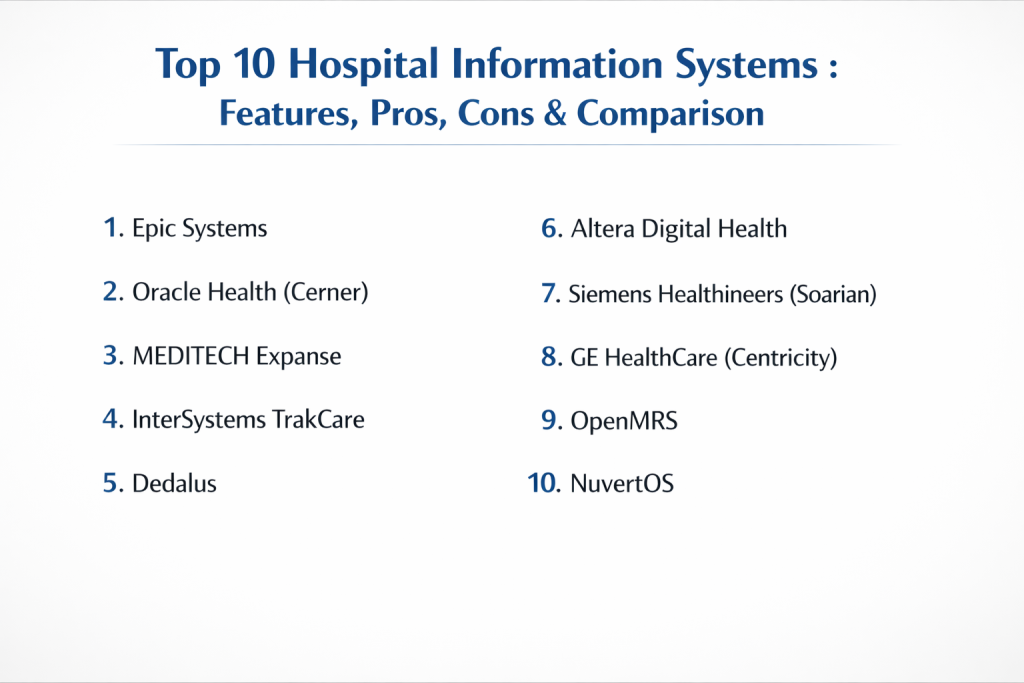
1. Epic Systems
Epic is widely regarded as the most comprehensive HIS for large-scale integrated delivery networks. It is known for its “One Patient, One Record” philosophy, ensuring that a patient’s data is consistent across every touchpoint, from the pharmacy to the surgical suite.
Key Features
- A unified database that eliminates the need for complex internal interfaces between departments.
- The MyChart patient portal, which is the most widely adopted patient engagement tool globally.
- Advanced clinical decision support that alerts doctors to potential risks in real-time.
- Deep integration for research and genomics, making it a favorite for academic medical centers.
- Robust revenue cycle management tools that automate complex insurance billing.
Pros
- The most feature-complete system available for large-scale healthcare enterprises.
- Exceptionally strong community and peer-to-peer knowledge sharing among users.
Cons
- Extremely high implementation costs and long deployment timelines.
- Requires a significant dedicated internal IT team to maintain and customize.
Platforms / Deployment
Web / Windows / iOS — Hybrid
Security & Compliance
Enterprise-grade security with full support for global healthcare privacy regulations.
Integrations & Ecosystem
Epic features a massive marketplace for third-party apps and connects seamlessly with almost all modern medical imaging and laboratory systems.
Support & Community
Known for its rigorous training programs and a highly active user group that shares best practices across the globe.
2. Oracle Health (Cerner)
Following its acquisition by Oracle, this platform has focused on leveraging massive cloud infrastructure to provide a highly interoperable and data-rich environment for hospitals of all sizes.
Key Features
- A powerful interoperability engine designed to connect with external health systems and public health registries.
- AI-driven clinical intelligence that helps identify patient deterioration before it becomes critical.
- Comprehensive pharmacy and laboratory modules that manage the entire diagnostic lifecycle.
- Scalable architecture that supports both single facilities and massive national health programs.
- Integrated population health management tools to track health trends across entire communities.
Pros
- Strong global presence with successful implementations in various healthcare models.
- Benefit of Oracle’s world-class cloud and database security infrastructure.
Cons
- The user interface can feel complex and may require extensive staff training.
- Customization can be challenging without specialized technical assistance.
Platforms / Deployment
Web / Windows — Cloud / Hybrid
Security & Compliance
Advanced security backed by Oracle Cloud Infrastructure, meeting the highest international standards.
Integrations & Ecosystem
Strong support for industry-standard messaging, allowing it to act as a central hub for medical devices and third-party clinical apps.
Support & Community
Provides extensive global support networks and professional services for large-scale digital transformations.
3. MEDITECH Expanse
MEDITECH Expanse is a modern, web-based HIS designed to provide a mobile-friendly experience for clinicians. It is particularly popular among mid-market and community hospitals.
Key Features
- A fully web-based platform that allows clinicians to access the system from any device.
- Integrated tools for acute, ambulatory, and home care in a single software suite.
- Personalized “navigators” that guide clinicians through their specific daily workflows.
- Strong focus on patient safety with automated alerts and barcode verification.
- Built-in tools for virtual care and remote patient monitoring.
Pros
- More affordable than the larger enterprise competitors while still offering a deep feature set.
- The web-based interface significantly reduces the burden on local IT hardware.
Cons
- May lack some of the extreme customization options found in larger systems.
- International support for very specific local regulations varies by region.
Platforms / Deployment
Web / Mobile — Cloud / Hybrid
Security & Compliance
Robust security features with a focus on data integrity and user access control.
Integrations & Ecosystem
Strong interoperability with major diagnostic and financial systems via standard protocols.
Support & Community
Well-regarded for its customer-focused culture and steady, reliable update cycles.
4. InterSystems TrakCare
TrakCare is an international leader in HIS, built on a high-performance database. It is designed to provide a unified clinical and administrative system that is highly adaptable to different countries’ regulations.
Key Features
- A high-performance database engine that ensures rapid access to patient data even in massive systems.
- Fully integrated clinical and administrative modules that share a single data source.
- Multilingual and multi-currency support, making it ideal for international hospital chains.
- Advanced analytics that provide real-time insights into hospital performance.
- A modular design that allows hospitals to implement features in stages.
Pros
- Exceptional performance and reliability under heavy data loads.
- Highly flexible and capable of meeting the specific needs of different global markets.
Cons
- Requires specialized knowledge of the InterSystems environment for deep customization.
- The learning curve for administrative staff can be significant.
Platforms / Deployment
Web / Windows — Cloud / Hybrid
Security & Compliance
Built with a “security-first” architecture, widely used in highly regulated national health systems.
Integrations & Ecosystem
One of the strongest tools for interoperability, often used as the backbone for regional health information exchanges.
Support & Community
Strong international presence with dedicated local support teams in many regions.
5. Dedalus
Dedalus is a major European player that has grown into a global leader, offering a modular HIS that focuses heavily on the clinical pathway and diagnostic integration.
Key Features
- A clinical-centric design that follows the patient throughout their entire journey.
- Deep integration with diagnostic imaging and laboratory information systems.
- Modular architecture that allows for “plug-and-play” implementation of specific tools.
- Strong focus on European regulatory compliance and data sovereignty.
- Advanced tools for managing complex surgical and intensive care workflows.
Pros
- Excellent for hospitals that need a modular approach to digital transformation.
- Very strong in clinical depth, particularly in diagnostics and specialized care.
Cons
- The variety of modules can sometimes lead to a fragmented user experience if not managed well.
- Brand awareness and support in the North American market are still growing.
Platforms / Deployment
Web / Windows — Hybrid
Security & Compliance
High standards of data protection, especially regarding GDPR and European health data laws.
Integrations & Ecosystem
Features a robust set of APIs designed to work within a heterogeneous IT environment.
Support & Community
Extensive support network across Europe and a growing presence in Asia and the Middle East.
6. Altera Digital Health
Formerly part of Allscripts, Altera offers the Sunrise platform, which is known for its highly configurable clinical workflows that can be tailored to the specific needs of medical specialties.
Key Features
- Highly flexible clinical documentation that adapts to the way doctors actually work.
- Advanced computerized provider order entry (CPOE) to reduce medication errors.
- Integrated revenue cycle tools that connect clinical actions directly to billing.
- Support for a wide range of specialties, from oncology to pediatrics.
- Real-time analytics dashboards for tracking patient outcomes and hospital efficiency.
Pros
- Exceptional configurability, allowing hospitals to build their own unique workflows.
- Strong focus on reducing clinician burnout through streamlined interfaces.
Cons
- High level of configurability means implementation requires careful planning.
- Some legacy modules may not feel as modern as the core platform.
Platforms / Deployment
Windows / Web — Hybrid
Security & Compliance
Reliable security protocols with comprehensive audit logs and access management.
Integrations & Ecosystem
Strong history of open integration, allowing for easy connection to a wide variety of third-party tools.
Support & Community
Dedicated support and a loyal user base among large, multi-specialty hospitals.
7. Siemens Healthineers (Soarian)
Siemens offers a system that is uniquely positioned at the intersection of medical technology and IT, providing deep integration with diagnostic equipment.
Key Features
- Seamless workflow between diagnostic imaging, laboratory results, and clinical records.
- A “workflow-driven” architecture that automates many administrative tasks.
- Strong focus on financial management and revenue cycle optimization.
- Advanced tools for enterprise-wide clinical data management.
- Integration with Siemens’ vast array of medical imaging and laboratory hardware.
Pros
- Unrivaled for facilities that are heavily focused on high-end diagnostics and imaging.
- Strong financial and administrative modules that improve hospital profitability.
Cons
- Can be complex to manage for facilities that do not use Siemens medical hardware.
- The clinical interface may feel more technical than some of its “physician-first” competitors.
Platforms / Deployment
Windows / Web — On-Premise / Hybrid
Security & Compliance
Robust security aligned with the high standards of a global medical device manufacturer.
Integrations & Ecosystem
Excellent hardware-software integration, particularly in radiology and laboratory settings.
Support & Community
World-class global support and professional services tailored for high-complexity environments.
8. GE HealthCare (Centricity)
GE’s platform is a staple in the industry, offering a reliable and mature HIS that excels in clinical data management and departmental integration.
Key Features
- Specialized modules for high-acuity areas like the ICU and cardiology.
- Comprehensive clinical data repository that serves as a single source of truth.
- Strong administrative tools for scheduling, registration, and billing.
- Mature interoperability features for connecting with a wide range of external systems.
- Integrated imaging and reporting tools for a complete diagnostic picture.
Pros
- Extremely reliable and time-tested in high-pressure hospital environments.
- Excellent specialized modules for complex clinical departments.
Cons
- Some parts of the system may feel less modern than the newer cloud-native competitors.
- Update cycles can be slower due to the complexity of the integrated system.
Platforms / Deployment
Windows / Web — On-Premise / Hybrid
Security & Compliance
Proven security record with deep experience in meeting complex global regulatory requirements.
Integrations & Ecosystem
Highly compatible with a vast range of medical devices and imaging platforms.
Support & Community
A very large global user base and a mature support infrastructure with deep domain expertise.
9. OpenMRS
OpenMRS is the world’s leading open-source EMR and HIS framework, widely used by NGOs and governments to build custom health systems in resource-limited settings.
Key Features
- A completely open-source, modular architecture that can be customized for any clinical need.
- A robust community-driven library of modules for HIV, TB, and maternal health.
- Designed to work effectively on low-power hardware and in offline environments.
- Strong focus on standardizing medical data through a centralized concept dictionary.
- Completely free to download and use without licensing fees.
Pros
- No licensing costs, making it the most cost-effective option for global health projects.
- Unparalleled flexibility for building custom clinical applications.
Cons
- Requires a high level of technical expertise to implement and maintain.
- Lacks the out-of-the-box administrative and billing features of commercial systems.
Platforms / Deployment
Web — Self-hosted
Security & Compliance
Security is community-managed, requiring careful implementation by local technical teams.
Integrations & Ecosystem
Strong support for international data standards, allowing it to integrate into national health architectures.
Support & Community
A massive global community of volunteer developers and healthcare professionals providing constant updates and support.
10. NuvertOS
NuvertOS is a modern, cloud-native challenger that has gained traction by providing an all-in-one “brain” for hospitals, focusing on eliminating fragmentation in administrative and clinical tasks.
Key Features
- A unified cloud ecosystem that combines HIS, laboratory (LIS), and pharmacy management.
- AI-powered operational dashboards that identify revenue leakage and process bottlenecks.
- Fast, modern user interface built on contemporary web technologies.
- Streamlined discharge processes that use automation to reduce administrative time.
- Highly affordable subscription model designed for rapid digital transformation.
Pros
- Very fast to implement compared to traditional enterprise systems.
- Highly intuitive design that requires minimal staff training.
Cons
- As a newer platform, it may not yet have the decades-deep specialty modules of legacy giants.
- Community resources and third-party plugins are still in the early growth phase.
Platforms / Deployment
Web / Mobile — Cloud (SaaS)
Security & Compliance
Built with modern cloud security standards, focusing on high availability and data encryption.
Integrations & Ecosystem
Focuses on an “API-first” approach for easy connection to regional payment gateways and diagnostic labs.
Support & Community
Strongly focused on high-touch customer support and rapid iterative development based on user feedback.
Comparison Table (Top 10)
| Tool Name | Best For | Platform(s) Supported | Deployment | Standout Feature | Public Rating |
| 1. Epic Systems | Enterprise Networks | Windows, Web, Mobile | Hybrid | Integrated Patient Portal | 4.8/5 |
| 2. Oracle Health | Global Health Systems | Windows, Web | Cloud | Interoperability Engine | 4.7/5 |
| 3. MEDITECH | Community Hospitals | Web, Mobile | Cloud | Mobile-First UI | 4.5/5 |
| 4. InterSystems | Multi-Entity Systems | Windows, Web | Hybrid | Performance Database | 4.6/5 |
| 5. Dedalus | Clinical Pathways | Windows, Web | Hybrid | Modular Flexibility | 4.4/5 |
| 6. Altera Digital | Specialty Workflows | Windows, Web | Hybrid | Configurable Pathways | 4.3/5 |
| 7. Siemens | Imaging & Diagnostics | Windows, Web | Hybrid | Hardware Integration | 4.1/5 |
| 8. GE HealthCare | Departmental Depth | Windows, Web | On-Premise | Specialized ICU/Cardio | 4.2/5 |
| 9. OpenMRS | Global Health/NGOs | Web | Self-hosted | Open-Source Modular | 4.5/5 |
| 10. NuvertOS | Modern SMB/Mid-Market | Web, Mobile | Cloud | AI Operational Brain | 4.8/5 |
Evaluation & Scoring of Hospital Information Systems
| Tool Name | Core (25%) | Ease (15%) | Integrations (15%) | Security (10%) | Perf (10%) | Support (10%) | Value (15%) | Total |
| Epic Systems | 10 | 4 | 10 | 9 | 10 | 10 | 4 | 8.2 |
| Oracle Health | 9 | 5 | 10 | 9 | 9 | 9 | 5 | 8.0 |
| MEDITECH | 8 | 8 | 8 | 8 | 8 | 8 | 8 | 8.0 |
| NuvertOS | 7 | 10 | 7 | 8 | 9 | 9 | 9 | 7.9 |
| InterSystems | 9 | 4 | 10 | 9 | 10 | 8 | 6 | 7.8 |
| Dedalus | 8 | 7 | 8 | 8 | 8 | 8 | 7 | 7.5 |
| Altera Digital | 8 | 6 | 8 | 8 | 8 | 8 | 7 | 7.4 |
| GE HealthCare | 8 | 6 | 8 | 8 | 9 | 8 | 6 | 7.3 |
| Siemens | 8 | 5 | 9 | 8 | 8 | 8 | 6 | 7.1 |
| OpenMRS | 7 | 2 | 8 | 5 | 7 | 9 | 10 | 6.6 |
The scores represent a balanced view of how these tools perform in real-world scenarios. A top score in core features reflects a system that can run every department of a hospital without external help. High scores in ease of use indicate a modern interface that reduces staff burnout, while value scores highlight the long-term return on investment for the facility.
Which Hospital Information System Tool Is Right for You?
Solo / Freelancer
While most HIS tools are for institutions, a solo practitioner would find the most value in a lightweight cloud-based EMR like HealthPlix or the clinical modules of NuvertOS, which offer high value with minimal technical setup.
SMB (Small to Medium Business)
Small hospitals and clinics should prioritize ease of use and low upfront costs. NuvertOS or MEDITECH Expanse provide a full digital core without the massive server costs of traditional enterprise software.
Mid-Market
For multi-specialty community hospitals, MEDITECH and Altera Digital Health offer the best balance of deep clinical functionality and manageable complexity, allowing the facility to scale without losing its local focus.
Enterprise
Large university hospitals and national health networks require the proven power of Epic Systems or Oracle Health. These systems are designed to handle the complexity of thousands of users and millions of patient records while maintaining strict security.
Budget vs Premium
If the goal is to modernize on a very tight budget, OpenMRS provides the framework to build a custom solution for free. For those seeking a premium, “white-glove” experience with maximum feature depth, Epic remains the gold standard.
Feature Depth vs Ease of Use
Hospitals focused on research and complex specialties will prefer the depth of Epic or InterSystems. Conversely, those looking to improve staff satisfaction and reduce training time will find NuvertOS or MEDITECH much more accessible.
Integrations & Scalability
If your hospital needs to connect with a wide variety of medical hardware and external labs, Oracle Health and Siemens offer the most robust hardware-level integrations. InterSystems is the best choice for those building a massive, data-driven health ecosystem.
Security & Compliance Needs
Facilities in highly litigious or strictly regulated environments should lean toward Epic or Oracle Health, as these vendors invest billions into maintaining global security certifications and defensive data architectures.
Frequently Asked Questions (FAQs)
1. Is a Hospital Information System different from an Electronic Health Record?
Yes. An EHR focuses on the patient’s medical history, while an HIS is a broader system that also manages administrative, financial, and inventory tasks for the entire hospital.
2. How long does it take to implement a new HIS?
A cloud-based system can be up and running in 3–6 months, while a massive enterprise deployment for a large hospital network can take 12–24 months.
3. Can these systems help reduce medical errors?
Absolutely. By providing automated alerts for drug interactions, patient allergies, and identifying abnormal lab results, an HIS acts as a critical safety net for clinicians.
4. Are these systems secure enough to protect patient privacy?
Leading HIS vendors use advanced encryption and strictly follow laws like HIPAA and GDPR. However, the security also depends on the hospital’s internal IT protocols and staff training.
5. Do all hospital staff need to be trained on the new system?
Yes. Everyone from the receptionists and billing staff to the nurses and specialist doctors must be trained to ensure data is entered and used correctly across the facility.
6. Can a hospital use multiple systems at once?
While possible, it is not recommended. Fragmented systems lead to data silos and errors. The goal of a modern HIS is to provide a single “source of truth” for the entire hospital.
7. Is a cloud-based HIS better than one on-premise?
Cloud systems are generally easier to update and require less local hardware. On-premise systems give the hospital more direct control over their data but are much more expensive to maintain.
8. How do these systems handle power outages?
Professional systems have robust backup and recovery plans. Cloud-based systems are often more resilient as the data is stored in off-site data centers with redundant power supplies.
9. Can patients see their own records in these systems?
Most modern systems include a patient portal where individuals can view their lab results, schedule appointments, and see their medication lists securely.
10. What is the most common reason for HIS implementation failure?
The most common reasons are a lack of proper staff training, poor planning for data migration, and choosing a system that doesn’t fit the actual workflow of the medical staff.
Conclusion
Choosing a Hospital Information System is one of the most significant strategic decisions a healthcare leader will ever make. It is an investment that defines how a hospital will function for the next decade or more. Whether you select a global leader like Epic or a modern cloud challenger like NuvertOS, the goal is always the same: to create a safer, more efficient, and more patient-centered environment. A successful transition to a modern HIS requires a clear vision, a commitment to staff training, and a focus on long-term scalability. The right system does more than just digitize records; it empowers your medical team to focus on what matters most—delivering exceptional patient care. As healthcare continues to evolve toward a future of AI and real-time data, having a robust digital core is no longer a luxury; it is the foundation of modern medicine. By carefully evaluating your facility’s specific needs against the strengths of these top ten tools, you can ensure that your hospital remains at the forefront of healthcare delivery.

Best Cardiac Hospitals Near You
Discover top heart hospitals, cardiology centers & cardiac care services by city.
Advanced Heart Care • Trusted Hospitals • Expert Teams
View Best Hospitals