Introduction
A Patient Engagement Platform is a specialized digital ecosystem designed to foster active communication and collaboration between healthcare providers and their patients. Beyond simple portals, these platforms act as a bridge, enabling individuals to manage their own health journey through features like automated scheduling, secure messaging, and digital intake. By providing a unified interface for both clinical and administrative tasks, these tools reduce the friction typically associated with navigating the healthcare system, turning passive recipients of care into active participants.
In the current medical landscape, engagement technology has become a fundamental necessity rather than a luxury. With the shift toward value-based care, hospitals and clinics are increasingly measured on patient outcomes and satisfaction levels. These platforms address the growing demand for “on-demand” healthcare experiences that mirror the convenience of modern retail or banking. By automating routine interactions, they allow clinical staff to focus on complex care while ensuring patients remain connected to their care teams through every stage of their treatment.
Real-World Use Cases
- Automating pre-visit registrations and insurance verifications to eliminate waiting room bottlenecks.
- Delivering personalized post-operative care instructions and medication reminders to reduce hospital readmission rates.
- Providing 24/7 self-service scheduling that allows patients to book or reschedule appointments without calling the office.
- Managing chronic conditions through remote monitoring and periodic check-in surveys that alert doctors to potential issues.
- Implementing broadcast messaging to alert entire patient populations about health clinics, office closures, or new service offerings.
Evaluation Criteria for Buyers
- The level of native integration with existing Electronic Health Record (EHR) systems to ensure data flows seamlessly.
- The simplicity of the patient interface, specifically how easily it can be used on mobile devices without complex downloads.
- The robustness of automated communication workflows, such as intelligent appointment reminders and recall campaigns.
- The platform’s ability to handle secure payments and digital forms to streamline the revenue cycle.
- The scalability of the tool to grow from a single-provider practice to a multi-location health system.
- The availability of analytics and reporting dashboards to track patient satisfaction and no-show rates.
- The strength of security certifications to ensure all interactions remain protected under strict regulatory standards.
Best for: Large hospital systems, specialty medical practices, dental groups, and outpatient clinics seeking to modernize the patient experience and improve operational efficiency.
Not ideal for: Medical facilities that do not utilize digital records or those looking for a simple website without any interactive patient-facing functionality.
Key Trends in Patient Engagement Platforms
- The integration of Generative AI to handle routine patient inquiries and route complex medical questions to the correct clinical staff.
- A shift toward “digital front door” strategies that consolidate scheduling, intake, and payments into a single mobile-first experience.
- The rise of ambient AI health assistants that can assist patients at home with medication coaching and side-effect tracking.
- Increased use of predictive analytics to identify patients at high risk of missing appointments or disengaging from their treatment plans.
- The adoption of Universal Scene Description patterns for better data interoperability between disparate healthcare software.
- Expanding support for multilingual engagement to ensure equitable access to care across diverse patient populations.
- Enhanced focus on financial engagement tools that provide transparent cost estimates and flexible payment plan options.
- The growth of remote patient monitoring (RPM) integrations that feed real-time wearable data directly into the engagement platform.
How We Selected These Tools
The selection of these ten platforms followed a rigorous methodology focused on market leadership and technical reliability. We evaluated tools based on their proven adoption rates across various healthcare segments, from small private practices to massive enterprise health systems. A primary focus was placed on “EHR-agnostic” capabilities, meaning the tool’s ability to integrate with multiple record systems like Epic, Cerner, and athenahealth. We also prioritized platforms that demonstrate a commitment to high-level security and those that have actively integrated AI to reduce administrative burnout. Finally, we looked for evidence of high patient adoption, as an engagement tool is only effective if the patients actually use it.
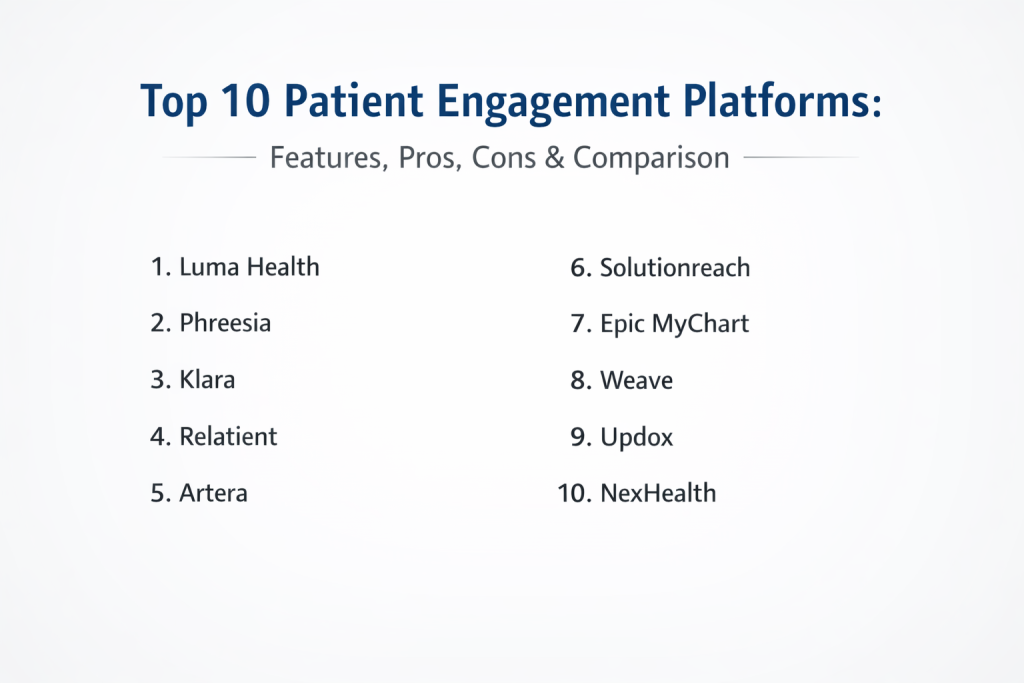
Top 10 Patient Engagement Platforms Tools
1. Luma Health
Luma Health is a comprehensive “Patient Success Platform” that unifies the operational, clinical, and financial aspects of the patient journey. It is highly regarded for its intelligent scheduling engine and its ability to automate the entire lifecycle of a patient visit without requiring manual staff intervention.
Key Features
- An AI-powered waitlist that automatically fills canceled appointment slots.
- Fully digital patient intake and registration workflows that sync with the EHR.
- Two-way, HIPAA-compliant text messaging that supports over 20 languages.
- Automated referral management to prevent patients from falling through the cracks.
- Multichannel outreach for reminders, recalls, and health education campaigns.
Pros
- Exceptional automation that significantly reduces front-desk workload.
- Very high patient response rates due to the intuitive mobile-first design.
Cons
- The advanced configuration can take time for smaller teams to set up correctly.
- Pricing is typically on the higher end for small, solo practices.
Platforms / Deployment
Web / iOS / Android — Cloud
Security & Compliance
HIPAA compliant and SOC 2 Type 2 certified.
Integrations & Ecosystem
Luma Health integrates with more than 80 different EHR systems. It features a robust API and pre-built connectors for major platforms like Epic and Oracle Health.
Support & Community
Known for a dedicated customer success team and a library of pre-configured “Success Playbooks” for different specialties.
2. Phreesia
Phreesia is a market leader in patient intake and “check-in” solutions. While it started as a hardware-based kiosk company, it has evolved into a sophisticated digital platform that handles everything from appointment self-scheduling to payment collection and clinical screenings.
Key Features
- Mobile-first check-in that allows patients to register on their own devices.
- Automated collection of copays and outstanding balances during the intake process.
- Specialized clinical screening tools for behavioral health and social determinants.
- Appointment self-scheduling that integrates directly with the provider’s calendar.
- Real-time insurance verification to reduce claim denials at the source.
Pros
- Unrivaled expertise in streamlining the “front door” of the clinic.
- Proven ability to increase point-of-service collections.
Cons
- Some patients may find the intake process too long if many screenings are enabled.
- The platform is highly structured, which may limit certain custom workflows.
Platforms / Deployment
Web / Windows / Tablet — Cloud / Hybrid
Security & Compliance
HIPAA, PCI-DSS, and HITRUST CSF certified.
Integrations & Ecosystem
Phreesia has deep, bi-directional integrations with most major PM and EHR systems, including Allscripts and NextGen.
Support & Community
Extensive training programs and a large user base that shares best practices for revenue cycle management.
3. Klara
Klara is a modern communication platform that centralizes all patient and internal team interactions into a single, secure thread. It is designed to act as a “central nervous system” for medical practices, replacing fragmented phone calls and emails with a unified messaging experience.
Key Features
- A centralized team inbox that allows staff to collaborate on patient requests.
- Secure two-way messaging that doesn’t require a patient login or app download.
- Automated workflows for reminders, insurance card capture, and pre-op instructions.
- Built-in telehealth capabilities that can be launched directly from a text.
- Call-to-text features that help reduce phone volume for busy front desks.
Pros
- Extremely simple for both staff and patients to use immediately.
- Drastically reduces the “phone tag” common in specialist practices.
Cons
- Not as many enterprise-level scheduling features as Luma or Relatient.
- Reporting features are solid but less detailed than dedicated analytics platforms.
Platforms / Deployment
Web / iOS / Android — Cloud
Security & Compliance
HIPAA compliant with end-to-end encryption.
Integrations & Ecosystem
Klara integrates with many popular EHRs and is particularly well-suited for outpatient specialties like dermatology and plastic surgery.
Support & Community
High customer satisfaction ratings and a straightforward onboarding process for new clinics.
4. Relatient (Dash)
Relatient provides an enterprise-grade suite called Dash, which is designed for large health systems managing complex scheduling needs. It focuses heavily on the “Dash” rules-based engine to ensure patients are booked with the right provider at the right time and location.
Key Features
- Rules-based scheduling that handles complex multi-provider and multi-site logic.
- Automated appointment reminders across SMS, voice, and email.
- A digital registration suite that includes financial clearance and payments.
- Broadcast messaging for mass patient communications and emergency alerts.
- Post-discharge outreach to ensure patients are recovering as expected.
Pros
- Highly scalable for organizations with hundreds of locations.
- Strong focus on reducing no-show rates and optimizing provider schedules.
Cons
- The complexity of the scheduling engine can require significant initial mapping.
- The user interface for staff is powerful but has a steeper learning curve.
Platforms / Deployment
Web / Windows — Cloud / Hybrid
Security & Compliance
HIPAA, SOC 2, and HITRUST CSF compliant.
Integrations & Ecosystem
Deep integration with enterprise EHRs like Epic, Cerner, and athenahealth, focusing on high-volume data sync.
Support & Community
Offers professional services for large-scale implementations and a technical support team for custom integrations.
5. Artera (formerly WELL Health)
Artera is a unified communications platform that aims to consolidate every patient interaction into a single thread. It focuses on “Journey Orchestration,” ensuring that the various departments of a health system are not sending conflicting or redundant messages to the patient.
Key Features
- A unified patient inbox that brings together text, email, and voice interactions.
- Intelligent routing that sends patient replies to the correct clinical department.
- Smart “AI Agents” that can handle routine scheduling and FAQ responses.
- Multi-language support to reach patients in their preferred tongue.
- Enterprise-level analytics to track engagement across the entire organization.
Pros
- Excellent at preventing “communication fatigue” in large systems.
- Very strong integration capabilities with diverse tech stacks.
Cons
- Can be overkill for a very small, single-provider office.
- Some advanced AI features are locked behind higher pricing tiers.
Platforms / Deployment
Web / iOS / Android — Cloud
Security & Compliance
HIPAA and SOC 2 Type 2 compliant.
Integrations & Ecosystem
Artera prides itself on being an “integration layer” that connects EHRs, billing systems, and third-party health apps.
Support & Community
Well-regarded for its strategic advisory services and a robust community of healthcare IT professionals.
6. Solutionreach
Solutionreach is one of the pioneers in the patient engagement space, with a historical focus on dental and vision practices. It has expanded into a full-service platform that helps medical practices grow through better retention and online reputation management.
Key Features
- Automated appointment reminders and “SR Conversations” for two-way texting.
- Patient recall campaigns designed to bring inactive patients back to the practice.
- Automated review invitations to build a practice’s online reputation.
- A patient portal that provides easy access to records and bill pay.
- Digital intake forms that reduce paper waste and manual data entry.
Pros
- Exceptional tools for patient retention and practice marketing.
- Very mature platform with a wide range of features for SMBs.
Cons
- The interface can feel a bit more traditional compared to newer “startup” platforms.
- Some integrations with newer cloud EHRs are not as deep as competitors.
Platforms / Deployment
Web / Windows — Cloud / Hybrid
Security & Compliance
HIPAA compliant.
Integrations & Ecosystem
Strongest in the dental and vision sectors, with legacy support for many older practice management systems.
Support & Community
Provides “Solutionreach University,” an extensive self-paced learning platform for office staff.
7. Epic MyChart
MyChart is the patient-facing portal for the Epic EHR. While technically a module of a larger system, it is the most widely used patient engagement tool in the world by volume, offering deep clinical access that independent tools often struggle to match.
Key Features
- Full access to health records, test results, and provider notes.
- Integrated telehealth visits and secure provider messaging.
- Direct appointment scheduling and prescription refill requests.
- “Hello Patient” feature for automated, location-based check-in.
- Family access features for managing the care of children or elderly parents.
Pros
- Unmatched depth of clinical data and EHR integration.
- No additional cost if your organization is already on the Epic system.
Cons
- Only available to organizations that use Epic as their primary EHR.
- Customization is limited by what the Epic ecosystem allows.
Platforms / Deployment
Web / iOS / Android — Cloud / Self-hosted
Security & Compliance
Enterprise-grade security; HIPAA and SOC 2 compliant via Epic.
Integrations & Ecosystem
Part of the massive Epic ecosystem, integrating with thousands of hospitals and third-party apps via App Orchard.
Support & Community
Supported by a massive internal Epic team and a global community of health system administrators.
8. Weave
Weave is an all-in-one communication platform that integrates a practice’s phone system with its patient database. It is highly popular among small to mid-sized practices because it combines phones, texting, and payments into a single desktop application.
Key Features
- A smart phone system that displays patient details on-screen when they call.
- Two-way texting and automated appointment reminders.
- Integrated payment processing and “Text-to-Pay” functionality.
- Automated review requests to boost Google and Yelp rankings.
- Digital forms and specialized “Recall” lists for dental and optometry.
Pros
- The “Pop” feature gives staff instant context before they even answer the phone.
- Replaces several separate vendors (phones, texting, payments) with one bill.
Cons
- Primarily focused on SMBs; not designed for large, complex hospital systems.
- Requires switching your phone service to the Weave platform.
Platforms / Deployment
Web / Windows / iOS / Android — Cloud
Security & Compliance
HIPAA and PCI compliant.
Integrations & Ecosystem
Strongest integrations are with dental and optometry systems, but it is expanding into general medical and veterinary fields.
Support & Community
Excellent live phone support and a high-energy community of small business owners.
9. Updox
Updox is a versatile platform that focuses on the “communication gaps” in healthcare. It is well-known for its secure faxing, video chat, and patient messaging, making it a favorite for independent practices and pharmacies.
Key Features
- HIPAA-compliant electronic faxing that eliminates the need for paper.
- Secure video chat for one-click telehealth consultations.
- Automated appointment reminders and broadcast messaging.
- Digital intake forms that can be sent via text or email.
- A unified inbox for managing faxes, messages, and form submissions.
Pros
- One of the best solutions for practices that still rely heavily on faxing.
- Very affordable and easy to deploy for small, independent clinics.
Cons
- The user interface is functional but lacks the “slick” feel of newer platforms.
- Scheduling features are basic compared to enterprise tools like Relatient.
Platforms / Deployment
Web — Cloud
Security & Compliance
HIPAA compliant and SOC 2 certified.
Integrations & Ecosystem
Integrated with over 100 EHR systems, focusing on maintaining workflows for independent providers.
Support & Community
Solid technical documentation and a reputation for being responsive to the needs of small practices.
10. NexHealth
NexHealth is a modern engagement platform that emphasizes real-time synchronization with a practice’s health record system. It is designed to be a “plug-and-play” solution that modernizes the patient experience without requiring a massive IT overhaul.
Key Features
- Real-time online booking that reflects actual provider availability.
- Automated reminders and “one-click” rescheduling for patients.
- Digital forms and integrated payments that sync back to the practice system.
- Automated review and feedback management to improve practice ratings.
- Specialized tools for patient acquisition and marketing.
Pros
- The synchronization with practice management systems is exceptionally fast.
- Provides a very modern, “tech-forward” experience for the patient.
Cons
- Some users report that the initial integration can be tricky with older systems.
- Features are heavily focused on growth and booking, with less emphasis on clinical chronic care.
Platforms / Deployment
Web / iOS / Android — Cloud
Security & Compliance
HIPAA compliant.
Integrations & Ecosystem
Known for its proprietary “Synchronizer” technology that creates a bridge between the platform and various legacy health systems.
Support & Community
Growing quickly with a strong focus on support for dental and specialized medical groups.
Comparison Table (Top 10)
| Tool Name | Best For | Platform(s) Supported | Deployment | Standout Feature | Public Rating |
| 1. Luma Health | Journey Orchestration | Web, iOS, Android | Cloud | Smart Waitlist AI | 4.8/5 |
| 2. Phreesia | Intake & Revenue | Web, Windows, Tablet | Hybrid | Mobile Check-In | 4.6/5 |
| 3. Klara | Specialist Messaging | Web, iOS, Android | Cloud | Unified Team Inbox | 4.7/5 |
| 4. Relatient | Enterprise Scheduling | Web, Windows | Hybrid | Dash Rules Engine | 4.5/5 |
| 5. Artera | Unified Comms | Web, iOS, Android | Cloud | AI Journey Routing | 4.6/5 |
| 6. Solutionreach | Patient Retention | Web, Windows | Hybrid | Recall Campaigns | 4.4/5 |
| 7. Epic MyChart | Clinical Access | Web, iOS, Android | Cloud | Full Health Record | 4.5/5 |
| 8. Weave | SMB All-in-one | Web, Windows, Mobile | Cloud | Phone-EHR Pop | 4.7/5 |
| 9. Updox | Independent Clinics | Web | Cloud | Secure E-Faxing | 4.3/5 |
| 10. NexHealth | Real-time Booking | Web, iOS, Android | Cloud | Sync Technology | 4.6/5 |
Evaluation & Scoring of Patient Engagement Platforms
| Tool Name | Core (25%) | Ease (15%) | Integrations (15%) | Security (10%) | Perf (10%) | Support (10%) | Value (15%) | Total |
| 1. Luma | 10 | 8 | 9 | 9 | 9 | 9 | 8 | 8.9 |
| 2. Phreesia | 9 | 7 | 10 | 10 | 9 | 8 | 7 | 8.5 |
| 3. Klara | 8 | 10 | 8 | 9 | 9 | 9 | 8 | 8.5 |
| 4. Relatient | 9 | 6 | 10 | 9 | 10 | 8 | 7 | 8.3 |
| 5. Artera | 9 | 8 | 9 | 9 | 9 | 8 | 7 | 8.2 |
| 6. Solutionreach | 8 | 7 | 8 | 8 | 8 | 9 | 8 | 7.9 |
| 7. MyChart | 10 | 6 | 10 | 10 | 10 | 5 | 10 | 8.8 |
| 8. Weave | 7 | 9 | 7 | 8 | 9 | 10 | 9 | 8.2 |
| 9. Updox | 7 | 8 | 8 | 9 | 8 | 8 | 9 | 7.8 |
| 10. NexHealth | 8 | 9 | 8 | 8 | 9 | 7 | 8 | 8.0 |
Scoring for these platforms focuses on the balance between clinical depth and administrative efficiency. Tools like MyChart and Luma Health score highest in core features and integration, whereas Klara and Weave are the clear leaders for ease of use and immediate staff adoption.
Which Patient Engagement Platform Is Right for You?
Solo / Freelancer
For an independent practitioner, Klara or Updox provides the best value. They offer the essential communication tools—secure texting and video chat—without the enterprise overhead or high cost of a full health system platform.
SMB (Small to Medium Business)
Small dental or medical groups often find Weave to be the ideal choice because it consolidates their phones and patient reminders into one tool. If growth is the primary goal, NexHealth or Solutionreach offers better marketing and booking capabilities.
Mid-Market
Multi-location clinics need a more robust integration layer. Luma Health is often the top recommendation here due to its “Success Platform” approach that covers the entire patient journey from referral to post-visit follow-up.
Enterprise
Large health systems managing thousands of providers require Artera or Relatient. These platforms are designed to handle the “noise” of a massive organization, using intelligent routing to ensure messages reach the right department without confusing the patient.
Budget vs Premium
If the budget is tight, starting with a tool that solves one major problem—like Updox for faxing/telehealth—is wise. For those ready for a premium, all-encompassing solution, Luma Health offers the most advanced automation suite.
Feature Depth vs Ease of Use
Epic MyChart offers the most clinical depth but can be complex for patients to navigate. Conversely, Klara offers extreme ease of use by keeping everything in a simple text thread, though it lacks the deep clinical record access of a portal.
Integrations & Scalability
Phreesia and Relatient are built to scale with massive EHR databases. They are the go-to choices for organizations that cannot afford data lag or integration failures during high-volume periods.
Security & Compliance Needs
All listed tools are HIPAA compliant, but for organizations requiring the absolute highest level of enterprise certification (HITRUST or SOC 2 Type 2), Phreesia, Luma, and Relatient are the standout performers.
Frequently Asked Questions (FAQs)
1. What is the difference between a patient portal and an engagement platform?
A portal is a passive place for patients to view records. An engagement platform is an active system that uses reminders, AI, and messaging to drive patient action throughout their care.
2. Can these platforms help reduce appointment no-shows?
Yes, most platforms use automated, multi-channel reminders and easy “one-click” rescheduling to significantly lower the rate of missed appointments.
3. Do patients need to download an app to use these tools?
Many modern platforms like Klara and Luma Health are “app-less,” meaning patients can interact via standard web links and text messages without downloading anything.
4. Are these systems secure enough for sensitive medical data?
All reputable platforms are HIPAA compliant and use end-to-end encryption. Enterprise-grade tools often hold additional certifications like SOC 2 or HITRUST.
5. How long does it take to implement a new platform?
Small clinics can often go live with a tool like Klara in a few days. Large hospital integrations for tools like Relatient or Luma can take several weeks or months.
6. Can these tools help with payment collection?
Yes, platforms like Phreesia and Weave include “Text-to-Pay” and digital intake tools that allow patients to pay copays and balances from their phones.
7. Will these tools work with my existing EHR?
Most platforms are designed to integrate with major EHRs. It is important to verify “bi-directional” sync, which means data flows both ways between the tool and your records.
8. Can I use these platforms for telehealth?
Many engagement platforms, such as Klara and Updox, have built-in HIPAA-compliant video tools, while others integrate with Zoom or Microsoft Teams.
9. Do these platforms support multiple languages?
Yes, several leaders in this space, including Luma and Artera, offer automated translation and support for dozens of languages to improve access to care.
10. How do these tools improve staff productivity?
By automating reminders, intake, and routine questions, these platforms free up front-desk staff from hours of phone calls and manual data entry every day.
Conclusion
Choosing the right patient engagement platform is a critical step in modernizing the healthcare experience for both providers and patients. The ten platforms highlighted here represent the best of the current market, ranging from lightweight communication tools to enterprise-level journey orchestration engines. The right choice depends on your organization’s size, your specific EHR ecosystem, and whether your primary goal is clinical depth, administrative automation, or revenue cycle improvement. As healthcare continues to move toward a digital-first model, these platforms provide the essential infrastructure to ensure that care remains accessible, efficient, and deeply human. Successful implementation requires a clear understanding of your patient’s needs and a commitment to ongoing staff training. By selecting a tool that aligns with your operational goals and focusing on high-quality engagement, you can transform the way your practice interacts with its community. The future of healthcare is collaborative, and these platforms are the tools that make that collaboration possible.

Best Cardiac Hospitals Near You
Discover top heart hospitals, cardiology centers & cardiac care services by city.
Advanced Heart Care • Trusted Hospitals • Expert Teams
View Best Hospitals