Introduction
A Medical Imaging PACS (Picture Archiving and Communication System) is a specialized healthcare technology platform designed to store, retrieve, manage, and distribute medical images. Historically, hospitals relied on physical film, but modern PACS solutions digitize this entire workflow. By using the DICOM standard, these systems allow radiologists and clinicians to access high-resolution images—such as X-rays, MRIs, and CT scans—from any authorized workstation or mobile device. A PACS typically integrates four core components: the imaging modalities (the machines), a secured network, workstations for viewing, and an archive for the long-term storage of patient data.
In the current healthcare environment, the role of PACS has evolved from a simple storage locker into an intelligent diagnostic hub. As we navigate the demands of modern medicine, PACS platforms are increasingly cloud-native and enhanced by machine learning. These systems are now essential for handling the massive data volumes produced by 3D and 4D imaging, while also supporting remote reading for teleradiology. For healthcare buyers, evaluating a system requires looking beyond storage capacity to focus on workflow orchestration, ease of integration with Electronic Health Records (EHR), and the ability to maintain rapid image loading speeds across distributed networks.
Real-World Use Cases
- Centralizing multi-site radiology images into a single unified worklist for large hospital networks.
- Enabling remote radiologists to perform diagnostic reads from home with the same speed as an on-site workstation.
- Automating the triage of critical cases, such as identifying potential strokes or fractures, using integrated artificial intelligence.
- Providing surgeons with 3D reconstructions and surgical planning tools directly at the point of care in the operating room.
- Sharing diagnostic images and reports with referring physicians and patients through secure, web-based portals.
Evaluation Criteria for Buyers
- The speed and reliability of image streaming, especially for large datasets across low-bandwidth connections.
- Seamlessness of integration with the hospital’s existing EHR and Radiology Information Systems (RIS).
- The quality of built-in diagnostic tools, including advanced visualization, 3D post-processing, and multi-planar reconstruction.
- The flexibility of the deployment model, whether it is purely cloud-native, on-premise, or a hybrid architecture.
- The effectiveness of AI orchestration in prioritizing urgent cases and reducing manual reporting tasks.
- Compliance with international security standards such as HIPAA, GDPR, and SOC 2 to protect sensitive patient data.
- The scalability of the system to add new departments like cardiology, pathology, and orthopedics over time.
Best for: Hospital radiology departments, multi-site imaging centers, teleradiology groups, and academic medical centers seeking high-performance diagnostic workflows.
Not ideal for: Small private practices with very low imaging volumes that may find the cost and infrastructure requirements of an enterprise PACS unnecessary.
Key Trends in Medical Imaging PACS Systems
- The transition toward “Zero-Footprint” viewers that run entirely in a web browser without requiring local software installation.
- The integration of AI algorithms directly into the worklist to automatically flag urgent findings for immediate review.
- A major push toward cloud-native architectures that eliminate the need for expensive on-site server maintenance and hardware.
- The rise of Enterprise Imaging, where PACS expands beyond radiology to include digital pathology, cardiology, and dermatology.
- Use of server-side rendering technology to deliver high-resolution 3D images to mobile devices and tablets without losing detail.
- Enhanced interoperability through the adoption of modern data standards like FHIR and DICOMweb for better cross-platform communication.
- Predictive analytics used to balance workloads among radiologists to prevent burnout and ensure timely report turnarounds.
- Improved cybersecurity measures, including multi-factor authentication and end-to-end encryption for all transmitted medical data.
How We Selected These Tools
The selection of these top ten PACS systems is the result of a detailed methodology focused on clinical performance and technological leadership. We prioritized platforms that are recognized as industry standards and are currently being used in high-volume medical environments. A key factor was the system’s ability to support a “borderless” radiology department, where data flows smoothly between facilities. We also evaluated the maturity of each tool’s AI integration and its history of stability in critical care settings. Furthermore, we considered the strength of the vendor’s support ecosystem and their commitment to modernization, ensuring these tools are prepared for the future of digital health.
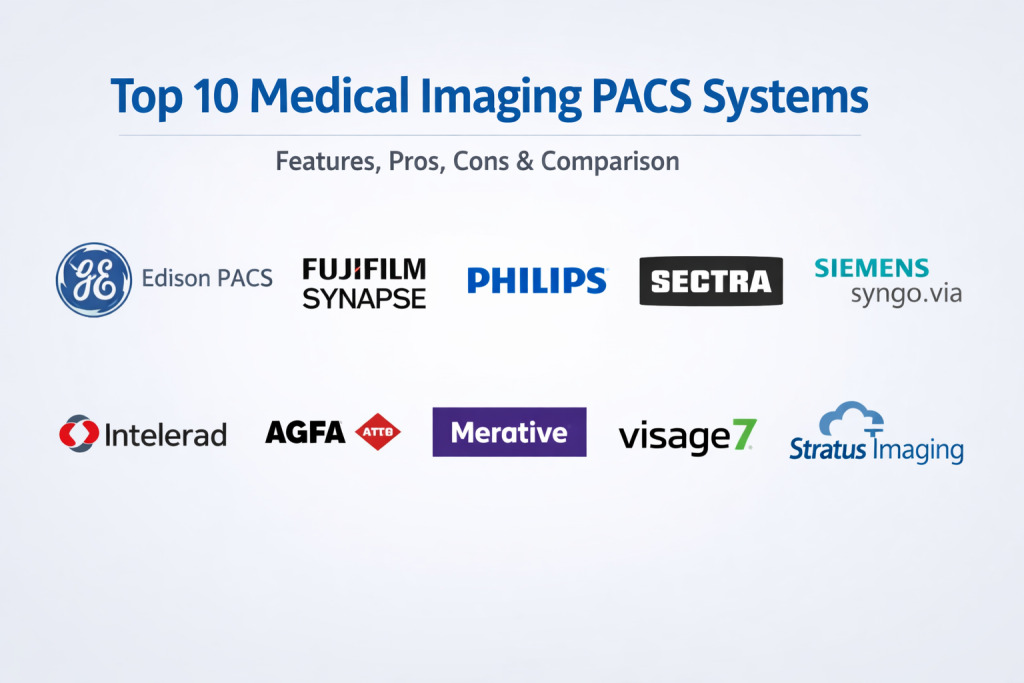
Top 10 Medical Imaging PACS Systems Tools
1. GE HealthCare Centricity / Edison True PACS
This system is a mainstay in the medical world, known for its “Universal Viewer” that provides a consistent experience across different clinical areas. It is designed to reduce the time radiologists spend setting up images by using smart reading protocols that learn user preferences. The platform is increasingly shifting toward the Edison AI framework to help clinicians find and prioritize the most critical data points.
Key Features
- Smart Reading Protocols that automate image layout based on previous user behavior.
- Integrated AI Orchestrator that allows for easy deployment of third-party clinical applications.
- Advanced visualization tools directly embedded in the primary diagnostic workflow.
- Intelligent worklists that balance the load of studies across a team of radiologists.
- Deep integration with EMR systems to provide full clinical context at the point of read.
Pros
- Extremely stable and familiar to a large portion of the global radiology workforce.
- Excellent at handling multi-modality datasets in a single interface.
Cons
- Upgrading legacy versions to modern cloud-native formats can be a complex process.
- The breadth of features can make the interface feel complex for new users.
Platforms / Deployment
Windows / Web — Cloud / Hybrid
Security & Compliance
Robust enterprise security including SSO, MFA, and SOC 2 compliance.
Integrations & Ecosystem
It sits at the center of a massive healthcare ecosystem, connecting seamlessly with GE’s own imaging machines and a wide range of third-party reporting and dictation tools.
Support & Community
As one of the world’s largest healthcare IT providers, GE offers extensive global support and a massive user community.
2. Fujifilm Synapse PACS
Synapse is famous for its server-side rendering technology, which allows for blazing-fast access to large imaging studies without the need for high-end hardware at every desk. It focuses on a “unified” approach, bringing together radiology and cardiology on a single platform to simplify the IT landscape for hospital systems.
Key Features
- Server-side rendering that minimizes data transfer across the network.
- A single, unified database and viewer for multiple clinical specialties.
- Advanced mammography tools integrated directly into the standard viewer.
- AI-enabled workflows that support over 50 validated imaging algorithms.
- A zero-footprint diagnostic viewer that requires no local plugins.
Pros
- Exceptional speed when viewing large 3D and 4D datasets.
- Reduces IT overhead by consolidating multiple viewers into one.
Cons
- The “PowerJacket” clinical view can take time to master for those used to legacy systems.
- Heavy reliance on server performance means the backend infrastructure must be robust.
Platforms / Deployment
Windows / Web — Cloud / Hybrid
Security & Compliance
High-level encryption and secure server-side processing to prevent data leakage.
Integrations & Ecosystem
Fujifilm offers a strong VNA (Vendor Neutral Archive) and mobility tools that allow clinicians to access images securely from tablets and smartphones.
Support & Community
Fujifilm has a strong presence in large-scale enterprise imaging, with dedicated professional services for complex implementations.
3. Philips Vue PACS
Formerly known as Carestream, Philips Vue PACS is a highly scalable solution designed for everything from small clinics to massive, multi-site hospital networks. It is particularly noted for its integrated reporting and lesion management tools, which help radiologists track the growth or shrinkage of tumors over time.
Key Features
- Integrated dictation and reporting tools that eliminate the need for separate software.
- Advanced lesion management with semi-automated tracking and measurement.
- A common viewer that supports everything from basic X-rays to complex PET/CT.
- Multi-site orchestration that creates a single virtual worklist across facilities.
- Built-in tools for 3D reconstruction and vessel analysis.
Pros
- Excellent for long-term oncology tracking and clinical documentation.
- Highly customizable workflows that can be tailored to specific specialties.
Cons
- The integration of the legacy Carestream architecture with Philips systems is ongoing.
- Administrative configuration can be technical and time-consuming.
Platforms / Deployment
Windows / Web — Cloud / Hybrid
Security & Compliance
Standard HIPAA and GDPR compliance with robust audit logging.
Integrations & Ecosystem
Philips provides deep connectivity to its wide range of medical devices and hospital informatics suites, supporting standard DICOM and HL7 protocols.
Support & Community
A global support network with significant experience in large-scale public and private health transitions.
4. Sectra Enterprise Imaging PACS
Sectra is frequently ranked as one of the best in user satisfaction, often winning “Best in KLAS” awards. Its focus is on extreme reliability and a unified strategy for all imaging needs, including radiology, pathology, and cardiology. It is built to facilitate collaboration between different types of doctors.
Key Features
- A single workstation for all “ologies,” reducing the need to switch between apps.
- Leading-edge digital pathology integration that works alongside radiology.
- Built-in multidisciplinary team meeting tools for oncology boards.
- Advanced orthopedic planning tools for 3D pre-operative assessments.
- High-performance streaming that allows for rapid remote reading.
Pros
- Consistently rated highest for ease of use and radiologist comfort.
- One of the best platforms for integrated cancer care and pathology.
Cons
- The premium features and high user satisfaction come with a premium price tag.
- May be more robust than what a small, single-department clinic requires.
Platforms / Deployment
Windows / Web — Cloud / Self-hosted
Security & Compliance
Meets high-level international security standards, often used in government health sectors.
Integrations & Ecosystem
Sectra focuses on a modular approach, allowing hospitals to add specific clinical modules as their needs grow.
Support & Community
Highly proactive customer support with a very loyal user base that influences product development.
5. Siemens Healthineers Syngo.via
Siemens offers a highly intelligent platform that focuses on automated case preparation. Syngo.via uses AI to perform tasks like removing the rib cage from a scan or labeling coronary arteries before the radiologist even opens the file, significantly speeding up the interpretation process.
Key Features
- AI-powered case preparation that automates routine pre-processing tasks.
- Specialized engines for cardiology, neurology, and oncology reading.
- Seamless transition between the PACS viewer and advanced clinical apps.
- Mobile viewing capabilities that provide live access to diagnostic tools.
- Centralized management for multi-modality data across the enterprise.
Pros
- Significantly reduces report turnaround time through automated preparation.
- Best-in-class tools for complex quantitative assessment in oncology.
Cons
- The system is most efficient when paired with other Siemens hardware and software.
- Requires a significant amount of training to utilize all automated features.
Platforms / Deployment
Windows / Web — Hybrid / Cloud
Security & Compliance
Enterprise-grade security with Siemens Remote Service for proactive monitoring.
Integrations & Ecosystem
It is deeply integrated with the Siemens Syngo Carbon environment, providing a unified data model across the entire hospital.
Support & Community
Siemens provides world-class technical support and continuous remote updates to keep the system current.
6. Intelerad IntelePACS
IntelePACS is a cloud-native platform built specifically with the needs of large teleradiology groups and ambulatory imaging centers in mind. It is known for its high performance and its “InteleOrchestrator,” which automates the routing and assignment of cases to the most appropriate doctor.
Key Features
- High-performance cloud-native streaming for remote diagnostic reading.
- InteleOrchestrator for automated, rule-based case assignment and load balancing.
- A unified viewer that handles multi-modality images and reporting in one.
- Secure image sharing through the InteleShare VNA.
- Integrated portals for referring physicians and patients.
Pros
- Exceptional for remote workflows and teleradiology business models.
- Rapid implementation and scalability compared to on-premise systems.
Cons
- The feature set is heavily focused on radiology, with less depth in other specialties.
- Pricing models are often geared toward high-volume users.
Platforms / Deployment
Web / Windows — Cloud / Hybrid
Security & Compliance
Advanced cloud security protocols including data redundancy and encryption.
Integrations & Ecosystem
It integrates easily with third-party voice recognition and AI programs, making it a flexible “hub” for diagnostic tasks.
Support & Community
A strong reputation for being responsive to the needs of private radiology practices.
7. Agfa HealthCare Enterprise Imaging
Agfa’s platform is designed to break down the barriers between departments. It offers a true zero-footprint viewer and focuses on a “longitudinal” view of the patient, meaning it makes it easy to see every image a patient has ever had across all departments in one linear timeline.
Key Features
- True zero-footprint application with no local downloads or plugins.
- Task-based workflow orchestration that aligns with radiologist preferences.
- Longitudinal patient records that consolidate images from all “ologies.”
- CPU-based rendering that reduces the need for expensive GPU servers.
- Built-in collaboration tools for real-time consultation between specialists.
Pros
- Dramatically reduces IT complexity and hardware costs.
- One of the best interfaces for viewing a patient’s complete imaging history.
Cons
- Some users find the initial setup of orchestration rules to be complex.
- The support for third-party AI can vary depending on the specific module.
Platforms / Deployment
Web-based — SaaS / Cloud / Hybrid
Security & Compliance
Managed security services with focus on reducing the attack surface of the hospital.
Integrations & Ecosystem
Agfa focuses on “Imaging Health Networks,” allowing multiple hospitals to share a single platform seamlessly.
Support & Community
Solid professional services with a focus on streamlining hospital infrastructure.
8. Merative Merge PACS
Formerly part of IBM Watson Health, Merge PACS is designed for speed and simplicity. It is favored by high-volume imaging centers that need to process hundreds of cases a day. It offers a “sensitive image” workflow to protect patient privacy and real-time analytics to track departmental productivity.
Key Features
- A composite worklist that provides real-time updates across the enterprise.
- Sensitive Image Workflow to flag and protect private or distressing images.
- Integrated instant messaging for real-time consultations within the viewer.
- Real-time dashboards to track reading goals and turnaround times.
- Intelligent routing engine that assigns exams based on specialty and priority.
Pros
- Highly efficient for high-volume, fast-paced radiology environments.
- Strong focus on administrative data and performance metrics.
Cons
- Deep clinical AI features may require additional integration steps.
- The transition from IBM to Merative has led to some changes in the support structure.
Platforms / Deployment
Windows / Web — Cloud / Hybrid
Security & Compliance
Standard HIPAA compliance with advanced user permission controls.
Integrations & Ecosystem
Merge has a massive partner ecosystem, allowing users to plug in almost any third-party AI or advanced visualization tool.
Support & Community
A long-standing player in the market with a very large installed base in the United States.
9. Visage 7 Enterprise Imaging Platform
Visage 7 is often described as the “speed king” of PACS. It uses a unique, patented server-side rendering architecture that allows even the most massive 3D datasets to be viewed instantly on a standard laptop or tablet. It is the choice for elite academic institutions and large healthcare networks that demand the highest possible performance.
Key Features
- Ultra-fast server-side rendering that eliminates the need to download image data.
- A single code base for diagnostic, clinical, and mobile viewing.
- Native support for mobile access via Visage Ease for iOS.
- 510(k) clearance for diagnostic interpretation on a standard web browser.
- Advanced visualization and 3D tools built directly into the core viewer.
Pros
- Unrivaled speed and performance for massive datasets and remote reading.
- Simplifies IT by using a single platform for all viewing needs.
Cons
- Significant upfront investment and infrastructure requirements.
- Its high performance may be overkill for smaller, low-volume facilities.
Platforms / Deployment
Windows / macOS / iOS — Cloud / Hybrid
Security & Compliance
High-level security with no data ever persistently stored on the client device.
Integrations & Ecosystem
Designed to be “archive neutral,” meaning it can sit on top of any existing storage system or VNA.
Support & Community
White-glove support typically aimed at large, high-end enterprise clients.
10. Change Healthcare Stratus Imaging PACS
Now part of Optum, this is a next-generation, cloud-native PACS built on the Google Cloud Platform. It is designed to be a true Software-as-a-Service (SaaS) experience, meaning hospitals can get up and running without any on-site hardware or VPN hassles.
Key Features
- Pure cloud-native architecture built on Google Cloud Platform.
- Zero-footprint viewer that works across all modern browsers.
- Intelligent worklist that dynamically prioritizes cases based on urgency.
- Integrated clinical reporting that flows directly into the diagnostic viewer.
- Automated updates that ensure the system is always running the latest version.
Pros
- Eliminates capital costs for servers and local hardware maintenance.
- Exceptionally easy to scale up for new facilities or seasonal volume spikes.
Cons
- Entirely dependent on high-quality, stable internet connectivity.
- Some legacy integrations may require a hybrid bridge.
Platforms / Deployment
Web / Browser-based — Pure Cloud (SaaS)
Security & Compliance
Leverages Google Cloud’s world-class security and compliance infrastructure.
Integrations & Ecosystem
Strong focus on vendor-neutrality, allowing it to work with a wide variety of archives and EHRs.
Support & Community
Backed by the massive resources of Optum and UnitedHealth Group.
Comparison Table (Top 10)
| Tool Name | Best For | Platform(s) Supported | Deployment | Standout Feature | Public Rating |
| 1. GE Edison PACS | Large Hospitals | Windows, Web | Hybrid | AI Orchestrator | 4.3/5 |
| 2. Fujifilm Synapse | Speed & Enterprise | Windows, Web | Hybrid | Server-side Rendering | 4.4/5 |
| 3. Philips Vue | Oncology/Longitudinal | Windows, Web | Hybrid | Lesion Management | 4.1/5 |
| 4. Sectra Enterprise | Integrated Care | Windows, Web | Cloud | Best-in-KLAS UX | 4.7/5 |
| 5. Siemens syngo.via | Automated Prep | Windows, Web | Hybrid | AI Pre-processing | 4.4/5 |
| 6. Intelerad | Teleradiology | Windows, Web | Cloud | Load Balancing | 4.3/5 |
| 7. Agfa Enterprise | Infrastructure Saving | Web-based | SaaS | Zero-Footprint | 4.2/5 |
| 8. Merative Merge | High Volume | Windows, Web | Cloud | Real-time Dashboards | 4.3/5 |
| 9. Visage 7 | High Performance | Windows, macOS | Hybrid | Patented Streaming | 4.8/5 |
| 10. Stratus Imaging | Pure Cloud/SaaS | Web-based | Cloud | Google Cloud Native | 4.2/5 |
Evaluation & Scoring of Medical Imaging PACS Systems
| Tool Name | Core (25%) | Ease (15%) | Integrations (15%) | Security (10%) | Perf (10%) | Support (10%) | Value (15%) | Total |
| 1. GE Edison | 10 | 6 | 10 | 9 | 8 | 9 | 6 | 8.1 |
| 2. Fujifilm Synapse | 9 | 7 | 9 | 9 | 10 | 8 | 7 | 8.3 |
| 3. Philips Vue | 9 | 6 | 8 | 8 | 8 | 8 | 7 | 7.6 |
| 4. Sectra | 9 | 10 | 9 | 9 | 9 | 10 | 6 | 8.6 |
| 5. Siemens | 10 | 5 | 9 | 9 | 9 | 9 | 6 | 8.1 |
| 6. Intelerad | 8 | 8 | 8 | 8 | 9 | 8 | 8 | 8.1 |
| 7. Agfa | 8 | 8 | 8 | 8 | 8 | 8 | 9 | 8.1 |
| 8. Merative Merge | 9 | 7 | 8 | 8 | 9 | 8 | 7 | 7.9 |
| 9. Visage 7 | 10 | 9 | 7 | 10 | 10 | 9 | 5 | 8.3 |
| 10. Stratus | 8 | 9 | 8 | 9 | 8 | 8 | 9 | 8.3 |
The total scores reflect the platform’s ability to serve a large, complex healthcare system. High marks in performance often correlate with server-side rendering capabilities, while top marks in support indicate a vendor with a strong global presence.
Which Medical Imaging PACS System Tool Is Right for You?
Solo / Freelancer
For a solo radiologist starting a small teleradiology service, Intelerad or Stratus Imaging are excellent choices. Their cloud-native nature means you don’t need a server room in your office, and they offer “pay-per-study” models that scale with your business.
SMB (Small to Medium Business)
A medium-sized imaging center will find Fujifilm Synapse or Agfa Enterprise highly efficient. These systems offer a good balance of professional features and IT simplicity, allowing a small team to manage the system without a massive IT department.
Mid-Market
Regional hospital groups often lean toward Philips Vue or Merative Merge. These platforms are robust enough to handle high volumes across several sites while providing the detailed reporting and administrative dashboards needed to manage a growing business.
Enterprise
For massive academic medical centers and health networks, Sectra, GE, or Visage 7 are the primary candidates. These systems are designed to handle millions of studies a year, provide high-level security, and integrate deeply with complex research and teaching workflows.
Budget vs Premium
If the goal is to eliminate capital expenditure and maintenance costs, Stratus Imaging (SaaS) is the budget-friendly path. If performance and speed are the absolute priority and budget is secondary, Visage 7 is the premium gold standard.
Feature Depth vs Ease of Use
Siemens Syngo.via and GE offer incredible depth in clinical automation but require significant training. Sectra and Cinema 4D (in the design world) are known for their user-friendly interfaces, but in this category, Sectra is the clear leader for ease of use in clinical practice.
Integrations & Scalability
Sectra and Agfa excel at scaling across different medical specialties like pathology and cardiology. For hospitals already using GE or Siemens scanners, sticking with their native PACS often provides the tightest possible hardware-to-software integration.
Security & Compliance Needs
All tools listed meet basic medical security standards. However, GE and Sectra are particularly strong in government and large enterprise settings where advanced identity management and strict audit compliance are non-negotiable.
Frequently Asked Questions (FAQs)
1. What is the main difference between a PACS and a VNA?
A PACS is primarily a workflow tool used by radiologists for viewing and reporting, while a VNA (Vendor Neutral Archive) is a long-term storage solution designed to hold images from any PACS in a standardized format.
2. Is a cloud-based PACS as fast as an on-premise one?
Modern cloud-native PACS systems use server-side rendering and intelligent streaming to provide speeds that are often indistinguishable from or faster than on-premise systems, provided there is a stable internet connection.
3. Does a PACS store only radiology images?
While they started with radiology, modern “Enterprise Imaging” PACS platforms now store and manage data from cardiology, pathology, dermatology, and even clinical photos.
4. How long do hospitals typically keep images in a PACS?
Legal requirements vary, but most hospitals keep adult patient images for 7 to 10 years, and pediatric images until the patient reaches adulthood, often stored in a mix of fast PACS storage and slower archive storage.
5. What is “Zero-Footprint” in a PACS viewer?
Zero-footprint means the software runs entirely in a web browser like Chrome or Safari without requiring the installation of any local files, plugins, or Java.
6. Can a PACS help find tumors automatically?
Many modern PACS systems integrate AI algorithms that flag suspicious areas for the radiologist to review, but the final diagnosis is always made by a human doctor.
7. Is it possible to view PACS images on a smartphone?
Yes, many leading systems like Fujifilm and Visage offer FDA-cleared mobile apps that allow clinicians to review images securely from anywhere.
8. What happens if the PACS goes down?
Hospitals have strict disaster recovery plans, including secondary on-site caches or cloud-based backups, to ensure that clinicians can still access critical images during an outage.
9. How expensive is a PACS system?
The cost varies greatly based on the number of users and the volume of studies. Many modern providers are moving to a “subscription” or “per-study” model to make costs more predictable.
10. What is the biggest challenge in switching PACS vendors?
The biggest challenge is migrating millions of historical images from the old system to the new one without losing data or disrupting the daily clinical workflow.
Conclusion
Choosing a Medical Imaging PACS system is one of the most significant technology decisions a healthcare facility can make. It is the core platform that determines how quickly a diagnosis is reached and how efficiently a radiology team can operate. While legacy giants like GE and Siemens continue to lead with clinical automation, newer cloud-native players like Intelerad and Stratus are redefining what it means to be flexible and scalable. The “best” system depends entirely on the size of your organization and your specific clinical needs, whether that is high-performance remote reading or enterprise-wide data consolidation. As healthcare continues to move toward a more integrated, data-driven model, the importance of a PACS that can handle AI and multi-departmental data cannot be overstated. The right choice will not only improve the daily lives of radiologists but will ultimately lead to better patient outcomes through faster and more accurate diagnoses. For any organization looking to modernize, the focus should be on finding a partner that understands the intersection of medical necessity and technological innovation.

Best Cardiac Hospitals Near You
Discover top heart hospitals, cardiology centers & cardiac care services by city.
Advanced Heart Care • Trusted Hospitals • Expert Teams
View Best Hospitals