Introduction
A Pathology Laboratory Information System (LIS) is a specialized software platform designed to manage and optimize the complex lifecycle of a diagnostic specimen. From the initial accessioning of a tissue sample to its final digital sign-out, these systems serve as the digital nervous system of the laboratory. Unlike general clinical lab software, a pathology-specific LIS focuses deeply on anatomic pathology workflows, including histology, cytology, and surgical pathology. It handles critical tasks such as specimen tracking, cassette and slide labeling, synoptic reporting, and the management of high-resolution digital images.
In the current diagnostic landscape, the demand for pathology services is rising alongside the complexity of molecular testing. Modern laboratories are moving away from manual, paper-heavy processes toward integrated digital environments. These systems are now required to act as more than just a database; they must be active partners in the diagnostic process, facilitating remote consultations through telepathology and integrating AI-driven analysis tools. As diagnostic precision becomes the standard, a robust LIS is the foundational tool that ensures accuracy, speed, and regulatory compliance in every patient case.
Real-World Use Cases
- Automating the end-to-end workflow of surgical pathology, from grossing and processing to microscopic review.
- Managing complex molecular and genetic testing data to support personalized medicine and targeted therapies.
- Enabling digital pathology workflows that allow pathologists to review slides remotely via high-resolution imaging.
- Facilitating multi-site collaboration where specialists at different locations can share and review the same digital cases instantly.
- Generating structured synoptic reports that comply with international cancer reporting standards for clinical clarity.
Evaluation Criteria for Buyers
- The depth of support for anatomic pathology workflows versus general clinical testing.
- The quality of integration with Electronic Health Records (EHR) and existing hospital information systems.
- Capability for digital pathology and the ability to interface with various slide scanners.
- Ease of use for pathologists, specifically regarding reporting templates and voice recognition.
- The robustness of specimen tracking and the ability to maintain a clear chain of custody.
- Scalability to handle increasing volumes of high-resolution image data and molecular results.
- Compliance with global data security standards and healthcare privacy regulations.
Best for: Hospital-based pathology departments, large reference laboratories, independent pathology groups, and academic medical centers.
Not ideal for: General practitioner offices with minimal lab needs, or research facilities that do not perform clinical diagnostic work on patient samples.
Key Trends in Pathology Laboratory Information Systems
- The deep integration of artificial intelligence to assist in field-of-view triaging and automated tumor quantification.
- A massive transition toward cloud-native SaaS architectures that allow for rapid deployment and lower local IT maintenance.
- The adoption of vendor-neutral digital pathology, allowing labs to use different scanners and AI algorithms within a single LIS.
- Enhanced focus on molecular diagnostics and multi-omics, requiring the LIS to handle massive genomic data sets alongside traditional slides.
- The rise of “invisible technology” where voice-to-text and automated barcoding create a frictionless environment for the pathologist.
- Increased emphasis on interoperability via HL7 and FHIR standards to ensure seamless data flow across the healthcare ecosystem.
- The growth of telepathology modules that allow for immediate remote consultations and global second opinions.
- Improved performance analytics that help lab managers identify bottlenecks in turnaround time in real-time.
How We Selected These Tools
The selection of these ten systems is the result of a detailed evaluation of the global diagnostic informatics market. We focused on platforms that demonstrate a strong commitment to the specific needs of anatomic pathology, rather than those that treat it as a secondary module. A major priority was given to tools that have successfully navigated the “digital shift,” offering robust support for whole-slide imaging and AI integration. We also analyzed market adoption rates, vendor stability, and the ability of each system to scale across multi-site networks. Finally, we considered user feedback regarding the ease of implementation and the quality of post-live technical support.
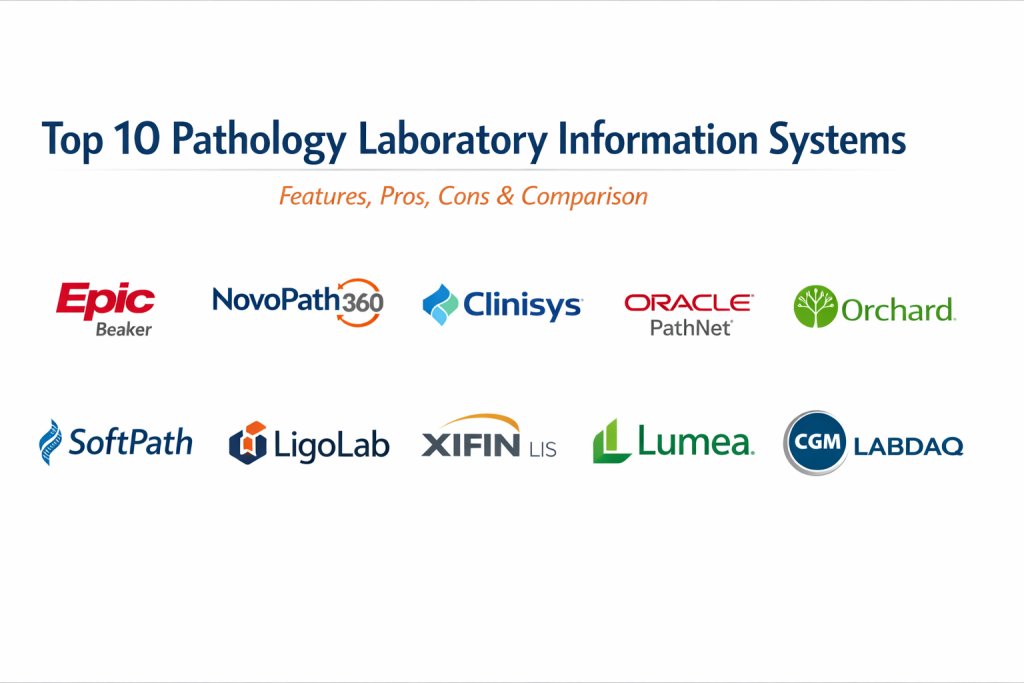
Top 10 Pathology Laboratory Information Systems Tools
1. Epic Beaker Anatomic Pathology
Beaker is a comprehensive LIS that lives natively within the broader Epic EHR ecosystem. For organizations already utilizing Epic, it provides a seamless “single source of truth,” allowing pathologists to access clinical history and images without ever leaving the patient’s chart. It is built for high-volume enterprise environments that require maximum data continuity.
Key Features
- Native integration with clinical health records for a unified patient view.
- Advanced specimen and slide tracking with automated barcode generation.
- Support for structured and narrative reporting tailored to pathology.
- Integrated digital pathology viewers and image management tools.
- Comprehensive decision support and quality assurance workflows.
Pros
- Eliminates the need for complex interfaces between the lab and the EHR.
- Excellent data security and standardized enterprise-grade reliability.
Cons
- Only feasible for organizations already committed to the Epic ecosystem.
- Implementation is often long and requires significant IT resources.
Platforms / Deployment
Windows / Web — Enterprise Hybrid
Security & Compliance
Enterprise-grade security with full HIPAA, SOC 2, and ISO 27001 compliance.
Integrations & Ecosystem
As part of the Epic suite, it features unmatched connectivity to clinical modules. It also supports various instrument and scanner interfaces via standard protocols.
Support & Community
Large-scale professional support and an extensive “UserWeb” community for sharing best practices and reporting templates.
2. NovoPath 360
NovoPath 360 is a modern, cloud-native LIS specifically engineered for anatomic, molecular, and digital pathology. It is highly regarded for its streamlined user interface and its focus on reducing the administrative burden on pathologists. Its SaaS-based architecture makes it a flexible choice for growing lab groups.
Key Features
- A rules-based workflow engine that automates multi-site operations.
- Cloud-based deployment that supports remote slide review and reporting.
- Deep digital pathology integration with support for multiple scanner types.
- Advanced reporting templates that focus on diagnostic speed and clarity.
- Built-in tools for molecular and genomic testing workflows.
Pros
- Fast deployment times compared to traditional on-premise systems.
- Exceptional flexibility for customizing workflows without vendor help.
Cons
- May offer more features than a very small physician office lab requires.
- Requires a stable, high-bandwidth internet connection for cloud performance.
Platforms / Deployment
Web / Cloud-based — SaaS
Security & Compliance
HIPAA compliant with SOC 2 certification and modern data encryption.
Integrations & Ecosystem
Features over 150 EMR integrations and a vendor-neutral approach to digital pathology scanners and AI algorithms.
Support & Community
Professional enterprise support and an internal “NovoU” reference library for rapid staff onboarding.
3. Clinisys (PowerPath / Sunquest)
Following the consolidation of several major brands, Clinisys offers a powerful suite of informatics tools, with PowerPath standing as a leader for anatomic pathology. It is particularly strong in large-scale diagnostic networks that require standardization across many different geographies.
Key Features
- Comprehensive coverage for surgical pathology, cytology, and autopsy.
- Advanced molecular and genetics modules for precision diagnostics.
- Robust interoperability tools for multi-site data synchronization.
- Integrated quality management and regulatory compliance tools.
- Support for high-volume clinical and anatomic testing in a single system.
Pros
- Massive global scale and a long history of reliability in large networks.
- Excellent for labs needing a unified platform for both clinical and AP work.
Cons
- Legacy modules can sometimes feel less modern than newer SaaS tools.
- Upgrading from older versions can be a complex technical project.
Platforms / Deployment
Windows / Web — Hybrid / Cloud
Security & Compliance
Strong adherence to international standards including GDPR and HIPAA.
Integrations & Ecosystem
A global leader in interoperability, with thousands of existing interfaces to instruments and EHR systems.
Support & Community
Deep professional services and a massive installed base of global laboratory experts.
4. Oracle Health (Cerner PathNet)
PathNet is a mature and highly stable LIS that has been a staple in large hospital systems for years. Since the Oracle acquisition, it has seen increased investment in cloud capabilities and advanced analytics, making it a reliable choice for high-throughput environments.
Key Features
- End-to-end management of specimen tracking and chain of custody.
- Integration of clinical and anatomic pathology workflows in one database.
- Scalable architecture designed for multi-facility healthcare organizations.
- Advanced reporting with integrated clinical data from the EHR.
- Robust automation features for high-volume lab testing.
Pros
- Highly stable and proven in some of the world’s busiest labs.
- Strong focus on data reliability and high-throughput automation.
Cons
- Can be complex to configure for smaller, specialized pathology groups.
- The transition to the newest cloud-based versions is still ongoing for some.
Platforms / Deployment
Web / Enterprise — Hybrid / Cloud
Security & Compliance
Comprehensive security backed by Oracle’s enterprise infrastructure protocols.
Integrations & Ecosystem
Seamless integration with the Oracle Health (Cerner) Millennium platform and vast experience with third-party EHRs.
Support & Community
Extensive global support network and formal training academies for lab professionals.
5. Orchard Enterprise Pathology
Orchard Software is a favorite among independent and mid-sized laboratories. Its pathology module is known for its flexibility and user-friendly interface, providing enterprise-grade features without the complexity associated with larger EHR-centric systems.
Key Features
- A modular design that allows labs to add features as they grow.
- Streamlined accessioning and result reporting for anatomic pathology.
- Customizable dashboards for real-time operational monitoring.
- Integrated outreach and billing modules for independent lab groups.
- Strong support for molecular and specialty testing workflows.
Pros
- Much faster learning curve for lab staff and technicians.
- Highly responsive customer support and dedicated account management.
Cons
- Not as deeply integrated into a single-system EHR as Epic or Cerner.
- May lack some of the most advanced “heavy” simulations found in specialized VFX tools.
Platforms / Deployment
Windows / Web — Cloud / Hybrid
Security & Compliance
HIPAA compliant with SOC 2 security standards.
Integrations & Ecosystem
Broad connectivity options with a strong focus on instrument and EHR interfacing for independent labs.
Support & Community
Known for high customer satisfaction and a collaborative approach to user feedback and feature development.
6. SCC Soft Computer (SoftPath)
SCC Soft Computer is a major player in the LIS market, with SoftPath offering a dedicated solution for anatomic pathology. It is built for scalability and is often found in large reference laboratories that process millions of specimens annually.
Key Features
- Complete automation of grossing, microscopy, and sign-out workflows.
- Advanced quality assurance and peer review modules.
- Deep integration for anatomic, clinical, and molecular pathology.
- Highly configurable reporting templates with image inclusion.
- Comprehensive billing and revenue cycle management integration.
Pros
- Exceptional performance and reliability for ultra-high-volume labs.
- A single vendor solution for almost every laboratory discipline.
Cons
- The interface can be dense and requires significant initial training.
- Customization often requires deep technical knowledge of the system.
Platforms / Deployment
Windows / Web — Enterprise Hybrid
Security & Compliance
Rigorous internal quality controls and full HIPAA/SOC 2 compliance.
Integrations & Ecosystem
Strong multi-site connectivity and experience with complex hospital system integrations.
Support & Community
Global support network and annual user conferences that foster a strong professional community.
7. LigoLab Information System
LigoLab provides a unified platform that combines LIS and Revenue Cycle Management (RCM). It is particularly popular with labs that want to manage both their diagnostic workflows and their financial operations in a single, high-performance environment.
Key Features
- A native, unified architecture for LIS and billing management.
- Automated specimen life cycle tracking with real-time visibility.
- An engine for custom workflow automation and rules-based logic.
- Integrated client portals for faster result delivery and communication.
- Advanced analytics and operational dashboards built-in.
Pros
- Eliminates data silos between the lab operations and the billing team.
- High degree of autonomy for labs to manage their own rule changes.
Cons
- Requires a commitment to learning a highly integrated financial-clinical workflow.
- Smaller overall market presence compared to the major legacy vendors.
Platforms / Deployment
Web / Cloud — SaaS
Security & Compliance
HIPAA and SOC 2 compliant with a focus on audit-ready recordkeeping.
Integrations & Ecosystem
Designed for interoperability with a strong focus on outreach and provider experience.
Support & Community
Strong focus on implementation quality and standardizing adoption for pathology teams.
8. XIFIN LIS
XIFIN is a leader in laboratory informatics, known for its highly configurable SaaS platform. It is particularly strong in pathology and molecular testing, offering a modern alternative for labs looking to move away from legacy on-premise hardware.
Key Features
- A unified platform for LIS and financial management.
- Advanced digital pathology readiness with viewer-agnostic integrations.
- Robust molecular and genomic testing modules.
- Comprehensive analytics for both clinical and business intelligence.
- Cloud-based deployment for multi-site scalability.
Pros
- Excellent for labs that prioritize financial wellness and revenue protection.
- Modern, web-based interface that is accessible from anywhere.
Cons
- Can be complex to set up due to the depth of financial and clinical rules.
- Not as naturally integrated into hospital clinical records as EHR-based LIS.
Platforms / Deployment
Web / Cloud-based — SaaS
Security & Compliance
HITRUST, HIPAA, and SOC 2 certified with high-level data protection.
Integrations & Ecosystem
Strong emphasis on interoperability and a broad partner ecosystem for digital pathology.
Support & Community
Professional enterprise support with a strong focus on financial training and clinical workflow efficiency.
9. Lumea
Lumea is a disruptive force that focuses on the “digital journey” of the specimen. It is an ideal choice for laboratories looking to fully digitize their workflow, offering unique pre-analytical tracking and digital pathology tools.
Key Features
- Innovative pre-analytical specimen tracking from the point of collection.
- A native digital pathology viewer designed for high-speed diagnostic review.
- Integrated AI orchestration for automated case screening.
- Case-centric workflow management with integrated digital images.
- Simplified reporting that focuses on the “digital-first” pathologist.
Pros
- One of the most forward-thinking tools for true digital transformation.
- Greatly improves the quality of specimen data before it even reaches the lab.
Cons
- Newer to the market compared to established enterprise giants.
- Requires a commitment to a fully digital way of working to see full value.
Platforms / Deployment
Web / Cloud — SaaS
Security & Compliance
HIPAA compliant with modern cloud security protocols.
Integrations & Ecosystem
Designed to act as an LIS or sit on top of existing systems to modernize the digital workflow.
Support & Community
Very modern support experience with high-quality video training and agile customer service.
10. CompuGroup Medical (CGM LABDAQ)
CGM LABDAQ is one of the most widely installed LIS solutions in the world. It is highly favored by community hospitals and independent labs for its user-friendly interface and robust feature set that covers both clinical and pathology needs.
Key Features
- An intuitive user interface that is easy to learn and navigate.
- Robust modules for medical necessity verification and billing.
- Strong instrument and analyzer connectivity for diverse lab menus.
- Configurable dashboards for tracking lab performance and KPIs.
- Integrated support for anatomic pathology and cytology workflows.
Pros
- Reliable and dependable for labs without a large internal IT department.
- Excellent focus on financial wellness and preventing “revenue leakage.”
Cons
- May lack the ultra-complex technical depth of systems like Houdini for specialized FX.
- Interface is clean but can feel less “cinematic” than high-end digital suites.
Platforms / Deployment
Windows / Web — Hybrid
Security & Compliance
Full HIPAA compliance with strong data auditing capabilities.
Integrations & Ecosystem
Vast experience in connecting with all major EHRs and laboratory instruments.
Support & Community
A classic and dependable vendor with a very high user satisfaction rate and extensive training resources.
Comparison Table (Top 10)
| Tool Name | Best For | Platform(s) Supported | Deployment | Standout Feature | Public Rating |
| 1. Epic Beaker | Epic Hospitals | Windows, Web | Hybrid | Native EHR Continuity | 4.4/5 |
| 2. NovoPath 360 | Modern Anatomic Labs | Web | Cloud-SaaS | Rules-Based Workflow | 4.6/5 |
| 3. Clinisys | Large Networks | Windows, Web | Hybrid | Multi-Site Scalability | 4.5/5 |
| 4. Oracle PathNet | High-Volume Systems | Web | Cloud-Hybrid | Established Stability | 4.3/5 |
| 5. Orchard Pathology | Independent Labs | Windows, Web | Hybrid | User-Friendly Interface | 4.6/5 |
| 6. SoftPath | Reference Labs | Windows, Web | Hybrid | Advanced Automation | 4.2/5 |
| 7. LigoLab | LIS + RCM Unified | Web | Cloud-SaaS | Unified Billing Engine | 4.5/5 |
| 8. XIFIN LIS | Financial Focus | Web | Cloud-SaaS | Revenue Protection | 4.4/5 |
| 9. Lumea | Digital-First Labs | Web | Cloud-SaaS | Pre-Analytical Tracking | 4.7/5 |
| 10. CGM LABDAQ | Community Labs | Windows, Web | Hybrid | Intuitive Navigation | 4.6/5 |
Evaluation & Scoring of Pathology Laboratory Information Systems
| Tool Name | Core (25%) | Ease (15%) | Integrations (15%) | Security (10%) | Perf (10%) | Support (10%) | Value (15%) | Total |
| 1. Epic Beaker | 10 | 4 | 10 | 10 | 9 | 10 | 5 | 8.2 |
| 2. NovoPath 360 | 9 | 8 | 9 | 9 | 9 | 8 | 8 | 8.6 |
| 3. Clinisys | 9 | 6 | 9 | 9 | 9 | 9 | 7 | 8.1 |
| 4. Oracle PathNet | 9 | 5 | 9 | 9 | 9 | 8 | 6 | 7.7 |
| 5. Orchard | 8 | 9 | 8 | 8 | 8 | 9 | 8 | 8.2 |
| 6. SoftPath | 9 | 5 | 8 | 9 | 10 | 8 | 6 | 7.6 |
| 7. LigoLab | 8 | 7 | 8 | 9 | 9 | 8 | 9 | 8.1 |
| 8. XIFIN LIS | 8 | 6 | 8 | 9 | 8 | 8 | 8 | 7.7 |
| 9. Lumea | 7 | 8 | 7 | 8 | 9 | 9 | 8 | 7.8 |
| 10. CGM LABDAQ | 8 | 9 | 8 | 8 | 8 | 8 | 9 | 8.3 |
The scoring above is a comparative measure. A high “Core” score reflects a system’s ability to handle complex, enterprise-level pathology without external tools. “Ease of use” highlights systems that allow for faster daily operations, while “Value” considers the feature set against the total cost and infrastructure required.
Which Pathology Laboratory Information System Tool Is Right for You?
Solo / Freelancer
For small independent pathology consultants, NovoPath 360 or Lumea offer a high-performance, digital-first environment that is accessible without a massive local server room. These cloud-native tools provide the most flexibility for mobile or remote diagnostic work.
SMB (Small to Medium Business)
A mid-sized independent lab should focus on Orchard Enterprise Pathology or CGM LABDAQ. These platforms offer a perfect balance of advanced features and straightforward implementation, ensuring the lab stays agile and profitable without excessive IT overhead.
Mid-Market
For multi-site regional lab groups, XIFIN LIS or LigoLab are excellent choices. Their unified approach to clinical work and revenue cycle management ensures that financial stability scales alongside diagnostic volume.
Enterprise
Large hospital systems and massive diagnostic networks will find the most success with Epic Beaker, Clinisys, or Oracle PathNet. These systems are designed to manage millions of patient records while maintaining strict enterprise security and data integrity.
Budget vs Premium
Labs on a strict budget should look for modular systems like Orchard, where you only pay for the features you need. Premium, all-encompassing suites like Epic Beaker offer unparalleled continuity but require a much larger initial investment.
Feature Depth vs Ease of Use
If your priority is the deepest possible molecular and genetic workflow, SoftPath and Clinisys are the technical leaders. If you prioritize a fast, modern interface that pathologists will love immediately, NovoPath 360 is the standout.
Integrations & Scalability
Epic Beaker wins for internal clinical integration, while NovoPath and Lumea lead in vendor-neutral digital pathology scalability. Choose based on whether you are building around an EHR or around a digital laboratory workflow.
Security & Compliance Needs
For organizations with high-level regulatory requirements, Epic and Oracle provide the highest levels of corporate-grade security. However, all SaaS-based tools on this list now offer robust HIPAA and SOC 2 protections.
Frequently Asked Questions (FAQs)
1. What is the primary difference between a LIS and a LIMS?
A LIS (Laboratory Information System) is focused on clinical diagnostics and patient health data, while a LIMS (Laboratory Information Management System) is often more focused on research, samples, and industrial testing.
2. Is digital pathology support included in most LIS tools?
Most modern systems now offer digital pathology modules, but the level of integration varies. Some provide native viewers, while others act as a gateway to third-party imaging systems.
3. How long does a typical LIS implementation take?
For a mid-sized lab, implementation usually takes 6–9 months. For large enterprise systems like Epic or Cerner, it can take over a year due to the complexity of EHR integration.
4. Can a LIS help with lab accreditation and audits?
Yes, most top-tier systems have built-in quality management and audit trail features that make it much easier to comply with CAP, CLIA, and ISO standards.
5. Do these systems support molecular and genetic testing?
Yes, leading systems like Clinisys and SoftPath have dedicated modules specifically designed to handle the complex data generated by next-generation sequencing.
6. Can pathologists work remotely using these systems?
Cloud-based systems like NovoPath and Lumea are specifically designed to allow pathologists to review cases and sign out reports securely from any location.
7. How do these tools improve turnaround time (TAT)?
By automating manual tasks like barcoding, data entry, and report generation, these systems eliminate bottlenecks and allow specimens to move through the lab faster.
8. Is voice recognition software compatible with these systems?
Most pathology-centric LIS tools integrate with professional medical dictation software, allowing for hands-free reporting during grossing or microscopy.
9. What kind of hardware is needed for a modern LIS?
Cloud-based systems require minimal local hardware but need high-speed internet. On-premise systems require dedicated servers and a robust local network infrastructure.
10. How do I choose the right system for a multi-site network?
Focus on systems with strong interoperability and central governance features, such as those offered by Clinisys or Oracle PathNet, to ensure consistency across all locations.
Conclusion
The selection of a Pathology Laboratory Information System is a critical strategic decision that determines the operational efficiency and diagnostic accuracy of a modern laboratory for years to come. Whether you choose an EHR-centric powerhouse like Epic Beaker or a cloud-native, pathology-first platform like NovoPath 360, the goal remains the same: to create a frictionless environment for diagnostic excellence. As the industry continues to move toward a digital-first model, the most successful laboratories will be those that prioritize interoperability, AI readiness, and user experience. By aligning your technology choices with your long-term growth and patient care goals, you can ensure that your laboratory remains a vital and efficient hub of diagnostic information in the evolving healthcare landscape.

Best Cardiac Hospitals Near You
Discover top heart hospitals, cardiology centers & cardiac care services by city.
Advanced Heart Care • Trusted Hospitals • Expert Teams
View Best Hospitals