Introduction
Secure software supply chain attestation tools are specialized security solutions designed to verify the integrity and origin of software throughout its development lifecycle. In an era where “software is assembled, not written,” these tools provide the cryptographic proof—often referred to as provenance—that a piece of code was built on a trusted system from a specific source repository without being tampered with. The industry standard for this verification is the Supply-chain Levels for Software Artifacts (SLSA) framework, which codifies how build systems should generate and sign these attestations.
As we move deeper into a landscape defined by zero-trust architectures and automated pipelines, attestation has become a non-negotiable requirement for enterprise security. These tools ensure that when an image is pulled into a production environment, it carries a verifiable digital “passport.” This process prevents attacks where malicious actors attempt to swap legitimate binaries with compromised versions during the transit from code to deployment.
Real-World Use Cases
- Verifying that a container image in a production cluster was actually built by an authorized CI/CD pipeline and not an untrusted local machine.
- Generating a Software Bill of Materials (SBOM) and linking it to a signed attestation to meet federal and regulatory compliance requirements.
- Protecting against dependency confusion attacks by ensuring only cryptographically signed third-party libraries are integrated into the build.
- Automating the rejection of any software artifact that fails to meet a minimum SLSA level during the deployment phase.
- Providing a tamper-evident audit trail for forensic analysis in the event of a security breach within the supply chain.
Evaluation Criteria for Buyers
- The ability to support multiple attestation formats, specifically in-toto and SLSA-compliant JSON.
- Integration depth with existing CI/CD platforms like GitHub Actions, GitLab CI, and Jenkins.
- Support for “keyless” signing to avoid the risks associated with long-lived cryptographic key management.
- Performance overhead added to the build pipeline when generating and signing metadata.
- Transparency log support (such as Rekor) to provide a publicly or privately verifiable record of attestations.
- Policy enforcement capabilities that allow security teams to block unverified artifacts at the gate.
- Scalability for organizations managing thousands of microservices and frequent deployment cycles.
Best for: DevSecOps engineers, security architects, site reliability engineers (SREs), and compliance officers looking to harden their build-to-deploy pipelines.
Not ideal for: Solo developers working on local hobby projects or legacy systems that lack automated build pipelines and modern container orchestration.
Key Trends in Software Supply Chain Attestation
- The standard adoption of “Keyless” signing, which utilizes short-lived certificates tied to OIDC identities instead of traditional static private keys.
- Increased integration between SBOM generators and attestation tools to create a unified “identity” for every software package.
- Emergence of automated admission controllers in Kubernetes that natively validate SLSA provenance before allowing container execution.
- The transition from SLSA Level 1 (basic provenance) to Level 3 (hardened, non-falsifiable build environments) across the enterprise sector.
- Universal adoption of the in-toto metadata standard to ensure interoperability between different security scanning and signing tools.
- Rise of “policy-as-code” frameworks that use attestations to automatically determine if a build meets corporate security standards.
- Use of transparency logs to provide immutable records that can be audited by third parties without sharing private source code.
- Development of AI-powered analysis tools that scan provenance data to identify anomalies or potential supply chain drift.
How We Selected These Tools
The selection of these top ten attestation and provenance tools is based on their technical alignment with the SLSA framework and their adoption within the cloud-native ecosystem. We prioritized tools that offer cryptographic signing capabilities and those that integrate seamlessly into modern DevOps workflows. Our methodology focused on the maturity of the project, specifically looking for those backed by major foundations like the Linux Foundation or the OpenSSF. We also considered the ease of automation, as supply chain security must be “invisible” to developers to be effective. Finally, we looked at the ability of these tools to generate verifiable evidence that can survive the transition through various registries and deployment stages.
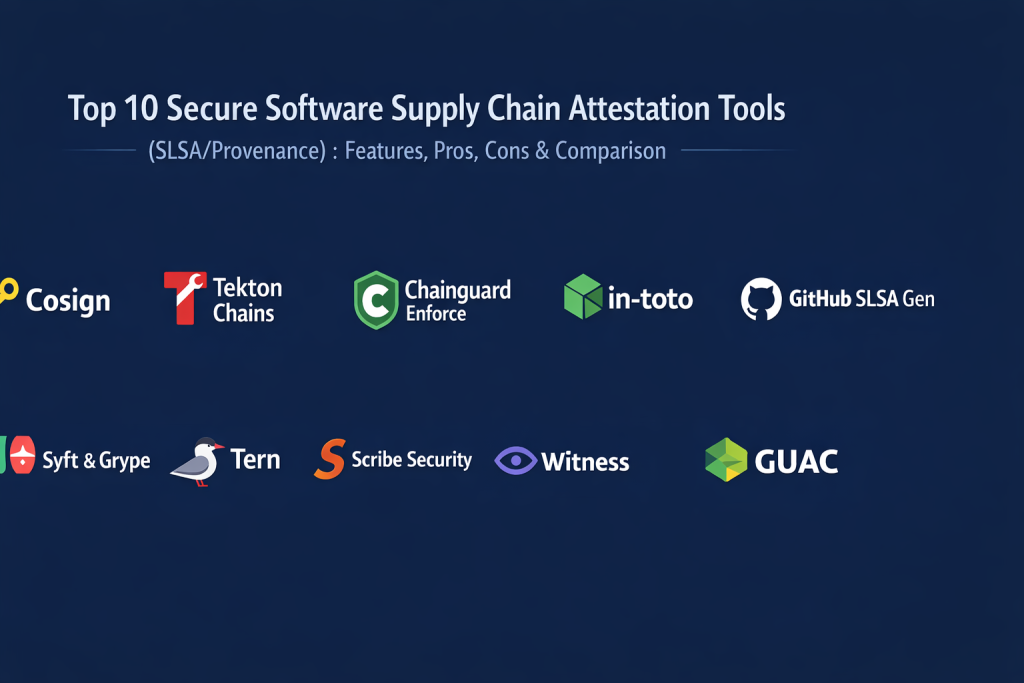
Top 10 Secure Software Supply Chain Attestation Tools
1. Sigstore Cosign
Cosign is the flagship tool for signing and verifying container images and other artifacts. It simplifies the process of adding cryptographic signatures to OCI registries and is the leading implementation of the Sigstore project. Its primary goal is to make digital signing as easy as possible for developers.
Key Features
- Native support for signing and verifying container images in any OCI-compliant registry.
- Keyless signing using OpenID Connect (OIDC) identities for enhanced security.
- Integration with the Rekor transparency log for tamper-evident audit trails.
- Support for multiple signature formats, including specialized hardware security modules (HSM).
- Seamless verification within Kubernetes using admission controllers.
Pros
- Eliminates the nightmare of managing long-term private keys.
- Massive industry support and rapid feature development.
Cons
- Requires an active OIDC provider for the keyless workflow.
- Still relatively new compared to legacy GPG-based systems.
Platforms / Deployment
Windows / macOS / Linux — Cloud / Hybrid
Security & Compliance
Standardized through Sigstore/OpenSSF; supports MFA and OIDC.
Integrations & Ecosystem
Integrates with all major cloud providers (AWS, GCP, Azure) and CI tools like GitHub Actions and Tekton. It is the de facto standard for modern container signing.
Support & Community
One of the fastest-growing open-source security communities with extensive documentation and corporate backing from Google and Red Hat.
2. Tekton Chains
Tekton Chains is a specialized controller for Kubernetes that observes Tekton pipeline executions. Once a task or pipeline completes, it automatically captures the results, signs them, and generates an attestation, ensuring that the build process itself is verifiable.
Key Features
- Automatic provenance generation for all Tekton build tasks.
- Support for the in-toto attestation format and SLSA provenance.
- Direct integration with Sigstore for cryptographic signing.
- Ability to store attestations in OCI registries or specialized metadata databases.
- Configurable policies to determine which build artifacts require signing.
Pros
- Transparent operation that requires no changes to existing developer pipelines.
- Built-in support for reaching SLSA Level 2 and Level 3 compliance.
Cons
- Strictly tied to the Tekton ecosystem; not useful for other CI tools.
- Requires a running Kubernetes cluster for the controller to operate.
Platforms / Deployment
Linux (Kubernetes) — Cloud / Self-hosted
Security & Compliance
Implements SLSA Level 3 requirements for non-falsifiable provenance.
Integrations & Ecosystem
Works seamlessly within the Tekton and OpenShift pipelines and connects easily to OCI registries for artifact storage.
Support & Community
Strong community support as part of the CD Foundation and favored by organizations heavily invested in cloud-native CI/CD.
3. Chainguard Enforce
Chainguard Enforce is an enterprise-grade platform designed to manage and enforce software supply chain policies. It provides a centralized way to ensure that only verified, signed, and compliant software enters a production environment across multiple clusters.
Key Features
- Continuous monitoring of software artifacts against organizational security policies.
- Real-time verification of SLSA attestations and SBOMs at the time of deployment.
- Centralized dashboard for visibility into the security posture of the entire supply chain.
- Automated rejection of unverified or high-risk container images.
- Integration with Chainguard’s hardened “distroless” images for maximum security.
Pros
- Provides a unified management layer for complex multi-cluster environments.
- Drastically reduces the “noise” of vulnerability scanning by focusing on verified provenance.
Cons
- Enterprise-tier pricing may be high for smaller organizations.
- Best used in conjunction with other Chainguard products for the full experience.
Platforms / Deployment
Cloud-based SaaS — Hybrid
Security & Compliance
SOC 2, ISO 27001; focused on achieving maximum SLSA compliance levels.
Integrations & Ecosystem
Strong ties to Kubernetes, Sigstore, and all major cloud-managed Kubernetes services like EKS, GKE, and AKS.
Support & Community
High-level professional support with a deep focus on educational resources and supply chain security advocacy.
4. In-toto
In-toto is not just a tool but a comprehensive framework for providing end-to-end integrity for the software supply chain. It allows developers to define a “layout” of the build process and verifies that each step was performed by the authorized person or system.
Key Features
- A flexible metadata standard for describing the steps in a software supply chain.
- Cryptographic “links” that prove a specific action was taken by a specific actor.
- Language-agnostic design that works with any build system or programming language.
- Support for multi-signature layouts to require verification from multiple parties.
- Ability to detect unauthorized changes at any point between coding and deployment.
Pros
- The most comprehensive and flexible framework for total supply chain visibility.
- Prevents “insider threats” by requiring cryptographic proof for every build step.
Cons
- Can be complex to set up and configure for multi-stage pipelines.
- Requires a deep understanding of the supply chain layout to be effective.
Platforms / Deployment
Windows / macOS / Linux — Self-hosted
Security & Compliance
The underlying standard for most SLSA implementations.
Integrations & Ecosystem
Integrates with almost all modern attestation tools, including Tekton, Jenkins, and GitHub Actions.
Support & Community
A mature, research-backed project with strong academic and industry contributions.
5. GitHub Actions SLSA Generator
This is a specialized collection of reusable workflows and actions provided by the SLSA framework team. It allows developers using GitHub to easily generate high-strength SLSA provenance for their builds without needing to build their own security infrastructure.
Key Features
- Reusable workflows for generating SLSA Level 3 provenance on GitHub.
- Automatic signing of provenance using GitHub’s internal OIDC provider.
- Support for various build types, including Go, Node.js, and container images.
- Tamper-resistant design that prevents the build process from modifying the provenance.
- Simple integration into existing GitHub Actions YAML files.
Pros
- The easiest way for GitHub users to achieve high-level SLSA compliance.
- Zero infrastructure to manage; everything runs within the GitHub ecosystem.
Cons
- Limited to the GitHub Actions platform.
- May not support highly custom or exotic build environments.
Platforms / Deployment
Cloud (GitHub) — SaaS
Security & Compliance
Aligned with SLSA Level 3 requirements.
Integrations & Ecosystem
Perfectly integrated with the GitHub marketplace and the native GitHub security dashboard.
Support & Community
Supported by the OpenSSF and the SLSA steering committee, with a vast user base on GitHub.
6. Syft & Grype (Anchore)
While Syft is an SBOM generator and Grype is a vulnerability scanner, they are essential in the attestation process. Together, they create the detailed “ingredients list” of a software artifact, which is then wrapped in an attestation to prove the artifact’s security state.
Key Features
- Syft generates detailed SBOMs in standard formats like SPDX and CycloneDX.
- Grype scans those SBOMs for known vulnerabilities across multiple databases.
- Capability to output machine-readable JSON for integration into attestation metadata.
- Support for scanning container images, filesystems, and remote repositories.
- Fast, lightweight execution designed for CI/CD pipelines.
Pros
- Provides the necessary data that makes an attestation meaningful.
- Exceptional speed and accuracy in identifying deep transitive dependencies.
Cons
- These tools generate the “what,” but another tool (like Cosign) is needed to sign the “how.”
- Requires frequent updates to keep the vulnerability database current.
Platforms / Deployment
Windows / macOS / Linux — Self-hosted
Security & Compliance
Essential for meeting SBOM mandates and vulnerability disclosure requirements.
Integrations & Ecosystem
Industry-standard tools that integrate with every major CI/CD platform and security tool.
Support & Community
Widely adopted with strong commercial support from Anchore and a very active open-source following.
7. Tern
Tern is an inspection tool that finds the metadata of packages installed in a container image. It is particularly valuable for generating provenance for containerized applications where the build history might be opaque.
Key Features
- Deep inspection of container image layers to identify installed software.
- Generation of detailed reports on the origin and licensing of each package.
- Ability to create an inventory that can be used for compliance and attestation.
- Support for identifying “hidden” dependencies within complex container layers.
- Integration with other tools to provide a complete picture of image provenance.
Pros
- Excellent for auditing third-party or legacy container images.
- Provides high-quality data for licensing and security compliance.
Cons
- Can be slower than other scanners when dealing with very large images.
- Primarily focused on containers rather than other artifact types.
Platforms / Deployment
Linux — Self-hosted
Security & Compliance
Strong focus on license compliance and software origin.
Integrations & Ecosystem
A Linux Foundation project that works well within the broader container security ecosystem.
Support & Community
A specialized community of maintainers focused on deep container inspection and auditing.
8. Scribe Security
Scribe Security provides a platform that continuously collects and manages attestations throughout the development lifecycle. It acts as a “trust hub” that validates that every artifact in the organization meets defined security and compliance standards.
Key Features
- Continuous collection of SDLC metadata from various tools in the pipeline.
- Management of SBOMs and attestations in a centralized, searchable portal.
- Policy enforcement based on SLSA levels and vulnerability thresholds.
- Real-time visibility into the “trust score” of every software component.
- Automated generation of compliance reports for various regulatory frameworks.
Pros
- Simplifies the management of thousands of disparate attestations.
- Provides clear, actionable insights for security managers.
Cons
- Requires integration across the entire pipeline to provide full value.
- SaaS-based model may not suit air-gapped or highly restrictive environments.
Platforms / Deployment
Cloud-based SaaS — Hybrid
Security & Compliance
Focused on SLSA, NIST, and other global supply chain standards.
Integrations & Ecosystem
Integrates with all major Git providers, CI/CD tools, and container registries.
Support & Community
Professional support with a strong emphasis on enterprise supply chain visibility.
9. Witness (TestifySec)
Witness is a pluggable framework for supply chain attestation. It focuses on gathering evidence from the build environment (such as environment variables, git history, and build logs) and signing it to create a comprehensive record of a build’s context.
Key Features
- A flexible “attestor” system that can gather evidence from various sources.
- Integration with SPIFFE/SPIRE for strong identity-based signing.
- Support for a wide range of attestation types beyond just build provenance.
- Capability to verify attestations at the edge or within a Kubernetes cluster.
- Lightweight agent that can run in any CI environment.
Pros
- Highly extensible; you can write your own attestors for unique needs.
- Excellent integration with modern zero-trust identity frameworks.
Cons
- Smaller market share compared to the Sigstore ecosystem.
- Requires some configuration to define which evidence to collect.
Platforms / Deployment
Linux — Self-hosted / Cloud
Security & Compliance
Designed to meet high-level zero-trust and SLSA requirements.
Integrations & Ecosystem
Strong ties to the SPIFFE ecosystem and works well in Kubernetes-heavy environments.
Support & Community
A dedicated community of security professionals focused on zero-trust supply chains.
10. Guac (Graph for Understanding Artifact Composition)
Guac is a unique tool that aggregates supply chain metadata (like SBOMs and attestations) into a graph database. While it doesn’t generate attestations, it is the premier tool for verifying and understanding them at scale across an entire organization.
Key Features
- Aggregation of multiple security metadata sources into a single graph.
- Ability to trace a vulnerability from a low-level library up through every affected container image.
- Verification of attestations across a massive inventory of artifacts.
- Analysis of “blast radius” when a specific supplier or package is compromised.
- Support for standard formats like SLSA, CycloneDX, and SPDX.
Pros
- The only tool that provides a holistic view of the entire organization’s supply chain trust.
- Invaluable for responding to new zero-day vulnerabilities across a large fleet.
Cons
- Requires significant infrastructure to ingest and manage the graph data.
- Does not generate the data itself; it relies on other tools to be in place.
Platforms / Deployment
Linux / Docker — Self-hosted / Cloud
Security & Compliance
Focused on the “Verification” and “Audit” portions of security frameworks.
Integrations & Ecosystem
Integrates with almost every tool on this list to provide a central intelligence layer.
Support & Community
Backed by major industry players and a rapidly growing community of supply chain security experts.
Comparison Table (Top 10)
| Tool Name | Best For | Platform(s) Supported | Deployment | Standout Feature | Public Rating |
| 1. Sigstore Cosign | Image Signing | Windows, macOS, Linux | Hybrid | Keyless Signing | 4.8/5 |
| 2. Tekton Chains | Kubernetes CI/CD | Linux (K8s) | Cloud | Auto-Attestation | 4.6/5 |
| 3. Chainguard Enforce | Policy Management | SaaS | Hybrid | Real-time Enforcement | 4.7/5 |
| 4. In-toto | Total Integrity | Windows, macOS, Linux | Self-hosted | Multi-step Verification | 4.9/5 |
| 5. GitHub SLSA Gen | GitHub Users | SaaS (GitHub) | Cloud | Zero-Config SLSA L3 | 4.5/5 |
| 6. Syft & Grype | SBOM & Scanning | Windows, macOS, Linux | Self-hosted | Deep Dependency Map | 4.7/5 |
| 7. Tern | Container Auditing | Linux | Self-hosted | Layer Inspection | 4.3/5 |
| 8. Scribe Security | Enterprise Trust | SaaS | Hybrid | Trust Hub Dashboard | 4.4/5 |
| 9. Witness | Zero-Trust ID | Linux | Self-hosted | SPIRE Integration | 4.5/5 |
| 10. Guac | Supply Chain Intel | Linux, Docker | Hybrid | Graph-based Visibility | 4.6/5 |
Evaluation & Scoring of Secure Software Supply Chain Attestation Tools
| Tool Name | Core (25%) | Ease (15%) | Integrations (15%) | Security (10%) | Perf (10%) | Support (10%) | Value (15%) | Total |
| 1. Cosign | 10 | 8 | 10 | 9 | 9 | 9 | 10 | 9.4 |
| 2. Tekton | 9 | 6 | 7 | 10 | 8 | 8 | 9 | 8.1 |
| 3. Chainguard | 8 | 9 | 9 | 9 | 9 | 9 | 6 | 8.3 |
| 4. In-toto | 10 | 3 | 9 | 10 | 9 | 8 | 9 | 8.3 |
| 5. GitHub Gen | 8 | 10 | 7 | 10 | 10 | 9 | 10 | 8.9 |
| 6. Syft/Grype | 9 | 9 | 10 | 8 | 10 | 9 | 10 | 9.2 |
| 7. Tern | 7 | 6 | 6 | 8 | 7 | 7 | 8 | 7.0 |
| 8. Scribe | 8 | 8 | 8 | 8 | 9 | 8 | 7 | 7.9 |
| 9. Witness | 9 | 6 | 7 | 10 | 8 | 7 | 8 | 8.0 |
| 10. Guac | 10 | 4 | 10 | 9 | 7 | 8 | 8 | 8.0 |
The scoring emphasizes the effectiveness of each tool in a modern automated pipeline. Tools that support keyless signing or zero-configuration for popular platforms score higher in ease of use and value. Core features reflect the depth of cryptographic proof provided.
Which Secure Software Supply Chain Attestation Tool Is Right for You?
Solo / Freelancer
For independent developers, Cosign combined with GitHub Actions SLSA Generator is the perfect starting point. It requires almost no infrastructure and provides high-level security for public repositories for free.
SMB (Small to Medium Business)
A growing business should focus on Syft and Grype for visibility and Cosign for signing. This combination provides the best balance of security and speed without requiring specialized security teams.
Mid-Market
Organizations at this stage often need the centralized visibility provided by Scribe Security or Chainguard Enforce. These tools help manage the complexity of multiple teams and ensure consistent security standards across the company.
Enterprise
Large enterprises with complex, heterogeneous environments will benefit most from the In-toto framework and Guac. These tools allow for deep, organization-wide analysis and the ability to define custom, high-security build layouts.
Budget vs Premium
The open-source stack—Blender, Cosign, and In-toto—provides world-class security at no licensing cost. For companies that need a “turnkey” solution with official support and managed dashboards, Chainguard and Scribe are the premium choices.
Feature Depth vs Ease of Use
In-toto offers the deepest security features but requires technical expertise to implement. Conversely, GitHub Actions SLSA Generator is extremely easy to use but is restricted to the GitHub ecosystem.
Integrations & Scalability
Cosign is the most widely integrated tool in the market. For those needing to scale security across thousands of images, the graph-based analysis of Guac is essential for understanding the big picture.
Security & Compliance Needs
If you are aiming for SLSA Level 3 compliance, Tekton Chains and GitHub Actions SLSA Generator are designed specifically to meet those rigid standards by hardening the build environment itself.
Frequently Asked Questions (FAQs)
1. What exactly is SLSA?
SLSA (Supply-chain Levels for Software Artifacts) is a security framework that provides a checklist of standards and controls to prevent tampering and improve the integrity of software.
2. What is the difference between an SBOM and an attestation?
An SBOM is a list of ingredients (what is in the software), while an attestation is a signed statement (how and where it was made). You need both for a secure supply chain.
3. Do I need to manage my own cryptographic keys?
Not necessarily. Modern tools like Cosign support “keyless” signing, which uses temporary certificates tied to your identity, removing the need for long-term key management.
4. How does attestation prevent supply chain attacks?
Attestation ensures that only code from authorized sources can be built and that only artifacts from authorized builds can be deployed, blocking “man-in-the-middle” style code injection.
5. Is this only for container images?
While many tools focus on containers, frameworks like in-toto and tools like Cosign can sign binaries, libraries, and even blobs of data.
6. Does adding these tools slow down my build pipeline?
Most modern attestation tools add only a few seconds to a build. The security benefits far outweigh the minimal performance impact.
7. Can I achieve SLSA Level 3 on my own?
It is difficult because Level 3 requires a “hardened” build environment. Using managed tools like the GitHub SLSA Generator makes reaching this level much easier.
8. What is a transparency log?
A transparency log (like Rekor) is an immutable, append-only record that stores signatures and attestations so they can be verified by anyone later without needing the original keys.
9. Why is in-toto mentioned so often?
In-toto is the industry-standard metadata format that almost all these tools use to communicate information about the build process.
10. How do I start if I have no supply chain security yet?
Start with an SBOM generator (Syft) and a signing tool (Cosign). This gives you an inventory and a basic level of trust that you can build upon.
Conclusion
Securing the software supply chain is a critical challenge that requires a combination of robust metadata, cryptographic signing, and strict policy enforcement. The tools featured in this list provide a variety of paths toward achieving SLSA compliance, from simple automated actions for independent developers to comprehensive graph-based analysis for large enterprises. By implementing these solutions, organizations can ensure that their software remains untampered and verifiable from the moment code is committed to the final deployment in production. The transition toward these secure practices is no longer an optional security enhancement; it is a fundamental requirement for building trust in modern digital infrastructure.

Best Cardiac Hospitals Near You
Discover top heart hospitals, cardiology centers & cardiac care services by city.
Advanced Heart Care • Trusted Hospitals • Expert Teams
View Best Hospitals