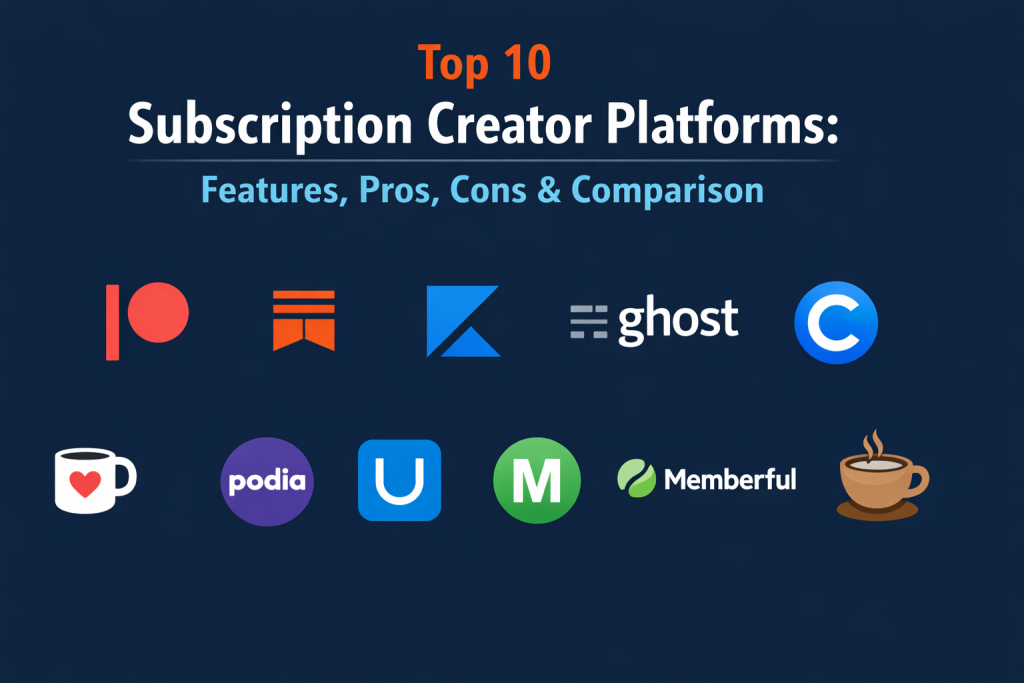
Introduction
Subscription creator platforms are specialized digital ecosystems that allow individuals to monetize their influence, creativity, or expertise through recurring payments from their audience. Unlike social media platforms that rely primarily on advertising revenue, these platforms facilitate a direct financial relationship between the creator and the fan. By offering exclusive content, early access, or community interaction behind a paywall, creators can transform casual followers into a sustainable source of monthly income.
In the current digital landscape, the “Direct-to-Fan” model has become a necessity for professional creators. Reliance on unpredictable social algorithms and fluctuating ad rates has led to a major shift toward owned audiences. These platforms matter because they offer financial stability and creative freedom, allowing artists, writers, and educators to build a business that scales with the depth of their community rather than just the breadth of their reach.
Real-World Use Cases
- Exclusive Media Hubs: Podcasters and YouTubers offering ad-free episodes, extended cuts, or behind-the-scenes vlogs to their most loyal supporters.
- Premium Newsletters: Journalists and industry analysts delivering deep-dive reports and niche insights directly to the inboxes of paying subscribers.
- Educational Memberships: Coaches and teachers providing structured courses, live Q&A sessions, and downloadable resources within a gated environment.
- Artistic Patrons: Visual artists and musicians receiving monthly “tips” or “stipends” in exchange for early access to new works or physical merchandise.
- Professional Communities: Experts hosting private discussion forums and networking groups where the “product” is access to like-minded peers and mentorship.
Evaluation Criteria for Buyers
- Revenue Share & Fees: The percentage the platform takes from your earnings, ranging from 0% (flat fee) to 12% or more.
- Content Ownership: Whether the platform allows you to export your subscriber list and content if you decide to move elsewhere.
- Monetization Diversity: Support for various income streams such as tiered memberships, one-time tips, digital products, and physical merch.
- Customization & Branding: The ability to make the creator page look and feel like your own brand rather than a generic profile.
- Built-in Marketing Tools: Features like email automation, recommendation engines, and “discover” feeds to help you find new subscribers.
- Payment Flexibility: Support for multiple currencies, global payment methods (Stripe/PayPal), and various billing cycles.
- Community Features: Presence of discussion boards, private messaging, and integration with third-party apps like Discord.
Best for: Independent writers, video creators, podcasters, educators, and community leaders seeking a predictable, recurring revenue stream.
Not ideal for: One-time product sellers with no ongoing content strategy, or those who prefer the high-reach but low-control environment of purely ad-supported social media.
Key Trends in Subscription Creator Platforms
- AI-Enhanced Retention: Platforms are integrating AI to predict subscriber churn and suggest personalized “win-back” offers to keep members engaged.
- Platform-to-Platform Discovery: A shift toward recommendation networks where creators on the same platform are incentivized to cross-promote each other’s subscriptions.
- Tiered “Access” Economy: Moving beyond content gating toward “access” gating, where the highest tiers buy direct time or interaction with the creator.
- Unified Commerce: The merging of subscription models with e-commerce, allowing fans to buy physical goods and digital downloads within the same membership portal.
- Global Localized Pricing: Automated tools that adjust subscription costs based on the subscriber’s local purchasing power to maximize global reach.
- Zero-Fee Models: The rise of self-hosted or flat-fee alternatives that challenge the traditional percentage-based revenue share model.
- Mobile-First Member Apps: A focus on providing creators with their own branded mobile apps to bypass the friction of web-based logins.
- Privacy-Centric Monetization: Enhanced tools that allow creators to monetize without harvesting invasive data from their supporters.
How We Selected These Tools
Our evaluation of the top subscription platforms for creators is based on a rigorous analysis of market mindshare and functional depth. We prioritized tools that demonstrate a strong “creator-first” philosophy, particularly those that offer robust audience portability and reliable payout systems. Our methodology considered the specific needs of different creator niches—ranging from the written word to high-definition video. We looked for a balance between “all-in-one” business suites and “membership-first” tools that integrate with existing websites. Security, payment processing reliability, and the quality of customer support were heavily weighted, as these are the pillars of any recurring revenue business.
Top 10 Subscription Creator Platforms
1. Patreon
As the most recognized name in the industry, Patreon is the go-to “membership-first” hub for creators across all mediums. It excels at turning a loyal audience into a community of patrons through flexible, tiered support levels.
Key Features
- Tiered Membership System: Create multiple levels of access with varying perks and price points.
- Patreon Video: Native, high-quality video hosting specifically for members, eliminating the need for third-party players.
- Discord Integration: Automatically assign roles and access to private community servers based on membership tier.
- Merch for Members: Integrated tool to design and fulfill physical merchandise for your top-tier subscribers.
- Insights Dashboard: Comprehensive analytics on member growth, churn, and financial health.
Pros
- Highest brand recognition makes it easy for fans to trust and sign up.
- Powerful “Discover” engine helps new fans find your work within the platform.
Cons
- Platform fees can be high (up to 12%) as your revenue grows.
- Limited customization options for your creator page’s visual design.
Platforms / Deployment
Web / iOS / Android — Managed
Security & Compliance
PCI compliant, GDPR support, and secure payment processing via Stripe/PayPal.
Integrations & Ecosystem
Strongest ecosystem of third-party integrations, including WordPress, Discord, and various podcasting tools.
Support & Community
Extensive creator blog, help center, and a massive community of successful creators to learn from.
2. Substack
Substack has revolutionized the newsletter industry by making it incredibly simple for writers and podcasters to start a paid subscription business. It combines a clean writing interface with powerful growth features.
Key Features
- Paid Newsletters: Seamless transition between free and gated email content.
- Substack Grow: A recommendation engine that suggests your newsletter to readers of similar publications.
- Podcast Hosting: Native tools to publish and distribute premium audio feeds to subscribers.
- Substack Notes: A built-in social feed that allows creators to engage with the broader Substack community.
- Custom Domains: Option to use your own URL to maintain brand consistency.
Pros
- Extremely low barrier to entry; you can start writing and earning in minutes.
- Built-in “Network Effect” significantly helps with audience discovery.
Cons
- Takes a flat 10% cut of all paid subscriptions.
- Limited design flexibility; most Substack pages look very similar.
Platforms / Deployment
Web / iOS / Android — Managed
Security & Compliance
Secure payment handling via Stripe and GDPR-compliant data management.
Integrations & Ecosystem
Focused primarily on its own internal network, with limited external software integrations.
Support & Community
Strong editorial support and a community of high-profile journalists and thought leaders.
3. Kajabi
Kajabi is an all-in-one “business-in-a-box” for creators who want to sell knowledge. It goes far beyond simple subscriptions, offering a full suite of marketing and sales automation tools.
Key Features
- Course Builder: Professional tools for creating structured, video-based learning programs.
- Marketing Pipelines: Pre-built sales funnels and landing page builders to convert leads.
- Kajabi Communities: A dedicated, high-engagement space for members to interact.
- Email Marketing: Native, automated email sequences to nurture your subscriber base.
- Mobile App: A branded app for your members to access your content on the go.
Pros
- No transaction fees; you keep 100% of your revenue (minus payment processing).
- Replaces multiple tools (hosting, email, funnels) with a single subscription.
Cons
- High monthly starting cost makes it a significant investment for beginners.
- The feature set can be overwhelming for those who only need simple memberships.
Platforms / Deployment
Web / iOS / Android — Managed
Security & Compliance
Enterprise-grade security, PCI compliance, and robust data protection.
Integrations & Ecosystem
Seamlessly integrates with major tools like Zapier, Google Analytics, and Facebook Pixel.
Support & Community
Exceptional 24/7 support and a highly professional community of digital entrepreneurs.
4. Ghost
Ghost is a powerful, open-source alternative for writers and publishers who want total control over their brand. It offers a professional publishing experience with a focus on high-performance design and SEO.
Key Features
- Native Memberships: Built-in tools to manage free and paid subscriber tiers.
- Best-in-Class Editor: A distraction-free Markdown editor optimized for long-form writing.
- Newsletter Delivery: Send beautiful, branded emails directly to your segments.
- Advanced SEO: Professional-grade search engine optimization tools built into the core.
- Developer API: Completely open for those who want to build a truly custom experience.
Pros
- Zero platform fees; you only pay a flat monthly hosting fee.
- You have absolute ownership over your content and subscriber data.
Cons
- Requires a bit more technical setup than Substack or Patreon.
- No built-in “Discovery” network; you are responsible for all your own marketing.
Platforms / Deployment
Web (Self-hosted or Managed) — Hybrid
Security & Compliance
Strong emphasis on privacy and GDPR compliance; security depends on hosting choice.
Integrations & Ecosystem
Extensive library of integrations via Zapier and a powerful native API for custom work.
Support & Community
Supportive forum for developers and professional documentation for managed users.
5. Circle
Circle is the industry leader for “community-first” creators. It allows you to build a private social network where discussions, events, and content all live under one roof.
Key Features
- Discussion Spaces: Organized areas for different topics, tiers, or interest groups.
- Live Streams: Built-in capability to host workshops and Q&A sessions directly in the community.
- Course Hosting: Integrate structured lessons and curriculum into your community platform.
- Member Directory: Custom profiles that help your subscribers network with each other.
- Event Calendar: Manage RSVPs and reminders for virtual or in-person meetups.
Pros
- The best interface for fostering peer-to-peer engagement and discussion.
- Can be used as a standalone site or embedded into an existing website.
Cons
- Primarily focused on community; not as strong for pure newsletter or video delivery.
- Pricing can become expensive as your member count grows.
Platforms / Deployment
Web / iOS / Android — Managed
Security & Compliance
Secure SSO (Single Sign-On) options and industry-standard data protection.
Integrations & Ecosystem
Deeply integrates with platforms like Teachable, Memberstack, and Zapier.
Support & Community
A very active community of community managers and creators sharing best practices.
6. Ko-fi
Ko-fi is the most “friendly” and low-pressure platform on this list. It started as a way for fans to “buy a creator a coffee” and has grown into a full subscription and shop system.
Key Features
- Zero Platform Fees: No percentage-based cut on one-time donations for the basic plan.
- Monthly Memberships: Add recurring support tiers with unique rewards for fans.
- Commissions & Requests: A specialized tool for artists to sell custom work.
- Ko-fi Shop: Sell digital or physical products directly from your profile.
- Supporter Gallery: A public way to showcase and thank your most loyal fans.
Pros
- Most affordable way to start accepting support from an audience.
- Very simple to use with no complex setup required.
Cons
- Lacks the advanced marketing and automation tools of Kajabi or Substack.
- The “tip-focused” branding might not suit highly professional or corporate creators.
Platforms / Deployment
Web — Managed
Security & Compliance
Uses industry-standard processors like PayPal and Stripe for all transactions.
Integrations & Ecosystem
Offers simple widgets to embed on websites and basic Discord notifications.
Support & Community
Friendly creator blog and help center focused on independent artists and hobbyists.
7. Podia
Podia is designed for creators who want an “all-in-one” platform that is actually easy to use. It handles everything from digital downloads to memberships without the technical complexity of other suites.
Key Features
- Everything-in-One: Sell courses, webinars, and memberships from a single storefront.
- Email Marketing: Built-in tools to send broadcasts and automated campaigns.
- Free Migration: They will move your content from other platforms for you.
- Affiliate Marketing: Create your own team of fans to promote your work for a commission.
- Custom Website: A simple, drag-and-drop builder to create a professional home for your brand.
Pros
- Incredibly intuitive; perfect for creators who want to spend time on content, not tech.
- Exceptional customer support and a very clean user interface.
Cons
- Design customization is somewhat limited compared to specialized builders.
- Not as powerful as Kajabi for complex, multi-step marketing funnels.
Platforms / Deployment
Web — Managed
Security & Compliance
PCI-compliant payments and secure hosting with regular backups.
Integrations & Ecosystem
Integrates well with a wide variety of third-party tools via Zapier.
Support & Community
Famous for high-quality, human-led support and helpful creator resources.
8. Uscreen
Uscreen is the gold standard for video-centric creators. If you want to build your own “Netflix” for a specific niche—like fitness, education, or entertainment—this is the platform.
Key Features
- Video Subscription Management: Easily gate high-definition video content behind a paywall.
- OTT Apps: Launch your own branded apps for Roku, Apple TV, and Amazon Fire TV.
- Live Streaming: Host professional live events with real-time chat for members.
- Video Player Analytics: Deep insights into how long and where your audience is watching.
- Marketing & Retention: Built-in tools to reduce churn and upsell subscribers.
Pros
- Unrivaled for video delivery and a professional viewing experience.
- The best way to monetize a large library of video content.
Cons
- Significant upfront investment; not suitable for those just starting out.
- Specifically focused on video; not ideal for writers or podcasters.
Platforms / Deployment
Web / OTT / iOS / Android — Managed
Security & Compliance
High-level video encryption and secure, industry-standard payment processing.
Integrations & Ecosystem
Integrates with major marketing tools like Mailchimp, Salesforce, and Zapier.
Support & Community
Professional support and training for serious video entrepreneurs.
9. Memberful
Memberful is a “behind-the-scenes” membership layer that integrates into your existing website. It is preferred by professional publishers who want to keep their audience on their own domain.
Key Features
- Seamless Integration: Works perfectly with WordPress via a dedicated plugin.
- Custom Checkout Overlays: Keeps users on your site during the payment process.
- Private Podcasting: Generate secure, unique RSS feeds for your paying members.
- Tiered Access: Create complex membership structures with different renewal cycles.
- Member Management: A clean, back-end dashboard to handle your subscriber data.
Pros
- Allows you to maintain 100% control over the user experience and branding.
- Very stable and reliable for high-traffic professional publications.
Cons
- Requires you to already have a website (like WordPress or Squarespace).
- No built-in content delivery; it only handles the “access” layer.
Platforms / Deployment
Web (Integration layer) — Hybrid
Security & Compliance
Strict adherence to security standards and seamless Stripe integration.
Integrations & Ecosystem
Exceptional integrations with WordPress, Discourse, and Mailchimp.
Support & Community
Professional-grade support and clear documentation for site owners.
10. Buy Me a Coffee
Buy Me a Coffee is a simple yet powerful alternative to Patreon, focusing on a more casual and approachable way for fans to support your work.
Key Features
- One-Click Support: A simple interface for fans to give one-time tips or subscriptions.
- Supporter-Only Posts: A basic feed to share exclusive updates with your backers.
- Digital Shop: Sell small digital items like PDFs or templates without a full store.
- Wishlist: Let fans contribute toward specific equipment or goals.
- Instant Payouts: Direct integration with your bank account via Stripe.
Pros
- The fastest way to start accepting money from an audience with zero friction.
- Features a very clean and “non-corporate” aesthetic that fans appreciate.
Cons
- Lacks the deep membership features and automation of professional suites.
- Not ideal for managing large-scale, complex community operations.
Platforms / Deployment
Web / iOS / Android — Managed
Security & Compliance
Uses Stripe for secure payments and maintains standard data protection.
Integrations & Ecosystem
Basic integrations with social media and Discord for real-time notifications.
Support & Community
Supportive help center and a growing community of indie creators.
Comparison Table (Top 10)
| Tool Name | Best For | Platform(s) Supported | Deployment | Standout Feature | Public Rating |
| 1. Patreon | General Creators | Web, iOS, Android | Managed | Tiered Membership | 4.5/5 |
| 2. Substack | Writers & Podcasters | Web, iOS, Android | Managed | Growth Engine | 4.6/5 |
| 3. Kajabi | Digital Educators | Web, iOS, Android | Managed | All-in-One Suite | 4.4/5 |
| 4. Ghost | Professional Publishers | Web (Self/Managed) | Hybrid | 0% Platform Fees | 4.7/5 |
| 5. Circle | Community Building | Web, iOS, Android | Managed | Interactive Spaces | 4.6/5 |
| 6. Ko-fi | Low-pressure Support | Web | Managed | Zero Fees (Tips) | 4.3/5 |
| 7. Podia | Simple All-in-One | Web | Managed | Ease of Migration | 4.5/5 |
| 8. Uscreen | Video Creators | Web, OTT, Mobile | Managed | Branded Video Apps | 4.2/5 |
| 9. Memberful | Site Owners | Web (Integration) | Hybrid | Seamless Checkout | 4.4/5 |
| 10. Coffee | Casual Support | Web, iOS, Android | Managed | Instant Support | 4.2/5 |
Evaluation & Scoring of Subscription Creator Platforms
| Tool Name | Core (25%) | Ease (15%) | Integrations (15%) | Security (10%) | Perf (10%) | Support (10%) | Value (15%) | Total |
| 1. Patreon | 9 | 9 | 10 | 9 | 8 | 9 | 6 | 8.6 |
| 2. Substack | 8 | 10 | 6 | 9 | 9 | 8 | 7 | 7.9 |
| 3. Kajabi | 10 | 6 | 9 | 10 | 8 | 10 | 5 | 8.1 |
| 4. Ghost | 8 | 7 | 8 | 9 | 10 | 8 | 10 | 8.4 |
| 5. Circle | 9 | 8 | 8 | 9 | 9 | 8 | 6 | 8.1 |
| 6. Ko-fi | 6 | 9 | 6 | 8 | 8 | 7 | 10 | 7.6 |
| 7. Podia | 8 | 10 | 8 | 9 | 8 | 10 | 7 | 8.2 |
| 8. Uscreen | 10 | 5 | 7 | 10 | 9 | 9 | 5 | 7.7 |
| 9. Memberful | 7 | 7 | 10 | 9 | 10 | 9 | 8 | 8.3 |
| 10. Coffee | 6 | 10 | 6 | 8 | 8 | 7 | 9 | 7.5 |
The scoring is based on the platform’s suitability for building a long-term professional business. A high “Core” score indicates deep features for monetization and content management. “Value” scores prioritize platforms with low or zero transaction fees, while “Ease” scores identify how quickly a creator can launch their first subscription.
Which Subscription Creator Platform Is Right for You?
Solo / Freelancer
For the individual creator just testing the waters, Ko-fi or Buy Me a Coffee are the best places to start because they have no monthly fees and low pressure. If you are already established as a writer, Substack provides the best built-in growth engine to find your first hundred subscribers.
SMB
Small teams or professional creators with a growing catalog should consider Podia or Ghost. These platforms offer a more professional brand image and better long-term economics as your revenue increases, as they don’t take a massive percentage of your earnings.
Mid-Market
For creators who are scaling into a full-scale media business with courses and multiple products, Kajabi is the industry standard. It handles the complexity of marketing funnels and email automation that would otherwise require three or four separate tools.
Enterprise
Large publishers or media houses that already have their own technical infrastructure should look at Ghost (self-hosted) or Memberful. These tools allow for the most control over customer data and can be deeply customized to fit into an existing enterprise ecosystem.
Budget vs Premium
If the budget is tight, Ghost and Ko-fi offer the most “pro-creator” pricing. For those who want the “premium” experience where the platform handles everything—from video hosting to app development—Uscreen and Kajabi are worth the higher investment.
Feature Depth vs Ease of Use
Kajabi and Uscreen are incredibly deep but require a learning period. Substack and Patreon are designed to be “plug-and-play,” allowing you to focus purely on your creative work while they handle the business logic.
Integrations & Scalability
Memberful and Patreon lead the way in integrations, making them the easiest to fit into a complex web of other tools. For scalability in video, Uscreen is the only real choice for launching your own branded TV apps.
Security & Compliance Needs
All platforms on this list meet basic security standards, but Kajabi and Ghost (managed) offer the most robust data protections and compliance support for creators operating in highly regulated regions.
Frequently Asked Questions (FAQs)
1. What is a subscription creator platform?
It is a service that allows creators to charge fans a recurring monthly fee in exchange for exclusive content, community access, or other perks.
2. Is Patreon better than Substack?
It depends on your medium. Patreon is better for multi-media creators (video, art, podcasts), while Substack is specifically optimized for writers and journalists.
3. Do I need a website to use these tools?
No. Most platforms like Patreon and Kajabi provide a hosted page for you. Only “Memberful” and “Ghost” (self-hosted) require you to have your own site.
4. How do I get paid?
Most platforms connect to Stripe or PayPal, which then transfers the money directly to your bank account after taking their platform fee.
5. Are platform fees a big deal?
Yes. A 10% fee on $10,000 a month is $1,000 every single month. As you grow, you may want to move to a flat-fee platform like Ghost or Kajabi.
6. Can I take my subscribers with me if I leave?
Most reputable platforms (like those on this list) allow you to export your email list. However, you often cannot move the actual payment information; subscribers may have to sign up again.
7. Is a subscription model better than one-time sales?
Usually, yes. Subscriptions provide predictable monthly income, which makes it much easier to plan your finances and creative projects.
8. How much should I charge for a subscription?
Most creators charge between $5 and $15 per month for basic access, with higher tiers reaching $50 or $100 for premium access or coaching.
9. Do these platforms help me find new fans?
Some do (like Substack and Patreon via their discovery feeds), but most require you to bring your own audience from social media.
10. Can I use these platforms for free?
Many have a “free to start” model where they only take money when you make money (Patreon, Substack), while others have a monthly subscription fee (Kajabi, Ghost).
Conclusion
The shift toward subscription-based creator platforms represents a maturing of the digital economy, where value is measured by audience loyalty rather than simple view counts. Each of the ten tools highlighted offers a unique path to building a sustainable, independent business. Whether you are a writer seeking the growth engine of Substack, a video creator looking for the professional reach of Uscreen, or an educator building a suite on Kajabi, the core requirement remains the same: providing consistent, high-quality value to your members. As the industry continues to professionalize, the most successful creators will be those who own their data, diversify their income, and focus on the deep human connection at the heart of their community. I suggest you list your three most important content types (e.g., video, writing, community) and use the comparison table above to shortlist two platforms for a pilot run. Most platforms offer a free trial or a low-cost entry point to test the experience before committing to a full migration.

Best Cardiac Hospitals Near You
Discover top heart hospitals, cardiology centers & cardiac care services by city.
Advanced Heart Care • Trusted Hospitals • Expert Teams
View Best Hospitals