Introduction
A Data Clean Room (DCR) is a secure, controlled environment where multiple parties can analyze combined datasets without ever exposing raw personally identifiable information (PII) to one another. These platforms act as a digital “neutral ground,” using privacy-enhancing technologies like differential privacy and multi-party computation to ensure that only aggregated insights can be extracted. In the landscape, DCRs have become essential as third-party cookies vanish and global privacy regulations tighten, making them the primary architecture for secure data collaboration between brands, publishers, and retailers.
The shift toward decentralized data management means that organizations no longer need to move their sensitive customer data into a third-party warehouse to gain insights. Instead, modern clean rooms allow for “zero-copy” analysis, where data remains at its source while being queried in the secure environment. This is critical for high-stakes industries where data sovereignty is as important as the insights themselves. For buyers, the evaluation process must focus on the platform’s ability to handle complex identity resolution, its interoperability across different cloud providers, and the rigor of its cryptographic protections.
Best for: Large-scale advertisers, retail media networks, financial institutions, and publishers who need to enrich their first-party data while maintaining strict regulatory compliance.
Not ideal for: Small businesses without significant first-party data assets or organizations looking for simple, one-way data sharing where a standard API would suffice.
Key Trends in Data Clean Rooms
- Zero-Copy Architecture: Modern rooms prioritize the “non-movement” of data, allowing organizations to run queries directly against their existing cloud storage without the risk of data duplication.
- Privacy-Enhancing Technologies (PETs): The use of Trusted Execution Environments (TEEs) and homomorphic encryption has become the standard for ensuring data is protected even while it is being processed.
- Interoperable Identity Graphs: Clean rooms are increasingly integrating with universal ID solutions to resolve customer identities across fragmented digital ecosystems accurately.
- No-Code Analytics Interfaces: To empower non-technical marketing teams, platforms are launching visual query builders that replace the need for complex SQL scripting.
- Automated Compliance Auditing: Real-time logging and automated reporting now provide a permanent audit trail for GDPR and CCPA compliance, significantly reducing legal overhead.
- Retail Media Network Expansion: Large retailers are launching their own clean rooms to provide brands with closed-loop attribution, linking ad spend directly to point-of-sale transactions.
How We Selected These Tools (Methodology)
- Market Presence: We selected tools that are currently utilized by major global enterprises and have high adoption rates in the advertising and tech sectors.
- Security Rigor: Priority was given to platforms that offer hardware-level security or advanced cryptographic enforcement rather than just administrative rules.
- Cloud Neutrality: We evaluated whether the tools can bridge data across different cloud environments like AWS, Azure, and Google Cloud.
- Actionability: The ability to turn insights directly into marketing segments or activation lists was a major factor in our scoring.
- Identity Resolution: We looked for platforms that offer built-in identity mapping to connect disparate datasets with high match rates.
- Ease of Onboarding: We considered the time and technical resources required to set up a new collaboration between two or more parties.
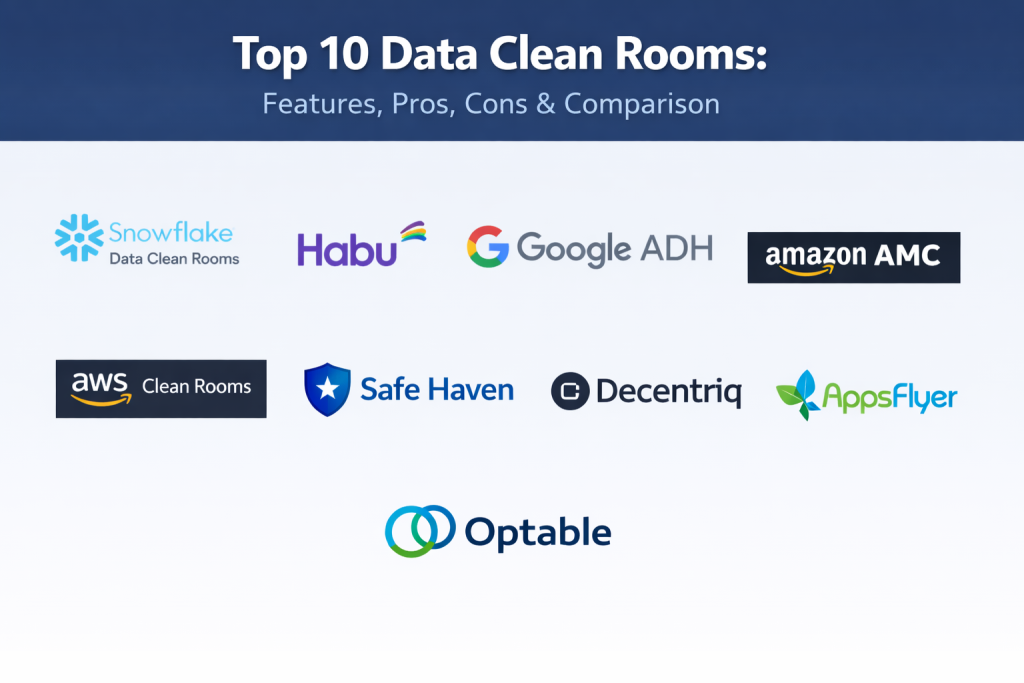
Top 10 Data Clean Rooms
1. Snowflake Data Clean Rooms
Snowflake provides a native clean room environment built directly on its global data cloud. It allows Snowflake users to collaborate without moving data, leveraging the platform’s existing governance and security frameworks.
Key Features
- Built-in differential privacy to prevent re-identification.
- Support for multi-party join operations without data movement.
- Fine-grained access controls for every participant.
- Native integration with Snowflake’s Marketplace for data enrichment.
- Support for SQL-based and no-code analysis.
Pros
- Seamless for existing Snowflake customers with zero ETL required.
- Massive scalability for handling multi-petabyte datasets.
Cons
- Most effective when all participating parties are on Snowflake.
- High cost associated with compute and storage usage.
Platforms / Deployment
- AWS / Azure / GCP
- Cloud-native
Security & Compliance
- SOC 2 Type II, ISO 27001, FedRAMP, and HIPAA.
- Encrypted data sharing via Snowflake’s “sharing” protocol.
Integrations & Ecosystem
Strongest within the Snowflake ecosystem but expanding.
- Adobe
- Salesforce
- Habu
- VideoAmp
Support & Community
Comprehensive documentation and access to a global network of specialized data engineering consultants.
2. Habu (by LiveRamp)
Recently acquired by LiveRamp, Habu is an orchestration layer that simplifies the management of clean rooms across multiple cloud providers. It focuses on making complex data collaboration accessible to business users.
Key Features
- Multi-cloud orchestration across AWS, Azure, and GCP.
- Automated query templates for common marketing use cases.
- Real-time identity resolution powered by LiveRamp’s RampID.
- Flexible governance controls for data owners.
- Visual interface for non-technical users to build queries.
Pros
- Excellent for managing collaborations across diverse cloud stacks.
- Fast time-to-value with pre-built analysis modules.
Cons
- Adding another layer of software can increase complexity.
- Pricing can be high for large-scale multi-partner networks.
Platforms / Deployment
- AWS / Azure / GCP
- Cloud-agnostic (SaaS)
Security & Compliance
- SOC 2, GDPR, and CCPA aligned.
- Privacy-safe query guardrails.
Integrations & Ecosystem
Deeply integrated into the LiveRamp identity ecosystem.
- Google Ads Data Hub
- Amazon Marketing Cloud
- Snowflake
- Databricks
Support & Community
High-touch professional services and a strong presence in the digital advertising sector.
3. Google Ads Data Hub (ADH)
Google Ads Data Hub is the exclusive environment for analyzing event-level data from Google Ads, YouTube, and DV360. It is a mandatory tool for any brand heavily invested in the Google ecosystem.
Key Features
- Access to YouTube and Google Search event-level data.
- Privacy-centric aggregation thresholds that hide individual users.
- Direct activation of audiences into Google Ads.
- Built on BigQuery for high-speed SQL analysis.
- Integration with first-party CRM data via Google Cloud.
Pros
- The only way to get granular insights into YouTube performance.
- Backed by Google’s world-class infrastructure and security.
Cons
- Strictly limited to the Google ecosystem.
- No access to raw event-level data; only aggregated output.
Platforms / Deployment
- Google Cloud Platform
- Cloud-native
Security & Compliance
- Google internal privacy standards, GDPR, and CCPA.
- Automated privacy checks on every query.
Integrations & Ecosystem
Built for the Google Marketing Platform.
- BigQuery
- Google Ads
- Search Ads 360
- Display & Video 360
Support & Community
Extensive self-service documentation and Google Cloud support tiers.
4. Amazon Marketing Cloud (AMC)
Amazon Marketing Cloud is a holistic, privacy-safe clean room that allows advertisers to analyze their first-party data alongside Amazon’s pseudonymized signals to understand the full customer journey.
Key Features
- Access to cross-channel Amazon Ads signals (Search, Display, Video).
- Ability to upload and join offline conversion data.
- Custom SQL queries for multi-touch attribution analysis.
- Audience creation for activation in Amazon DSP.
- Integration with AWS Clean Rooms for enhanced security.
Pros
- Unrivaled insights into Amazon shopper behavior.
- Highly flexible for custom attribution modeling.
Cons
- Requires SQL expertise to extract meaningful value.
- Data history is generally limited to one rolling year.
Platforms / Deployment
- AWS
- Cloud-native
Security & Compliance
- AWS-backed security, GDPR, and CCPA compliant.
- PII is never accessible to Amazon or the advertiser.
Integrations & Ecosystem
Focused on the Amazon advertising and AWS ecosystems.
- Amazon DSP
- AWS S3
- AWS Glue
- Various 3P identity providers.
Support & Community
Growing library of instructional queries and dedicated AWS partner support.
5. InfoSum
InfoSum is a decentralized data clean room platform that emphasizes “non-movement” of data. It uses a patented architecture where data remains in its original location while still allowing for matching and analysis.
Key Features
- Decentralized processing via secure “bunkers.”
- True non-movement architecture (no data copying).
- Instant match rate reporting between partners.
- Differential privacy controls built into the platform.
- Drag-and-drop interface for marketing teams.
Pros
- Eliminates the risk of data leakage during transit.
- Rapid onboarding for new collaboration partners.
Cons
- May require internal IT approval for decentralized node setup.
- Less focus on heavy data engineering compared to Snowflake.
Platforms / Deployment
- Multi-cloud (AWS, Azure, GCP)
- SaaS / Hybrid
Security & Compliance
- ISO 27001, SOC 2 Type II, GDPR, and CCPA.
- Zero-trust security model.
Integrations & Ecosystem
Broad network of media owners and data providers.
- Experian
- ITV
- Channel 4
- Boot’s Media Group
Support & Community
Strong focus on customer success and strategic guidance for media partnerships.
6. AWS Clean Rooms
AWS Clean Rooms is a service that helps companies across industries collaborate on their collective datasets without sharing or copying one another’s underlying data.
Key Features
- Direct integration with Amazon S3 and AWS Glue.
- Cryptographic computing for enhanced privacy.
- Analysis rules to limit the types of queries allowed.
- Audit logs via AWS CloudTrail.
- Pay-as-you-go pricing integrated into AWS billing.
Pros
- Minimal setup for organizations already hosted on AWS.
- Leverages existing AWS security and identity controls.
Cons
- Requires all parties to have an AWS account for the best experience.
- Interface is more technical and geared toward developers.
Platforms / Deployment
- AWS
- Cloud-native
Security & Compliance
- FIPS 140-2, GDPR, HIPAA, and SOC compliant.
- IAM-controlled access.
Integrations & Ecosystem
Native to the massive AWS ecosystem.
- Amazon Athena
- Amazon QuickSight
- AWS Lake Formation
- Amazon Marketing Cloud
Support & Community
Standard AWS technical support and extensive developer forums.
7. LiveRamp Safe Haven
Safe Haven is LiveRamp’s specialized environment for data collaboration, built on the foundation of their industry-leading identity resolution technology.
Key Features
- Powered by RampID for high-accuracy identity matching.
- Global interoperability across major cloud providers.
- Secure multi-party analytics and machine learning.
- Built-in tools for audience suppression and activation.
- Detailed reporting on match rates and overlap.
Pros
- Best-in-class identity resolution capabilities.
- Massive network of pre-connected partners.
Cons
- Can be complex for organizations not using LiveRamp’s core services.
- Higher price point targeted at enterprise-level brands.
Platforms / Deployment
- AWS / GCP / Azure
- SaaS / Hybrid
Security & Compliance
- SOC 2 Type II, HIPAA, GDPR, and CCPA.
- Strict data isolation and encryption.
Integrations & Ecosystem
Connects to over 350 destinations for activation.
- The Trade Desk
Support & Community
Comprehensive onboarding and professional services for complex global deployments.
8. Decentriq
Decentriq is a Swiss-based clean room platform that utilizes confidential computing (hardware-based enclaves) to ensure that data is encrypted even during calculation.
Key Features
- Trusted Execution Environments (TEEs) for hardware-level security.
- No-code interface for quick collaboration setup.
- Neutral, platform-agnostic architecture.
- Support for advanced machine learning on encrypted data.
- Low technical barrier for invited partners.
Pros
- Highest level of “provable” security via hardware enclaves.
- Extremely easy to invite external partners who lack technical teams.
Cons
- Hardware-based enclaves can sometimes limit very large-scale query speeds.
- Smaller ecosystem compared to American cloud giants.
Platforms / Deployment
- Multi-cloud (Azure / AWS)
- SaaS
Security & Compliance
- GDPR compliant by design; SOC 2 and ISO standards.
- Zero-knowledge architecture.
Integrations & Ecosystem
Focused on privacy-conscious sectors like banking and healthcare.
- Microsoft Azure
- Various European media giants.
Support & Community
Strong technical support and focus on European regulatory compliance.
9. AppsFlyer Data Clean Room
Specifically designed for mobile-first organizations, AppsFlyer’s clean room allows app developers to join their first-party data with attribution data while maintaining user privacy.
Key Features
- Native integration with mobile attribution data.
- Private Set Intersection (PSI) for secure matching.
- Automated reporting on LTV and ROI.
- Aggregated insights that bypass Apple’s ATT restrictions.
- Easy configuration for existing AppsFlyer customers.
Pros
- The leading choice for mobile app measurement and growth.
- Near real-time data freshness and reporting.
Cons
- Limited to the scope of mobile and app-centric data.
- Not a general-purpose enterprise data clean room.
Platforms / Deployment
- AWS / Snowflake
- SaaS
Security & Compliance
- ePrivacyseal, SOC 2, ISO 27001, and GDPR.
- Threshold-based privacy protections.
Integrations & Ecosystem
Centric to the mobile marketing and attribution world.
- Snowflake (Data Locker)
- Salesforce
- Meta
- TikTok
Support & Community
Extensive documentation and a large community of mobile marketing experts.
10. Optable
Optable is a newer, identity-centric data clean room built specifically for publishers and advertisers to collaborate on audience planning and activation without high technical overhead.
Key Features
- Decentralized identity resolution across channels.
- Turn-key ecosystem integrations (50+ sources).
- Built-in audience builder and activation tools.
- Low-latency performance for real-time requests.
- Support for major ID providers like UID2.0 and ID5.
Pros
- Very fast deployment (often under 6 weeks).
- User-friendly interface designed for media planners.
Cons
- Smaller market share compared to established giants.
- Fewer advanced data engineering features than Snowflake or AWS.
Platforms / Deployment
- Cloud-agnostic
- SaaS
Security & Compliance
- GDPR and CCPA compliant with a dedicated DSR module.
- PII-safe infrastructure.
Integrations & Ecosystem
Focused on the ad-tech and mar-tech landscape.
- The Trade Desk
- Experian
- TransUnion
- Criteo
Support & Community
Focused customer success team with a strong emphasis on media ROI.
Comparison Table
| Tool Name | Best For | Platform(s) Supported | Deployment | Standout Feature | Public Rating |
| 1. Snowflake | Snowflake Users | AWS, Azure, GCP | Cloud-native | Zero-Copy Sharing | N/A |
| 2. Habu | Multi-Cloud Ops | AWS, Azure, GCP | SaaS | Orchestration UI | N/A |
| 3. Google ADH | Google Ad Insights | GCP | Cloud-native | YouTube Event Data | N/A |
| 4. Amazon AMC | Amazon Shoppers | AWS | Cloud-native | Shopper Path Analysis | N/A |
| 5. InfoSum | Non-Movement | Multi-Cloud | SaaS/Hybrid | Decentralized Bunkers | N/A |
| 6. AWS Clean Rooms | AWS Power Users | AWS | Cloud-native | Athena Integration | N/A |
| 7. Safe Haven | Identity Matching | Multi-Cloud | SaaS/Hybrid | RampID Integration | N/A |
| 8. Decentriq | High Security | Azure, AWS | SaaS | Hardware Enclaves | N/A |
| 9. AppsFlyer | Mobile Apps | AWS, Snowflake | SaaS | Attribution Join | N/A |
| 10. Optable | Media Planning | Cloud-agnostic | SaaS | Rapid Partner Onboarding | N/A |
Evaluation & Scoring of Data Clean Rooms
| Tool Name | Core (25%) | Ease (15%) | Integrations (15%) | Security (10%) | Performance (10%) | Support (10%) | Value (15%) | Weighted Total |
| 1. Snowflake | 10 | 5 | 9 | 9 | 10 | 8 | 7 | 8.45 |
| 2. Habu | 9 | 9 | 9 | 8 | 8 | 9 | 7 | 8.55 |
| 3. Google ADH | 8 | 6 | 7 | 10 | 9 | 8 | 8 | 7.95 |
| 4. Amazon AMC | 8 | 5 | 7 | 10 | 9 | 8 | 8 | 7.75 |
| 5. InfoSum | 9 | 8 | 8 | 10 | 8 | 9 | 8 | 8.60 |
| 6. AWS Clean Rooms | 9 | 4 | 9 | 9 | 9 | 8 | 9 | 7.95 |
| 7. Safe Haven | 9 | 7 | 10 | 9 | 8 | 9 | 6 | 8.20 |
| 8. Decentriq | 7 | 9 | 6 | 10 | 7 | 8 | 8 | 7.60 |
| 9. AppsFlyer | 7 | 9 | 8 | 9 | 9 | 8 | 9 | 8.20 |
| 10. Optable | 7 | 9 | 8 | 8 | 8 | 8 | 9 | 7.90 |
This scoring model highlights that there is no universal “winner,” as the best tool depends on your existing cloud infrastructure. Snowflake leads in pure data performance, while InfoSum and Decentriq offer the highest security scores due to their unique non-movement and hardware-based privacy architectures.
Which Data Clean Room Tool Is Right for You?
Solo / Freelancer
Data Clean Rooms are generally enterprise-grade tools. Solo users rarely have the volume of data or the partner network required to justify the cost. Standard privacy-safe APIs are typically sufficient at this level.
SMB
Small to medium businesses should prioritize tools like AppsFlyer if they are app-centric, or focus on the free layers of Google Ads Data Hub and Amazon Marketing Cloud if they are primarily trying to measure their ad spend on those specific platforms.
Mid-Market
For companies with a growing first-party database, Optable and Habu offer the best balance of ease of use and professional feature sets, allowing for fast partner onboarding without a massive team of data engineers.
Enterprise
Large organizations with diverse data needs should look toward Snowflake for massive-scale internal collaboration or InfoSum for high-security external partnerships. LiveRamp Safe Haven is the preferred choice for those needing deep identity resolution.
Budget vs Premium
AWS Clean Rooms offers a more flexible “pay-as-you-go” model which can be budget-friendly for targeted projects. Premium suites like Habu and Safe Haven require higher upfront investments but offer significant strategic value and automation.
Feature Depth vs Ease of Use
Snowflake and AWS offer the most technical depth for data scientists. In contrast, InfoSum and Decentriq provide highly intuitive, no-code workflows that are much easier for marketing teams to operate independently.
Integrations & Scalability
LiveRamp Safe Haven and Habu excel in this category, offering the widest range of pre-built connections to the broader advertising ecosystem, from social platforms to television networks.
Security & Compliance Needs
If your primary concern is “zero-trust” or navigating strict European regulations, Decentriq and InfoSum are the leaders, as they offer cryptographic and architectural proofs that data is never exposed.
Frequently Asked Questions
What is a Data Clean Room?
It is a secure platform that allows multiple organizations to match and analyze datasets without sharing the underlying raw customer information or PII.
Why do I need a clean room now?
With the removal of third-party cookies and stricter privacy laws, clean rooms are the only safe way to achieve granular attribution and audience targeting.
Does data leave my cloud in a clean room?
Modern decentralized clean rooms like InfoSum and AWS Clean Rooms allow you to query data “at rest,” meaning the data never actually leaves your secure storage.
Who typically manages a clean room?
Usually, it is a collaborative effort between the marketing team (who defines the goals) and the data engineering or privacy team (who manages the technical setup).
How does identity resolution work in a clean room?
Tools like LiveRamp use pseudonymized identifiers (like hashed emails) to match users across different datasets without ever seeing the original email address.
Are clean rooms expensive?
They are enterprise tools with pricing that often includes a platform fee plus compute costs. However, the ROI comes from improved ad targeting and reduced compliance risk.
Can I use a clean room for non-marketing data?
Yes, they are increasingly used in healthcare for medical research and in finance for fraud detection where data sensitivity is extremely high.
What is differential privacy?
It is a mathematical technique that adds a small amount of “noise” to a dataset so that individual users cannot be identified from the resulting reports.
How long does it take to set up a clean room?
Simple cloud-native rooms can be ready in days, but complex multi-party enterprise collaborations typically take 4 to 8 weeks to fully configure and audit.
Do I need a clean room if I only use one cloud?
Not necessarily. If you and your partners are all on one cloud (like AWS), you can use the native cloud tools, but third-party clean rooms offer better cross-platform flexibility.
Conclusion
Implementing a Data Clean Room is a critical strategic move for any organization looking to thrive in a privacy-first digital economy. The transition from third-party data reliance to secure first-party collaboration requires a shift in both technology and mindset—moving away from data ownership toward data partnership. By selecting a platform that aligns with your existing cloud infrastructure and security requirements, you can unlock deeper customer insights while future-proofing your business against evolving global regulations. The next step is to evaluate your current partner network and run a small-scale pilot project to validate match rates and query performance before scaling your clean room operations across the enterprise.

Best Cardiac Hospitals Near You
Discover top heart hospitals, cardiology centers & cardiac care services by city.
Advanced Heart Care • Trusted Hospitals • Expert Teams
View Best Hospitals