Introduction
The role of data in modern enterprise environments has shifted from a backend storage concern to the primary engine of business value. As organizations struggle to manage the sheer volume and velocity of data, the need for a Certified DataOps Manager has become critical. This guide is designed for engineering leaders, data professionals, and operations experts who want to bridge the gap between data engineering and operational excellence. By following this path at DataOpsSchool, professionals can move beyond simple pipeline management into a strategic role that ensures data reliability and speed. This guide provides a clear roadmap to help you understand the certification landscape and make an informed decision for your long-term career growth.
What is the Certified DataOps Manager?
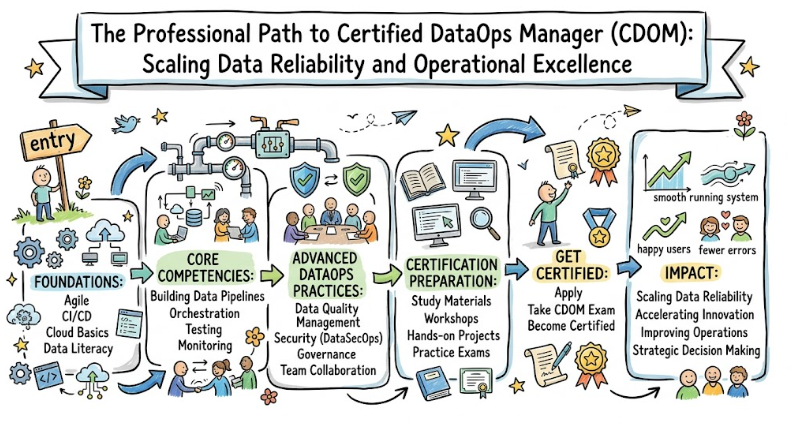
The Certified DataOps Manager (CDOM) is a professional designation that focuses on the intersection of data management, lean manufacturing principles, and DevOps practices. Unlike traditional data management courses that focus heavily on theory or specific database syntax, this program emphasizes real-world application in production environments. It exists to solve the “data silo” problem by teaching managers how to automate data delivery and improve data quality through continuous integration and deployment. By aligning data workflows with modern engineering practices, the CDOM program prepares leaders to handle the complexities of enterprise-scale data architecture and governance.
Who Should Pursue Certified DataOps Manager?
This certification is specifically designed for individuals who are responsible for the lifecycle of data within an organization. Senior data engineers, Site Reliability Engineers (SREs), and cloud architects will find the curriculum highly relevant to their daily technical challenges. Furthermore, engineering managers and technical leads who oversee data teams can use this certification to better understand how to scale their operations. Whether you are a beginner looking to enter the data operations field or an experienced professional in India or the global market, this program offers the framework needed to manage complex data ecosystems. It is also highly beneficial for security and compliance officers who need to understand how data moves through automated pipelines.
Why Certified DataOps Manager is Valuable in and Beyond
In an era where data-driven decision-making is the standard, the demand for professionals who can guarantee data availability is at an all-time high. The CDOM certification provides a level of career longevity that tool-specific certifications often lack by focusing on core methodologies and architectural patterns. Enterprise adoption of DataOps is growing rapidly as companies realize that throwing more tools at data problems does not work without a proper operational strategy. By earning this credential, you demonstrate a commitment to efficiency and a return on investment that executive leadership highly values. It positions you as a forward-thinking leader who can navigate the shifts in technology without losing focus on business outcomes.
Certified DataOps Manager Certification Overview
The CDOM program is a comprehensive educational track delivered through the official course portal at Certified DataOps Manager and hosted by the experts at dataopsschool.com. The certification is structured to provide a logical progression from foundational concepts to advanced managerial strategies, ensuring a deep understanding of the subject. Assessment is handled through a mix of practical examinations and scenario-based questions that mirror the challenges faced in real-world data environments. The program is owned and maintained by industry practitioners who ensure the content stays relevant to the latest shifts in cloud-native and platform engineering. By participating in this track, you gain access to a structured learning environment that prioritizes hands-on competence over rote memorization.
Certified DataOps Manager Certification Tracks & Levels
The certification path is divided into three distinct tiers to cater to different levels of professional experience and career goals. The Foundation level introduces the core philosophy of DataOps, including the elimination of manual handoffs and the basics of data pipeline automation. As you move to the Professional level, the focus shifts toward specialized tracks such as FinOps for data or integrating SRE principles into data pipelines. Finally, the Expert or Managerial level is designed for those who will lead large-scale transformations and oversee the entire DataOps strategy for an organization. This tiered approach ensures that you can align your learning with your current job responsibilities while keeping a clear eye on your next promotion.
Complete Certified DataOps Manager Certification Table
| Track | Level | Who it’s for | Prerequisites | Skills Covered | Recommended Order |
| Core DataOps | Foundation | Junior Engineers / Analysts | Basic Data Knowledge | Pipeline Basics, Automation | First |
| Data Operations | Professional | Data Engineers / SREs | 2+ Years Experience | Orchestration, Monitoring | Second |
| Data Governance | Professional | Compliance / Security | Basic SQL / Policy Knowledge | Security, Privacy, Quality | Concurrent |
| Strategic Management | Expert | Managers / Directors | 5+ Years Experience | Strategy, ROI, Team Building | Third |
| Cloud DataOps | Advanced | Cloud Architects | Professional Level | Scaling, Multi-cloud Data | Fourth |
Detailed Guide for Each Certified DataOps Manager Certification
Certified DataOps Manager – Foundation
What it is
This certification validates a professional’s understanding of the basic tenets of DataOps, focusing on the cultural and technical shifts required to automate data delivery. It acts as the starting point for anyone new to the field of data-centric operations.
Who should take it
It is ideal for data analysts, junior data engineers, and traditional database administrators who want to modernize their skill set. No extensive prior experience in automation is required, making it accessible for those transitioning from other IT roles.
Skills you’ll gain
- Understanding the DataOps Manifesto and its core principles.
- Identifying bottlenecks in traditional data delivery cycles.
- Basic knowledge of version control for data.
- Understanding the role of automated testing in data pipelines.
Real-world projects you should be able to do
- Create a simple automated data ingestion script.
- Map out a current data workflow and identify areas for automation.
- Implement basic unit tests for a small data set.
Preparation plan
- 7–14 days: Review the core documentation and complete the introductory modules provided by the site.
- 30 days: Engage with community forums and practice setting up a basic CI/CD pipeline for a mock data project.
- 60 days: This is usually more than enough time for a beginner to feel fully confident in the foundational exam.
Common mistakes
- Focusing too much on specific tools rather than the underlying methodology.
- Skipping the cultural aspects of DataOps to focus only on the code.
Best next certification after this
- Same-track option: Professional DataOps Engineer.
- Cross-track option: Cloud Practitioner.
- Leadership option: Junior Team Lead workshops.
Certified DataOps Manager – Professional
What it is
This level confirms your ability to design and implement complex data architectures that are resilient, scalable, and secure. It moves beyond the “why” and focuses heavily on the “how” of enterprise data operations.
Who should take it
Intermediate data engineers, SREs, and platform engineers with at least two years of experience in data-related roles. It is for those who are currently responsible for maintaining production data environments.
Skills you’ll gain
- Advanced orchestration of multi-stage data pipelines.
- Implementing Observability and Monitoring for data health.
- Designing self-healing data systems.
- Managing data infrastructure as code (IaC).
Real-world projects you should be able to do
- Deploy a production-grade orchestration engine like Airflow or Prefect.
- Build a dashboard that tracks data quality metrics in real-time.
- Automate the recovery of a failed data pipeline with minimal downtime.
Preparation plan
- 7–14 days: Deep dive into technical labs and advanced configuration scenarios.
- 30 days: Work on a capstone project that involves integrating multiple data sources into a single automated flow.
- 60 days: Conduct extensive mock exams and review case studies of failed data migrations to learn troubleshooting.
Common mistakes
- Over-engineering simple pipelines with unnecessary complexity.
- Neglecting the monitoring aspect until after the system is in production.
Best next certification after this
- Same-track option: Expert DataOps Strategist.
- Cross-track option: Certified SRE Professional.
- Leadership option: Technical Product Manager.
Certified DataOps Manager – Expert / Manager
What it is
The Expert level is the pinnacle of the program, focusing on the strategic and organizational side of managing data teams. It validates your ability to lead large-scale digital transformations and manage significant budgets and resources.
Who should take it
Senior managers, CTOs, and principal engineers who have at least five years of experience in high-level technical leadership roles. This is for those who make the final decisions on toolchains and staffing.
Skills you’ll gain
- Building and scaling high-performance DataOps teams.
- Calculating and presenting the ROI of DataOps initiatives to stakeholders.
- Advanced data governance and compliance at scale.
- Long-term strategic planning for data evolution.
Real-world projects you should be able to do
- Develop a three-year roadmap for an organization’s data transformation.
- Lead a cross-functional team through a major cloud data migration.
- Implement an enterprise-wide data quality framework.
Preparation plan
- 7–14 days: Review leadership modules and financial modeling for technical projects.
- 30 days: Analyze real-world enterprise case studies and develop mock strategic plans.
- 60 days: Engage in executive coaching or peer review sessions to refine management strategies.
Common mistakes
- Losing touch with the technical reality of the team’s daily work.
- Failing to communicate the value of technical debt reduction to non-technical executives.
Best next certification after this
- Same-track option: Continued executive education.
- Cross-track option: FinOps Certified Practitioner.
- Leadership option: MBA or Executive Leadership Program.
Choose Your Learning Path
DevOps Path
If you are coming from a DevOps background, your path into DataOps involves applying your existing knowledge of CI/CD and automation to the data layer. You will focus on how to treat data pipelines exactly like software code, ensuring that every change is tested and validated before it hits production. This path is perfect for those who want to broaden their scope from application delivery to the more complex world of data state management. You will spend time learning how to manage “state” in ways that standard application DevOps rarely requires.
DevSecOps Path
The DevSecOps professional focuses on integrating security into every step of the data lifecycle. In this path, the CDOM certification helps you understand how to automate data masking, encryption, and access controls within the pipeline. You will learn how to ensure that data privacy regulations like GDPR or CCPA are built into the automation rather than treated as an afterthought. This is a critical path for industries like finance and healthcare where data security is the top priority.
SRE Path
Site Reliability Engineers will find that DataOps provides the specific tools needed to apply “Error Budgets” and “Service Level Objectives” to data pipelines. This path emphasizes the reliability of data delivery, focusing on how to build systems that can withstand failures without corrupting the underlying data sets. You will learn advanced monitoring techniques that look not just at server health, but at the actual content and quality of the data flowing through the pipes.
AIOps Path
For those specializing in AIOps, the focus is on using artificial intelligence to manage the data environment itself. You will learn how to implement machine learning models that can predict when a data pipeline is likely to fail or when data quality is beginning to drift. This path is about moving from reactive management to proactive, intelligent operations. It requires a blend of data science knowledge and high-level operational skill to execute effectively.
MLOps Path
MLOps professionals focus specifically on the lifecycle of machine learning models, and DataOps is the foundation upon which those models sit. In this path, you will learn how to provide high-quality, versioned data sets to data scientists at scale. You will focus on the “feature store” concept and how to automate the training and deployment cycles of models. Without a solid DataOps foundation, MLOps is nearly impossible to scale, making this a vital certification.
DataOps Path
The pure DataOps path is for those who want to be specialists in the orchestration and governance of data systems. You will dive deep into toolchains like dbt, Airflow, and Snowflake, learning how to weave them into a cohesive ecosystem. This path is focused on the end-to-end journey of data from the source system to the final business dashboard. It is the most comprehensive route for anyone wanting to be a dedicated DataOps professional.
FinOps Path
The FinOps path addresses the growing concern of cloud costs associated with massive data storage and processing. You will learn how to optimize your data pipelines to be as cost-efficient as possible, ensuring that the business isn’t overpaying for unused resources. This path teaches you how to tag data assets and attribute costs back to specific business units or projects. It is an essential skill set for managers who need to justify their cloud spend to the finance department.
Role → Recommended Certified DataOps Manager Certifications
| Role | Recommended Certifications |
| DevOps Engineer | Foundation + Professional (Operations Track) |
| SRE | Professional (Reliability Track) + Expert |
| Platform Engineer | Foundation + Professional (Cloud Track) |
| Cloud Engineer | Foundation + Professional (Cloud Track) |
| Security Engineer | Professional (Governance Track) |
| Data Engineer | Foundation + Professional (Full Stack) |
| FinOps Practitioner | Professional (Cost Optimization) |
| Engineering Manager | Foundation + Expert (Management Track) |
Next Certifications to Take After Certified DataOps Manager
Same Track Progression
Once you have mastered the CDOM levels, you should look toward deep specialization in specific data technologies or advanced architectural patterns. This might involve getting certified in specific cloud data platforms like AWS Certified Data Analytics or Google Professional Data Engineer. The goal is to take the broad management skills you’ve learned and apply them to the specific nuances of the platforms your organization uses. Continuous learning in this track involves staying updated on the latest open-source orchestration tools and data mesh architectures.
Cross-Track Expansion
To become a truly versatile leader, you should consider expanding your knowledge into adjacent “Ops” domains. Gaining a certification in SRE or DevSecOps can provide a more holistic view of how data interacts with the rest of the technology stack. This cross-training allows you to speak the language of different teams and break down the silos that often exist between data and application engineers. It makes you a much more valuable asset to any organization looking for “T-shaped” professionals.
Leadership & Management Track
For those who want to move entirely into the executive suite, the CDOM is a great stepping stone toward a Chief Data Officer (CDO) or CTO role. You might follow this up with leadership certifications or even formal business education like an MBA. The focus here should be on organizational design, talent management, and strategic financial planning. You will be shifting your focus from managing pipelines to managing the people and budgets that make those pipelines possible.
Training & Certification Support Providers for Certified DataOps Manager
DevOpsSchool
As a pioneer in the DevOps education space, DevOpsSchool provides a broad range of resources that help professionals understand the foundational shifts in modern engineering. Their approach is focused on practical, hands-on training that goes beyond just passing an exam. They offer extensive community support and a library of real-world scenarios that are invaluable for anyone starting their journey. Their instructors are typically industry veterans who bring years of production experience into the virtual classroom, ensuring that students learn what actually matters in a job setting.
Cotocus
Cotocus specializes in high-end technical consulting and training, making them a great partner for those looking for advanced architectural knowledge. They focus heavily on the integration of different toolchains and how to build cohesive platforms. Their training modules are often customized to meet the specific needs of enterprise clients, providing a level of depth that is hard to find in generic courses. For a professional looking to master the complexities of multi-cloud data environments, Cotocus offers a very rigorous and rewarding learning path.
Scmgalaxy
Scmgalaxy has long been a go-to resource for professionals looking for technical tutorials and community-driven knowledge. They provide a wealth of free and paid resources that cover everything from basic version control to complex CI/CD workflows. Their focus on the “Software Configuration Management” side of things provides a unique and necessary perspective for DataOps professionals. They are particularly known for their massive repository of scripts and configuration examples that can save engineers hundreds of hours of work.
BestDevOps
BestDevOps focuses on providing curated content and top-tier training for the most in-demand skills in the operations world. They have a reputation for simplifying complex topics and making them accessible to a wide audience. Their certification prep materials are known for being highly accurate and aligned with the latest industry standards. They provide a supportive learning environment that is ideal for professionals who are balancing a full-time job with their continuing education goals.
devsecopsschool.com
This provider is the gold standard for security-focused operations training, offering deep dives into how to secure the modern software supply chain. Their curriculum is essential for anyone who needs to integrate rigorous security checks into their automated data pipelines. They teach students how to think like both an attacker and a defender, ensuring that the systems they build are resilient to modern threats. In an era of constant data breaches, the skills taught here are some of the most valuable in the market.
sreschool.com
Sreschool focuses on the art and science of reliability, teaching professionals how to keep complex systems running smoothly under heavy load. Their training covers essential topics like incident management, post-mortems, and the implementation of meaningful service level objectives. For a DataOps professional, this provider offers the specific knowledge needed to ensure that data delivery is consistent and predictable. Their approach is heavily influenced by the practices of the world’s most successful technology companies.
aiopsschool.com
As artificial intelligence becomes more integrated into operations, aiopsschool.com provides the necessary training to stay ahead of the curve. They focus on how to use machine learning to automate the monitoring and management of large-scale infrastructure. Their courses help students understand how to filter through the “noise” of modern monitoring systems to find the signals that actually matter. This is an essential resource for anyone looking to lead the next generation of intelligent data operations.
dataopsschool.com
The primary host for the CDOM program, dataopsschool.com is dedicated entirely to the discipline of data operations. They provide the most comprehensive and focused training available, covering every aspect of the data lifecycle from ingestion to visualization. Their labs are designed to mirror the actual environments that professionals will encounter in the field, providing a safe place to practice complex migrations. Because they specialize in only one area, their depth of knowledge and focus is unmatched.
finopsschool.com
Finopsschool.com addresses the financial side of the cloud, teaching professionals how to manage and optimize their cloud spend. This is a critical skill for DataOps managers who are often responsible for some of the most expensive resources in the organization. Their training provides a clear framework for cost allocation, forecasting, and optimization. They help bridge the gap between the engineering team and the finance department, ensuring that everyone is aligned on the business’s financial goals.
Frequently Asked Questions (General)
- How difficult is the Certified DataOps Manager exam?
The exam is moderately difficult and is designed to test your practical knowledge rather than your ability to memorize facts. If you have production experience and have spent time in the labs, you will find it manageable. - How long does it typically take to get certified?
Most professionals take between 30 and 60 days to complete the training and feel ready for the exam. This depends heavily on your prior experience with automation and data systems. - What are the prerequisites for the Foundation level?
There are no formal prerequisites for the Foundation level, though a basic understanding of databases and IT operations is highly recommended. - Does this certification help with salary increases?
While no certification guarantees a raise, DataOps is a high-demand field, and having a validated credential often leads to higher-paying roles and better negotiation leverage. - Is the exam proctored or can I take it at home?
Most levels of the certification are available through an online proctored environment, allowing you to take the test from the comfort of your home or office. - How long is the certification valid?
The certification is typically valid for two or three years, after which you may need to take a recertification exam or earn continuing education credits. - Is there a community or alumni network for CDOM?
Yes, once you pass the exam, you gain access to an exclusive community of professionals where you can share knowledge and find job opportunities. - Can I skip the Foundation level if I have experience?
While it is possible to challenge the higher-level exams, it is generally recommended to start with the Foundation to ensure you have a firm grasp of the core philosophy. - What tools are covered in the training?
The program is tool-agnostic, but you will work with popular technologies like Airflow, Jenkins, Terraform, and various cloud-native data warehouses. - How does DataOps differ from standard DevOps?
Standard DevOps focuses on the application code, while DataOps focuses specifically on the challenges of managing data state, volume, and quality. - Is this certification recognized globally?
Yes, the program is recognized by major enterprises in India, the US, Europe, and other major technology hubs. - Are there any hidden costs like annual maintenance fees?
All costs are typically transparent and included in the initial certification fee, though there may be small fees for recertification in the future.
FAQs on Certified DataOps Manager
- What makes the CDOM unique compared to other data engineering certificates?
The CDOM focuses on management and operations rather than just technical implementation. It teaches you how to lead teams and build systems that last. - How does this certification address data privacy?
Privacy is a core component of the governance track, teaching you how to automate compliance checks directly into your pipelines. - Is there a heavy focus on coding in the Manager level?
The Manager level focuses more on strategy and architecture, though you are still expected to understand the technical workflows your team uses. - Can I use these skills on any cloud platform?
Yes, the principles of DataOps are universal and can be applied to AWS, Azure, Google Cloud, or even on-premises environments. - How does the assessment handle real-world scenarios?
The exams often include labs where you must troubleshoot a broken pipeline or design a solution for a specific business problem. - What is the return on investment for an employer?
Employers see a return through reduced downtime, faster data delivery cycles, and more efficient use of expensive cloud resources. - Does the program cover open-source tools?
Yes, there is a significant focus on open-source tools as they form the backbone of many modern DataOps environments. - How often is the course content updated?
The content is reviewed and updated regularly to ensure it reflects the latest best practices and technology shifts in the industry.
Final Thoughts: Is Certified DataOps Manager Worth It?
If you are looking for a way to stand out in a crowded market of data professionals, the CDOM is an excellent investment. It moves you beyond being a “tool user” and turns you into a “system builder” and a strategic leader. In my twenty years in the industry, I have seen many trends come and go, but the need for reliable, high-quality data only grows. This certification gives you the framework to meet that need consistently. It is not just about a piece of paper; it is about the shift in mindset that allows you to manage data at the speed of business. If you are ready to take the next step in your career, this is the path I would recommend.

Best Cardiac Hospitals Near You
Discover top heart hospitals, cardiology centers & cardiac care services by city.
Advanced Heart Care • Trusted Hospitals • Expert Teams
View Best Hospitals