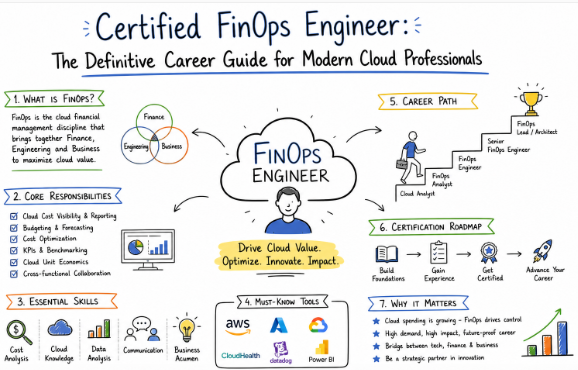
The shift toward cloud-native infrastructure has transformed how organizations consume resources, moving from fixed capital expenses to variable operational costs. In this landscape, the Certified FinOps Engineer designation has emerged as a critical benchmark for professionals who bridge the gap between engineering, finance, and business operations. This guide is designed for DevOps engineers, SREs, and cloud architects who need to master the art of cloud financial management to drive efficiency. By following this roadmap, professionals can transition from simply managing infrastructure to optimizing the economic value of every dollar spent in the cloud. Navigating the complexities of multi-cloud billing and unit economics requires a structured approach, and this certification through finopsschool provides the necessary framework.
What is the Certified FinOps Engineer?
The Certified FinOps Engineer is a professional credential designed to validate an engineer’s ability to implement FinOps principles directly within the technical lifecycle. Unlike high-level business certifications, this program focuses on the “Inform, Optimize, and Operate” phases from a practitioner’s perspective. It exists because modern enterprises realized that finance teams cannot optimize cloud costs alone; it requires engineers who understand how code changes impact the monthly bill.
This certification emphasizes real-world, production-focused learning, moving beyond theoretical definitions of cloud cost. It aligns with modern engineering workflows by integrating cost visibility into CI/CD pipelines and infrastructure-as-code templates. By mastering this domain, engineers ensure that scalability does not lead to financial waste, making cost-efficiency a core non-functional requirement similar to security or performance.
Who Should Pursue Certified FinOps Engineer?
This certification is primarily built for Cloud Engineers, DevOps practitioners, and Site Reliability Engineers (SREs) who are responsible for provisioning and maintaining cloud environments. It is equally beneficial for Platform Engineers who are building internal developer platforms that require automated cost-reporting features. Security and data roles also benefit, as data egress and storage costs often represent the most volatile portions of a modern enterprise budget.
In the global market, and specifically within the rapidly expanding tech hubs in India, there is a massive demand for professionals who can prove they reduced cloud waste. Beginners looking to enter the cloud space will find this a powerful differentiator, while experienced managers can use it to lead organizational change. It provides a common language for technical leaders to communicate effectively with CFOs and procurement departments.
Why Certified FinOps Engineer is Valuable Today and Beyond
As cloud environments grow in complexity, the “spend and pray” model is no longer sustainable for enterprises. The demand for FinOps expertise is tied to the longevity of cloud adoption; as long as companies use AWS, Azure, or GCP, they will need specialists to manage the variable cost model. This certification helps professionals stay relevant by focusing on the underlying economic principles of the cloud rather than just specific tool syntax.
The return on investment for this career path is significant, as FinOps practitioners often find themselves in high-visibility roles that impact the company’s bottom line directly. Enterprise adoption of FinOps frameworks is accelerating, and being a certified engineer places you at the forefront of this movement. It ensures that your skill set remains tool-agnostic, allowing you to provide value regardless of whether the organization shifts between different cloud providers or hybrid models.
Certified FinOps Engineer Certification Overview
The program is delivered via the official training portal and hosted on the specialized platform provided by finopsschool.com. The certification is structured to cater to different levels of expertise, ensuring a logical progression from foundational knowledge to advanced architectural optimization. Ownership of the certification rests with industry experts who have managed multi-million dollar cloud budgets in production environments.
The assessment approach is practical, often involving scenarios that require candidates to analyze billing data, identify anomalies, and suggest remediation strategies. Instead of rote memorization, the focus is on understanding the lifecycle of a cloud resource and its financial footprint. This structure ensures that once certified, an engineer can immediately contribute to a company’s FinOps culture and technical implementation.
Certified FinOps Engineer Certification Tracks & Levels
The certification is divided into three primary levels: Foundation, Professional, and Advanced. The Foundation level is designed to establish a baseline understanding of the FinOps phases and the cultural shift required for success. It acts as an entry point for those new to cloud financial management, providing the vocabulary and basic metrics needed to participate in cost-related discussions.
As professionals move to the Professional and Advanced tracks, the focus shifts toward specialization and automation. These tracks cover deep-dives into specific domains such as DevOps-driven cost headers, SRE-focused performance-to-cost ratios, and enterprise-wide governance. This progression ensures that as your career evolves from an individual contributor to a technical lead or architect, your certification level reflects your ability to handle higher levels of financial complexity.
Complete Certified FinOps Engineer Certification Table
| Track | Level | Who it’s for | Prerequisites | Skills Covered | Recommended Order |
| Core FinOps | Foundation | Junior Engineers / Analysts | Basic Cloud Knowledge | Cost Visibility, Lifecycle | 1 |
| Engineering | Professional | DevOps / SRE / Architects | Foundation Level | Automation, Tagging, Spot | 2 |
| Strategic | Advanced | Managers / Lead Architects | Professional Level | Unit Economics, Governance | 3 |
| Specialized | Expert | Principal Engineers | Advanced Level | Multi-cloud, Mergers/Acquisitions | 4 |
Detailed Guide for Each Certified FinOps Engineer Certification
Certified FinOps Engineer – Foundation
What it is
This certification validates the fundamental understanding of the FinOps framework and its core pillars. It confirms that the candidate understands how to navigate cloud billing and identify basic cost-saving opportunities.
Who should take it
It is suitable for junior cloud engineers, finance associates working with tech teams, and project managers who need to understand cloud spend. No deep coding experience is required, but a basic grasp of cloud services is essential.
Skills you’ll gain
- Understanding the Inform, Optimize, and Operate phases.
- Ability to read and interpret cloud billing dashboards.
- Knowledge of common cloud pricing models (On-demand, RI, Savings Plans).
- Understanding the importance of tagging and resource labeling.
Real-world projects you should be able to do
- Create a basic cost-visibility dashboard for a single department.
- Identify “zombie” resources or unattached storage volumes in a test environment.
Preparation plan
- 7-14 Days: Focus on the official FinOps terminology and core pillars.
- 30 Days: Practice identifying cost trends in a sandbox cloud account.
- 60 Days: Not typically required for this level, as 30 days is sufficient.
Common mistakes
- Overlooking the cultural and “people” aspect of FinOps in favor of just looking at tools.
- Confusing standard accounting practices with the variable nature of cloud billing.
Best next certification after this
- Same-track option: Certified FinOps Engineer Professional
- Cross-track option: Cloud Practitioner (AWS/Azure)
- Leadership option: FinOps Certified Practitioner
Certified FinOps Engineer – Professional
What it is
This level focuses on the technical implementation of cost optimization. It validates an engineer’s ability to automate cost controls and integrate financial metrics into the engineering workflow.
Who should take it
DevOps engineers and SREs with at least two years of experience in cloud infrastructure. It is intended for those who will be writing scripts and policies to manage spend.
Skills you’ll gain
- Implementing automated tagging policies via Infrastructure as Code (Terraform/CloudFormation).
- Managing Reserved Instances and Savings Plan portfolios technically.
- Rightsizing compute and storage resources using automated tools.
- Setting up real-time cost anomaly detection and alerting.
Real-world projects you should be able to do
- Build an automated “cleanup” script that deletes non-compliant resources.
- Implement a spot instance strategy for non-production workloads to save up to 90%.
Preparation plan
- 7-14 Days: Review advanced cloud pricing APIs and billing data exports.
- 30 Days: Build automation scripts for resource scheduling (start/stop logic).
- 60 Days: Conduct a full “Rightsizing” audit on a mock production environment.
Common mistakes
- Aggressive rightsizing that impacts system performance or availability.
- Failing to account for data transfer costs when optimizing compute.
Best next certification after this
- Same-track option: Certified FinOps Engineer Advanced
- Cross-track option: Kubernetes Administrator (CKA)
- Leadership option: Engineering Manager track
Choose Your Learning Path
DevOps Path
In the DevOps track, the focus is on integrating FinOps into the CI/CD pipeline. Engineers learn how to provide developers with “cost-feedback” during the pull request stage. This ensures that expensive architectural decisions are caught before they reach production. It transforms DevOps into a cost-aware culture where efficiency is treated as a deployment gate.
DevSecOps Path
The DevSecOps path merges security compliance with cost management. Professionals learn how security tools and logging levels impact cloud costs. For example, excessive logging or unoptimized security scanning can lead to massive hidden charges. This path teaches how to maintain a secure posture while ensuring that security-related data transfer remains within budget.
SRE Path
For SREs, the learning path centers on the relationship between reliability and cost. It involves defining “Error Budgets” that include financial constraints. SREs learn to balance high availability (multi-region/multi-zone) against the cost of redundancy. The goal is to reach the “Goldilocks” zone where the system is sufficiently reliable without being over-provisioned.
AIOps Path
AIOps focuses on using machine learning to predict spend and automate remediation. Professionals on this path learn to use AI models to analyze historical billing data and forecast future requirements. It covers the implementation of intelligent bots that can make real-time decisions about resource scaling based on both performance and cost metrics.
MLOps Path
The MLOps path is highly specialized for data science workflows. Training large machine learning models can be prohibitively expensive if not managed correctly. This path teaches how to optimize GPU utilization, manage large-scale data lake costs, and use spot instances for model training. It ensures that the innovation of AI doesn’t break the company’s cloud budget.
DataOps Path
DataOps professionals focus on the financial impact of data storage and movement. As data grows exponentially, managing egress fees and tiered storage becomes critical. This path covers the lifecycle of data, from hot storage to cold archiving, and how to automate the movement of data to the most cost-effective tier without losing accessibility.
FinOps Path
This is the dedicated path for those wanting to become full-time FinOps practitioners. It covers the entire breadth of the framework, including procurement, finance, and engineering collaboration. This path is ideal for those who want to lead a FinOps Center of Excellence (CoE) and drive organizational change across all departments.
Role → Recommended Certified FinOps Engineer Certifications
| Role | Recommended Certifications |
| DevOps Engineer | Foundation, Professional (DevOps Track) |
| SRE | Professional, Advanced (Reliability Focus) |
| Platform Engineer | Professional (Automation Focus) |
| Cloud Engineer | Foundation, Professional |
| Security Engineer | Foundation (DevSecOps Focus) |
| Data Engineer | Professional (DataOps Focus) |
| FinOps Practitioner | All Levels (Foundation to Advanced) |
| Engineering Manager | Foundation, Strategic/Advanced |
Next Certifications to Take After Certified FinOps Engineer
Same Track Progression
Once you have mastered the engineering side of FinOps, the logical step is to move into deep architectural optimization. This involves looking at serverless transformations and refactoring legacy applications specifically for cost-efficiency. Advanced certifications in specific cloud providers (AWS Solutions Architect Pro) can complement your FinOps knowledge by providing deeper technical levers for optimization.
Cross-Track Expansion
To become a more well-rounded professional, expanding into Kubernetes management (CKA/CKAD) is highly recommended. Containers introduce a new layer of complexity to FinOps, often referred to as “container cost allocation.” Understanding how to divide a single cluster’s bill among multiple teams is a high-demand skill that bridges the gap between FinOps and platform engineering.
Leadership & Management Track
For those looking to move into management, certifications focusing on ITIL or Agile leadership are beneficial. Transitioning from “doing” the optimization to “managing” the strategy requires a shift in mindset. You will need to learn how to build business cases for FinOps investments and how to manage the cultural change across large, diverse engineering teams.
Training & Certification Support Providers for Certified FinOps Engineer
DevOpsSchool provides a comprehensive ecosystem for learners, offering deep-dive sessions that connect FinOps with broader DevOps practices. Their curriculum is designed to be highly hands-on, ensuring that students don’t just learn the theory but actually implement cost-saving scripts in real cloud environments.
Cotocus focuses on high-end technical consulting and training, making them a great choice for corporate teams. They specialize in helping organizations set up their own internal FinOps practices, providing customized roadmaps that align with specific enterprise goals and existing technology stacks.
Scmgalaxy is a long-standing community leader in the software configuration management space. They offer a wealth of resources and community-driven insights that help engineers understand the historical context of infrastructure management and how FinOps fits into the modern automated world.
BestDevOps offers curated learning paths that are streamlined for busy professionals. Their approach is to cut through the noise and focus on the most impactful skills required to pass certifications and excel in production roles, providing high-quality video content and practice labs.
devsecopsschool.com is the go-to destination for those wanting to integrate security into their FinOps journey. Their training modules emphasize the financial benefits of secure coding and the cost-reduction opportunities found within a well-governed security perimeter.
sreschool.com provides targeted training for Site Reliability Engineers. Their FinOps modules focus specifically on the trade-offs between system uptime and cloud spend, teaching engineers how to build resilient systems that remain economically viable at scale.
aiopsschool.com addresses the future of automated operations. Their training covers how to implement machine learning algorithms for cost forecasting and anomaly detection, which is becoming a standard requirement for advanced FinOps roles in large enterprises.
dataopsschool.com focuses on the unique challenges of data-intensive organizations. They provide specialized training on managing the costs of big data clusters, storage tiers, and the financial implications of data sovereignty and movement across regions.
finopsschool.com is the primary authority and hosting site for the Certified FinOps Engineer program. They offer the most direct and updated curriculum, ensuring that all learners are aligned with the latest industry standards and the evolving FinOps Foundation framework.
Frequently Asked Questions (General)
- What is the difficulty level of this certification?
The difficulty ranges from moderate for the Foundation level to high for the Professional and Advanced levels. It requires a solid grasp of both cloud architecture and financial logic. - How long does it take to prepare?
Most professionals spend between 4 to 8 weeks preparing, depending on their existing experience with cloud billing and automation tools. - Are there any prerequisites?
The Foundation level has no hard prerequisites, but the Professional level requires a Foundation pass or significant documented experience in cloud engineering. - What is the ROI of becoming a Certified FinOps Engineer?
Professionals often see immediate career advancement and salary increases, as companies value the ability to directly reduce operational expenses. - Is this certification recognized globally?
Yes, FinOps is a global movement, and this certification is recognized by major enterprises and service providers across the world. - Do I need to be a coder?
For the Professional level, basic scripting skills (Python, Bash, or Terraform) are highly recommended to implement automation. - How does this differ from a standard Cloud Architect cert?
Standard certs focus on “how to build,” while this cert focuses on “how to build cost-effectively” and “how to measure the value of the build.” - Is there a practical exam component?
The higher-level certifications include scenario-based questions that mimic real-world billing anomalies and architectural trade-offs. - Does the certification expire?
Like most technical credentials, there is a renewal period (usually 2-3 years) to ensure you stay updated with changing cloud billing models. - Can a finance professional take this?
Yes, the Foundation level is excellent for finance staff. However, the Professional level is deeply technical and designed for engineers. - Which cloud provider is covered?
The principles are cloud-agnostic, but examples and labs often cover the “Big Three”: AWS, Microsoft Azure, and Google Cloud Platform. - Is it worth it if my company is small?
Yes, even small companies can have massive cloud waste. Learning these skills early prevents “bill shock” as the company scales.
FAQs on Certified FinOps Engineer
- How does this certification help with career growth?
It moves you from being a “cost center” (someone who just spends money on servers) to a “value creator” who helps the business grow efficiently. - Can I pass this using only free resources?
While free blogs exist, the structured curriculum and labs provided by the official school are essential for passing the higher-level technical exams. - What tools will I learn to use?
You will learn to work with native cloud tools (AWS Cost Explorer, Azure Cost Management) as well as third-party optimization and automation platforms. - Does this certification cover Kubernetes?
Yes, the Professional and Advanced tracks specifically address the challenges of allocating costs in shared container environments and clusters. - How relevant is this for the Indian IT market?
Highly relevant. With many global firms moving their Cloud Centers of Excellence to India, FinOps has become a top-tier requirement for lead roles. - Will I learn about unit economics?
Absolutely. A core part of the advanced curriculum is learning how to calculate the cost per transaction or cost per customer, rather than just total spend. - Is there a community for certified engineers?
Yes, passing the exam grants access to a global network of practitioners who share best practices, scripts, and job opportunities regularly. - Is the exam proctored?
Yes, the exams are typically proctored online to maintain the integrity and value of the credential in the professional marketplace.
Final Thoughts: Is Certified FinOps Engineer Worth It?
If you are looking for a way to stand out in a crowded market of cloud professionals, specializing in FinOps is one of the smartest moves you can make. It is an honest, practical skill set that addresses the single biggest pain point for modern enterprises: the cloud bill. This isn’t about marketing hype or chasing a temporary trend; it is about the fundamental reality of doing business in the digital age.
As a mentor, my advice is to look beyond the certificate itself. The real value lies in the shift in your engineering mindset. When you start seeing an EC2 instance not just as a virtual machine, but as a financial commitment that must deliver measurable business value, you become a much more powerful asset to your organization. If you are willing to put in the work to understand the intersection of code and capital, this certification is absolutely worth your time and effort.

Best Cardiac Hospitals Near You
Discover top heart hospitals, cardiology centers & cardiac care services by city.
Advanced Heart Care • Trusted Hospitals • Expert Teams
View Best Hospitals