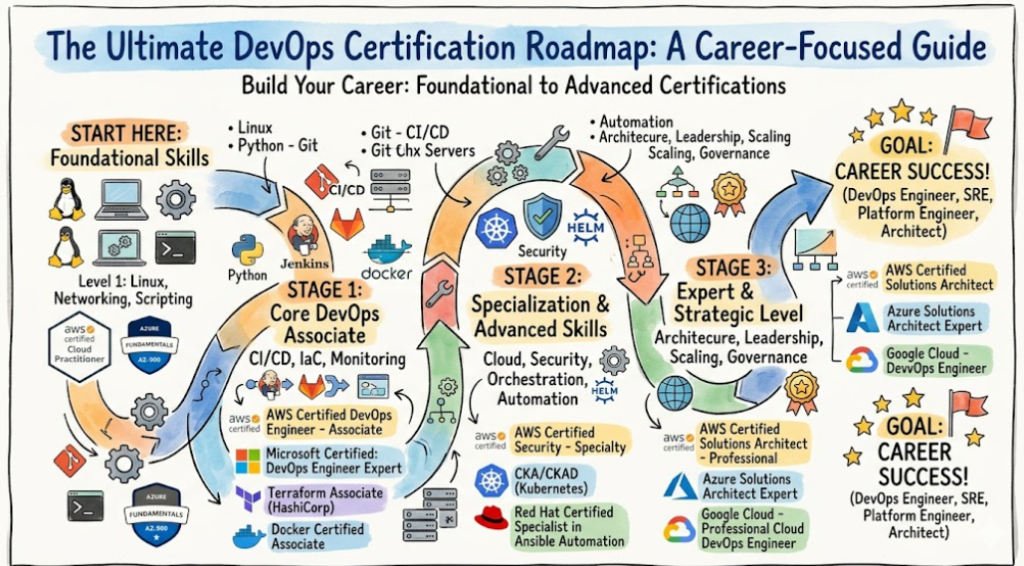
Navigating the world of DevOps certifications can often feel like searching for a map in a maze. With countless acronyms, vendor-specific paths, and theoretical programs, many learners find themselves choosing certifications based on hype rather than actual career utility. This approach often leads to “certificate collection” rather than skill acquisition.
The reality is that a roadmap matters far more than individual badges. Whether you are a system administrator looking to evolve, a developer transitioning to infrastructure, or an engineer aiming for an SRE role, your certification choices should align with your specific daily responsibilities and long-term career goals.
This guide is designed to cut through the noise. We focus on practical, industry-relevant certifications that validate real-world skills. By following a structured approach, you can bridge the gap between being a learner and becoming a highly competent DevOps professional.
Why DevOps Certifications Matter
Certifications are more than just a line on your resume. When approached with the right mindset, they serve as a catalyst for professional growth.
- Skill Validation: They force you to master concepts you might otherwise skim over in your daily routine.
- Structured Learning: Exams provide a clear syllabus, ensuring you don’t miss critical foundational pillars.
- Interview Preparation: The vocabulary and architectural patterns you learn are exactly what technical interviewers look for.
- Industry Demand: Employers often look for standardized benchmarks when hiring for cloud and platform engineering roles.
- Hands-on Focus: The best certifications require you to prove your skills through practical tasks, ensuring you can actually “do” the work, not just talk about it.
Who Should Read This Guide
This guide is tailored for those ready to commit to professional growth, including:
- Freshers: Building your first technical career path.
- Developers: Moving into infrastructure and deployment pipelines.
- Linux Administrators: Scaling your skills into cloud and containers.
- Cloud & Kubernetes Engineers: Specializing in modern orchestration.
- SRE & Platform Engineers: Focusing on system reliability and automation.
- DevSecOps Professionals: Integrating security into the delivery lifecycle.
DevOps Certification Categories
To simplify your journey, we have categorized the certifications into logical domains:
- Foundation: Essential basics to kickstart your career.
- Tool-Based: Mastery of specific, high-demand technologies.
- Cloud DevOps: Platform-specific expertise (AWS, Azure, GCP).
- DevSecOps: Security-first automation and delivery.
- SRE & Platform Engineering: Reliability, monitoring, and scaling.
- Advanced/Specialized: MLOps, AI, Data, and DataOps/GitOps.
Best DevOps Certifications at a Glance
| Certification Name | Best For | Level | Main Skills | Career Scope |
| DevOps Certified Professional (DCP) | Beginners | Foundation | SDLC, CI/CD, Automation | DevOps Engineer |
| DevSecOps Certified Professional (DSOCP) | Security Engineers | Advanced | Security Automation, Compliance | DevSecOps Engineer |
| Site Reliability Engineering (SRE) Certified Professional | Ops/Systems Admins | Advanced | Reliability, SLO/SLI, Scaling | SRE |
| Master in DevOps Engineering (MDE) | Intermediate | Intermediate | Advanced CI/CD, Pipelines | DevOps Specialist |
| Master in Azure DevOps | Azure Admins | Advanced | Azure Pipelines, Cloud Arch | Azure Cloud Engineer |
| AWS Certified DevOps Professional | AWS Admins | Advanced | AWS Services, IaC | AWS DevOps Engineer |
| Master in Python Programming | All Roles | Beginner | Scripting, Automation | Automation Engineer |
| Hashicorp Certified Terraform Associate | Cloud Engineers | Intermediate | IaC, Orchestration | Cloud Architect |
| Certified Kubernetes Administrator (CKA) | Platform Engineers | Advanced | K8s Architecture, Admin | Kubernetes Engineer |
| Docker Certified Associate (DCA) | Developers/Ops | Intermediate | Containerization | Container Specialist |
| Envoy ISTIO Certification Training | Network/SRE | Advanced | Service Mesh, Proxy | Network Specialist |
| MLOps Certification Training Course | ML/Data Engineers | Advanced | Model Lifecycle, Deployment | MLOps Engineer |
| Google Cloud Professional Cloud DevOps Engineer | GCP Admins | Advanced | GCP Operations, SRE | GCP DevOps Engineer |
| Master in Machine Learning | Data Scientists | Intermediate | Modeling, ML pipelines | ML Engineer |
| Master in Artificial Intelligence | Developers | Advanced | AI Concepts, Frameworks | AI Engineer |
| Master in AppDynamics | SRE/Monitors | Intermediate | APM, Observability | Observability Specialist |
| Master in Data Science | Analysts | Intermediate | Data Analysis, SQL/NoSQL | Data Analyst |
| Master in Deep Learning | AI Researchers | Advanced | Neural Networks | AI Specialist |
| Prometheus with Grafana | Monitoring Admins | Intermediate | Monitoring, Alerting | Observability Engineer |
| GitOps Certified Professional (GOCP) | DevOps/SRE | Advanced | GitOps Workflows, Automation | Platform Engineer |
DevOps Certification Roadmap
- Beginner: Start with DevOps Certified Professional (DCP) and Master in Python Programming. Focus on Linux fundamentals, Git basics, and early CI/CD concepts.
- Intermediate: Move to Docker Certified Associate (DCA) and Hashicorp Certified Terraform Associate. Gain confidence in containerization and IaC.
- Advanced: Tackle Certified Kubernetes Administrator (CKA) and your preferred cloud cert (AWS or Azure).
- Specialized: Explore MLOps Certification Training Course or GitOps Certified Professional (GOCP) for niche, high-value career paths.
Recommended Certification Path by Role
| Role | Initial Focus | Advanced Milestone |
| DevOps Beginner | DCP | MDE |
| Cloud Engineer | AWS/Azure DevOps | Terraform Associate |
| Kubernetes Engineer | Docker | CKA |
| SRE Engineer | SRE Pro | Prometheus & Grafana |
| DevSecOps Engineer | DSOCP | Security Automation |
| Platform Engineer | CKA | GitOps |
Real-World Career Scenarios
- Fresher: Don’t rush into Kubernetes. Start by mastering Linux, Git, and Python. Use the DevOps Certified Professional (DCP) to gain a structural understanding of how code travels from dev to production.
- Cloud Transition: If you are an experienced admin moving to the cloud, prioritize the Hashicorp Certified Terraform Associate and the relevant cloud-specific certification (AWS or Azure). Automation is key to your transition.
- Ops to SRE: Focus on Site Reliability Engineering (SRE) Certified Professional and Prometheus with Grafana. Moving to SRE is about measuring reliability, not just managing servers.
Common Mistakes to Avoid
- Skipping Fundamentals: Never skip Linux, networking, or CLI basics. Tools will change; these fundamentals will not.
- Kubernetes Too Early: You cannot manage a cluster if you don’t understand containers (Docker).
- Certification Collection: Do not try to collect certifications. Earn the ones you need to prove your skills for your next job.
- No Hands-On: Theory is useless without practice. Build, break, and fix things in a sandbox environment.
Hands-On Projects to Build
- Build a CI/CD Pipeline: Use Jenkins or Git-based tools to automate a deployment.
- Containerize an App: Dockerize a simple web application.
- Automate IaC: Provision cloud infrastructure using Terraform.
- Monitor your Stack: Set up a Prometheus and Grafana dashboard for your applications.
- Secure your Pipeline: Integrate basic security scanning into your CI/CD flow.
How to Choose the Right DevOps Certification
Your choice should depend on:
- Your Current Experience: Are you a beginner or an expert?
- Career Goals: Do you want to be an SRE, a Cloud Architect, or a DevSecOps specialist?
- Industry Trends: What tools are being used in the companies you want to work for?
- Hands-on Nature: Does the certification require practical exams or labs? Always choose practical.
FAQs
1. Is a DevOps certification worth it?
Yes, if it helps you structure your learning and provides hands-on practice.
2. Which certification should I start with?
For beginners, the DevOps Certified Professional (DCP) is the best foundation.
3. Do I need to be a programmer to do DevOps?
You need to be comfortable with scripting (Python/Bash). Master in Python Programming is a great start.
4. How long does it take to get certified?
It depends on the certification. Foundation courses take weeks, while advanced certifications like CKA require months of practice.
5. Is the CKA hard?
It is rigorous and practical, which is why it is highly respected.
6. Should I choose AWS or Azure DevOps?
Choose the one your current company uses, or the one most common in your target job market.
7. Is SRE part of DevOps?
SRE is a specific way of implementing DevOps. The goals are aligned, but SRE focuses heavily on reliability.
8. Can I learn DevOps without a degree?
Yes. DevOps is skill-based. Your project portfolio matters more than formal education.
9. How do I practice DevOps skills for free?
Use cloud-free tiers and local virtualization (like VirtualBox) to build your own labs.
10. What is GitOps?
GitOps is an operational framework that takes DevOps best practices used for application development and applies them to infrastructure automation.
Final Recommendation
Certifications are the map, but the path is built by you. Choose one certification that aligns with your immediate career goal, complete the hands-on labs, and build a project using what you learned. Do not stop at passing the exam—keep building, keep refining, and keep learning. Your goal is to become an engineer who can solve complex problems, not just someone who can pass a test.

Best Cardiac Hospitals Near You
Discover top heart hospitals, cardiology centers & cardiac care services by city.
Advanced Heart Care • Trusted Hospitals • Expert Teams
View Best Hospitals