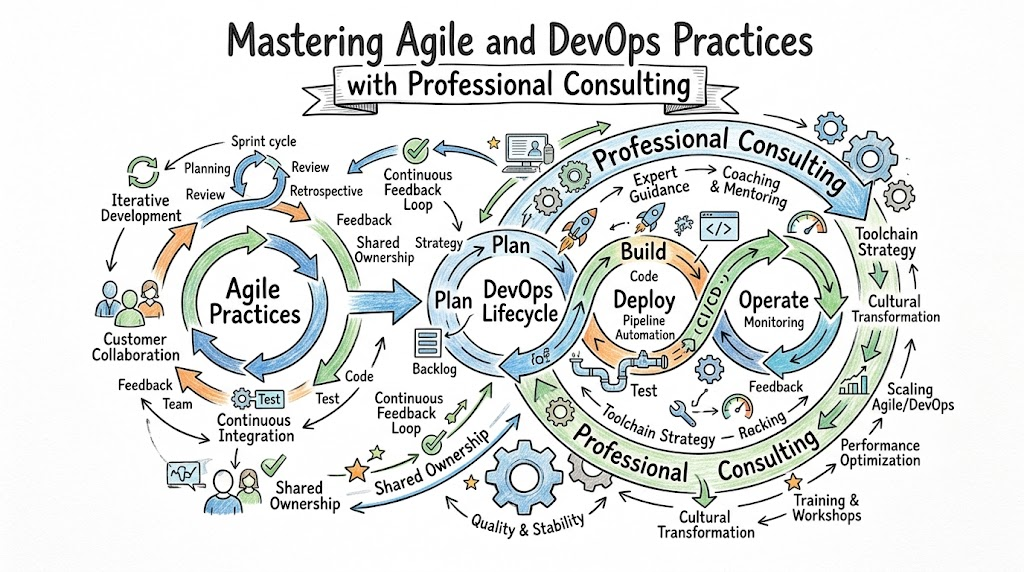
Introduction
A common pitfall I observe in enterprises today is the misconception that adopting DevOps is simply a procurement exercise. Leadership teams often invest heavily in sophisticated automation platforms and cloud infrastructure, expecting immediate results. Yet, time and again, these initiatives stagnate. The pipelines are built, but the release velocity remains low; the dashboards are installed, but the teams remain isolated.
The fundamental reason for this disconnect is that DevOps is not a software package—it is a cultural evolution.
The true challenge lies in human behavior, legacy communication patterns, and the rigid organizational structures that prevent agility. This is where an objective, experienced consultant becomes an essential catalyst for change. Their role is to look beyond the technology stack and address the underlying friction in how teams collaborate and make decisions. For those looking to build a solid foundation in these methodologies, platforms like DevOpsSchool offer the necessary insights to bridge the gap between technical implementation and cultural maturity.
When you shift your focus from “what tool do we need?” to “how can we work better together?”, the transformation truly begins. A consultant serves as that steady hand, guiding organizations through the complex transition from siloed, manual work to a streamlined, collaborative, and highly responsive culture
What DevOps Consultants Actually Do
Many assume a consultant’s primary job is to write scripts or configure infrastructure. While technical execution is part of the package, the strategic value lies elsewhere. A consultant acts as a bridge, a translator, and an objective observer.
Strategy and Roadmap
A consultant starts by mapping the current state of the organization. They do not just look at code; they look at decision-making processes, approval flows, and how teams interact during a crisis. They create a roadmap that balances immediate technical needs with long-term cultural shifts.
Process Improvement
Consultants identify the friction points in the software development life cycle. If a team is waiting three days for a ticket to be approved by a separate security department, the consultant does not just complain; they help design a workflow where security is integrated into the pipeline—shifting security left.
Collaboration Enablement
The most vital work happens in the meeting rooms and chat channels. Consultants facilitate conversations between traditionally opposing teams—Development, Operations, QA, and Security. They act as neutral parties to help these groups find common goals, moving the conversation from “whose fault is this?” to “how can we prevent this next time?”
Why Culture Matters in Agile and DevOps
If technology is the engine, culture is the fuel. You can have the most sophisticated, high-performance engines, but if the fuel is contaminated, you will not go far.
In an Agile environment, teams are expected to iterate quickly and fail fast. If your culture punishes failure or relies on hierarchical approval for every small change, your Agile practices will fail. DevOps thrives on trust, transparency, and a relentless focus on reliability. Without a culture that supports these values, teams will revert to manual, siloed workarounds as soon as the pressure mounts.
When consultants help establish a culture of shared ownership, they are creating an environment where developers care about the production environment, and operations engineers care about the product roadmap.
Common Organizational Problems Before Consulting
Before engagement, most organizations exhibit specific symptoms of dysfunction that a consultant is tasked to diagnose and resolve.
| Problem | Business Impact |
| Team Silos | Knowledge hoarding and lack of visibility between departments. |
| Slow Releases | High manual intervention leads to release delays and fear of deployment. |
| Poor Communication | Misaligned priorities and constant “he said, she said” conflicts. |
| Manual Workflows | High operational toil and increased risk of human error. |
| Blame Culture | Psychological safety is non-existent; teams hide mistakes instead of learning. |
| Weak Feedback Loops | Lack of visibility into production means issues remain hidden for weeks. |
How DevOps Consultants Shape Agile and DevOps Culture
Consultants do not “install” culture. They nurture it by implementing structural changes that force new behaviors to emerge.
| Area | Consultant Impact |
| Breaking Silos | Incentivizes cross-functional team structures. |
| Communication | Implements transparent, asynchronous communication standards. |
| Shared Ownership | Shifts the “not my job” mentality to “we succeed together.” |
| Automation Mindset | Treats infrastructure and processes as code. |
| Feedback Loops | Implements DORA metrics and rapid, data-driven retrospectives. |
| Agile Alignment | Synchronizes automated CI/CD with sprint velocity. |
| Leadership Support | Bridges the gap between C-suite goals and engineering reality. |
Area #1: Breaking Team Silos
The Challenge
I once worked with a bank where the Development team and the Operations team worked in different buildings. The developers wrote code and threw it “over the wall” to operations, who then struggled to deploy it because they didn’t understand the dependencies.
The Consultant Approach
A consultant breaks this by creating cross-functional squads. They might mandate that at least one Operations engineer sits in the Sprint Planning meetings with the developers. This forces early collaboration. When the Operations engineer hears about the new feature being built, they can immediately flag potential infrastructure concerns, preventing a disaster during the release phase.
Area #2: Improving Communication
The Challenge
Communication often suffers when it relies on gatekeepers. Organizations often have a “change management board” that meets once a week to approve deployments, effectively killing the speed of Agile delivery.
The Consultant Approach
The consultant introduces the idea of “transparent communication.” They recommend moving away from email-based approval chains toward automated notifications in shared channels (like Slack or Teams). When a deployment fails, the automated notification should go to the channel where both developers and operators are present. This visibility creates a shared context, allowing the team to solve the problem collectively in minutes rather than hours.
Area #3: Building Shared Ownership
The Challenge
The “not my job” mentality is the fastest way to kill a project. If a service goes down, and the developer says, “The code is fine, it’s an infrastructure problem,” while the operator says, “The infrastructure is fine, it’s a code problem,” the business loses.
The Consultant Approach
Consultants introduce the “You build it, you run it” philosophy. They help set up rotating on-call schedules that include developers. When a developer gets paged at 2 AM for a service they wrote, their next task is to make that service more resilient, easier to monitor, and self-healing. This cultural shift transforms the team from a group of individuals into a cohesive unit responsible for the product’s entire lifecycle.
Area #4: Introducing an Automation Mindset
The Challenge
Many teams believe they are doing DevOps because they use tools like Jenkins or GitLab. However, if they are still manually configuring the servers behind those tools, they are not practicing DevOps; they are just automating manual toil.
The Consultant Approach
The consultant shifts the focus from “automating tasks” to “automating processes.” They introduce Infrastructure as Code (IaC). They explain that if a server configuration cannot be defined in a version-controlled file, it does not exist. This changes the culture from one of “configuration drift” and “snowflake servers” to one of reproducibility and stability.
Area #5: Improving Feedback Loops
The Challenge
Teams often work in vacuums. They release a feature, and they do not know if it is successful, if it is causing latency, or if users hate it until months later during a post-mortem or a quarterly review.
The Consultant Approach
Consultants introduce observability and metrics. They help teams define success not just by “code deployed” but by “business value delivered” and “system health.” By integrating real-time dashboards into the daily stand-up, the team begins to talk about data. They stop guessing and start measuring.
Area #6: Aligning Agile With DevOps
The Challenge
Agile is about managing work; DevOps is about delivering it. Often, these two operate in isolation. A team might be running two-week Sprints but taking two months to get a deployment approved.
The Consultant Approach
The consultant helps the team realize that DevOps is the implementation detail of Agile. They assist in mapping the user story to the pipeline. If a feature is “Done,” it means it is running in production, not just sitting on a developer’s machine. They align the Sprint backlog with the deployment pipeline, ensuring that every piece of work finished in the sprint is ready to be deployed.
Area #7: Leadership and Culture Transformation
The Challenge
Transformation often dies because leadership does not support it. Executives often want the benefits of DevOps (speed) without the cost (reorganization and investment in training).
The Consultant Approach
A senior consultant speaks the language of business. They do not talk about “Kubernetes clusters” to the CEO; they talk about “reducing time to market” and “improving operational resilience.” By securing executive buy-in, they create the necessary top-down support that allows teams the breathing room to make mistakes and innovate during the transition.
Real-World Example: Organization Before DevOps Consulting
Consider a company, “TechFlow,” prior to our engagement.
- Workflow: Development teams completed features every two weeks, but deployments happened once a quarter.
- Collaboration: Deployment day was a “war room” event. Stress was high, and blame was the default reaction.
- Friction: The manual testing process took three days. If a bug was found, the code was sent back to the developer, and the cycle restarted, causing further delays.
- Outcome: High employee turnover, frequent outages, and a frustrated product team.
Real-World Example: Organization After Consulting
After six months of guided transformation:
- Workflow: The team implemented a continuous integration/continuous deployment (CI/CD) pipeline. Deployments became smaller, frequent, and automated.
- Collaboration: The “war room” was abolished. Instead, they used automated smoke tests. If a deployment failed, it was automatically rolled back.
- Teamwork: The team began using blameless post-mortems. When an incident occurred, they documented the technical cause and identified process gaps, not human errors.
- Benefits: The release cycle dropped from 90 days to 2 days, and team morale improved significantly as developers spent more time coding and less time fixing environment issues.
Common Mistakes Organizations Make
- Tool-first mindset: Trying to buy success with expensive software licenses.
- Ignoring people and culture: Failing to address the human resistance to change.
- No leadership support: Expecting teams to transform while management ignores the process.
- Unrealistic expectations: Demanding immediate results without allowing time for learning.
- “Big Bang” approach: Trying to change everything at once instead of incremental steps.
Common Misunderstandings About DevOps Consultants
- Consultants only recommend tools: In reality, the best advice is often about team structure, not software.
- Culture changes instantly: It is an evolutionary process, not a switch you flip.
- DevOps equals automation only: You can have 100% automation and still have a toxic, siloed culture.
- Agile automatically means DevOps success: Agile processes without technical discipline (DevOps) leads to technical debt.
Challenges in Cultural Transformation
- Resistance to change: People fear losing their status or their jobs.
- Skill gaps: Teams may not have the technical knowledge to adopt new practices.
- Legacy systems: Old, monolithic codebases often resist modern automation.
- Poor communication: Deep-seated resentments between departments can paralyze progress.
Best Practices Used by DevOps Consultants
- Start small: Pick one application or one small team to act as a pilot.
- Focus on collaboration: Always prioritize the “people” aspect before selecting tools.
- Measure outcomes: Use metrics (DORA metrics) to prove the value of the transformation.
- Improve transparency: Make all work visible, from development tasks to operational incidents.
- Foster a learning environment: Encourage continuous education, mentorship, and certification.
Role of DevOpsSchool in Understanding Agile + DevOps Culture
Building a sustainable culture requires continuous learning. Organizations that succeed are those where the team members invest in their own professional development. Platforms like DevOpsSchool provide the necessary framework for this. By fostering an environment where engineers, testers, and operations professionals study together, companies can align their teams on a shared language and a shared understanding of DevOps principles. Hands-on training in real-world scenarios helps bridge the gap between theoretical Agile concepts and the practical, daily realities of modern engineering, ensuring that the culture remains rooted in competency and collaboration.
Career Importance of Understanding DevOps Consulting
If you are an engineer or a manager, understanding the consulting mindset is a powerful career accelerator. It shifts you from being an “order taker” to being a “problem solver.”
Roles That Benefit
- DevOps Consultant: Direct influence on organizational strategy.
- DevOps Engineer: Ability to drive internal cultural change.
- Agile Coach: Integration of technical delivery into agile processes.
- SRE Engineer: Using the consulting approach to maintain production stability.
- Platform Engineer: Building internal tools that promote a self-service culture.
Essential Skills
- Communication: Being able to explain technical risks to non-technical stakeholders.
- Automation: Understanding how to replace manual effort with sustainable code.
- Collaboration: Working effectively across organizational boundaries.
- Leadership Mindset: Taking ownership of the problem, even if it is not in your job description.
Industries Using DevOps Consulting
- SaaS Platforms: Need rapid deployment and extreme reliability.
- Banking & Finance: Need strict compliance combined with high-speed delivery.
- Healthcare: Need data security and rigorous testing in their delivery cycles.
- E-Commerce: Need to handle massive scale and seasonal traffic spikes.
- Enterprise IT: Need to modernize legacy infrastructure while maintaining service.
Future of DevOps Consulting
The future is shifting toward Platform Engineering, where consultants help organizations build internal developer platforms that abstract away complexity. We are also seeing the rise of AI-assisted consulting, where data analysis identifies bottlenecks faster than ever. However, the core of the role—the human element—remains unchanged. As tools become more automated, the value of the consultant who can navigate the nuances of organizational culture, human resistance, and strategic alignment will only grow.
FAQs
- What do DevOps consultants do? They analyze workflows, identify silos, improve communication, and help teams adopt Agile and DevOps practices.
- Why is culture important in DevOps? Because tools only work if the people using them are aligned, trust each other, and share ownership of the results.
- Can Agile work without DevOps? Yes, but it will be slow. Without the technical discipline of DevOps, Agile teams often struggle with deployment bottlenecks.
- How do consultants improve collaboration? By breaking down departmental silos and creating cross-functional teams that share common goals.
- Why do DevOps transformations fail? Usually, they focus too much on tools and ignore the cultural, leadership, and process aspects.
- Is DevOps only about tools? No, tools are just enablers. DevOps is about people, process, and tools—in that order.
- What skills do consultants need? Communication, empathy, deep technical knowledge, and the ability to influence without authority.
- Do small companies need consultants? They can benefit from short-term consulting to establish the right foundation early, preventing the need for a massive overhaul later.
- How long does a cultural shift take? It is a long-term journey, usually seeing significant progress in 6 to 12 months.
- What is “shifting left”? It means integrating security and quality testing early in the development lifecycle rather than at the end.
- How do consultants handle resistance? By showing small wins that demonstrate value, thereby building trust with skeptical teams.
- Are DevOps and SRE the same? They are closely related; DevOps is the culture/philosophy, while SRE (Site Reliability Engineering) is a specific implementation of that culture.
- How do I measure DevOps success? Through DORA metrics: Deployment Frequency, Lead Time for Changes, Change Failure Rate, and Time to Restore Service.
- Is DevOps consulting a career? Yes, it is a high-growth field for those who enjoy solving complex organizational and technical challenges.
- Does DevOpsSchool help with this? Yes, it provides the educational foundation for individuals to learn the skills necessary to drive these cultural shifts.
Final Thoughts
The journey toward a mature Agile and DevOps culture is one of the most rewarding endeavors an engineering organization can undertake. It is rarely easy, and it is almost never quick. It requires patience, a willingness to admit that current processes might be flawed, and the courage to change how we work.
The role of the DevOps consultant is not to perform magic. It is to provide the compass, the map, and the occasional nudge in the right direction. Remember, tools like CI/CD pipelines and containerization are merely the instruments; the music comes from the collaboration, trust, and shared responsibility of the people behind the keyboards. Focus on your team, focus on your communication, and success will follow.

Best Cardiac Hospitals Near You
Discover top heart hospitals, cardiology centers & cardiac care services by city.
Advanced Heart Care • Trusted Hospitals • Expert Teams
View Best Hospitals