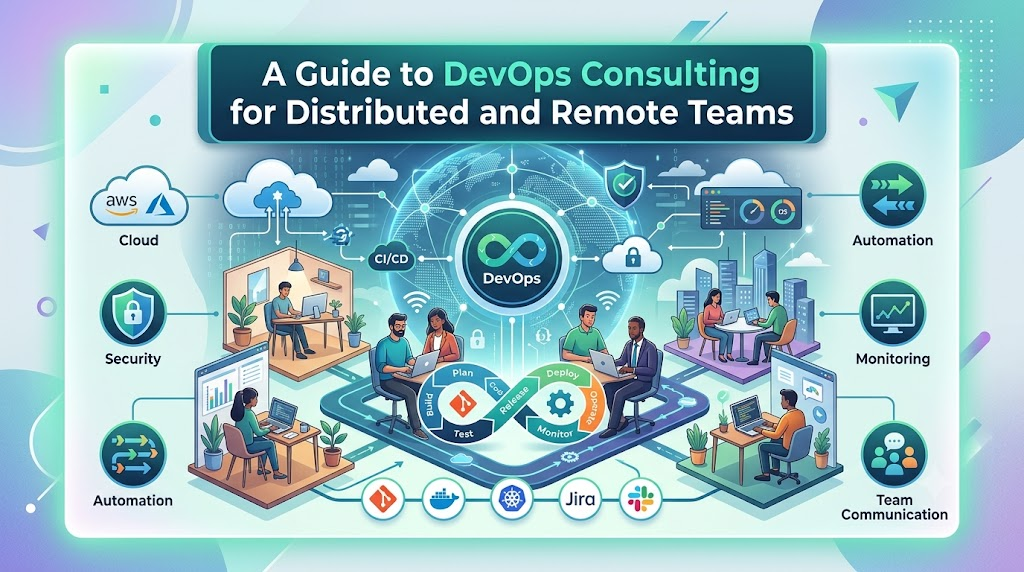
Introduction
The global landscape of software engineering has shifted permanently toward distributed and remote engineering frameworks, allowing organizations to source global talent across continents and time zones, but also introducing operational friction like misaligned workflows, fragmented tools, and broken delivery pipelines. Maintaining consistency across this distributed workforce requires more than adopting video tools; it demands a systematic re-engineering of how code is written, tested, secured, and deployed. This structural transformation is where targeted technical consulting becomes critical, providing the automated architectures, governance, and metrics needed to turn disconnected remote groups into unified, high-performing teams. By collaborating with specialized enterprise training and transformation partners like DevOpsSchool, technology leaders can transition from reactive troubleshooting to a proactive, automated delivery pipeline that drives predictable business outcomes.
Understanding Distributed and Remote DevOps Teams
A distributed DevOps team consists of software engineers, site reliability engineers (SREs), QA professionals, and security experts working across various physical locations. Unlike traditional colocated structures, these teams rely completely on digital systems to coordinate code changes, manage cloud infrastructure, and maintain application uptime.
Geographic distribution introduces distinct operational dynamics. Teams are frequently spread across different continents, meaning an engineer in Bangalore might write code that a peer in Austin reviews, which is then deployed to production by an SRE based in London. This structural separation removes the casual, verbal communication found in physical offices. Every piece of work must be explicit, trackable, and transparent.
Time-zone differences can act as either a bottleneck or a major operational benefit. When managed poorly, a five-hour time difference can delay code reviews by an entire day. When optimized through asynchronous workflows, it creates a “follow-the-sun” model where software development, testing, and operational monitoring occur continuously around the clock.
Remote collaboration within cloud-native work environments relies heavily on shared infrastructure. Teams operate inside cloud platforms, using version control systems, automated continuous integration pipelines, and infrastructure as code repositories as their primary engineering environment. The codebase and the automated platform serve as the single source of truth for the entire organization.
Why Remote Teams Face Unique Challenges
Distributed engineering organizations face specific friction points that rarely occur when teams sit in the same room. DevOps consulting focuses heavily on identifying and neutralizing these core vulnerabilities:
Communication Barriers
In a remote setting, communication gaps widen easily. Written text can be misinterpreted, and critical architecture updates can get buried in chat channels. Without intentional documentation, architectural decisions remain siloed within small sub-teams, leaving other engineers working with outdated assumptions.
Tool Fragmentation
Without centralized governance, different remote sub-teams tend to select their own tools. One team might use a specific CI/CD platform, while another builds an identical pipeline using an entirely different stack. This tool fragmentation breaks down internal mobility, increases software licensing costs, and complicates enterprise-wide compliance.
Deployment Coordination
Coordinating a production release across multiple time zones is highly complex without standard automation. If a deployment requires manual approvals, manual environment verification, or live synchronous coordination among engineers in three different countries, the release process slows down, leading to human error and extended deployment windows.
Security Concerns
Remote work broadens the corporate attack surface. Engineers access production cloud environments, repositories, and internal monitoring systems from various home networks and locations. Without proper identity and access management, automated secrets management, and centralized vulnerability scanning, the risk of credential leakage and compliance violations increases.
Visibility Gaps
Engineering leaders often struggle with visibility gaps in distributed setups. Without centralized dashboards, it is difficult to accurately assess pipeline health, understand deployment blockers, or evaluate infrastructure stability. This lack of clear data leads to reactive management and unexpected system downtime.
How DevOps Consulting Supports Remote Teams
To address these challenges, consultants implement a structured framework that systematically updates an organization’s engineering practices for remote operations.
Current State Assessment
        ↓
Collaboration Analysis
        ↓
Automation Strategy
        ↓
CI/CD Optimization
        ↓
Security Integration
        ↓
Monitoring & Observability
        ↓
Governance
        ↓
Continuous Improvement
1. Current State Assessment
The engagement begins by evaluating the organization’s current tech stack, pipeline velocity, team topologies, and delivery bottlenecks. Consultants audit code repositories, build tools, and interview engineering leads to map out the existing software delivery lifecycle.
2. Collaboration Analysis
Consultants review how information flows between teams. They look at documentation habits, repository pull request patterns, and how incidents are handled across different time zones. The goal is to identify communication silos that slow down delivery.
3. Automation Strategy
Here, consultants design a roadmap to replace manual interventions with automated processes. This covers everything from automated infrastructure provisioning to automated testing, ensuring engineers can move forward without waiting on manual approvals.
4. CI/CD Optimization
Pipelines are restructured to run quickly, securely, and reliably. Consultants focus on containerizing build steps, optimizing test suites for parallel execution, and implementing automated rollback mechanisms to make remote deployments low-risk events.
5. Security Integration
Security tools are integrated directly into the automated delivery process (DevSecOps). This step includes setting up static application security testing (SAST), software composition analysis (SCA), and dynamic scanning within the pipeline, removing the need for a separate manual security gate.
6. Monitoring & Observability
Consultants establish centralized telemetry systems. By setting up distributed tracing, centralized log management, and clear metrics dashboards, all remote engineers can view the same real-time operational data during an incident.
7. Governance
Clear policies are set up around cloud spend, resource access, and compliance standards. Role-based access control (RBAC) and policy-as-code frameworks ensure that remote teams operate safely within pre-defined boundaries.
8. Continuous Improvement
Finally, consultants build long-term feedback loops. This involves establishing data-driven post-mortems, tracking key operational metrics, and providing continuous upskilling pathways to ensure the engineering organization keeps evolving.
Collaboration Frameworks for Distributed Teams
To keep distributed teams aligned, consultants implement specific collaboration frameworks that transition the organization from real-time synchronous dependence to structured asynchronous execution.
| Collaboration Area | Challenge | DevOps Consulting Solution |
| Communication | Ping-pong chat threads; delayed decisions across time zones. | Asynchronous-First Communication: Decisions, architectural choices, and context are documented in structured templates rather than transient chat channels. |
| Documentation | Outdated readmes; siloed team wikis. | Documentation as Code: Engineering documentation lives inside the version-controlled repository alongside the application code, updated via pull requests. |
| Incident Management | Fragmented alerts; unclear ownership during off-hours. | Automated On-Call Rotation & ChatOps: Centralized alerting systems route incidents to the correct engineer based on time zones, with incident workflows managed inside dedicated rooms. |
| Knowledge Sharing | Siloed expertise; tribal knowledge. | Internal Developer Portals (IDPs): Centralized platforms (like Backstage) house approved software templates, golden paths, and API catalogs for easy access. |
| Team Alignment | Disconnected goals; conflicting priorities. | GitOps & Shared Version Control: All changes to infrastructure and applications flow through transparent, public pull requests where anyone can view project history. |
Practical Implementation
By treating documentation exactly like code, remote teams ensure that system documentation stays accurate. When an engineer updates an API or changes a database schema, the documentation update is required as part of the pull request validation process. This approach eliminates outdated setup guides and significantly reduces onboarding times for new remote engineers.
CI/CD Optimization for Remote Teams
A highly optimized Continuous Integration and Continuous Deployment (CI/CD) pipeline serves as the primary engine for remote software delivery. When engineers cannot walk over to a colleague’s desk to verify a build, the pipeline must provide complete clarity.
[Developer Push]
       ↓
[Automated Build & Unit Tests]
       ↓
[Static Security Scanning (SAST/SCA)]
       ↓
[Parallel Integration Testing]
       ↓
[Artifact Storage & Versioning]
       ↓
[Automated Staging Deployment]
       ↓
[Canary/Blue-Green Production Release]
Automated Pipelines
Every code push must automatically trigger a standardized build and test sequence. By utilizing containerized runners, consultants guarantee that the build environment remains identical regardless of whether the pipeline is triggered by an engineer working in Europe or Asia.
Release Consistency
DevOps consulting helps teams move away from chaotic manual deployments toward predictable, automated releases. Pipelines use progressive delivery strategies, such as canary deployments or blue-green deployments. These techniques route a small fraction of traffic to the new release, monitoring error rates automatically before rolling it out fully.
Deployment Visibility
Centralized dashboards ensure that every team member can view the status of a release. If a build fails on a specific branch, the pipeline provides clear logs, stack traces, and test results right within the version control platform. This transparency allows any available engineer to step in and fix the issue without needing to contact the original developer.
Quality Assurance
Automated test suites—including unit, integration, functional, and performance tests—are built directly into the delivery flow. By running these tests in parallel, pipelines provide quick feedback loops, allowing remote teams to catch and fix regressions early in the development cycle.
Infrastructure as Code and Remote Operations
Allowing remote engineers to manually configure cloud resources through web consoles introduces configuration drift, hidden costs, and security risks. Infrastructure as Code (IaC) solves this problem by defining all cloud infrastructure in readable, version-controlled configuration files.
Using tools like Terraform, OpenTofu, or Pulumi, consultants help organizations define networks, clusters, databases, and storage buckets as code. When a remote engineer needs to add a new cloud resource, they do not click through an administrative console; instead, they submit a pull request containing the updated configuration.
Remote Engineer
  └─► Submits IaC Pull Request (Terraform/OpenTofu)
        └─► Automated Plan & Linters Run
              └─► Peer Review & Approval
                    └─► GitOps Controller Applies to Cloud
This approach provides major benefits for remote teams:
- Environment Consistency: Development, staging, and production environments are built from the exact same configurations, eliminating bugs caused by subtle differences between staging and production environments.
- Automated Provisioning: Engineers can spin up temporary, isolated staging environments automatically to test features, destroying them when testing is complete to minimize cloud costs.
- Clear Governance: Every change to the infrastructure is permanently recorded in the git log, showing exactly who made the change, why it was made, and when it occurred.
Security and Compliance for Distributed Teams
Operating a distributed workforce requires moving away from traditional perimeter-based security toward a Zero Trust Architecture. DevOps consulting integrates security controls directly into the automated engineering workflow.
DevSecOps Practices
Security validation is shifted left, meaning it happens early in the development process. Automated scanners check application code for vulnerabilities (SAST) and analyze open-source dependencies for known security flaws (SCA) on every single commit.
Access Management
Consultants implement strict identity and access management policies using the principle of least privilege. Engineers log in via single sign-on (SSO) backed by multi-factor authentication (MFA). Rather than granting permanent access to production environments, organizations use Just-In-Time (JIT) access tools that grant temporary credentials only during active incidents.
Compliance Automation
For organizations in regulated fields (such as healthcare or finance), compliance audits can take up valuable engineering time. Consultants use policy-as-code frameworks (such as Open Policy Agent) to automatically enforce compliance rules—such as ensuring all cloud storage buckets are encrypted—before resources are ever created.
Observability and Monitoring in Remote Environments
When applications run across complex multi-cloud environments, distributed teams need clear visibility to quickly identify and fix runtime errors.
   [Logs] ──┐
  [Metrics] ┼─► Centralized Telemetry Engine ─► Real-Time Dashboards & Alerts
   [Traces] ──┘
Consultants assist organizations in moving past basic server uptime tracking toward full observability based on three main pillars:
- Metrics: Numerical data tracking resource usage, application error rates, and request volumes over time to spot trends.
- Logs: Granular, structured text records generated by applications and infrastructure, aggregated into centralized engines for rapid querying.
- Traces: End-to-end paths of individual user requests as they travel through microservices, helping isolate the exact cause of system latency.
Establishing this level of visibility helps remote teams resolve incidents faster. When a production alert fires, the system provides identical, detailed telemetry data to every engineer on call, regardless of their location. This shared view prevents finger-pointing and allows teams to focus entirely on fixing the issue.
Core Tools Supporting Remote DevOps Teams
Building a reliable remote DevOps operation requires a standardized, well-integrated tool ecosystem.
| Tool Category | Purpose | Remote Team Benefit |
| Source Control | Centralized code repository management and peer review workflows. | Provides a single source of truth for code; transparent code reviews via Git; built-in audit trails. |
| CI/CD Platforms | Automated building, testing, and deployment orchestration. | Guarantees identical compilation and validation workflows; removes reliance on local developer machines. |
| Monitoring Tools | Real-time observability, telemetry gathering, and unified dashboarding. | Gives all engineers the same visibility into system health; prevents informational silos during incidents. |
| Collaboration Platforms | Centralized asynchronous communication and structured tracking. | Reduces scattered email threads; logs technical discussions and decisions for future reference. |
| Infrastructure Automation | Defining cloud infrastructure using declarative configuration files. | Prevents configuration drift; enables automated environment spin-up; tracks infrastructure changes in version control. |
| Security Tools | Automated vulnerability scanning, secrets handling, and access governance. | Prevents credential leaks; automatically enforces security policies within the delivery pipeline. |
Measuring Success in Remote DevOps Operations
DevOps consulting relies on clear, objective metrics rather than guesswork. Consultants use the DORA (DevOps Research and Assessment) framework alongside collaboration metrics to track engineering performance.
| KPI | Why It Matters | Business Value |
| Deployment Frequency | Measures how often code is successfully deployed to production. | Indicates high agility, smaller release sizes, and reduced deployment risk. |
| Lead Time for Changes | Measures the time it takes for a commit to reach production. | Demonstrates pipeline efficiency and shows how quickly value reaches users. |
| Mean Time to Restore (MTTR) | Tracks how long it takes to recover from a production failure. | Reflects the quality of observability tools and the speed of remote incident management. |
| Change Failure Rate | The percentage of production deployments that result in downtime or require a rollback. | Tracks the stability of the delivery pipeline and the effectiveness of automated testing. |
| Pull Request Lead Time | Tracks the duration from when a code review is opened until it is merged. | Highlights communication blockers, scheduling issues, or review delays among remote teams. |
| Service Availability | The overall uptime and reliability percentage of user-facing systems. | Directly protects user experience, safeguards revenue, and fulfills service level agreements. |
Common Challenges in Remote DevOps Adoption
Transitioning to a modern DevOps model across a remote workforce comes with unique challenges. Consultants anticipate these issues and apply targeted strategies to resolve them.
| Challenge | Impact | Recommended Solution |
| Time-Zone Coordination | Long delays in code reviews and decision-making loops. | Adopt asynchronous-first workflows; establish clear core collaboration windows; design decoupled architecture. |
| Communication Gaps | Technical misunderstandings; siloed knowledge bases. | Standardize documentation templates; adopt documentation-as-code practices; create transparent code review standards. |
| Security Risks | Credential leakage; insecure remote access points. | Implement zero-trust network access; enforce multi-factor authentication; use automated secrets managers. |
| Tool Complexity | Cognitive overload; excessive operational costs. | Consolidate the enterprise tool suite; build internal developer platforms with clear paths. |
| Governance Consistency | Configuration drift; non-compliant cloud architecture. | Use policy-as-code engines; enforce automated infrastructure linting inside the CI/CD pipeline. |
| Cultural Differences | Varying feedback styles; disconnected team dynamics. | Run blameless post-mortems; clarify communication expectations; focus evaluations purely on output. |
Best Practices for DevOps Consulting Engagements
When participating in a DevOps consulting engagement, organizations should follow a structured approach to achieve lasting operational improvements:
- Standardize Engineering Workflows: Ensure every development team follows the same branching strategies, commit messaging styles, and pull request requirements to simplify cross-team collaboration.
- Automate Repetitive Tasks: Automate environment setup, linting, code formatting, security analysis, and testing to let remote engineers focus on writing feature code.
- Strengthen Communication Channels: Move key architectural and operational discussions out of private direct messages and into public, searchable project repositories or dedicated team channels.
- Implement Comprehensive Observability: Set up centralized logging and tracing systems so that distributed engineers have immediate access to identical data when debugging production issues.
- Integrate Security Controls Early: Build automated security scanners directly into the initial phases of the CI/CD pipeline to identify vulnerabilities before code is merged.
- Continuously Improve Engineering Practices: Run structured, blameless post-mortems after system incidents to discover root causes and implement automated fixes rather than assigning blame.
Real-World Example
The Challenge
A global logistics company transitioned its core engineering group to a completely remote model. Within six months, delivery velocity dropped significantly. The team faced long delays because engineers in different regions had to wait on manual deployment approvals from an infrastructure team based in a single time zone.
Furthermore, different sub-teams began using separate deployment tools, which led to significant environment drift. Production bugs increased by 35%, and the mean time to restore (MTTR) stretched to over seven hours because on-call remote engineers lacked access to centralized application logs.
The Consulting Roadmap
The organization engaged an enterprise DevOps consulting team to realign its engineering operations. The transformation was completed over a nine-month period across three major phases:
[Phase 1: Standardization] ──► [Phase 2: Automation] ──► [Phase 3: Observability]
- Phase 1 (Standardization): Consolidated all sub-teams onto a unified version control platform and standardized code branching strategies.
- Phase 2 (Automation): Replaced manual infrastructure configuration with modular OpenTofu scripts. Built standardized CI/CD templates that automatically handled building, linting, testing, and deployment steps.
- Phase 3 (Observability): Set up a unified observability platform that pulled logs, metrics, and distributed traces into a single dashboard accessible by all remote engineering teams.
The Outcomes
The move to automated GitOps pipelines removed the dependency on manual approvals across different time zones. Engineers could safely deploy microservices independently using automated canary releases.
Centralized logging gave on-call engineers instant visibility into production issues, helping them isolate bugs without waiting on input from other regions.
KPI Improvements
DORA Metrics Optimization:
  ├── Deployment Frequency:  From Bi-Weekly  ──► Multiple Times/Day
  ├── Lead Time for Changes: From 12 Days    ──► Under 45 Minutes
  ├── Change Failure Rate:   From 35%        ──► Under 5%
  └── Mean Time to Restore:  From 7+ Hours   ──► Under 14 Minutes
Lessons Learned
The engagement demonstrated that remote engineering challenges are rarely just about the tools themselves. True operational success requires combining automated infrastructure with a transparent, asynchronous engineering culture that provides every remote developer with the context and tooling needed to work independently.
Common Misconceptions
Remote teams cannot achieve high DevOps maturity
Many leaders believe that high-velocity DevOps requires real-time, in-person collaboration. This is incorrect. Distributed engineering groups frequently achieve high levels of DevOps maturity because the physical distance forces them to automate validation processes and document workflows thoroughly.
More tools solve collaboration issues
Adding more chat channels, notification systems, and project tools often increases cognitive load and worsens tool fragmentation. True efficiency comes from tool consolidation, clear usage rules, and building clear developer paths.
Automation eliminates the need for communication
Automation handles repetitive operational tasks, but it does not replace the need for clear communication around system architecture and product goals. Instead, automation frees up valuable time, allowing remote engineers to focus on high-quality asynchronous documentation.
Security is harder remotely by default
While a remote workforce introduces a larger attack surface, it also drives organizations to move away from weak perimeter security toward a modern, highly secure Zero Trust model. With automated access controls and pipeline vulnerability scanning, a remote engineering operation can achieve a stronger security posture than a traditional on-premise setup.
DevOps consulting is only for large enterprises
Small and mid-sized remote engineering teams often suffer from manual bottlenecks and undocumented configurations. Implementing sound DevOps practices early on through targeted consulting helps growing organizations scale smoothly without accumulating massive technical debt.
Remote DevOps Maturity Model
Organizations can track their progress using a structured DevOps maturity model tailored for distributed operations.
[Level 1: Ad Hoc] ──► [Level 2: Basic] ──► [Level 3: Automated] ──► [Level 4: Integrated] ──► [Level 5: Optimized]
Level 1 – Ad Hoc Remote Operations
Engineering environments are configured manually through web consoles, creating configuration drift. Code sharing is inconsistent, communication is fragmented across private direct messages, and deployments require manual intervention by a few key individuals.
Level 2 – Basic Collaboration
Teams consolidate onto a single version control provider. Basic CI pipelines run simple unit tests, but infrastructure provisioning, configuration changes, and final production deployments still require manual effort and live coordination.
Level 3 – Automated Delivery
Infrastructure is managed through version-controlled templates, and CI/CD pipelines automate building, testing, and staging deployments. Teams follow basic asynchronous communication habits, reducing the reliance on real-time meetings.
Level 4 – Integrated Observability
Automated security checking (DevSecOps) is fully integrated into the deployment pipeline. Centralized telemetry dashboards combine application logs, resource metrics, and request traces, allowing remote on-call engineers to troubleshoot production issues independently.
Level 5 – High-Performing Distributed DevOps
The organization runs a mature GitOps model where all infrastructure and application changes are managed through automated pull requests. Teams use internal developer portals to bootstrap new services instantly, and operational decisions are driven entirely by objective engineering data.
Future of Remote DevOps Consulting
As distributed engineering models mature, the discipline of DevOps consulting continues to evolve around several key technical developments:
AI-Assisted Collaboration
Artificial intelligence tools are moving beyond simple code generation into complex operational automation. Future remote environments will leverage intelligent agents to automatically generate documentation from pull request details, summarize long incident chat logs during handovers, and suggest pipeline optimizations based on build history.
Platform Engineering
Organizations are moving away from expecting every developer to master complex cloud infrastructure. Instead, platform engineering teams build internal developer platforms (IDPs). These portals allow remote developers to provision secure, compliant environments independently using clear workflows, reducing cognitive load across the team.
DevSecOps Evolution
Security policies are becoming completely integrated into code definitions. With the expansion of policy-as-code libraries, compliance validation runs automatically at every stage of the lifecycle, ensuring that globally distributed code meets regulatory requirements before deployment.
Intelligent Automation
Self-healing infrastructure systems are becoming more common. When a production anomaly is discovered, modern observability systems can automatically trigger canary rollbacks or adjust cloud resources without requiring manual intervention from a remote on-call engineer.
Global Engineering Ecosystems
Enterprise consulting focus is expanding from basic tool administration toward designing large-scale developer experiences. The goal is to build standardized development environments that allow engineers to onboard, commit code safely, and deliver value from anywhere in the world on day one.
Certifications & Learning Paths
To sustain these automated engineering practices long-term, distributed teams must invest in continuous technical upskilling.
| Certification Area | Best For | Skill Level | Remote Team Relevance |
| DevOps Lifecycle | Release Engineers, Systems Administrators, Development Leads. | Intermediate to Advanced | Standardizes core pipeline engineering, branching workflows, and automated release practices across remote groups. |
| Cloud Infrastructure | Cloud Architects, Infrastructure Engineers. | Intermediate to Advanced | Validates the ability to architect multi-region, resilient, and cost-effective cloud infrastructure for global users. |
| Kubernetes & Containers | Platform Engineers, Microservices Developers. | Advanced | Enforces consistent container orchestration, ensuring workloads run identically across environments. |
| DevSecOps | Security Engineers, Compliance Officers. | Advanced | Focuses on shifting security left by embedding automated scanning and compliance rules into the delivery flow. |
| Platform Engineering | Internal Tooling Developers, Systems Architects. | Advanced | Teaches engineers how to build internal portals that allow remote developers to provision resources independently. |
| SRE Principles | Site Reliability Engineers, Operations Managers. | Advanced | Provides the data-driven frameworks needed to manage incidents and monitor availability across time zones. |
When building these long-term educational roadmaps, technology leaders often leverage structured training systems like the DevOpsSchool learning ecosystem to align their distributed engineering teams around shared technical standards.
Remote DevOps Readiness Checklist
Use this checklist to evaluate whether your distributed engineering organization is prepared for high-velocity DevOps operations:
- Assess Collaboration Maturity: Verify if major architectural decisions, code patterns, and onboarding steps are explicitly documented in version-controlled repositories rather than transient chat logs.
- Improve Automation Coverage: Audit delivery pipelines to ensure that environment creation, code compilation, and quality checks run automatically without requiring manual setup.
- Strengthen CI/CD Infrastructure: Confirm that your build pipelines use isolated, containerized runners to guarantee identical compilation environments for all remote developers.
- Enhance System Observability: Ensure that application metrics, system logs, and distributed request traces are aggregated into a single centralized dashboard accessible to all on-call engineers.
- Implement Modern Security Controls: Enforce multi-factor authentication, apply strict role-based access control, and ensure that automated scanners run security checks on every code commit.
- Track Key Engineering Metrics: Establish automated tracking for DORA metrics—such as deployment frequency and change failure rates—to monitor delivery performance with objective data.
FAQs
1. What challenges do distributed DevOps teams face?
Distributed DevOps teams primarily struggle with communication silos, tool fragmentation, inconsistent environments, and deployment delays caused by time-zone differences. Without clear automation and documentation, coordinating production releases and troubleshooting system incidents across multiple regions becomes highly complex.
2. How does DevOps consulting help remote teams?
DevOps consulting evaluates an organization’s existing engineering bottlenecks and designs a roadmap to standardize delivery processes. Consultants help teams implement infrastructure as code, optimize CI/CD pipelines, set up centralized observability platforms, and establish clear asynchronous communication frameworks.
3. What tools are most important for remote DevOps operations?
The foundational tools include distributed version control systems, automated CI/CD platforms, infrastructure as code engines, centralized telemetry suites, and zero-trust security access tools. Together, these systems establish a clear, automated environment for software delivery.
4. How can collaboration be improved across time zones?
Collaboration improves when teams shift from real-time synchronous meetings toward structured asynchronous documentation. By practicing documentation-as-code, managing architectural updates inside repositories, and utilizing automated alerting networks, teams reduce operational dependencies on specific time zones.
5. What metrics should organizations track to measure success?
Organizations should track the four core DORA metrics: deployment frequency, lead time for changes, mean time to restore (MTTR), and change failure rate. Additionally, monitoring pull request lead time helps identify communication bottlenecks between distributed engineering groups.
6. How does security change in remote engineering environments?
Security shifts away from older perimeter networks toward a modern Zero Trust Architecture. Access to cloud platforms is governed by single sign-on, multi-factor authentication, and temporary credentials, while automated vulnerability checking is built directly into the early stages of the deployment pipeline.
7. Can small remote teams benefit from DevOps consulting?
Yes. Small teams often have limited engineering resources and suffer from manual tasks and single points of failure. Implementing clear automation and structured documentation early on allows small teams to scale smoothly without accumulating heavy technical debt.
8. Where should an organization begin its DevOps transformation?
The transformation should start with a thorough audit of the existing software delivery lifecycle to isolate the largest bottlenecks. In most remote setups, the best initial steps are standardizing the version control workflow and automating the test verification pipelines.
9. Does adopting DevOps tools solve cultural communication issues?
No. Tools only provide the infrastructure for collaboration. Resolving cultural issues requires setting clear engineering standards, adopting blameless post-mortems, prioritizing written documentation, and ensuring that performance evaluations focus on clear output.
10. What is the role of GitOps in remote team coordination?
GitOps ensures that git repositories serve as the absolute source of truth for both applications and infrastructure. Every configuration change is managed through a clear pull request, providing distributed teams with complete visibility, peer review opportunities, and an automated audit history.
11. How do you prevent environment drift across distributed teams?
Environment drift is prevented by defining all infrastructure using declarative config files (IaC) and banning manual infrastructure updates through web consoles. Changes are applied solely through automated delivery pipelines, ensuring development, staging, and production stay identical.
12. What is Platform Engineering, and how does it help remote developers?
Platform Engineering focuses on designing internal developer platforms that simplify underlying cloud infrastructure. These portals allow remote developers to provision secure, compliant environments independently, reducing cognitive load and accelerating software delivery.
13. How should on-call incident response be managed across time zones?
On-call rotations should leverage geographic distribution to establish a “follow-the-sun” model, routing alerts to engineers during their normal daytime working hours. Centralized alerting systems and integrated documentation ensure that on-call engineers can resolve incidents independently.
14. How does automated testing support remote release cycles?
Automated testing runs a comprehensive suite of unit, integration, and security checks on every code push. This provides immediate feedback to remote engineers, confirming that their code changes are safe to merge without requiring live coordination or manual verification.
15. How long does a typical DevOps consulting engagement take?
The timeline depends on the organization’s initial maturity level and size. A basic engagement focused on standardizing pipelines can take three to six months, while a full-scale enterprise transformation involving platform engineering and full DevSecOps integration may span nine to twelve months.
Final Thoughts
Transitioning to a highly productive distributed engineering model requires a practical approach focused on automation, workflow standardization, and thorough documentation. True efficiency is achieved by eliminating manual operational silos, consolidating tools, and providing remote engineers with clear, automated feedback loops.
Technology leaders should focus on building a robust, resilient delivery pipeline that treats infrastructure as code and integrates security validations directly into the engineering workflow. By grounding operational strategies in objective, data-driven frameworks like the DORA metrics, companies can build scalable, high-performing distributed development teams capable of delivering continuous value from anywhere in the world.

Best Cardiac Hospitals Near You
Discover top heart hospitals, cardiology centers & cardiac care services by city.
Advanced Heart Care • Trusted Hospitals • Expert Teams
View Best Hospitals