Introduction
Modern enterprise software development is often complex, slow, and prone to error. Engineering departments struggle with fragmented code repositories, manual testing bottlenecks, and unstable production environments. These inefficiencies slow down feature releases, frustrate developers, and directly impact company revenue through system downtime and missed market opportunities.
To resolve these core challenges, organizations look toward digital transformation. However, implementing modern deployment practices without clear direction often leads to wasted resources and tool sprawl. This reality drives the growing global demand for professional software architecture guidance and strategic transformation advisors.
Measuring the return on investment of any technical initiative is essential for corporate decision-makers. Executives cannot justify technology spending without a clear understanding of its financial and operational impact. This comprehensive guide outlines how specialized technical advisory services transform engineering operations into structured business assets.
Understanding the business value of these technical practices helps organizations transition from reactive maintenance to proactive innovation. For professionals seeking to master these core methodologies, platforms like DevOpsSchool provide the essential training frameworks required to understand automation strategies, continuous integration pipelines, and modern infrastructure governance.
What Does ROI Mean in DevOps Consulting?
Return on Investment within technical consulting is not just about reducing software license costs. It represents a comprehensive measurement of operational efficiency, speed to market, system reliability, and resource utilization. In simple terms, it calculates the financial value gained from engineering improvements relative to the capital spent on expert advisory services.
To understand this concept clearly, consider a practical real-world analogy. Imagine a traditional commercial bakery where staff mix dough, cut loaves, and pack boxes entirely by hand. The bakery operates slowly, struggles with inconsistent bread quality, and frequently discards ruined batches due to manual oven tracking.
The bakery owner decides to hire an industrial automation engineer. The engineer does not simply buy new ovens; they analyze the entire workflow, install automated mixing belts, set up precise temperature sensors, and train the staff on efficient operating procedures.
The initial cost of hiring that engineer and updating the layout represents the consulting investment. The subsequent return is found in the bakery producing five times more bread per hour, eliminating wasted ingredients, and ensuring every loaf tastes exactly the same.
In the software world, the manual baking process represents manual code deployments, fragmented testing, and human errors during releases. The DevOps consultant acts as that industrial engineer, designing automated build pipelines, configuring infrastructure monitoring, and aligning development teams. The financial return is realized through reduced engineering hours, faster feature releases, and minimal application downtime.
Why Companies Invest in DevOps Consulting
Organizations rarely lack the desire to improve; instead, they suffer from an internal engineering expertise gap. Internal development teams are usually fully occupied with building product features, fixing urgent software bugs, and managing daily operational fires. They do not have the time or specialized knowledge required to re-architect legacy deployment systems or design secure cloud infrastructure.
A specialized consulting service brings vast pattern recognition gained from working across multiple industries and diverse technology stacks. These advisors understand which automation patterns work, which tools cause unnecessary complexity, and how to avoid common pitfalls during structural transitions. This outside expertise allows companies to leapfrog years of trial-and-error experimentation.
Furthermore, external advisors accelerate organizational transformation by overcoming internal cultural inertia. Legacy engineering teams often resist changing their traditional workflows due to habit or fear of new systems. A structured consulting engagement establishes clear roadmaps, sets objective metrics, and provides hands-on mentorship, turning a painful organizational shift into a managed corporate upgrade.
Key Areas Where DevOps Consulting Creates ROI
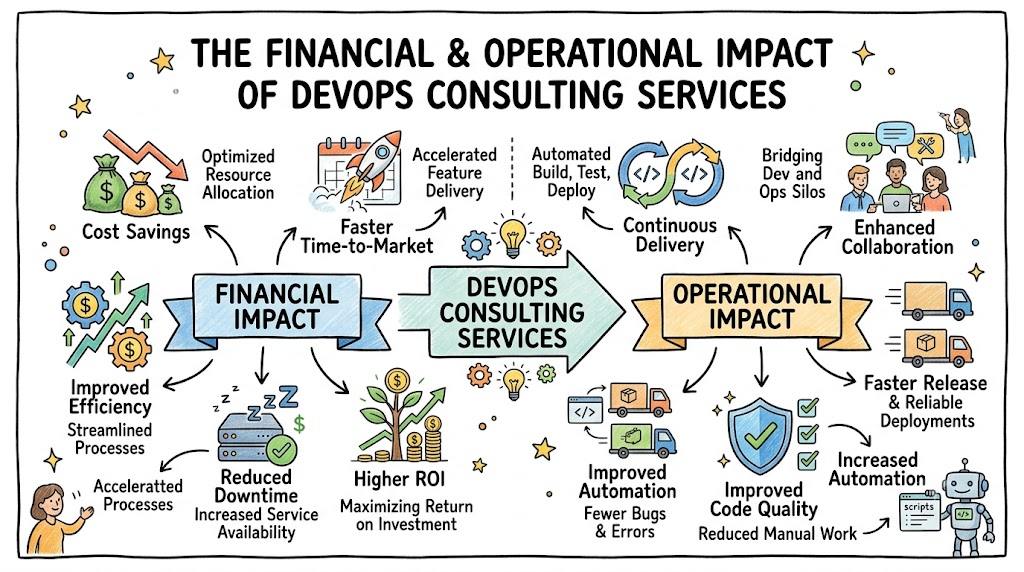
The financial and operational returns generated by structured engineering advisory services manifest across multiple departments. The following table provides an overview of these core operational impacts.
| DevOps Area | Business Impact |
| Faster Software Delivery | Decreased time-to-market and accelerated revenue generation from new application features. |
| Reduced Downtime | Lower financial losses from system outages and improved customer brand trust. |
| Better Automation | Elimination of repetitive manual tasks, allowing engineers to focus on high-value development. |
| Improved Team Collaboration | Removal of departmental silos, resulting in faster problem-solving and higher morale. |
| Cloud Optimization | Lower monthly infrastructure bills through precise resource allocation and auto-scaling. |
| Faster Incident Resolution | Rapid identification of software anomalies and reduced mean time to recovery. |
| Better Customer Experience | Stable application environments with continuous, invisible updates and fewer bugs. |
Area #1: Faster Software Delivery
Traditional software delivery relies on manual hand-offs between development teams and operations engineers. Developers finish writing code and hand it over to a separate team for QA testing, which then hands it over to systems administrators for deployment. This manual waterfall workflow can take weeks or months to complete.
A professional consultant restructures this process by implementing automated Continuous Integration and Continuous Deployment pipelines. Code changes are automatically checked, compiled, tested, and staged for production deployment the moment an engineer saves their work.
Consider a financial services company that takes 45 days to deploy a simple compliance update to its banking application. After a consulting intervention establishes an automated delivery pipeline, that same compliance update passes through automated testing gates and reaches production in 30 minutes, drastically reducing compliance risk.
Area #2: Reduced Downtime
System downtime directly drains corporate revenue, damages brand reputation, and frustrates end users. When an online service crashes, customers instantly migrate to competitors, and engineering teams waste hours frantically diagnosing the failure under intense pressure.
Consulting services introduce high-availability architectural patterns, automated rollback strategies, and self-healing infrastructure configurations. If a new software update contains a critical error, the system automatically detects the failure and rolls back to the last stable version without human intervention.
For instance, an e-commerce platform experiencing an average of four major outages per quarter during peak shopping seasons loses significant sales volume. By re-architecting the infrastructure for high availability and automated deployment safety gates, the platform achieves stable uptime, protecting thousands of dollars in seasonal transaction volume.
Area #3: Better Automation
Manual configuration of servers, manual databases updates, and manual security audits consume valuable engineering hours. Relying on human execution introduces high variability, as different engineers configuration environments in slightly different ways.
Consultants replace manual tasks with Infrastructure as Code frameworks, ensuring that servers, networks, and databases are managed entirely via software scripts. This eliminates configuration drift and allows entire environments to be duplicated perfectly within minutes.
Imagine an enterprise where system administrators spend 20 hours manually configuring every new staging server for the testing team. By converting that entire setup process into an automated software script, a new server environment can be spun up in 4 minutes with a single command, saving hundreds of engineering hours annually.
Area #4: Improved Team Collaboration
Siloed engineering departments create an environment of finger-pointing and defensive communication. When a production system fails, the development team frequently claims the code is perfect and blames the infrastructure, while the operations team blames the software design.
Strategic consulting focuses on aligning these disparate teams around shared metrics, unified tools, and collaborative communication workflows. By breaking down these traditional walls, engineers work together on the complete lifecycle of the software application.
A practical example involves a software company where feature deployment routinely stalls due to friction between the QA team and the development team. A consultant introduces cross-functional product teams with shared responsibility for system stability, cutting down internal email arguments and reducing delivery roadblocks by half.
Area #5: Cloud Optimization
Unmanaged cloud environments quickly accumulate massive unnecessary expenses through over-provisioned virtual servers, unattached storage volumes, and inefficient data transfer paths. Companies often waste thousands of dollars paying for cloud computing power they never actually use.
DevOps consultants audit infrastructure utilization patterns and implement automated resource management strategies. They configure precise auto-scaling policies, set up automated resource scheduling, and leverage cost-effective cloud pricing models.
A media streaming startup might find its monthly cloud infrastructure bill rising uncontrollably due to oversized staging environments running 24/7. A consultant configures automated shutdown policies for non-production environments outside of business hours, dropping the monthly infrastructure bill by 35% immediately.
Area #6: Faster Incident Resolution
When an application error occurs in production, finding the root cause without proper monitoring tools resembles searching for a needle in a haystack. Engineers must manually log into individual servers, download massive text files, and guess where the failure originated.
Consultants install comprehensive observability matrices, centralizing logs, application metrics, and performance traces into visual dashboards. They set up intelligent alerting thresholds so that engineering teams are notified before an anomaly escalates into a full system outage.
For example, a logistics company might take an average of six hours to locate a corrupted database connection string causing order tracking failures. With modern observability dashboards designed by an enterprise consultant, the system flags the exact line of code causing the failure within 90 seconds, leading to a near-instantaneous fix.
Area #7: Better Customer Experience
Slow feature releases and bug-ridden software applications quickly alienate modern digital consumers. If an application feels sluggish or frequently errors out during checkout, user satisfaction drops, and user retention numbers collapse.
By stabilizing the underlying software factory, consulting services enable product teams to deploy small, incremental improvements continuously. Users receive a steady stream of new features, bug fixes, and performance optimizations without experiencing service interruptions.
Consider a mobile gaming company that previously forced its users to download massive, disruptive application updates every two months. Transitioning to a continuous delivery model allows them to push micro-updates and performance adjustments seamlessly in the background, keeping user engagement scores high.
How Companies Measure DevOps Consulting ROI
To accurately calculate the return on investment of a DevOps consulting engagement, engineering leaders must track objective, quantifiable operational data. The following matrix highlights the key performance indicators used by top-tier organizations to evaluate transformation success.
| Metric | Why It Matters |
| Deployment Frequency | Measures organizational agility and how often code is safely released to production. |
| Mean Time to Recovery (MTTR) | Tracks operational resilience by calculating how fast the team fixes a production failure. |
| Change Failure Rate | Indicates code quality by measuring the percentage of deployments that cause immediate errors. |
| Lead Time for Changes | Calculates total velocity by tracking the time it takes for a line of code to go from commit to production. |
| Cloud Spend Efficiency | Quantifies financial health by measuring infrastructure costs against application user scaling. |
| Customer Satisfaction (CSAT) | Confirms that engineering performance improvements correlate directly with a positive user experience. |
Real-World Example: Company Without DevOps Consulting
To understand the practical contrast, let us look at the internal workflow of Legacy Insurance Corp, a fictional firm operating without modern engineering practices. The firm relies on manual processes to maintain its core customer portal.
[Developer Writes Code] ──> [Manual Email to QA] ──> [Manual Testing for 2 Weeks]
                                                               │
[Manual Infrastructure Setup] <── [Emergency Rollback] <── [Production Deployment Fails]
When developers complete a new insurance claim feature, they must write a detailed manual document describing how to install the software. This document is emailed to a separate testing team. Because the testing environment is configured differently than the developer’s computer, the software fails to run, causing a week of troubleshooting emails back and forth.
Once the testing team finally completes manual validation, the deployment package is handed over to the systems operations team. Deployments are scheduled for 2:00 AM on Sunday mornings to minimize consumer disruption. Three engineers must sit on a live phone conference, manually typing terminal commands to copy files onto production servers.
During this manual process, an engineer accidentally misses a critical file path configuration step. The customer portal goes completely offline, displaying error messages to users waking up on Sunday morning. The team spends four hours arguing over who made the mistake before executing an emergency manual rollback, canceling the release entirely, and wasting weeks of corporate work.
Real-World Example: Company Using DevOps Consulting
Now, let us examine Modern Insurance Corp, an identical firm that utilized professional DevOps consulting services to modernize its entire software delivery pipeline.
[Developer Commits Code] ──> [Automated CI/CD Pipeline] ──> [Automated Testing Passes]
                                                                   │
[Zero-Downtime Blue/Green Release] <── [Automated Security Scan] <─┘
When a developer at Modern Insurance Corp finishes the exact same insurance claim feature, they save the code to a central repository. This action automatically triggers an automated continuous integration pipeline. The pipeline compiles the code, executes thousands of automated unit tests, and performs an automated security scan within six minutes.
If any test fails, the pipeline automatically rejects the change and alerts the developer immediately, ensuring broken code never leaves their workstation. If the automated tests pass cleanly, the software package proceeds automatically to the staging environment for final automated verification.
The final production deployment occurs during normal business hours using a zero-downtime blue-green deployment strategy. The automated system slowly routes a small percentage of user traffic to the new feature while constantly monitoring error metrics. Because the entire pipeline is standardized and code is released in micro-segments, the deployment finishes smoothly without a single second of customer portal downtime.
Benefits of Investing in DevOps Consulting
Partnering with an external engineering consultant delivers systemic advantages that extend far beyond simple script writing. The overarching business value is realized through a fundamental change in how your organization builds and manages technology assets.
First, your organization gains immense operational speed. By eliminating manual approval gates, hand-offs, and communication delays, the time required to turn a business concept into a live production feature drops from months to hours, allowing you to outpace market competitors.
Second, human resource efficiency increases dramatically. Talented software developers who command high salaries should spend their time engineering innovative business logic, not manually copying files across servers or fighting broken deployment scripts. Automation frees your team to focus on high-value development.
Third, your software systems achieve unprecedented architectural reliability. Building automated guardrails around your deployment pipeline ensures that human error is systematically designed out of the infrastructure lifecycle, creating a stable software environment that keeps users happy.
Finally, these combined factors result in substantial long-term financial savings. Eliminating infrastructure waste, reducing system downtime losses, and maximizing developer output creates a highly efficient technology department that operates at a fraction of traditional legacy costs.
Challenges in Measuring DevOps ROI
Calculating the exact monetary return of an engineering transformation comes with unique challenges, primarily because many of the core benefits are preventative rather than additive. It is easy to calculate the revenue gained from a new sales channel, but harder to quantify the exact value of a catastrophic data outage that never happened because of automated testing.
Another challenge is the reality of delayed operational results. A DevOps transformation requires an upfront investment in consulting fees, tool licenses, and internal training. The cultural shifts and automation pipelines take time to build and mature, meaning the true financial returns typically become visible in business metrics three to six months after implementation begins.
Additionally, some of the most critical transformation improvements are qualitative rather than quantitative. Measuring an increase in deployment frequency is straightforward, but measuring the financial impact of improved developer morale, reduced burnout, and better cross-departmental trust requires sophisticated organizational tracking.
Common DevOps Consulting Mistakes Companies Make
- Expecting instant financial returns: Transformation is an ongoing cultural and operational evolution; expecting dramatic cost drops in the first two weeks leads to premature frustration.
- Ignoring the human culture element: Buying expensive automation software tools while refusing to break down internal team silos ensures your transformation will fail.
- Attempting to automate everything at once: Trying to modernize every legacy application simultaneously creates organizational chaos; focus on iterative improvements.
- Operating with a tool-first mindset: Focusing entirely on configuring specific software tools rather than optimizing the underlying delivery workflow results in automated inefficiencies.
- Lacking clear baseline metrics: Failing to measure your deployment frequency and downtime before the consultant arrives makes it impossible to prove subsequent ROI.
Best Practices for Maximizing DevOps Consulting ROI
To secure the highest possible return on your consulting investment, follow a structured, disciplined transformation roadmap:
- Establish objective baseline performance metrics: Document your exact deployment speeds, failure rates, and infrastructure costs before changing a single line of code.
- Secure strong executive championship: Ensure corporate leadership actively supports the cultural shift, clearing organizational roadblocks for the consulting team.
- Prioritize low-hanging fruit first: Target small, high-impact automation victories early to build organizational confidence and demonstrate immediate business value.
- Invest heavily in internal team education: Ensure your core staff works closely with the consultant to absorb the modern automation mindset and system architecture.
- Commit to a philosophy of continuous improvement: Treat DevOps optimization as a permanent operational strategy rather than a one-time IT project.
Role of DevOpsSchool in Understanding DevOps Consulting
Navigating the complexities of modern software delivery requires a deep, fundamental understanding of automation architectures, delivery guardrails, and continuous engineering mindsets. Organizations cannot effectively evaluate or maximize consulting outcomes if their internal teams lack the baseline technical literacy required to maintain automated pipelines.
This is where educational platforms like DevOpsSchool serve a vital role in the global technology ecosystem. Rather than offering superficial tool tutorials, they focus on building a comprehensive understanding of continuous integration pipelines, infrastructure automation strategies, and site reliability principles.
Providing enterprise teams and independent engineers with structured, real-world exposure ensures that when a consultant designs a modern cloud architecture, the internal staff is fully capable of operating, scaling, and optimizing that system over the long term. This foundational knowledge prevents organizations from becoming permanently dependent on external advice, ensuring long-term self-sufficiency.
Career Importance of DevOps Consulting Skills
As businesses worldwide realize the undeniable financial value of modern engineering practices, the market demand for professionals skilled in technical advisory roles has reached unprecedented levels. This evolution has created a variety of high-value career paths across the global technology sector.
                  ┌───> DevOps Consultant (Strategic Strategy & Architecture)
                  ├───> SRE / Platform Engineer (Reliability & IDPs)
Engineering Core ─┼───> Cloud Architect (Cost Optimization & Scale)
                  └───> Automation Engineer (CI/CD & Pipeline Safety)
DevOps Consultant
These senior specialists bridge the gap between corporate business strategy and technical execution. They analyze organizational value streams, design delivery workflows, and guide leadership teams through cultural and structural shifts.
Cloud Consultant
Focusing specifically on resource efficiency, cloud consultants design scalable, secure, and highly optimized infrastructure environments, ensuring companies get maximum value out of their cloud investments.
Site Reliability Engineer (SRE)
SRE professionals apply software engineering principles directly to infrastructure operations, focusing on system availability, automated incident response, and keeping mean time to recovery as close to zero as possible.
Platform Engineer
These engineers build Internal Developer Platforms (IDPs), creating curated automated toolchains that allow product developers to self-provision resources safely without manual operations tickets.
DevOps Engineer
The core engine of modern delivery teams, these specialists build and maintain the daily CI/CD pipelines, automated testing gates, and configuration scripts that keep software moving safely to production.
Industries Benefiting From DevOps Consulting
Banking & Finance
Financial institutions operate under strict regulatory compliance frameworks and zero-tolerance mandates for data loss or system downtime. Consulting services allow banks to automate security auditing and compliance logging directly into their deployment pipelines, enabling them to release secure software updates without risking regulatory penalties.
Healthcare
Modern digital healthcare providers manage sensitive patient data and critical application portals that must remain online around the clock. DevOps strategies ensure secure data handling protocols, automated high-availability infrastructure configurations, and rapid bug resolution paths that protect patient care.
SaaS Platforms
Software-as-a-Service firms rely on constant innovation and rapid feature delivery to retain global subscribers. Professional consulting helps SaaS companies transition to true continuous delivery models, allowing them to deploy updates multiple times a day without interrupting active user sessions.
E-Commerce
Online retail platforms experience massive, highly unpredictable traffic spikes during holiday sales events. Consultants protect retail revenue by engineering auto-scaling infrastructure frameworks that automatically expand server capacity during high traffic surges and shrink it afterward to minimize costs.
Telecom
Telecommunications giants manage incredibly complex, highly distributed network environments. Implementing infrastructure automation and centralized telemetry allows telecom engineering teams to manage massive data routing systems with minimal manual operational overhead.
Enterprise IT
Large corporate IT infrastructures frequently suffer from decades of accumulated legacy technical debt and fragmented departmental systems. Professional consulting systematically categorizes these legacy applications, introducing containerization and automated delivery pipelines to modernize old infrastructure safely.
Future of DevOps Consulting ROI
The business value generated by engineering advisory services continues to expand as new technological paradigms emerge. The next decade of operational efficiency will be driven by the integration of artificial intelligence into daily operational workflows, a field known as AIOps. Consultants will play a vital role in helping organizations deploy predictive anomaly detection systems that resolve infrastructure failures before they affect end users.
Furthermore, the industry is shifting away from fragmented tool management toward structured Platform Engineering models. Future consulting engagements will center on designing centralized Internal Developer Platforms that hide underlying cloud complexity, allowing developers to deploy code safely within pre-configured organizational guardrails.
Finally, as global cyber threats grow more sophisticated, security can no longer be treated as an afterthought at the end of the development cycle. The future of consulting return on investment lies in robust DevSecOps implementation—embedding automated security scanning, vulnerability testing, and compliance verification directly into every phase of the software lifecycle from day one.
FAQs
What is DevOps consulting ROI?
It is the measurable financial and operational value an organization gains from improving its software delivery pipelines, cloud infrastructure, and team collaboration relative to the capital spent on hiring expert DevOps advisors.
How is DevOps ROI measured?
It is calculated by tracking explicit, quantifiable engineering performance indicators, including increased deployment frequency, decreased mean time to recovery, lower change failure rates, and reduced monthly cloud infrastructure bills.
Does DevOps consulting save money?
Yes. It delivers substantial long-term savings by automating repetitive engineering tasks, eliminating unutilized cloud infrastructure waste, and drastically reducing revenue losses caused by production system downtime.
Is DevOps consulting worth it for startups?
Yes. Startups must move fast to survive. Establishing automated deployment pipelines and stable cloud architectures early prevents the accumulation of technical debt and allows small teams to scale rapidly.
How long does it take to see measurable DevOps ROI?
While initial operational improvements like automated builds can be seen within weeks, true financial returns and cultural shifts typically become visible in corporate business metrics within three to six months.
What KPIs matter most during an engineering transformation?
The core metrics that matter most are deployment frequency, lead time for changes, mean time to recovery from system failures, change failure rates, and overall cloud infrastructure spend efficiency.
Can small companies benefit from these consulting services?
Absolutely. Small companies often have limited engineering personnel. Automation allows a small team to manage complex application environments that would traditionally require a massive IT operations department.
Is automation the only component of DevOps ROI?
No. While automation is a significant factor, true return on investment also stems from cultural alignment, broken down departmental silos, improved employee retention, and a superior end-user customer experience.
How does consulting help reduce cloud infrastructure costs?
Consultants audit your cloud footprint, eliminate unattached storage volumes, right-size over-provisioned virtual servers, and configure automated auto-scaling rules to match actual consumer demand.
What is the difference between a DevOps tool and a DevOps culture?
A tool is simply a piece of software used to perform a task, like code compilation. Culture is the shared mindset, communication practices, and collaborative workflows that teams use to deliver software safely.
Why do engineering transformations fail without executive support?
Changing long-standing engineering workflows requires breaking down traditional departmental boundaries. Without clear executive backing, teams often slide back into traditional, comfortable siloed habits.
What role does security play in calculating transformation value?
Integrating security directly into the deployment pipeline avoids expensive last-minute release delays, prevents costly regulatory non-compliance fines, and protects the firm from catastrophic data breaches.
How does continuous delivery improve customer satisfaction?
It allows your product development teams to fix bugs, optimize performance, and deliver valuable new application features to your users continuously without causing system downtime or service interruptions.
What is the main cause of deployment failures in legacy systems?
The primary cause is human error resulting from manual server configurations, inconsistent testing environments, and massive, complex code releases that have not been validated by automated systems.
How do platforms like DevOpsSchool support corporate transformations?
They provide the structured technical training and foundational automation frameworks required to educate internal engineering teams, ensuring they can successfully maintain and scale modern architectures.
Final Thoughts
Securing a high return on investment from DevOps consulting services requires moving past the misconception that transformation is merely an expensive technology upgrade. True engineering optimization is a strategic business investment that reshapes how an organization creates, delivers, and maintains digital value for its consumers.
Realizing these measurable returns demands patience, discipline, and a willingness to evolve traditional organizational structures. Real transformation does not happen overnight by simply purchasing new software tools. It requires a sustained commitment to aligning human culture with modern architectural guardrails and automated workflows.
When executed with clear goals and professional guidance, the transition pays massive dividends. Your software delivery velocity accelerates, your production systems achieve robust reliability, and your engineering talent is freed from manual maintenance to focus on real business innovation.

Best Cardiac Hospitals Near You
Discover top heart hospitals, cardiology centers & cardiac care services by city.
Advanced Heart Care • Trusted Hospitals • Expert Teams
View Best Hospitals