Introduction
In the modern digital landscape, the speed of software delivery is no longer just a technical metric; it is a fundamental business necessity. Enterprises that struggle with slow deployment cycles, frequent outages, and misaligned team objectives often find themselves losing ground to more agile competitors. These bottlenecks are rarely the result of a single faulty tool. Instead, they are the symptoms of a traditional IT model that prioritizes stability through isolation rather than stability through continuous flow.
Transitioning from this legacy mindset to a modern engineering culture requires more than just installing new software; it requires a deliberate, structured approach. This is where an enterprise DevOps transformation roadmap becomes indispensable. By charting a clear path toward integration, automation, and shared responsibility, organizations can systematically dismantle the barriers between development and operations. Whether you are beginning your journey or recalibrating an existing strategy, DevOpsSchool provides the foundational knowledge and practical expertise necessary to guide teams through this complex shift. A successful transformation is not a sprint toward new technology, but a marathon of cultural and process refinement.
What Is an Enterprise DevOps Transformation Roadmap?
At its core, an enterprise DevOps transformation roadmap is a strategic document that outlines the evolution of an organization’s software delivery lifecycle. It acts as a compass, guiding teams from a state of fragmented, manual processes toward a model defined by automation, collaboration, and continuous improvement.
Think of it like planning a cross-country expansion for a company. You cannot simply decide to be in a new location overnight. You need to assess your current fleet, train your drivers, establish new logistics routes, and ensure every branch is operating under the same set of high standards. The roadmap identifies the “what,” “how,” and “when” of your journey, ensuring that your people, processes, and technology are synchronized as you scale.
Why Enterprises Need DevOps Transformation
Enterprises operate at a scale where even minor inefficiencies, when multiplied across hundreds of developers, result in massive waste. Traditional IT models often force teams into silos—Development writes code, QA tests it, and Operations deploys it—each working with different priorities.
- Faster Delivery: By breaking down silos, features reach the customer in days rather than months.
- Better Reliability: Automation reduces human error, which is the leading cause of production outages.
- Business Agility: A mature DevOps organization can pivot quickly in response to market demands.
- Improved Culture: When teams own their services from “cradle to grave,” morale increases and blame culture disappears.
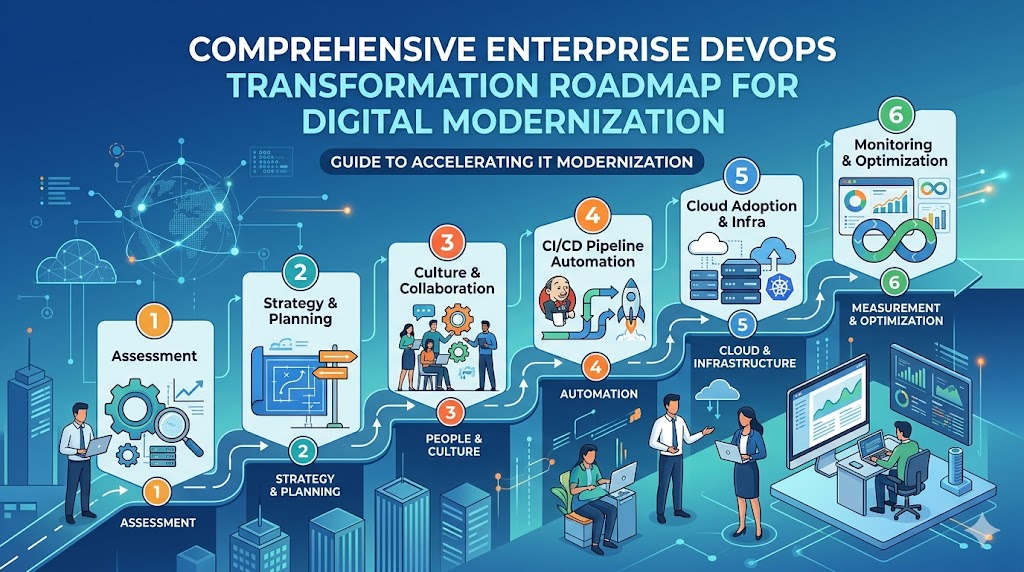
Key Stages of Enterprise DevOps Transformation
| Stage | Focus Area | Primary Goal |
| 1 | Assessment | Identify current bottlenecks and baseline metrics. |
| 2 | Culture | Establish shared ownership and psychological safety. |
| 3 | CI/CD | Automate code integration and delivery pipelines. |
| 4 | Automation | Eliminate manual effort through Infrastructure as Code. |
| 5 | Cloud Adoption | Leverage scalable, containerized environments. |
| 6 | Observability | Implement real-time monitoring and feedback loops. |
| 7 | Security | Integrate security checks throughout the pipeline (DevSecOps). |
| 8 | Optimization | Continuously iterate based on data and team feedback. |
Stage 1: Assessing Current IT Maturity
Before you can build a roadmap, you must understand your starting point. Many enterprises fail because they attempt to implement high-level automation on top of broken, inefficient workflows. You need to conduct a “value stream mapping” exercise to visualize how a piece of code moves from a developer’s laptop to production. Where does it sit waiting for approval? Where do manual handoffs happen? These are your primary targets for optimization.
Stage 2: Building DevOps Culture
Tools can be purchased, but culture must be built. The biggest challenge in any enterprise is shifting from a “not my job” mentality to a “shared product” mentality. Encourage cross-functional teams where developers and operators work together from the design phase. Celebrate small wins to build momentum and foster an environment where failure is viewed as a learning opportunity rather than a reason for punishment.
Stage 3: CI/CD Transformation
Continuous Integration and Continuous Delivery are the heartbeat of DevOps. If developers are working on branches for weeks, you are not doing DevOps. By using tools like Jenkins, GitLab CI, or GitHub Actions, your goal is to merge code frequently and automate the testing process. This ensures that the master branch is always in a deployable state, significantly reducing the “integration hell” that plagues many large enterprises.
Stage 4: Infrastructure Automation
If you are still manually configuring servers, you are creating a bottleneck. Infrastructure as Code (IaC) allows you to define your environments using version-controlled scripts. Using tools like Terraform or Ansible, you can spin up a development, staging, or production environment with a single command. This ensures environment parity—meaning your code will behave the same way in testing as it does in production.
Stage 5: Cloud and Container Adoption
Moving to the cloud is not just about using someone else’s hardware; it is about using cloud-native services. Containers, orchestrated by platforms like Kubernetes, allow you to package your application with all its dependencies. This solves the “it works on my machine” problem once and for all, providing a consistent runtime environment across the entire enterprise.
Stage 6: Monitoring and Observability
In a complex microservices architecture, things will break. The difference between a minor hiccup and a total outage is how quickly you can detect and fix the issue. Observability goes beyond simple “is the server up?” monitoring. It involves collecting logs, metrics, and traces to understand the internal state of your system, allowing engineers to troubleshoot issues proactively before customers notice.
Stage 7: Security Integration (DevSecOps)
Security should not be a final “gate” that happens right before release. By the time you get to the end of the pipeline, fixing a security vulnerability is expensive and time-consuming. Instead, shift security left. Include automated scanning for vulnerabilities in your dependencies and static analysis of your code as part of your CI/CD pipeline.
Stage 8: Continuous Improvement
The roadmap never truly ends. Once you have a stable pipeline, you look for ways to optimize. Are your build times too long? Is your test coverage sufficient? Use KPIs like Deployment Frequency, Lead Time for Changes, and Mean Time to Recovery (MTTR) to guide your next phase of improvement.
Common Enterprise Challenges
- Resistance to Change: Middle management often fears losing control. Focus on training and transparency.
- Legacy Systems: You cannot modernize everything at once. Pick a low-risk, high-value service to start your transformation.
- Skill Gaps: Your team may need to learn new tools. Invest in structured training to bridge this gap.
- Leadership Alignment: If the executive level doesn’t support the change, the effort will fizzle out.
Best Practices Checklist
- Start with one small, high-impact project.
- Focus on fixing the most painful manual process first.
- Prioritize cross-team communication channels.
- Automate incrementally; do not try to automate 100% of the lifecycle in month one.
- Measure everything, but focus on outcomes, not just output.
Role of DevOpsSchool
For many organizations, the internal knowledge gap is the biggest hurdle. DevOpsSchool bridges this by providing industry-standard training that focuses on the practical application of these concepts. Whether your team needs to master container orchestration, pipeline automation, or cloud-native architecture, professional guidance ensures that the transformation roadmap is built on a foundation of proven best practices rather than trial and error.
FAQs
1. What is an enterprise DevOps roadmap?
It is a strategic plan that details the stages, tools, and cultural shifts required to transition an organization to DevOps practices.
2. How long does transformation take?
It is a continuous journey. You can see improvements in weeks, but full-scale organizational maturity often takes 18 to 36 months.
3. Why do transformations fail?
They often fail when organizations prioritize tools over culture or attempt to force a “big bang” change instead of a phased, incremental approach.
4. Is culture important?
Culture is the most important component. Without collaboration and shared responsibility, even the best automation tools will fail to deliver value.
5. Do enterprises need Kubernetes?
Not always, but it is highly recommended for large-scale applications requiring high availability, scalability, and standardized deployment.
6. What role does CI/CD play?
CI/CD provides the mechanism for frequent, low-risk releases, which is essential for maintaining business agility.
7. How do enterprises measure success?
Success is measured through DORA metrics: Deployment Frequency, Lead Time for Changes, Change Failure Rate, and Mean Time to Recovery.
8. Is DevSecOps necessary?
Yes. In an era of rapid deployment, manual security checks are no longer viable. Security must be automated within the pipeline.
9. Can we automate everything?
You should aim to automate repetitive tasks, but always leave room for human judgment in areas like strategic decision-making and creative problem-solving.
10. What if we have legacy systems?
Use the “strangler fig” pattern: gradually replace pieces of the legacy system with modern services until the old system can be retired.
11. Who leads the transformation?
Ideally, it should be a partnership between Engineering leadership and empowered, cross-functional “champion” teams.
12. Does DevOps mean no operations team?
No, it means the operations team evolves into a platform engineering team that provides self-service capabilities to developers.
13. What is the most common mistake?
Hiring experts to build a toolset for teams that aren’t prepared to use them. Focus on enablement and training.
14. Are there specific tools required?
There are categories of tools (CI/CD, IaC, Monitoring), but the specific brand is less important than how they integrate into your workflow.
15. How do we keep the momentum going?
Continuously demonstrate the value of your efforts to stakeholders by highlighting reduced cycle times and fewer production bugs.
Final Thoughts
Enterprise DevOps transformation is a journey of continuous evolution. It requires patience, a focus on people, and a commitment to learning. Do not be discouraged by the scale of the task; focus on solving one problem at a time and celebrating the improvements in developer experience and customer satisfaction. True transformation is not measured by the tools you use, but by the reliability of your service and the speed at which you can safely deliver value to your users.

Best Cardiac Hospitals Near You
Discover top heart hospitals, cardiology centers & cardiac care services by city.
Advanced Heart Care • Trusted Hospitals • Expert Teams
View Best Hospitals