Introduction
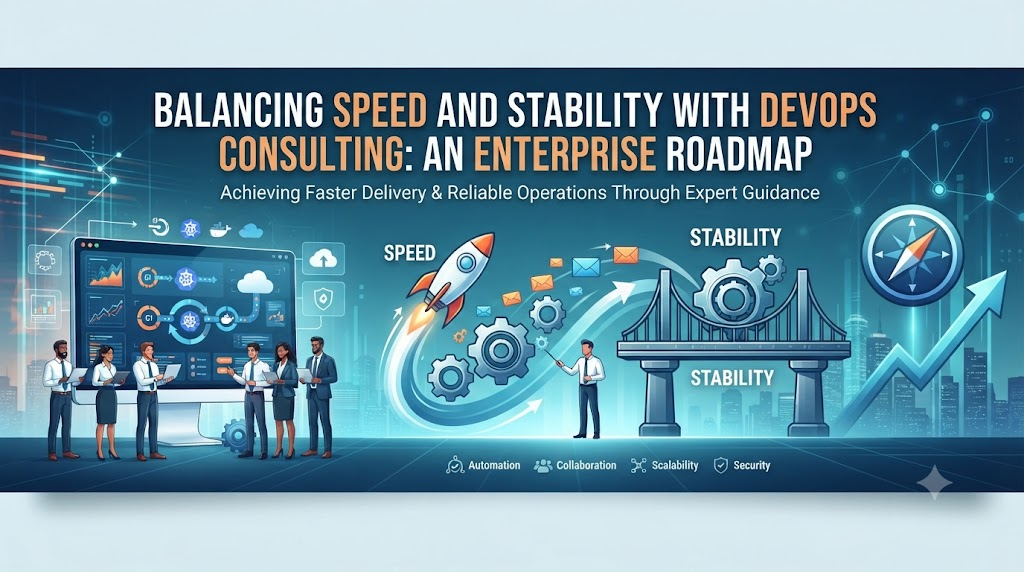
In the current digital economy, the ability to release software quickly is often viewed as the primary competitive advantage, yet the pursuit of velocity frequently creates a dangerous tension where stability is sacrificed for speed. Prioritizing deployment frequency without a corresponding focus on operational resilience leads to frequent outages and technical debt, while overly rigid manual controls stifle necessary innovation. This is where DevOps consulting becomes essential; by integrating robust automation, advanced observability, and mature governance frameworks, organizations can move beyond the binary choice of being either fast or stable. Expert guidance helps teams synchronize high-velocity development with high-reliability operations, providing the structured approach necessary to achieve sustainable performance. Whether scaling a cloud-native platform or managing complex legacy systems, DevOpsSchool offers the practical frameworks and expertise required to bridge the gap between rapid delivery and mission-critical stability.
Understanding the Speed vs Stability Challenge
The tension between speed and stability is rarely a result of poor intent; it is usually a result of misaligned incentives. Business stakeholders demand feature parity and faster time-to-market, while operations teams are incentivized to maintain 99.99% availability.
- Competitive Pressures: Market demands require constant feature updates.
- Customer Expectations: Users expect high-performing, bug-free applications.
- Operational Risks: Rapid changes increase the probability of downtime.
- Technical Complexity: Modern microservices architectures are harder to monitor than monolithic predecessors.
Successful organizations treat this not as a conflict to be won, but as an engineering problem to be solved through design and process evolution.
Why Organizations Struggle to Balance Speed and Stability
Many companies attempt to adopt DevOps methodologies without addressing underlying structural issues. Common inhibitors include:
- Manual Processes: Human intervention in the release pipeline is the primary source of deployment friction and human error.
- Legacy Systems: Older architectures lack the modularity required for safe, incremental updates.
- Limited Automation: Partial automation often creates “islands of efficiency” rather than a continuous, reliable flow.
- Siloed Teams: When developers and operations teams operate with different goals and tools, hand-offs become bottlenecks.
- Inconsistent Governance: Ad-hoc compliance checks lead to delayed releases or, worse, compliance gaps.
DevOps Consulting Framework for Balancing Speed and Stability
A professional consulting engagement follows a structured maturity model:
- Current State Assessment: Establishing a baseline of existing delivery performance and team culture.
- Delivery Bottleneck Analysis: Identifying exactly where hand-offs, manual approvals, or technical debt slow down the pipeline.
- Risk Assessment: Pinpointing critical failure points in the architecture that currently limit deployment confidence.
- Automation Strategy: Moving from script-based tasks to comprehensive, policy-driven orchestration.
- CI/CD Optimization: Streamlining the path from commit to production with integrated quality gates.
- Observability Implementation: Moving from simple alerting to actionable data-driven insights.
- Governance Alignment: Embedding security and compliance into the automation process (DevSecOps).
- Performance Measurement: Establishing a shared dashboard of KPIs to track progress.
- Continuous Improvement: Building a feedback loop that evolves the process based on real-world data.
Core Areas Where DevOps Consulting Creates Value
| Area | Speed Benefit | Stability Benefit |
| CI/CD Pipelines | Automated, repeatable builds and deploys. | Standardized quality gates prevent bad code. |
| Infrastructure Automation | Rapid environment provisioning. | Configuration consistency reduces drift. |
| Monitoring | Faster identification of performance regressions. | Proactive detection before user impact. |
| Testing | Shift-left testing catches bugs early. | Reduced production incident frequency. |
| Release Management | Feature flags enable safer rollouts. | Ability to perform instant rollbacks. |
| Incident Response | Reduced time to resolution via automation. | Improved post-mortem and learning culture. |
Optimizing CI/CD Pipelines
A CI/CD pipeline should be the heartbeat of your delivery organization. Optimization involves reducing the “Lead Time for Changes.”
- Build Automation: Ensure builds are deterministic and reproducible.
- Automated Testing: Integrate unit, integration, and security testing directly into the pipeline.
- Quality Gates: Use policy-driven gates that automatically stop a deployment if performance or security benchmarks are not met.
- Feedback Loops: Notify developers immediately of failures so they can fix issues while the context is fresh.
Reliability Engineering and Stability
Stability is not just about avoiding failure; it is about managing how systems behave when they inevitably fail.
- Site Reliability Engineering (SRE): Applying software engineering principles to infrastructure problems.
- Service Level Objectives (SLOs): Defining clear targets for availability.
- Error Budgets: Using data to decide when to prioritize new features (when the budget is healthy) versus stability work (when the budget is depleted).
- Resilience Practices: Implementing circuit breakers, retries, and rate limiting to prevent cascading failures.
Automation Without Losing Control
Automation is often feared as a loss of control, but it is actually the mechanism that enables governance at scale.
- Controlled Automation: Define infrastructure as code (IaC) so that every change is version-controlled and auditable.
- Approval Workflows: Automate the “request” process while keeping the human “approval” where necessary for business compliance.
- Deployment Safeguards: Use automated canary analysis to stop deployments if error rates spike.
Monitoring and Observability
Traditional monitoring tells you if a system is up or down; observability tells you why it is behaving the way it is.
- Metrics: Tracking system performance over time.
- Logs: Providing deep context into application behavior.
- Traces: Mapping requests across complex distributed microservices.
- Proactive Detection: Utilizing AIOps to identify anomalies before they become critical incidents.
Release Management Best Practices
Modern release management shifts away from “Big Bang” releases toward continuous, granular updates.
- Blue-Green Deployments: Maintaining two identical environments to switch traffic instantly.
- Canary Releases: Gradually rolling out changes to a small subset of users to test stability.
- Feature Flags: Decoupling deployment from release, allowing you to toggle functionality without changing code.
- Rollback Strategies: Ensuring every deployment has a pre-validated path back to the previous stable state.
Governance and Compliance
Governance should be an enabler, not a hurdle. By integrating compliance checks into the CI/CD pipeline, organizations achieve “Compliance as Code.”
- Policy Enforcement: Using automated tools to check for vulnerabilities or misconfigurations during the build.
- Audit Readiness: Maintaining an immutable history of every change, who authorized it, and the results of all automated tests.
- Security Integration: Ensuring security scans occur in every step of the development lifecycle.
Measuring Success
| Metric | Why It Matters | Business Value |
| Deployment Frequency | Measures velocity and agility. | Faster time to market for features. |
| Lead Time for Changes | Measures pipeline efficiency. | Rapid feedback and innovation cycles. |
| Change Failure Rate | Measures deployment quality. | Reduced cost of rework and downtime. |
| Mean Time to Recovery (MTTR) | Measures operational resilience. | Minimized impact of inevitable failures. |
| Service Availability | Measures system health. | Higher customer trust and retention. |
Common Challenges
| Challenge | Impact | Recommended Solution |
| Resistance to Change | Cultural stagnation. | Executive sponsorship and pilot teams. |
| Legacy Infrastructure | High technical debt. | Incremental modernization using strangler patterns. |
| Tool Sprawl | Complexity and cost. | Standardizing on a cohesive DevOps platform. |
| Skills Shortages | Inconsistent implementation. | Continuous learning and skill mapping. |
Best Practices for Balancing Speed and Stability
- Automate Strategically: Automate the high-frequency, high-effort tasks first.
- Implement Observability: Invest in tools that provide high-cardinality data.
- Strengthen Testing: Adopt a “Shift-Left” approach to quality.
- Define SLOs: Build consensus between product and engineering on reliability targets.
- Improve Collaboration: Break silos by co-locating SREs and developers.
- Measure Outcomes: Use the DORA metrics as your primary North Star.
Real-World Example
Case Study: Financial Services Enterprise
- Initial Challenges: A major bank struggled with quarterly releases, massive manual testing phases, and high production failure rates.
- Consulting Assessment: Found that 60% of time was spent in manual regression testing and environment configuration.
- Automation Improvements: Implemented a unified CI/CD platform with automated integration tests and containerized environments.
- Stability Enhancements: Introduced blue-green deployment patterns and canary releases.
- KPI Improvements: Deployment frequency increased from quarterly to weekly, while the Change Failure Rate dropped by 45%.
- Lessons Learned: Focus on the “low-hanging fruit” of manual toil before re-architecting applications.
Common Misconceptions
- “Faster delivery increases risk”: Incorrect. Manual, infrequent releases are more dangerous because they involve more changes at once.
- “Stability requires slower releases”: Stability is achieved through testing and observability, not by slowing down.
- “Automation removes accountability”: Automation enforces accountability by creating a transparent trail of actions.
- “More tools guarantee better outcomes”: Tools are only as effective as the processes they support.
Future of DevOps Consulting
The future lies in Platform Engineering, where internal developer platforms (IDPs) allow developers to self-serve infrastructure reliably. We are also seeing the rise of AI-assisted operations, where machine learning models predict failures before they happen, and Predictive Reliability, which moves beyond reactive alerting into proactive system tuning.
Certifications & Learning Paths
| Certification Area | Best For | Skill Level | Consulting Relevance |
| DevOps | Automation & Process | Intermediate | High |
| SRE | Reliability & Scaling | Advanced | High |
| Cloud | Infrastructure | Intermediate | High |
| Kubernetes | Orchestration | Advanced | Very High |
| DevSecOps | Security Integration | Intermediate | Essential |
Speed and Stability Readiness Checklist
- Does the team have shared SLOs?
- Is infrastructure defined as code (IaC)?
- Are build, test, and deployment processes automated?
- Is there a central dashboard for DORA metrics?
- Are deployment rollbacks automated and tested?
- Is observability integrated into the application layer?
FAQs
- Why is balancing speed and stability difficult? It requires aligning opposing organizational incentives—velocity versus uptime—which necessitates deep cultural and technical change.
- How does DevOps consulting help? It provides an objective roadmap to remove process bottlenecks and implement industry-standard reliability patterns.
- What metrics should organizations track? Focus on the four DORA metrics: Deployment Frequency, Lead Time, MTTR, and Change Failure Rate.
- How do SLOs improve reliability? They define quantitative targets for reliability, allowing teams to balance feature work with technical stability.
- What deployment strategies reduce risk? Canary releases, blue-green deployments, and feature flags allow for incremental, low-risk changes.
- How can organizations improve observability? By implementing structured logging, distributed tracing, and high-resolution metrics.
- What role does automation play? It removes human error, provides consistency, and accelerates feedback cycles.
- How should leaders get started? Start with a comprehensive assessment of the current delivery pipeline and identify the most impactful bottleneck.
- What is the impact of technical debt on stability? High technical debt makes systems brittle, increasing the likelihood of failure during deployment.
- How does DevSecOps fit in? It ensures security is not a final gate but an continuous, automated part of the CI/CD process.
- Can legacy systems be DevOps-enabled? Yes, by wrapping legacy components in modern APIs and automating their test harnesses.
- Is DevOps only for Cloud-native apps? No, DevOps principles apply to any software development lifecycle, regardless of deployment target.
- How often should we review our DevOps maturity? Quarterly reviews ensure that processes evolve alongside the business.
- What is the most important skill in DevOps? Collaboration and the ability to view the “system” as a whole rather than a set of isolated tasks.
- Where can we find training for these practices? DevOpsSchool offers structured learning paths for all levels of expertise.
Final Thoughts
Achieving the balance between speed and stability is an ongoing journey of continuous optimization. There is no “final state” where you can stop improving. By focusing on sustainable delivery performance, automating away the toil that slows down engineering teams, and prioritizing data-driven decision-making, organizations can thrive. Build for reliability, automate for speed, and always measure the outcomes to ensure your efforts are delivering genuine business value.

Best Cardiac Hospitals Near You
Discover top heart hospitals, cardiology centers & cardiac care services by city.
Advanced Heart Care • Trusted Hospitals • Expert Teams
View Best Hospitals