Navigating the financial landscape of modern engineering initiatives can be challenging. When organizations decide to accelerate their delivery pipelines, migrate to the cloud, or adopt container orchestration, one of the first questions leadership asks is: “How much is this going to cost, and how are we being billed?”
Understanding DevOps Consulting Cost Structures and Pricing Models is essential for CTOs, engineering managers, and finance teams alike. Unlike traditional software licenses or hardware purchases, DevOps consulting involves deep architectural transformations, cultural shifts, and technical implementations tailored to your exact environment.
Costs are rarely one-size-fits-all. They depend on the problem being solved, project scope, technical expertise required, infrastructure complexity, and expected outcomes. This comprehensive guide explores how DevOps consulting pricing works, the factors influencing expenses, different engagement models, and how to evaluate proposals effectively.
What Is DevOps Consulting?
Before diving into numbers and structures, it helps to establish what DevOps consulting entails. DevOps consulting involves partnering with external engineering experts to design, implement, optimize, and manage software delivery lifecycles, cloud infrastructure, and automation frameworks.
Depending on organizational maturity, a DevOps consulting company may assist with a wide array of services:
- DevOps Assessment: Evaluating current workflows, identifying bottlenecks, and building a roadmap.
- CI/CD Implementation: Designing robust continuous integration and continuous deployment pipelines.
- Cloud Migration: Moving workloads securely to AWS, Azure, Google Cloud, or hybrid environments.
- Infrastructure as Code (IaC): Automating provisioning using tools like Terraform, Ansible, or CloudFormation.
- Kubernetes Implementation: Deploying and managing container orchestration platforms.
- DevSecOps: Integrating security testing, vulnerability management, and compliance guardrails into pipelines.
- Monitoring and Observability: Setting up logging, metrics, and tracing for proactive incident management.
- Platform Engineering: Building Internal Developer Platforms (IDPs) to enhance developer self-service.
Why DevOps Consulting Costs Vary
There is no universal price tag for DevOps consulting services. A small startup automating a single web application will incur very different costs than a multinational enterprise modernizing legacy systems across multiple cloud accounts.
Major factors influencing DevOps consulting costs include:
- Project Complexity & Scope: Simple pipeline fixes require fewer resources than a full-scale cloud native transformation.
- Organization & Application Size: The number of applications, microservices, and repositories directly impacts effort.
- Infrastructure Complexity: Managing legacy on-premise systems versus modern cloud-native architectures changes the migration path.
- Number of Environments: Developing across local, staging, UAT, pre-prod, and production environments multiplies configuration needs.
- Security & Compliance Requirements: Rigorous frameworks (such as SOC 2, HIPAA, or GDPR) require specialized compliance automation.
- Consultant Expertise & Geography: Senior architects, Kubernetes specialists, and security experts command higher DevOps consulting rates than junior engineers.
- Support Requirements: Post-implementation maintenance and DevOps managed services alter ongoing financial commitments.
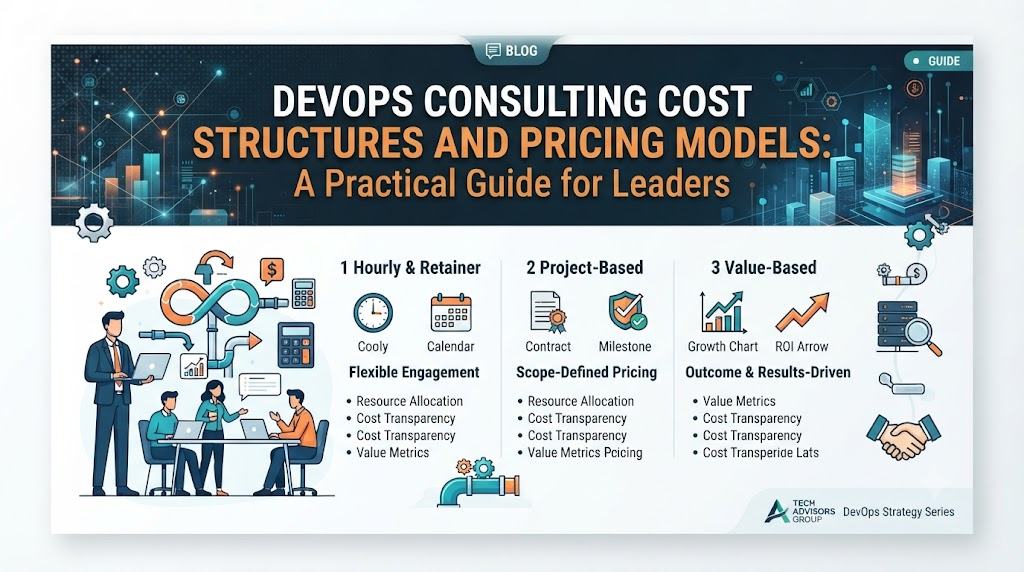
Major DevOps Consulting Cost Structures
Consulting firms utilize several commercial frameworks to structure their engagements. Choosing the right model depends on project clarity, internal team capacity, and risk tolerance.
1. Hourly or Daily Consulting Rates
Consultants charge based on time spent working on the project. This is ideal for advisory sessions, troubleshooting, or short-term mentoring.
- Advantages: Maximum flexibility; you can pivot tasks instantly.
- Limitations: Low budget predictability; project creep can inflate final bills.
2. Fixed-Price DevOps Projects
The consulting firm provides a defined deliverable for a set fee. This works well for bounded projects like a specific CI/CD migration or a security assessment.
- Advantages: High budget predictability; clear financial boundaries.
- Limitations: Requires extremely well-defined requirements; changes to scope require formal change requests.
3. Time-and-Materials (T&M) Pricing
Organizations pay for actual hours worked and materials/tools consumed. This is popular for complex, evolving projects where the end state cannot be fully mapped upfront.
- Advantages: Highly flexible for iterative development and shifting priorities.
- Limitations: Requires active stakeholder oversight to keep costs within expected thresholds.
4. Monthly Retainer Model
Clients pay a recurring monthly fee to secure dedicated engineering hours or ongoing advisory support, architectural guidance, and continuous improvement.
- Advantages: Ensures steady access to expertise and predictable operational budgeting.
- Limitations: Unused hours generally do not roll over depending on contract terms.
5. Dedicated DevOps Team Model
The consulting agency provides a full pod of engineers (DevOps, SRE, security, and platform specialists) to act as an extension of your internal engineering department.
- Advantages: Rapid scale-up capability without recruitment overhead.
- Limitations: Higher recurring monthly commitment.
6. Milestone-Based Pricing
Payments are tied to the successful completion and sign-off of predefined project phases or deliverables.
- Advantages: Aligns financial outlay with tangible progress and quality checks.
- Limitations: Disputes can arise if milestone criteria are ambiguous.
DevOps Consulting Pricing Model Comparison
| Pricing Model | How It Works | Best Suited For | Main Advantage | Potential Limitation | Scope Flexibility | Budget Predictability |
| Hourly / Daily | Charged per hour/day worked | Advisory, troubleshooting, audits | Ultimate flexibility | Unpredictable final cost | High | Low |
| Fixed-Price | Set fee for a defined scope | Assessments, specific migrations | Financial certainty | Rigid if scope changes | Low | High |
| Time-and-Materials | Billed by actual time and effort | Complex, evolving projects | Adaptable to changes | Requires careful oversight | High | Medium |
| Monthly Retainer | Recurring monthly fee for ongoing work | Continuous optimization, support | Access to steady expertise | Retainer hours may lapse | Medium | High |
| Dedicated Team | Full team provided on contract | Large transformations, team augmentation | Fast execution capacity | Higher recurring cost | High | Medium |
| Milestone-Based | Paid upon specific deliverable sign-off | Phased multi-month projects | Risk reduction per phase | Requires clear acceptance criteria | Medium | High |
What Services Are Usually Included in DevOps Consulting Costs?
When reviewing a DevOps consulting proposal, it is vital to examine the specific inclusions. A comprehensive engagement typically features:
- Discovery and assessment reports outlining current bottlenecks and recommendations.
- Architecture design blueprints for cloud environments and pipeline flows.
- Infrastructure as Code scripts (Terraform/OpenTofu) for repeatable provisioning.
- Configured CI/CD pipelines integrated with version control systems.
- Containerization setups and Kubernetes cluster configuration.
- Monitoring and alerting dashboards paired with log aggregation.
- Security integration (SAST/DAST, secrets management).
- Comprehensive documentation and knowledge transfer sessions for internal teams.
Note: Inclusions vary significantly between providers. Always confirm whether training, post-launch hypercare, or ongoing maintenance are bundled into the initial quote.
Cost Factors for Specific Technical Domains
Cloud and Infrastructure Transformation
Cloud architecture choices directly impact both consulting fees and ongoing cloud overhead. Whether you operate on AWS, Azure, Google Cloud, or a hybrid setup, migration projects involve untangling legacy dependencies, refactoring applications, and establishing secure networking topologies.
CI/CD Implementation Costs
The cost of establishing automated delivery pipelines depends on application complexity. Factors include the number of microservices, multi-branch testing strategies, automated rollback protocols, and compliance approval gates across tools like GitHub Actions, GitLab CI/CD, or Jenkins.
Kubernetes Consulting Expenses
Kubernetes implementations vary widely. Setting up a managed Kubernetes service (like EKS, AKS, or GKE) is generally faster than designing a self-managed cluster. Additional considerations include ingress controllers, persistent storage configuration, auto-scaling policies, and multi-cluster disaster recovery setups.
DevSecOps and Compliance
Integrating security into the development lifecycle adds specialized consulting effort. Securing the software supply chain, implementing automated vulnerability scanning, managing secrets securely, and establishing automated compliance reporting require security-focused engineering hours.
Hidden Costs to Consider
When budgeting for a DevOps initiative, leaders must distinguish between consulting service fees and underlying technology expenses. Overlooking secondary costs can derail a project budget. Ensure you account for:
- Cloud Infrastructure Usage: Compute, storage, and networking consumed during testing and production runs.
- Software Licenses & SaaS Tools: Subscriptions for enterprise monitoring, security scanners, or artifact repositories.
- Legacy System Remediation: Refactoring older codebases so they can run inside containers or automated pipelines.
- Internal Team Time: The hours your own engineers spend in discovery workshops, code reviews, and training.
- Ongoing Maintenance: Post-implementation support or managed services to keep systems healthy.
How to Compare DevOps Consulting Proposals
Evaluating multiple proposals requires a structured framework. The cheapest proposal is rarely the best choice if it omits crucial deliverables or relies on junior resources. Use these evaluation criteria:
- Scope Alignment: Do all proposals address the same business objectives and technical requirements?
- Deliverables Clarity: Are specific outputs (e.g., IaC repositories, runbooks, training sessions) explicitly listed?
- Team Expertise: What is the real-world experience of the engineers assigned to your project?
- Knowledge Transfer: Does the plan ensure your internal team will be able to manage the systems independently afterwards?
- Assumptions and Exclusions: What is explicitly left out of the quote? Check for hidden assumptions regarding legacy system state.
- Change-Request Process: How are out-of-scope requests handled commercially?
How to Build a DevOps Consulting Budget
Building a realistic financial plan involves a systematic approach:
[Assess Current State] ➔ [Define Scope] ➔ [Identify Resources] ➔ [Select Pricing Model] ➔ [Estimate Timeline] ➔ [Account for Tech Costs] ➔ [Add Contingency] ➔ [Define Success Metrics]
- Assess: Audit your current infrastructure maturity and bottlenecks.
- Define Scope: Isolate the exact problem you need solved (e.g., pipeline speed or cloud migration).
- Identify Resources: Determine whether you need strategic advisory, hands-on implementation, or team augmentation.
- Select Pricing Model: Choose between fixed-price, T&M, or retainers based on project certainty.
- Estimate Timeline: Map out milestones with your consulting partner.
- Account for Technology Costs: Budget separately for cloud provider bills and SaaS tools.
- Add Contingency: Reserve 10% to 15% for unexpected technical debt or legacy roadblocks.
- Define Success Metrics: Tie project completion to clear operational KPIs (e.g., deployment frequency, lead time for changes).
How DevOps Training Reduces Long-Term Dependency
While hiring external consultants provides immediate acceleration, long-term success relies on internal capability. Pairing consulting engagements with structured DevOps training helps internal teams master automation tools, cloud platforms, and modern operational workflows.
Organizations looking to upskill their internal engineering teams often partner with specialized providers like DevOpsSoftware or DevOpsSchool to build practical, hands-on competencies in CI/CD, Kubernetes, and DevSecOps. Equipping your staff reduces long-term consulting dependency and ensures sustainable internal ownership.
Frequently Asked Questions
How much does DevOps consulting cost?
Because projects range from brief multi-week assessments to year-long enterprise transformations, costs vary greatly based on scope, team seniority, and geographic region.
Is fixed-price or hourly DevOps consulting better?
Fixed-price models work best for tightly scoped, well-defined projects. Hourly or time-and-materials models are better for complex, exploratory transformations where requirements evolve.
Does DevOps consulting include cloud costs?
Typically, consulting fees cover professional engineering hours and expertise. Cloud infrastructure usage, software licenses, and tool subscriptions are billed separately by your cloud or software provider.
How can businesses reduce DevOps consulting expenses?
You can optimize costs by defining a clear project scope upfront, preparing internal documentation, automating repetitive preliminary tasks, and investing in internal team training to handle day-to-day maintenance post-launch.
Conclusion
Choosing the right DevOps consulting pricing model requires balancing project certainty, budget predictability, and technical flexibility. Rather than selecting a partner based solely on the lowest quoted price, evaluate proposals based on scope thoroughness, consultant expertise, knowledge transfer quality, and long-term value. By defining clear requirements and selecting an engagement model aligned with your organization’s maturity, you can ensure a successful and cost-effective DevOps transformation.

Best Cardiac Hospitals Near You
Discover top heart hospitals, cardiology centers & cardiac care services by city.
Advanced Heart Care • Trusted Hospitals • Expert Teams
View Best Hospitals