Introduction
Legal research is the foundational process of identifying and retrieving information necessary to support legal decision-making. In the digital age, this has evolved from physical law libraries to sophisticated AI-driven platforms that host millions of case laws, statutes, secondary sources, and administrative rulings. A modern legal research platform is designed to provide attorneys, paralegals, and law students with the tools to find “the needle in the haystack”—the specific precedent or regulation that can win a case or ensure corporate compliance.
The transition to advanced research platforms has been driven by the sheer volume of legal data produced globally. Manual searching is no longer viable for high-stakes litigation or complex regulatory environments. Today’s platforms leverage Natural Language Processing (NLP) to understand the intent behind a query, moving beyond simple keyword matching to conceptual understanding. For any legal professional, these tools are essential for maintaining a competitive edge, reducing billable hours spent on discovery, and ensuring the highest level of accuracy in legal opinions.
Real-World Use Cases
- Litigation Strategy: An attorney searching for “persuasive authority” in a specific jurisdiction to convince a judge to adopt a particular interpretation of a new statute.
- Transactional Due Diligence: A corporate lawyer researching obscure tax regulations or environmental mandates across multiple states during a cross-border merger.
- Judicial Analytics: A legal team analyzing a specific judge’s past rulings on summary judgment motions to tailor their oral arguments more effectively.
- Pro Bono Work: Small firms or solo practitioners using cost-effective research tools to find relevant civil rights precedents for community-based litigation.
Evaluation Criteria for Buyers
When selecting a platform, buyers should evaluate:
- Content Breadth: Does the platform cover all necessary federal, state, and international jurisdictions?
- Citator Reliability: Does it have a robust system (like Shepard’s or KeyCite) to verify if a case is still “good law”?
- AI Capabilities: Can the tool summarize long opinions or suggest related cases automatically?
- Search Sophistication: Does it support both Boolean connectors and natural language queries?
- Cost Predictability: Is the pricing transparent, or are there “out-of-plan” charges for specific documents?
- Mobile Accessibility: Can research be conducted effectively on tablets or smartphones during court sessions?
- Secondary Sources: Does it include reputable treatises, practice guides, and legal encyclopedias?
- Best for: Law firms of all sizes, corporate legal departments, government agencies, and academic institutions.
- Not ideal for: General consumers looking for basic “do-it-yourself” legal forms without professional oversight.
Key Trends in Legal Research Platforms
- Generative AI Chatbots: Platforms are integrating AI assistants that can draft research memos or answer complex legal questions by synthesized data from thousands of cases.
- Visual Mapping of Precedent: New interfaces show “citation maps,” allowing researchers to visually see how a landmark case has branched into different legal doctrines over time.
- Predictive Analytics: Tools now predict the likely outcome of a motion or the duration of a trial based on historical data from similar cases and specific venues.
- Crowdsourced Intelligence: Some platforms allow users to share annotated notes or research folders within a firm, creating a private internal knowledge base.
- Integrated Brief Analysis: Users can now upload an opponent’s brief, and the AI will automatically identify missing citations or cases that have been overturned.
- Voice-Activated Research: Lawyers are increasingly using voice commands to pull up specific statutes or case citations while hands-free in the office or car.
- Focus on Diversity & Inclusion Data: Advanced platforms are starting to track and report on diversity metrics in judicial appointments and firm leadership within their directories.
How We Selected These Tools (Methodology)
To identify the top platforms, we applied a rigorous evaluation framework:
- Database Authority: We prioritized platforms that are recognized by courts and bar associations as authoritative sources of law.
- Innovation Pace: We looked for companies that have successfully integrated AI and machine learning into their core search functionality.
- Reliability: We evaluated the uptime and document retrieval speed of each service.
- User Sentiment: We analyzed feedback regarding the intuitiveness of the search interface and the quality of customer support.
- Security: High marks were given to platforms that protect user search history and client-related research queries.
- Comprehensive Coverage: Only tools providing a wide array of primary and secondary law were considered for the top spots.
- Global Reach: We evaluated the ability of the platforms to serve users requiring international law and cross-border research.
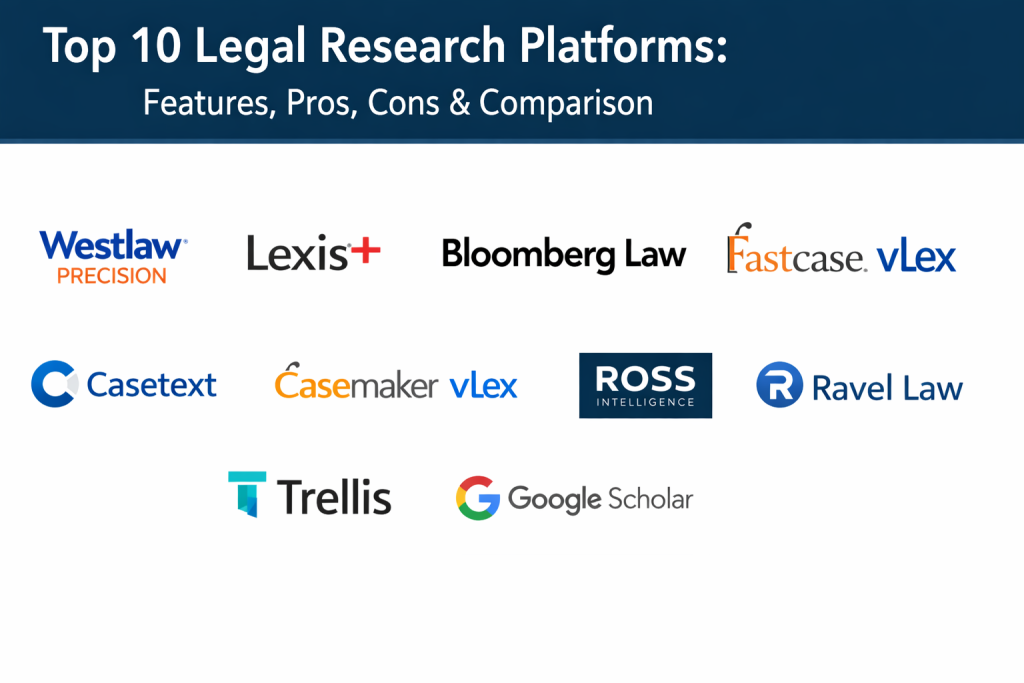
Top 10 Legal Research Platforms
1.Westlaw Precision (Thomson Reuters)
Westlaw is long considered the industry standard for legal research. Its latest version, Precision, uses high-level AI to provide the most granular search results in the market.
Key Features
- KeyCite: The industry-leading citator for checking the validity of legal authorities.
- Key Number System: A proprietary classification system that organizes law by over 100,000 legal topics.
- Precision Research: New AI-driven filters that allow users to search by specific legal issues or fact patterns.
- Practical Law: Integrated practice notes and standard documents written by expert attorneys.
- Westlaw Edge AI: Advanced summaries and “Quick Check” brief analysis.
Pros
- The most comprehensive and authoritative legal database in the world.
- Extremely reliable citator system that minimizes the risk of citing bad law.
Cons
- Generally the most expensive option on the market.
- Complex feature set can require extensive training for new users.
Platforms / Deployment
- Web / iOS / Android
- Cloud
Security & Compliance
- SSO, MFA, RBAC, High-level encryption
- SOC 2, ISO 27001, GDPR
Integrations & Ecosystem
Deeply integrated with the Thomson Reuters ecosystem and major legal productivity tools.
- Microsoft Word (Westlaw drafting)
- HighQ
- Practical Law
- Various Practice Management Systems
Support & Community
Unparalleled 24/7 support from reference attorneys and a vast network of training resources.
2.Lexis+ (LexisNexis)
Lexis+ is the primary competitor to Westlaw, offering a sleek, unified interface that combines research, practical guidance, and brief analysis.
Key Features
- Shepard’s Citations: The original and world-renowned citation validation service.
- Context: Specialized judicial and expert witness analytics.
- Answers: An AI feature that provides direct answers to legal questions with supporting citations.
- Lexis+ Brief Analysis: Scans documents for legal weaknesses and suggests stronger authorities.
- Search Trees: Visual representations of how search terms are impacting results.
Pros
- Excellent user interface that feels modern and intuitive.
- Shepard’s is a gold standard for citation reliability.
Cons
- Premium pricing can be a barrier for solo practitioners.
- Some users find the sheer volume of “extra” features distracting.
Platforms / Deployment
- Web / iOS / Android
- Cloud
Security & Compliance
- SSO, MFA, RBAC
- SOC 2 Type II, ISO 27001, GDPR
Integrations & Ecosystem
Integrates smoothly with the LexisNexis suite and standard legal software.
- Microsoft Office
- InterAction CRM
- CounselLink
- Various document management systems
Support & Community
Extensive support through Lexis University and a dedicated team of research consultants.
3.Bloomberg Law
Bloomberg Law provides a unique, all-in-one pricing model that includes all features, news, and secondary sources without hidden costs.
Key Features
- BCite: Bloomberg’s proprietary citator for checking case law validity.
- Points of Law: Uses AI to identify the specific language in an opinion that defines a legal rule.
- Docket Coverage: Unrivaled access to federal and state court dockets and filings.
- Transactional Intelligence: Deep data on M&A deals and corporate filings.
- Health & Life Sciences Practice Center: Specialized research hubs for specific industries.
Pros
- Transparent, all-inclusive pricing model with no “out-of-plan” fees.
- Best-in-class integration of legal research and business news.
Cons
- BCite is newer and sometimes perceived as less established than Shepard’s or KeyCite.
- Search interface can be more complex due to the breadth of non-legal data.
Platforms / Deployment
- Web / iOS / Android
- Cloud
Security & Compliance
- SSO, MFA, RBAC, Enterprise encryption
- SOC 2, ISO 27001, GDPR
Integrations & Ecosystem
Strongest for teams requiring high-level corporate and financial data alongside legal law.
- Bloomberg Terminal
- Microsoft Office
- Standard API access
Support & Community
Excellent 24/7 technical and research support included in the subscription.
4.Fastcase (vLex)
Fastcase, now part of vLex, is known for being a high-value, tech-forward platform that is often provided for free through state bar associations.
Key Features
- vLex Fastcase AI: Advanced global search across the combined vLex and Fastcase databases.
- Interactive Timeline: A visual tool that shows the history and relevance of case law over time.
- Authority Check: A built-in citator that flags negative treatment of cases.
- Mobile Sync: Seamless transition between desktop research and the mobile app.
- Cloud Linking: Automatically turns citations in uploaded documents into live links.
Pros
- Exceptional value; often the most cost-effective solution for small firms.
- Strongest international law coverage following the vLex merger.
Cons
- Secondary source library is not as deep as Westlaw or Lexis.
- Citator is reliable but lacks the “editorial” depth of Shepard’s.
Platforms / Deployment
- Web / iOS / Android
- Cloud
Security & Compliance
- SSO, MFA, RBAC
- SOC 2, GDPR
Integrations & Ecosystem
Integrates with many popular mid-market practice management tools.
- Clio
- CosmoLex
- Microsoft Word
- Dropbox / OneDrive
Support & Community
Strong community support and excellent webinars for training.
5.Casetext
Casetext is a pioneer in legal AI, specifically known for “CoCounsel,” one of the first reliable AI legal assistants based on large language models.
Key Features
- CoCounsel: An AI assistant that can summarize cases, review documents, and draft memos.
- CARA A.I.: Allows users to upload a brief to find cases with similar facts and legal issues.
- Parallel Search: Uses natural language to find cases that share the same “concept” even if keyword matches are low.
- SmartCite: A citator that provides red/yellow flags for case treatment.
- Tailored Folders: Automated organization of research projects.
Pros
- Leader in practical, usable legal AI for small to mid-sized firms.
- Search results are often more relevant for specific fact patterns.
Cons
- Case database is primarily focused on U.S. law.
- Smaller library of secondary treatises compared to legacy providers.
Platforms / Deployment
- Web
- Cloud
Security & Compliance
- SSO, MFA, RBAC, Data encryption
- SOC 2 Type II, GDPR
Integrations & Ecosystem
Focuses on being a lean, powerful addition to a firm’s tech stack.
- Microsoft Word
- Clio
- Various browser extensions
Support & Community
Highly responsive digital support and a very active user feedback loop.
6.Casemaker (vLex)
Casemaker was a long-time favorite for solo and small firm practitioners, now integrated into the vLex Fastcase ecosystem to provide a broader reach.
Key Features
- CasemakerDigest: Daily summaries of new opinions from specific courts.
- CiteCheck: Automatically scans a document to ensure all citations are accurate.
- CaseCheck+: A citator service that provides real-time updates on case law status.
- Multibook Search: Search across multiple statutes and codes simultaneously.
- Personalized Archive: Saves search history and frequently used documents.
Pros
- Historically the simplest and most straightforward interface for quick research.
- Included as a benefit for many state bar members.
Cons
- The standalone Casemaker experience is being phased into the unified vLex platform.
- Advanced analytics are not as robust as the “Big Three” providers.
Platforms / Deployment
- Web
- Cloud
Security & Compliance
- SSO, MFA, RBAC
- SOC 2, GDPR
Integrations & Ecosystem
Standard integrations for small firm workflows.
- Clio
- Microsoft Office
- Email-to-research tools
Support & Community
Reliable support with a deep understanding of solo practitioner needs.
7.Ross Intelligence
Ross was one of the first platforms to market itself as “AI-powered legal research,” focusing on natural language and speed.
Key Features
- Natural Language Queries: Allows users to ask questions as they would to a colleague.
- Legal Memo Summaries: AI-generated summaries of complex legal doctrines.
- Case Law Notifications: Real-time alerts when new cases matching a specific query are published.
- Concept Search: Moves beyond keywords to find relevant precedents.
- Document Review Integration: Helps find relevant law during the discovery phase.
Pros
- Innovative approach to search that reduces the need for complex Boolean logic.
- Faster retrieval of specific “answers” within opinions.
Cons
- Has faced significant legal and competitive hurdles affecting its market presence.
- Database depth for secondary sources is limited.
Platforms / Deployment
- Web
- Cloud
Security & Compliance
- SSO, MFA, RBAC
- SOC 2, GDPR
Integrations & Ecosystem
Designed to work as a standalone intelligence layer.
- Standard APIs
- Browser extensions
Support & Community
Digital-first support model.
8.Ravel Law (LexisNexis)
Ravel Law, now integrated into the Lexis+ ecosystem, changed legal research by introducing data visualization and judicial analytics.
Key Features
- Court Analytics: Data on how specific courts rule on particular issues.
- Judge Analytics: Deep dives into a judge’s citation patterns and ruling history.
- Citation Maps: Visual clusters showing how cases are related.
- Case History: Interactive timelines showing the evolution of a legal rule.
- Firm Analytics: Benchmarking against other law firms’ research habits.
Pros
- The pioneer of visual legal research; excellent for spotting trends.
- Judicial analytics provide a significant advantage in trial preparation.
Cons
- No longer available as a completely independent standalone platform.
- Analytics are only as good as the underlying data pool.
Platforms / Deployment
- Web
- Cloud (via Lexis+)
Security & Compliance
- SSO, MFA, RBAC
- SOC 2, ISO 27001, GDPR
Integrations & Ecosystem
Part of the LexisNexis ecosystem.
- Lexis+
- Microsoft Office
- Law firm billing systems
Support & Community
Supported by the global LexisNexis infrastructure.
9.Trellis
Trellis is a unique research platform that focuses specifically on state trial court data, providing insights often missed by platforms that focus on appellate law.
Key Features
- Trial Court Records: Access to thousands of state court dockets and rulings.
- Judge Dashboard: Deep analytics on state court judges’ tendencies.
- Ruling Search: Search for specific rulings on motions at the trial court level.
- Opposing Counsel Intelligence: See how your opponent has performed in front of a specific judge.
- Alerts: Get notified when new filings occur in specific cases or venues.
Pros
- Best-in-class for state trial court research, which is notoriously fragmented.
- Provides “ground-level” insights that appellate-focused tools lack.
Cons
- Coverage is currently focused on specific major states (though expanding).
- Not a primary tool for federal or international appellate research.
Platforms / Deployment
- Web
- Cloud
Security & Compliance
- SSO, MFA, RBAC
- SOC 2 Type II, GDPR
Integrations & Ecosystem
Integrates with core litigation tools.
- Microsoft Word
- Standard Practice Management tools
- API for data teams
Support & Community
Specialized support for litigation and trial prep workflows.
10.Google Scholar
While not a dedicated “legal” platform, Google Scholar provides a free, surprisingly robust way to research case law for those with zero budget.
Key Features
- Case Law Filter: Specifically toggle search results to include only legal opinions.
- Jurisdiction Selection: Narrow searches to specific state or federal courts.
- Cited By: See other documents that have cited a particular opinion.
- Related Articles: Automatically find similar legal scholarship and cases.
- Alerts: Set up simple keyword alerts for new cases.
Pros
- Completely free to use for anyone with an internet connection.
- Fast, familiar Google search interface.
Cons
- No citator (KeyCite/Shepard’s); extremely dangerous to use without a separate verification tool.
- No secondary sources, treatises, or practical guidance.
Platforms / Deployment
- Web / Mobile Web
- Cloud
Security & Compliance
- Standard Google security
- GDPR
Integrations & Ecosystem
Minimal; works primarily as a standalone browser-based tool.
- Google Workspace
Support & Community
Self-service help documentation only.
Comparison Table
| Tool Name | Best For | Platform(s) Supported | Deployment | Standout Feature | Public Rating |
|---|---|---|---|---|---|
| Westlaw Precision | High-Stakes Litigation | Web/iOS/Android | Cloud | Key Number System | 4.8/5 |
| Lexis+ | Unified Experience | Web/iOS/Android | Cloud | Shepard’s Citations | 4.7/5 |
| Bloomberg Law | All-In-One Pricing | Web/iOS/Android | Cloud | Federal/State Dockets | 4.5/5 |
| Fastcase (vLex) | Value / Bar Members | Web/iOS/Android | Cloud | Global Law Reach | 4.3/5 |
| Casetext | Generative AI | Web | Cloud | CoCounsel AI Assistant | 4.7/5 |
| Casemaker (vLex) | Solo Practitioners | Web | Cloud | CasemakerDigest | 4.1/5 |
| Ross Intelligence | Natural Language | Web | Cloud | Question-Based Search | 3.9/5 |
| Ravel Law | Data Visualization | Web | Cloud | Visual Citation Maps | 4.4/5 |
| Trellis | Trial Court Data | Web | Cloud | State Court Analytics | 4.6/5 |
| Google Scholar | Zero-Budget Research | Web | Cloud | Free Case Law Access | 4.0/5 |
Evaluation & Scoring of Legal Research Platforms
Below is a weighted scoring model focusing on accuracy, depth, and innovation.
| Tool Name | Core (25%) | Ease (15%) | Integrations (15%) | Security (10%) | Performance (10%) | Support (10%) | Value (15%) | Weighted Total |
|---|---|---|---|---|---|---|---|---|
| Westlaw Precision | 10 | 6 | 9 | 10 | 10 | 10 | 5 | 8.55 |
| Lexis+ | 10 | 8 | 9 | 10 | 9 | 9 | 6 | 8.60 |
| Bloomberg Law | 9 | 7 | 8 | 10 | 9 | 9 | 8 | 8.45 |
| Fastcase (vLex) | 7 | 9 | 8 | 9 | 8 | 8 | 10 | 8.30 |
| Casetext | 8 | 10 | 8 | 9 | 10 | 9 | 9 | 8.75 |
| Casemaker (vLex) | 6 | 9 | 7 | 9 | 8 | 8 | 10 | 7.90 |
| Ross Intelligence | 7 | 8 | 6 | 9 | 8 | 7 | 7 | 7.20 |
| Ravel Law | 9 | 7 | 7 | 9 | 9 | 8 | 7 | 8.05 |
| Trellis | 8 | 8 | 8 | 9 | 9 | 9 | 8 | 8.30 |
| Google Scholar | 5 | 10 | 4 | 7 | 10 | 3 | 10 | 6.75 |
How to Interpret These Scores:
- Total Score: A score above 8.5 indicates a premier, market-leading platform for serious legal work.
- Value vs. Core: High scores in “Value” (like Google Scholar or Fastcase) often come with lower scores in “Core” editorial features like proprietary citators.
- AI Leaders: Casetext’s high score is driven by its industry-leading “Ease” and “Performance” in modern AI applications.
Which Legal Research Platform Is Right for You?
Solo / Freelancer
For solo practitioners, Fastcase or Casetext offer the best balance of cost and power. Fastcase is often free through bar memberships, while Casetext’s AI can act as a virtual associate.
SMB
Small to mid-sized law firms should consider Lexis+ or Bloomberg Law. Lexis provides the essential citator reliability, while Bloomberg’s flat pricing makes budgeting easy.
Mid-Market
Growing firms with heavy litigation needs should evaluate Trellis for trial court insights and Casetext for rapid brief analysis and document review.
Enterprise
Large law firms and global corporations almost universally require Westlaw Precision or Lexis+ to ensure the highest level of risk management and access to secondary treatises.
Budget vs Premium
- Budget-Friendly: Google Scholar (Free) or Fastcase (Low-cost).
- Premium: Westlaw Precision and Lexis+ represent the high-end of the market with the deepest editorial teams.
Feature Depth vs Ease of Use
- Feature Depth: Westlaw is the deepest tool available but has a steeper learning curve.
- Ease of Use: Casetext and Ironclad (in the contract space) prioritize modern, clean interfaces that require almost no training.
Integrations & Scalability Needs
If your firm is built on Microsoft 365, Westlaw and Lexis offer the most robust Word plugins. If you use Clio, Fastcase and Casetext offer native, seamless sync.
Security & Compliance Needs
Organizations with high-security requirements, such as government agencies or banks, should stick to the “Big Three” (Westlaw, Lexis, Bloomberg) as they maintain the most rigorous global certifications.
Frequently Asked Questions (FAQs)
Why are Westlaw and Lexis so expensive?
The cost pays for thousands of attorneys who manually read and tag cases, create the classification systems, and maintain the citators (KeyCite/Shepard’s) to ensure 100% accuracy.
Can I trust AI to do my legal research?
AI should be used as a tool to find information, not as a replacement for legal judgment. Always verify the AI’s output by reading the primary source text and checking its validity with a citator.
What is a “citator” and why do I need one?
A citator tells you if a case has been overturned, vacated, or criticized by a later court. Citing a case that is no longer “good law” can lead to sanctions and losing your case.
Is Google Scholar sufficient for a professional lawyer?
Generally, no. While it’s great for quick lookups, it lacks the citators and practice guides required for ethical, professional-grade legal research.
How often are these databases updated?
Top-tier platforms like Westlaw and Lexis update their databases in near real-time, often within hours of an opinion being released by the court.
Can I share my login with my team?
Most platforms forbid login sharing and use MFA to prevent it. However, they usually offer discounted “firm-wide” pricing or per-user seats.
Do these tools include international law?
Westlaw and vLex have the strongest international coverage. Lexis also has significant global holdings, but you must ensure your specific plan includes those jurisdictions.
What is “Boolean” searching?
Boolean searching uses connectors like AND, OR, and NOT (e.g., “negligence AND ‘medical malpractice'”) to create precise search parameters.
Can these tools help me find expert witnesses?
Yes, Lexis (via Context) and Westlaw provide deep data on expert witnesses, including their previous testimony and how often their theories have been accepted by courts.
Are these platforms tax-deductible?
For most businesses and law firms, professional software subscriptions like these are considered necessary business expenses.
Conclusion
The choice of a legal research platform is a decision that impacts the speed, accuracy, and profitability of your legal practice. While the “Big Three” continue to dominate the high-end market, AI-first platforms like Casetext and trial-focused tools like Trellis are providing powerful, specialized alternatives. We recommend starting with a trial of the platform that best aligns with your primary practice area (e.g., Trellis for state trial work, Westlaw for federal appellate). Always prioritize the reliability of the citator system to protect your professional reputation.

Best Cardiac Hospitals Near You
Discover top heart hospitals, cardiology centers & cardiac care services by city.
Advanced Heart Care • Trusted Hospitals • Expert Teams
View Best Hospitals