Introduction
Insurance Claims Management Systems are the critical operational hubs where the “promise” of an insurance policy is actually fulfilled. When a loss occurs, these platforms manage the complex workflow from the initial First Notice of Loss (FNOL) through investigation, adjudication, and final settlement. In an industry where customer satisfaction is defined by the speed and fairness of a claim payout, these systems serve as the primary engine for maintaining policyholder trust and operational efficiency.
Modern claims platforms have evolved from simple record-keeping databases into sophisticated orchestration engines. They leverage automation to handle routine “fast-track” claims while providing deep investigative tools for complex, high-value losses. By centralizing communication between adjusters, claimants, repair shops, and legal teams, these systems eliminate the fragmentation that historically led to long delays and high administrative costs. For carriers, the ability to accurately assess risk and detect fraud during the claims process is directly tied to the technical capabilities of their management software.
Evaluating a claims management system requires a focus on “cycle time”—the speed from filing to payment—and “loss adjustment expenses” (LAE). The transition toward digital-first claims, where users can upload photos from a smartphone and receive automated estimates, has made mobile integration and AI-driven image analysis mandatory features for any competitive platform.
Best for: Insurance carriers, Third-Party Administrators (TPAs), and self-insured corporations looking to streamline the adjudication process and reduce settlement delays.
Not ideal for: Small local insurance agencies that do not have the authority to settle claims directly or manage their own loss funds.
Key Trends in Insurance Claims Management Systems
- Touchless Claims Processing: Using AI to automatically approve and pay simple claims (like glass or minor dent repair) without human intervention.
- Computer Vision for Damage Assessment: Analyzing photos and videos uploaded by claimants to generate instant repair estimates.
- Fraud Detection via Machine Learning: Identifying patterns and anomalies in claim data to flag potential insurance fraud before payments are issued.
- Omnichannel FNOL: Allowing claimants to report losses via mobile apps, web portals, chatbots, or traditional voice calls seamlessly.
- IoT and Telematics Integration: Using data from connected cars or smart home devices to verify the exact time, location, and severity of an accident.
- Automated Subrogation: Streamlining the process of recovering funds from at-fault third parties through digital legal and communication workflows.
- Blockchain for Transparent Settlements: Using distributed ledger technology to ensure secure, immutable records of all claim transactions and payments.
- Vendor Network Management: Digital integration with preferred repair shops, medical providers, and legal firms for real-time status updates.
How We Selected These Tools (Methodology)
- Workflow Automation: Evaluating how well the system automates task assignments, notifications, and document routing.
- Adjudication Speed: Assessing the platform’s ability to facilitate rapid decision-making and settlement.
- Fraud and Compliance Tools: Checking for built-in tools that identify suspicious patterns and ensure regulatory adherence.
- Integration Depth: Analyzing how the system connects with policy administration, billing, and external data providers.
- Mobile Capabilities: Evaluating the effectiveness of the claimant and adjuster mobile interfaces for field use.
- Analytics and Reporting: Looking for robust data visualization tools that track loss ratios and adjuster performance.
- Scalability: Testing the platform’s ability to handle catastrophic (CAT) events with massive spikes in claim volume.
- Customer Portal Quality: Assessing the ease of use for the policyholder when tracking their claim status.
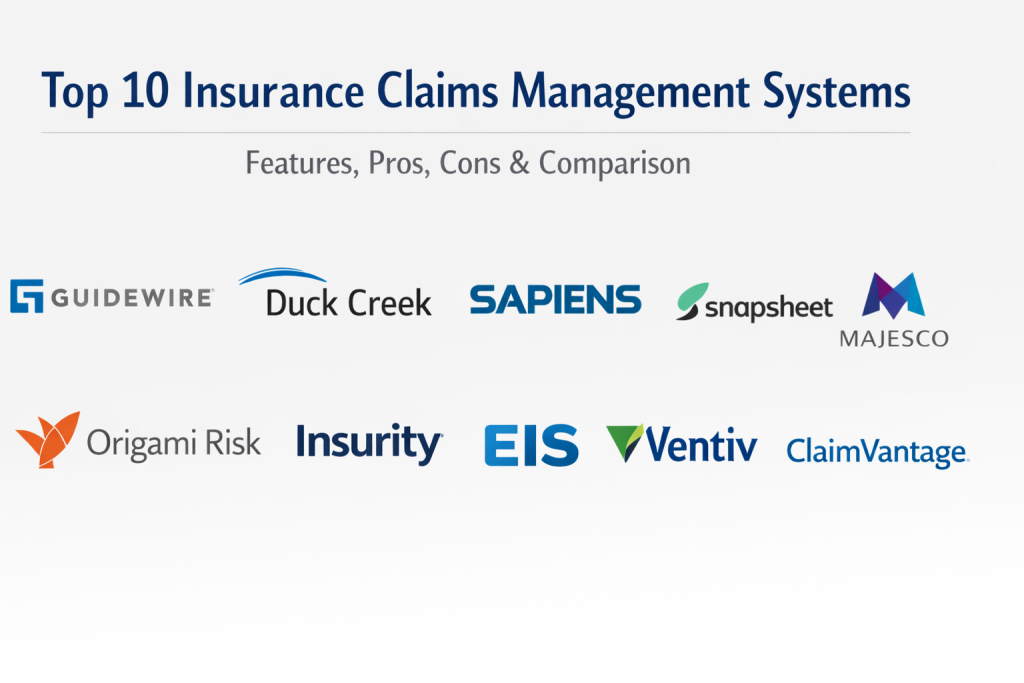
Top 10 Insurance Claims Management Systems
1.Guidewire (ClaimCenter)
Guidewire ClaimCenter is widely considered the industry benchmark for P&C claims, offering a deep, highly configurable platform used by the world’s largest carriers.
Key Features
- End-to-end management of the entire claims lifecycle for all P&C lines.
- Advanced “ClaimCanvas” for a visual representation of the loss event.
- Integrated fraud detection and subrogation management tools.
- Seamless integration with the Guidewire Cloud and Marketplace.
- Automated task routing based on adjuster expertise and workload.
- Robust mobile support for field adjusters and investigators.
- Real-time financial tracking for reserves and payments.
Pros
- Unmatched depth of functionality and industry-specific content.
- Massive ecosystem of third-party service providers.
- Proven reliability for handling massive scale during CAT events.
Cons
- Implementation is often long, complex, and expensive.
- The system requires specialized technical expertise to maintain.
Platforms / Deployment
- Web / Mobile
- Cloud (Guidewire Cloud)
Security & Compliance
- SOC 1/2, ISO 27001.
- SSO, MFA, RBAC.
Integrations & Ecosystem
The largest marketplace of pre-built insurance integrations globally.
- Guidewire Marketplace
- Salesforce
- Major data enrichment providers
Support & Community
Extensive global training programs and a massive user community.
2.Duck Creek (Claims)
Duck Creek Claims is a modern, cloud-native platform that emphasizes low-code agility and a digital-first approach to loss management.
Key Features
- Low-code configuration for rapid adjustment of claims workflows.
- Native cloud deployment on Microsoft Azure for high availability.
- Integrated communication tools for claimants and third-party vendors.
- Advanced “Anywhere” API for easy mobile and web connectivity.
- Comprehensive support for high-volume personal and complex commercial lines.
- Automated “Smart Tasks” that guide adjusters through the process.
- Real-time dashboard for monitoring key performance indicators (KPIs).
Pros
- Excellent for carriers that prioritize digital transformation and speed.
- Highly flexible and easy to update without deep coding.
- Strong focus on the modern claimant’s mobile experience.
Cons
- Requires Azure-specific knowledge for optimal performance.
- Licensing costs are tailored for larger enterprise users.
Platforms / Deployment
- Web / Mobile
- Cloud (SaaS)
Security & Compliance
- Azure Security Stack, SOC 2.
- SSO, MFA.
Integrations & Ecosystem
Deeply integrated with the Microsoft ecosystem and modern insurtech tools.
- Microsoft Power BI
- Dynamics 365
- Third-party estimate providers
Support & Community
Strong customer success focus and a growing delivery partner network.
3.Sapiens (ClaimPro)
Sapiens provides a highly specialized and modular claims solution that is particularly strong in the European and Asian markets.
Key Features
- Modular architecture that can be deployed as a standalone or suite component.
- Specialized support for complex workers’ compensation and disability claims.
- Advanced rules engine for automated adjudication and routing.
- Integrated document and image management for evidence tracking.
- Comprehensive subrogation and salvage management modules.
- Multi-currency and multi-language support for global carriers.
- Detailed financial management for complex loss reserves.
Pros
- Exceptional depth in specialized lines like Workers’ Comp.
- Highly localized for various international regulatory environments.
- Strong track record in large-scale legacy replacement projects.
Cons
- The user interface is functional but can feel “heavy” compared to newer apps.
- Slower deployment cycles for highly customized environments.
Platforms / Deployment
- Web
- Cloud / On-premise
Security & Compliance
- ISO 27001, GDPR compliant.
- SSO, MFA, RBAC.
Integrations & Ecosystem
Extensive library of connectors for global insurance and legal hubs.
- SAP / Oracle Financials
- Local regulatory bodies
- Third-party data services
Support & Community
Global support footprint with deep regional expertise.
4.Snapsheet
Snapsheet is a pioneer in “virtual claims,” focusing on a cloud-native, mobile-first approach that automates much of the estimating process.
Key Features
- Industry-leading virtual appraisal and estimating tools.
- Fully automated FNOL workflows for digital-first carriers.
- Integrated payment platform for “instant” claimant settlements.
- Advanced “Snapsheet Cloud” for managing the entire vendor network.
- AI-driven image analysis for rapid damage assessment.
- Transparent, real-time communication portal for claimants.
- Light-weight, API-first architecture for rapid integration.
Pros
- Best-in-class for speed and modern candidate experience.
- Very fast implementation compared to traditional suites.
- Highly effective at reducing loss adjustment expenses (LAE).
Cons
- Less focused on deep, complex commercial liability investigations.
- Not a “full” suite—requires integration with a policy system.
Platforms / Deployment
- Web / Mobile
- Cloud (SaaS)
Security & Compliance
- SOC 2 Type II.
- SSO, MFA.
Integrations & Ecosystem
Built for the modern API economy and digital front-ends.
- Policy Administration Systems
- Payment gateways
- Customer CRM tools
Support & Community
Agile support model with a strong focus on insurtech innovation.
5.Majesco (Claims)
Majesco offers a modern, unified claims platform that bridges the gap between traditional reliability and next-gen digital features.
Key Features
- Unified platform for P&C, L&A, and group benefits.
- Cloud-native microservices architecture for high scalability.
- “EcoExchange” for rapid integration of third-party insurtech apps.
- Advanced digital engagement portals for all stakeholders.
- Support for usage-based and innovative micro-insurance claims.
- Automated fraud scoring and adjudication logic.
- Robust reporting and business intelligence suite.
Pros
- One of the few platforms that handles both P&C and Benefits well.
- Very modern interface that is intuitive for new adjusters.
- Strong focus on the “customer journey” in the claims process.
Cons
- Rapid update schedule can be challenging for traditional IT teams.
- Some niche modules are still maturing.
Platforms / Deployment
- Web / Mobile
- Cloud (SaaS)
Security & Compliance
- SOC 2 Type II, ISO 27001.
- SSO, MFA.
Integrations & Ecosystem
Focuses on “open insurance” and third-party connectivity.
- Majesco Digital1st
- Salesforce
- Payment and lab integrations
Support & Community
Proactive customer support and a strong commitment to R&D.
6.Origami Risk (Claims)
Origami Risk is highly rated for its flexibility and its ability to manage claims alongside broader risk and safety data.
Key Features
- Unified data model for policy, claims, and safety management.
- Highly customizable workflows and dashboard visualizations.
- Automated notification engine for all claim milestones.
- Integrated tools for self-insureds and captive managers.
- Mobile-ready portals for adjusters in the field.
- Deep reporting capabilities for analyzing “total cost of risk.”
- Collaborative features for adjusters, legal, and risk managers.
Pros
- Unmatched flexibility—can be configured for almost any niche risk.
- Outstanding customer service and high user satisfaction.
- Excellent for organizations that manage their own claims (TPAs/Self-Insureds).
Cons
- The depth of configuration options can lead to a steeper learning curve.
- Not designed for high-volume personal auto “commodity” claims.
Platforms / Deployment
- Web / Mobile
- Cloud
Security & Compliance
- SOC 2 Type II, FISMA.
- SSO, MFA.
Integrations & Ecosystem
Strong connectivity with safety, HR, and risk management tools.
- Salesforce
- HRIS systems
- Medical bill review providers
Support & Community
Award-winning support and a highly collaborative client community.
7.Insurity (Claims Decisions)
Insurity provides a data-centric claims platform that is specifically optimized for commercial lines and Managing General Agents (MGAs).
Key Features
- Specialized workflows for complex commercial and specialty risks.
- High-performance automation for routine tasks.
- Integrated “Data Analytics” for identifying loss trends.
- Self-service portals for agents and TPAs to track status.
- Support for multi-jurisdictional compliance and reporting.
- Automated document generation and routing.
- Scalable cloud infrastructure optimized for high-volume periods.
Pros
- Deep expertise in commercial and surplus lines.
- Very strong analytical capabilities built into the core.
- Excellent for MGAs that need to prove performance to carriers.
Cons
- Less focus on the life or personal lines markets.
- The reporting interface is powerful but requires some training.
Platforms / Deployment
- Web
- Cloud (SaaS)
Security & Compliance
- SOC 1/2, PCI-DSS.
- SSO, MFA.
Integrations & Ecosystem
Focused on the commercial risk and data ecosystem.
- HazardHub
- ISO / NCCI data
- Third-party legal and bill review
Support & Community
Responsive customer service with a focus on commercial partnerships.
8.EIS (Claims)
EIS provides a customer-centric claims platform that breaks down silos to provide a holistic view of the claimant’s history.
Key Features
- Person-centric data model for a 360-degree customer view.
- Microservices and API-first architecture.
- Unified suite for policy, billing, and claims management.
- Advanced digital experience platform (DXP) for custom interfaces.
- Support for multi-line and multi-channel loss reporting.
- Automated “Next Best Action” logic for claim adjusters.
- High scalability for global digital transformations.
Pros
- Best for carriers looking to improve customer lifetime value.
- Avoids the “legacy trap” with a very modern tech stack.
- Strong focus on omnichannel communication (text, web, app).
Cons
- Requires a significant organizational shift toward customer-centricity.
- Large-scale implementation requires substantial resources.
Platforms / Deployment
- Web / Mobile
- Cloud
Security & Compliance
- SOC 2, GDPR compliant.
- SSO, MFA.
Integrations & Ecosystem
Deeply integrated with modern CRM and digital marketing tools.
- Salesforce
- Adobe Experience Manager
- Modern payment and communication APIs
Support & Community
Focused on enterprise-level transformation and professional services.
9.Ventiv (Claims)
Ventiv is a global leader in claims and risk management software, particularly favored by TPAs and large corporate risk departments.
Key Features
- Comprehensive end-to-end claims administration for all lines.
- Advanced “Ventiv IRM” for integrated risk management.
- Powerful data analytics and predictive modeling tools.
- Automated bill review and medical management integrations.
- Robust reporting for complex global insurance programs.
- Multi-language and multi-currency capabilities.
- Dedicated portals for claimants, adjusters, and brokers.
Pros
- Excellent for managing complex global loss funds and risk.
- Very strong predictive analytics to identify “high-cost” claims early.
- High degree of stability and mature feature set.
Cons
- The interface can feel more “corporate” and less “modern” than insurtechs.
- Implementation times are standard for enterprise software.
Platforms / Deployment
- Web
- Cloud / On-premise
Security & Compliance
- SOC 2 Type II, ISO 27001.
- SSO, MFA, RBAC.
Integrations & Ecosystem
Broad connectivity with global financial and risk data providers.
- Oracle / SAP Financials
- Global banking systems
- Medical and legal data providers
Support & Community
Global support footprint with a focus on large enterprise clients.
10.ClaimVantage (by Majesco)
ClaimVantage (now part of Majesco) is the industry leader for Life, Health, and Absence management claims.
Key Features
- Specialized engine for Life, Disability, and Health claims.
- Comprehensive “Absence Management” for FMLA and state laws.
- Automated benefit calculation based on complex policy terms.
- Integrated medical assessment and clinical review tools.
- Robust compliance tracking for changing labor and health laws.
- High-volume processing for group benefits and individual life.
- Detailed financial tracking for benefit payouts.
Pros
- The gold standard for Life and Disability claims.
- Exceptional handling of complex Absence Management laws.
- Highly specialized for the needs of Life and Health carriers.
Cons
- Not intended for P&C, auto, or property claims.
- Now part of the Majesco ecosystem, which may change deployment.
Platforms / Deployment
- Web / Mobile
- Cloud (Salesforce Platform)
Security & Compliance
- Salesforce Platform Security, SOC 2.
- SSO, MFA.
Integrations & Ecosystem
Deeply integrated into the Salesforce and Health ecosystems.
- Salesforce CRM
- Health and Wellness providers
- Payroll systems
Support & Community
Specialized support teams with deep expertise in Life and Health regulations.
Comparison Table (Top 10)
| Tool Name | Best For | Platform(s) Supported | Deployment | Standout Feature | Public Rating |
|---|---|---|---|---|---|
| Guidewire | Global P&C Carriers | Web, Mobile | Cloud | Marketplace Ecosystem | N/A |
| Duck Creek | Agility and Speed | Web, Mobile | Cloud | Low-Code Flexibility | N/A |
| Sapiens | Workers’ Comp/Global | Web | Cloud, On-prem | Specialized Claims Depth | N/A |
| Snapsheet | Virtual/Digital Claims | Web, Mobile | Cloud | Virtual Appraisal Tools | N/A |
| Majesco | Modern P&C/Benefits | Web, Mobile | Cloud | Digital Experience Portals | N/A |
| Origami Risk | TPAs/Self-Insureds | Web, Mobile | Cloud | Risk-Claims Integration | N/A |
| Insurity | Commercial/MGAs | Web | Cloud | Commercial Data Analytics | N/A |
| EIS | Customer-Centricity | Web, Mobile | Cloud | Person-Centric Model | N/A |
| Ventiv | Global Risk Managers | Web | Cloud, On-prem | Predictive Modeling | N/A |
| ClaimVantage | Life and Disability | Web, Mobile | Cloud | Absence Management | N/A |
Evaluation & Scoring of Insurance Claims Management Systems
| Tool Name | Core (25%) | Ease (15%) | Integrations (15%) | Security (10%) | Perf (10%) | Support (10%) | Value (15%) | Weighted Total |
|---|---|---|---|---|---|---|---|---|
| Guidewire | 10 | 6 | 10 | 10 | 9 | 10 | 6 | 8.85 |
| Duck Creek | 9 | 8 | 9 | 10 | 9 | 9 | 7 | 8.65 |
| Sapiens | 10 | 6 | 8 | 10 | 8 | 9 | 7 | 8.35 |
| Snapsheet | 7 | 10 | 9 | 9 | 10 | 8 | 9 | 8.55 |
| Majesco | 9 | 8 | 9 | 9 | 9 | 8 | 8 | 8.55 |
| Origami Risk | 8 | 9 | 8 | 9 | 9 | 10 | 8 | 8.60 |
| Insurity | 9 | 7 | 8 | 9 | 9 | 9 | 8 | 8.35 |
| EIS | 9 | 8 | 9 | 9 | 9 | 8 | 7 | 8.40 |
| Ventiv | 9 | 7 | 8 | 10 | 8 | 9 | 7 | 8.20 |
| ClaimVantage | 10 | 8 | 9 | 9 | 9 | 9 | 8 | 8.95 |
Scoring Interpretation: These scores reflect the platform’s ability to automate and adjudicate claims efficiently. “Core” scores indicate depth in specific lines (P&C vs Life). “Ease” measures the user experience for adjusters and claimants. “Value” is balanced against the total cost of ownership. ClaimVantage scores highest for its specific niche (Life/Health), while Guidewire remains the P&C leader.
Which Insurance Claims Management System Is Right for You?
Solo / Freelancer
Solo adjusters or very small TPAs should look at Snapsheet or Origami Risk. These platforms allow small teams to handle claims with the same digital efficiency as large carriers without needing a massive internal IT infrastructure.
SMB
Small-to-mid-sized carriers should prioritize Duck Creek or Majesco. These cloud-native tools allow smaller firms to implement “touchless” claims and mobile portals quickly, allowing them to compete with larger rivals on customer experience.
Mid-Market
Carriers focusing on specialized or commercial lines should choose Insurity or Sapiens. These systems provide the deep industry content and regulatory reporting required for mid-market complexity.
Enterprise
For the world’s largest P&C insurers, Guidewire is the definitive choice for scale and stability. For massive Life and Health carriers, ClaimVantage is the undisputed leader for managing complex benefit structures and absence laws.
Budget vs Premium
Snapsheet offers an excellent “pay-per-claim” value model that is highly cost-effective for digital-first firms. Guidewire and Duck Creek are premium enterprise solutions that require higher investment but offer the most complete feature sets.
Feature Depth vs Ease of Use
If you need pre-built workflows for every possible P&C scenario, Guidewire wins on depth. If you want a system that an adjuster can learn in a single morning, Snapsheet or BriteCore (often integrated with claims) wins on ease of use.
Integrations & Scalability
Snapsheet and Duck Creek lead in modern API-first integrations. Guidewire and Ventiv are the leaders in pure scalability, capable of processing millions of claims and managing billions in loss funds globally.
Security & Compliance Needs
Organizations managing highly sensitive medical data (Health/Life) or government risks should prioritize ClaimVantage or Ventiv. These platforms are built with the highest levels of auditability and data privacy compliance.
Frequently Asked Questions (FAQs)
What is an Insurance Claims Management System?
It is a software platform used by insurance companies to manage the end-to-end process of a claim, from the initial report to investigation, adjudication, and final payout.
What is FNOL?
First Notice of Loss (FNOL) is the initial report made to an insurance company following a loss or accident. Modern systems allow this to be done via mobile apps or chatbots.
How does AI help in claims management?
AI can automate “fast-track” claims, analyze photos for damage estimation, identify fraudulent patterns, and route claims to the most appropriate adjuster based on complexity.
What is “touchless” claims processing?
This is a process where a claim is reported, analyzed, approved, and paid entirely by software without any human intervention, typically used for low-value, high-frequency claims.
Can one system handle both Auto and Life claims?
While some platforms are versatile, most carriers use specialized systems. Auto claims focus on repair networks and telematics, while Life claims focus on medical records and legal beneficiaries.
What is subrogation in claims software?
Subrogation is the legal process where an insurance company seeks to recover the cost of a claim from the at-fault third party. Good claims software automates the tracking and recovery of these funds.
Why is mobile integration important for adjusters?
Mobile tools allow field adjusters to upload photos, record statements, and update claim status in real-time while at the scene of the loss, significantly reducing cycle times.
How do these systems prevent fraud?
They use predictive modeling and data cross-referencing to identify “red flags,” such as multiple claims from the same person or suspicious patterns in medical billing.
What is the difference between a TPA and a Carrier?
A Carrier is the insurance company that holds the risk. A Third-Party Administrator (TPA) is a firm hired to handle the actual claims processing. Both use these systems to manage their work.
How long does it take to settle a claim with these systems?
With modern automation, simple claims can be settled in minutes or hours. Complex liability claims can still take weeks, but the software helps keep all parties informed throughout the process.
Conclusion
The Insurance Claims Management System is where the “moment of truth” happens for policyholders. In a digital world, an insurer’s reputation is built on how quickly and transparently they can resolve a loss. We recommend starting by evaluating your claim complexity. If you are a digital-first personal lines carrier, the virtual speed of Snapsheet is a game-changer. If you are a global enterprise managing complex commercial risks, the power and ecosystem of Guidewire or Sapiens are essential. By investing in a system that balances automation with deep investigative tools, you can reduce loss adjustment expenses while delivering a superior customer experience.

Best Cardiac Hospitals Near You
Discover top heart hospitals, cardiology centers & cardiac care services by city.
Advanced Heart Care • Trusted Hospitals • Expert Teams
View Best Hospitals