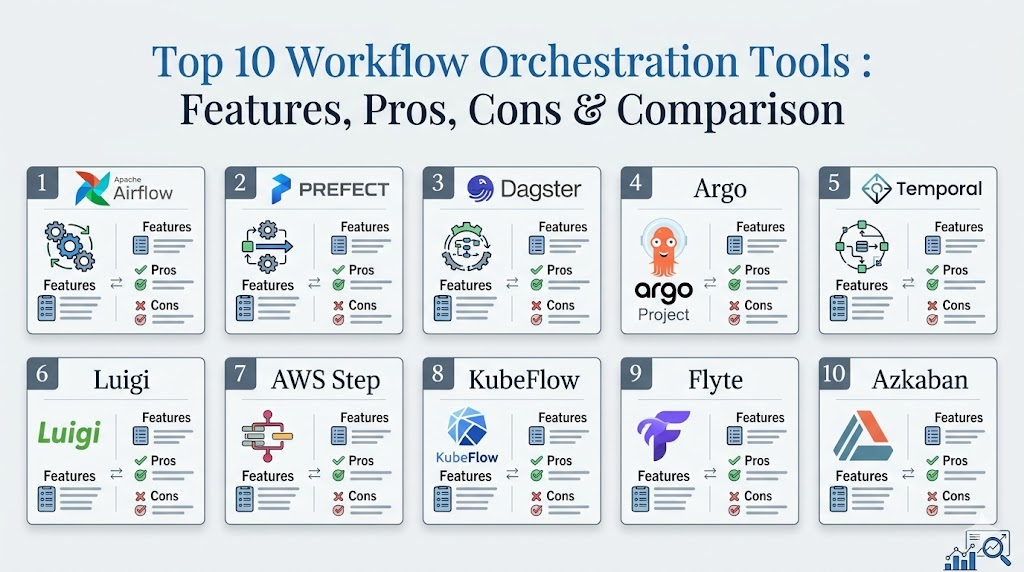
Introduction
Workflow orchestration has become the central nervous system of modern data engineering and software operations. In an era defined by distributed systems and massive data pipelines, orchestration tools are responsible for scheduling, managing, and monitoring complex sequences of tasks across disparate environments. These platforms ensure that data flows seamlessly from ingestion to analysis, handling dependencies, retries, and error reporting automatically. Without robust orchestration, organizations struggle with “spaghetti” scripts and manual interventions that lead to significant downtime and data inconsistency.
Orchestration has moved beyond simple cron jobs. Modern tools now integrate deeply with cloud-native ecosystems, supporting containerized workloads and event-driven triggers. The shift toward “DataOps” and “MLOps” has pushed these tools to handle not just linear sequences, but complex directed acyclic graphs (DAGs) that can scale to thousands of concurrent tasks. Whether managing a financial reporting pipeline or training a machine learning model, the right orchestration tool acts as the invisible hand that maintains operational order.
Best for: Data engineers, DevOps professionals, and MLOps teams who need to manage complex, multi-stage data pipelines and automated operational workflows across hybrid cloud environments.
Not ideal for: Simple, single-task automation, basic website cron jobs, or small teams with very low data volume where the overhead of managing an orchestration platform exceeds the benefits.
Key Trends in Workflow Orchestration
- Shift to Configuration as Code: Leading tools now allow workflows to be defined entirely in Python or YAML, enabling version control and CI/CD integration for data pipelines.
- Serverless Orchestration: A move toward managed services where users can run complex workflows without managing the underlying infrastructure or scaling servers manually.
- Event-Driven Triggers: Workflows are increasingly triggered by real-time events—such as a file upload or a database change—rather than just fixed schedules.
- Dynamic Pipeline Generation: The ability for a workflow to modify its own structure at runtime based on the data it encounters, providing extreme flexibility for complex tasks.
- Data Observability Integration: Orchestrators are now integrating with monitoring tools to provide deep visibility into data quality and lineage, not just task success or failure.
- Container-Native Execution: Using Kubernetes as the primary execution engine to ensure that every task runs in a consistent, isolated, and scalable environment.
- AI-Optimized Scheduling: Using machine learning to predict task duration and optimize resource allocation across large-scale clusters.
- Cross-Cloud Orchestration: Tools that can seamlessly manage dependencies between tasks running in AWS, Azure, and Google Cloud simultaneously.
How We Selected These Tools
- Dependency Management: We prioritized tools that excel at managing complex task relationships and handling conditional logic within pipelines.
- Scalability and Performance: Each tool was evaluated on its ability to handle thousands of concurrent tasks without significant latency or system degradation.
- Extensibility and Ecosystem: We looked for platforms with a rich library of pre-built operators for connecting to databases, cloud services, and APIs.
- Developer Experience: Priority was given to tools that offer robust SDKs, clear documentation, and a high-quality local development environment.
- Community and Support: We evaluated the strength of the user community and the availability of professional enterprise support for mission-critical deployments.
- Operational Visibility: The selection includes tools that provide high-quality dashboards for monitoring, retrying, and debugging failed workflows in real-time.
Top 10 Workflow Orchestration Tools
1. Apache Airflow
Originally created at Airbnb, Airflow is the most widely adopted open-source orchestrator. It uses Python to define workflows as Directed Acyclic Graphs (DAGs), making it highly flexible and extensible for complex data engineering tasks.
Key Features
- Python-based DSL for defining complex task dependencies and logic.
- Massive library of community-contributed “Providers” for connecting to any cloud service.
- Robust web UI for visualizing pipeline progress and managing retries.
- Extensible executor architecture supporting Celery, Kubernetes, and local execution.
- Powerful Jinja templating for dynamic parameterization of tasks.
Pros
- The largest community and ecosystem in the orchestration space.
- Completely open-source with no vendor lock-in for the core engine.
Cons
- Can be complex to scale and manage on-premises.
- The scheduler can occasionally experience latency in very high-volume environments.
Platforms / Deployment
Linux / Windows (via Docker) / macOS
Self-hosted / Cloud Managed (AWS MWAA, Google Cloud Composer)
Security & Compliance
RBAC, Kerberos support, and integration with Secret Managers.
Not publicly stated for open-source.
Integrations & Ecosystem
Integrates with almost every major data tool, including Snowflake, Spark, dbt, and all major cloud providers through a plugin-based system.
Support & Community
Unmatched community support with thousands of contributors and professional enterprise support available through vendors like Astronomer.
2. Prefect
Prefect is a modern orchestrator designed to reduce the “boilerplate” code required for pipelines. It focuses on a “code-first” approach where any Python function can be turned into a tracked task with a simple decorator.
Key Features
- Native Python support with minimal changes to existing code required.
- Hybrid execution model that keeps your data within your infrastructure while managing the state in the cloud.
- Dynamic mapping for parallelizing tasks across large datasets instantly.
- Built-in support for asynchronous execution and modern Python patterns.
- Sophisticated UI with “Automations” for reacting to pipeline states.
Pros
- Much lower barrier to entry for Python developers compared to Airflow.
- Excellent handling of “small data” and high-frequency tasks.
Cons
- Smaller community and fewer third-party integrations than Airflow.
- The cloud-managed version can become expensive as task volume scales.
Platforms / Deployment
Windows / macOS / Linux
Cloud (Control Plane) / Local (Execution)
Security & Compliance
API key management and fine-grained access control in the cloud tier.
SOC 2 compliant.
Integrations & Ecosystem
Strong support for modern data stack tools like dbt, Snowflake, and various Kubernetes-based execution environments.
Support & Community
Very active Slack community and high-quality official documentation.
3. Dagster
Dagster is an “orchestrator for the full development lifecycle.” It emphasizes local development, testing, and data assets, allowing engineers to model the actual data being produced rather than just the tasks.
Key Features
- Software-defined assets that track the state of the data itself.
- Strong typing and built-in data quality checks for every step of a pipeline.
- Rich local development environment with a tool called “Dagit” for visualization.
- Built-in support for environment-specific configurations.
- Excellent integration with modern data transformation tools.
Pros
- The best tool for teams focusing on data quality and testing.
- Enables much faster debugging through its asset-centric view.
Cons
- Requires a mental shift from “task-based” to “asset-based” thinking.
- Less mature ecosystem for non-data-engineering tasks.
Platforms / Deployment
Windows / macOS / Linux
Self-hosted / Cloud Managed (Dagster Cloud)
Security & Compliance
Role-based access control and secure agent-based execution.
SOC 2 compliant.
Integrations & Ecosystem
Deeply integrated with dbt, Airbyte, and Fivetran, making it a favorite for modern analytics engineering.
Support & Community
Professional support for cloud customers and a highly engaged community of data engineers.
4. Argo Workflows
Argo is a container-native workflow engine for Kubernetes. It is designed for high-scale, cloud-native operations where every task in a workflow is executed as a separate container.
Key Features
- Native Kubernetes integration using Custom Resource Definitions (CRDs).
- YAML-based workflow definitions that fit perfectly into GitOps pipelines.
- Massive scalability, capable of handling tens of thousands of tasks.
- Built-in support for artifacts, retries, and exit handlers.
- Support for Directed Acyclic Graphs (DAGs) and step-based templates.
Pros
- The most efficient choice for organizations already running on Kubernetes.
- Extremely robust and scalable for massive machine learning workloads.
Cons
- Requires deep Kubernetes expertise to manage and troubleshoot.
- YAML-based definitions can be verbose compared to Python.
Platforms / Deployment
Kubernetes (Any Cloud or On-prem)
Self-hosted (Native K8s)
Security & Compliance
Inherits Kubernetes security models, including RBAC and Network Policies.
Not publicly stated.
Integrations & Ecosystem
Part of the Argo Project ecosystem, integrating with Argo CD and Argo Events for a complete automation suite.
Support & Community
Huge community within the CNCF ecosystem and professional support through various Kubernetes vendors.
5. Temporal
Temporal is a “durable execution” platform. It allows developers to write code that is guaranteed to run to completion, even in the face of infrastructure failures, making it ideal for long-running business processes.
Key Features
- Support for multiple languages including Go, Java, Python, and TypeScript.
- Automatic state persistence, allowing workflows to sleep for months and resume instantly.
- Native support for complex retries, timeouts, and compensation logic (Sagas).
- High-throughput architecture designed for microservices orchestration.
- Detailed execution history that provides a “flight recorder” for every workflow.
Pros
- Solves the “reliability” problem for distributed systems better than any other tool.
- Allows developers to write standard code rather than learning a new DSL.
Cons
- Steeper learning curve for understanding “durable execution” concepts.
- Requires managing its own cluster (though a cloud version exists).
Platforms / Deployment
Windows / macOS / Linux
Self-hosted / Cloud Managed (Temporal Cloud)
Security & Compliance
mTLS support and encryption at rest for workflow state.
SOC 2 Type 2 compliant.
Integrations & Ecosystem
Widely used in fintech and e-commerce for managing transactions and mission-critical background jobs.
Support & Community
Rapidly growing community and world-class support for enterprise customers.
6. Luigi
Luigi is a Python package built by Spotify for managing long-running batch processes. While older than Airflow, it remains popular for its simplicity and focus on file-based dependencies.
Key Features
- Simple Python classes for defining tasks and their dependencies.
- Built-in support for Hadoop, Hive, and Pig.
- Visualization tools for tracking task progress and failures.
- Focus on “idempotency” and ensuring tasks don’t run twice unnecessarily.
- Minimal infrastructure requirements compared to other orchestrators.
Pros
- Very easy to get started with for simple Python-based batch jobs.
- Stable and battle-tested in high-volume production environments.
Cons
- Lacks the advanced scheduling and UI features of modern competitors.
- Scaling to thousands of tasks can become difficult due to its architecture.
Platforms / Deployment
Windows / macOS / Linux
Local / Self-hosted
Security & Compliance
Depends on the local environment and Python security practices.
Not publicly stated.
Integrations & Ecosystem
Strongest in the Hadoop ecosystem, though it supports modern databases through community plugins.
Support & Community
Established community with a long history of use in the data science world.
7. AWS Step Functions
A fully managed serverless orchestrator from Amazon. It allows you to coordinate multiple AWS services into serverless workflows using visual diagrams or JSON-based definitions.
Key Features
- Visual workflow designer for drag-and-drop pipeline creation.
- Automatic scaling and high availability with zero server management.
- Native integration with over 200 AWS services (Lambda, S3, DynamoDB, etc.).
- Built-in error handling and retry logic with exponential backoff.
- Support for “Standard” and “Express” workflows for different latency needs.
Pros
- The easiest way to orchestrate AWS-native serverless applications.
- Pay-as-you-go pricing model is highly cost-effective for low-volume tasks.
Cons
- Strong vendor lock-in to the AWS ecosystem.
- Defining complex logic in JSON (Amazon States Language) can be cumbersome.
Platforms / Deployment
AWS (Serverless)
Cloud
Security & Compliance
IAM roles, VPC endpoints, and AWS CloudTrail integration.
SOC, ISO, HIPAA, and PCI DSS compliant.
Integrations & Ecosystem
The ultimate tool for orchestrating AWS Lambda, Fargate, and Glue jobs.
Support & Community
Full enterprise support through AWS and a massive library of reference architectures.
8. KubeFlow Pipelines
Part of the KubeFlow project, this tool is specifically designed for orchestrating machine learning (ML) workflows on Kubernetes. It manages the end-to-end lifecycle of ML models.
Key Features
- Python SDK for building ML pipelines as reusable components.
- Integrated tracking for experiments, versions, and runs.
- Native support for Jupyter notebooks and distributed training.
- Visualization tools for comparing the performance of different ML models.
- Built on top of Argo Workflows for high-scale execution.
Pros
- The best choice for data science teams running on Kubernetes.
- Simplifies the transition from research to production for ML models.
Cons
- Heavyweight installation that requires a full KubeFlow setup.
- Can be overkill for standard data engineering tasks.
Platforms / Deployment
Kubernetes
Self-hosted / Cloud Managed (Google Vertex AI Pipelines)
Security & Compliance
Kubernetes-native security with multi-user isolation features.
Not publicly stated.
Integrations & Ecosystem
Deeply integrated with TensorFlow, PyTorch, and Scikit-learn.
Support & Community
Strong backing from Google and a large community of MLOps practitioners.
9. Flyte
Flyte is an open-source, container-native workflow orchestrator specifically built for machine learning and data processing at scale. It was originally developed at Lyft.
Key Features
- Strongly typed interfaces for every task, ensuring data consistency.
- Native support for versioning of tasks and workflows.
- Built-in “memoization” to skip tasks that have already run with the same inputs.
- Support for multi-tenant environments with isolated resources.
- Extensible through a plugin system for specialized compute like Spark or Ray.
Pros
- Incredible reliability and reproducibility for complex ML pipelines.
- The type system prevents many common runtime errors before they happen.
Cons
- Relatively new compared to Airflow, leading to a smaller community.
- Installation on Kubernetes can be complex for small teams.
Platforms / Deployment
Kubernetes
Self-hosted / Cloud Managed (Union.ai)
Security & Compliance
Enterprise-grade security with fine-grained RBAC and audit logs.
Not publicly stated.
Integrations & Ecosystem
Strongest in the ML and AI space, with deep ties to the Kubernetes ecosystem.
Support & Community
Professional support through Union.ai and a growing community of contributors.
10. Azkaban
Azkaban was developed at LinkedIn to manage Hadoop jobs. It focuses on simplicity and a user-friendly web interface, making it a solid choice for teams that want a “no-nonsense” scheduler.
Key Features
- Simple property-file based workflow definitions.
- User-friendly web UI for viewing dependencies and job logs.
- Modular plugin system for adding new job types.
- Support for project-based permission management.
- Built-in SLA alerting for long-running or failed jobs.
Pros
- Much simpler to set up and use than Airflow or Dagster.
- Perfect for traditional Hadoop/HDFS environments.
Cons
- Lacks the modern “Workflow as Code” features of Python-based tools.
- Limited support for cloud-native and serverless execution.
Platforms / Deployment
Linux
Self-hosted
Security & Compliance
Built-in user authentication and role-based permissions.
Not publicly stated.
Integrations & Ecosystem
Best suited for organizations with heavy investments in the Hadoop/Big Data ecosystem.
Support & Community
Maintained by LinkedIn and used by several large-scale tech companies.
Comparison Table
| Tool Name | Best For | Platform(s) Supported | Deployment | Standout Feature | Public Rating |
| 1. Airflow | General DataOps | Win, Mac, Linux | Hybrid | Massive Ecosystem | N/A |
| 2. Prefect | Python Developers | Win, Mac, Linux | Cloud | Hybrid Execution | N/A |
| 3. Dagster | Data Quality | Win, Mac, Linux | Hybrid | Software Assets | N/A |
| 4. Argo | K8s Workloads | Kubernetes | Local | Container-Native | N/A |
| 5. Temporal | Microservices | Win, Mac, Linux | Hybrid | Durable Execution | N/A |
| 6. Luigi | Simple Batch | Win, Mac, Linux | Local | Dependency Logic | N/A |
| 7. AWS Step | AWS Serverless | AWS | Cloud | Serverless Visual | N/A |
| 8. KubeFlow | Machine Learning | Kubernetes | Local | ML Experimentation | N/A |
| 9. Flyte | ML at Scale | Kubernetes | Local | Type-Safe Tasks | N/A |
| 10. Azkaban | Hadoop Jobs | Linux | Local | Simplicity | N/A |
Evaluation & Scoring
| Tool Name | Core (25%) | Ease (15%) | Integrations (15%) | Security (10%) | Perf (10%) | Support (10%) | Value (15%) | Total |
| 1. Airflow | 10 | 5 | 10 | 8 | 8 | 9 | 9 | 8.45 |
| 2. Prefect | 9 | 9 | 8 | 8 | 9 | 8 | 7 | 8.20 |
| 3. Dagster | 9 | 8 | 9 | 8 | 8 | 8 | 8 | 8.25 |
| 4. Argo | 9 | 4 | 8 | 9 | 10 | 8 | 9 | 8.15 |
| 5. Temporal | 10 | 4 | 7 | 9 | 10 | 9 | 8 | 8.10 |
| 6. Luigi | 6 | 8 | 6 | 5 | 7 | 6 | 10 | 6.65 |
| 7. AWS Step | 8 | 9 | 9 | 10 | 9 | 9 | 7 | 8.55 |
| 8. KubeFlow | 9 | 4 | 8 | 8 | 9 | 7 | 7 | 7.50 |
| 9. Flyte | 9 | 5 | 7 | 9 | 10 | 7 | 8 | 7.75 |
| 10. Azkaban | 7 | 8 | 6 | 7 | 7 | 6 | 9 | 7.05 |
The scoring above represents a balance between flexibility and ease of management. Tools like AWS Step Functions and Apache Airflow score high because they offer extreme reliability and integration depth, which are critical for enterprise production. While Argo and Temporal score perfectly in performance, they require more effort to learn and operate, which lowers their “Ease” score. Every tool on this list is a leader in its specific domain, and the “Total” score should be viewed in the context of your specific technical requirements.
Which Workflow Orchestration Tool Is Right for You?
Solo / Freelancer
For a single developer or a very small project, Prefect is often the best choice. It allows you to add orchestration to your existing Python scripts with almost no extra work, and its cloud-managed tier handles the infrastructure for free or a very low cost.
SMB
Small and mid-sized businesses looking for a balance of power and ease of use should consider Dagster. Its focus on data quality and testing helps small teams prevent bugs before they reach production, and its cloud version is very easy to manage.
Mid-Market
For growing companies with complex data stacks, Apache Airflow remains the standard. The ability to find experienced Airflow engineers is much easier than for other tools, and managed services like AWS MWAA make it much simpler to operate at scale.
Enterprise
Large-scale enterprises with massive Kubernetes footprints should prioritize Argo Workflows or Flyte. These tools provide the isolation and scalability required for global operations and heavy machine learning workloads.
Budget vs Premium
Airflow and Argo are the best “budget” options because they are completely open-source and can be run on your existing infrastructure. AWS Step Functions and Temporal Cloud are “premium” options where you pay for the peace of mind of managed durability and scale.
Feature Depth vs Ease of Use
Airflow offers the most features but can be daunting. Prefect and AWS Step Functions are significantly easier to get started with, allowing you to build your first workflow in minutes rather than hours.
Integrations & Scalability
If your workflow is entirely within the cloud, AWS Step Functions provides the best integration. For cross-cloud and cross-tool workflows, Airflow’s massive library of providers makes it the most scalable integrator.
Security & Compliance Needs
For highly regulated industries, AWS Step Functions and Temporal offer the most robust security certifications out of the box. They provide the audit trails and isolation necessary for healthcare and financial service compliance.
Frequently Asked Questions (FAQs)
1. What is the difference between a scheduler and an orchestrator?
A scheduler (like Cron) just starts a task at a specific time. An orchestrator manages the relationships between tasks, handles failures, and ensures that Step B only starts if Step A finishes successfully.
2. Do I need to know how to code to use these tools?
For most of the top tools like Airflow, Dagster, and Prefect, knowledge of Python is essential. However, AWS Step Functions offers a visual designer for those who prefer a low-code approach.
3. Is Airflow still the best choice?
Yes, while newer tools offer better developer experiences, Airflow’s massive community and support for every imaginable cloud service make it the safe, “standard” choice for most enterprises.
4. What is a DAG (Directed Acyclic Graph)?
It is a collection of all the tasks you want to run, organized in a way that reflects their relationships and dependencies. “Acyclic” means the workflow cannot loop back on itself; it always moves forward.
5. Can I run these tools on my local laptop?
Most can be run locally for development using Docker. Tools like Prefect and Dagster are particularly well-designed for a “local-first” development experience.
6. How much do these tools cost to run?
Open-source tools like Airflow are free to use, but you pay for the servers they run on. Managed services like AWS Step Functions or Cloud Composer have specific pricing based on task volume and duration.
7. Which tool is best for Machine Learning?
KubeFlow Pipelines and Flyte are specifically designed for the unique needs of ML, such as experiment tracking and managing high-compute resources for model training.
8. What happens when a task fails?
Most orchestrators allow you to define a “retry policy.” For example, if a database is temporarily down, the tool can automatically try the task again three times with a five-minute delay between each try.
9. Can these tools handle real-time data?
While most are designed for “batch” processing, many can now react to real-time events through triggers or integrations with tools like Kafka and AWS Lambda.
10. Is Kubernetes required for workflow orchestration?
No, but it is highly recommended for scaling. While you can run Airflow or Prefect on a single server, Kubernetes provides the isolation and resource management needed for large-scale production.
Conclusion
The evolution of workflow orchestration has moved from simple automation to complex, data-aware intelligence. As organizations face increasing pressure to deliver real-time insights and maintain 24/7 reliability, the orchestrator has become the most critical component of the data stack. Choosing between the community-driven power of Airflow, the modern developer experience of Prefect, or the container-native scale of Argo depends entirely on your team’s expertise and the complexity of your environment. Regardless of your choice, implementing a structured orchestration layer is the only way to move from manual, fragile scripts to a professional, scalable operation.

Best Cardiac Hospitals Near You
Discover top heart hospitals, cardiology centers & cardiac care services by city.
Advanced Heart Care • Trusted Hospitals • Expert Teams
View Best Hospitals