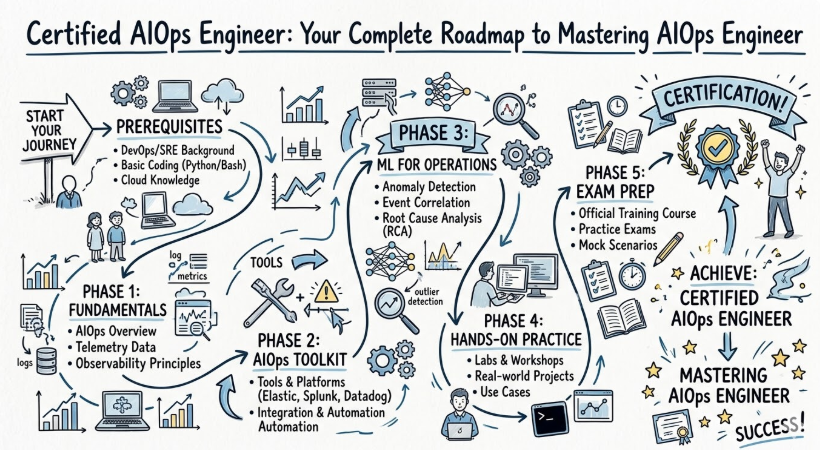
Introduction
The Certified AIOps Engineer program is a specialized professional track designed to bridge the gap between traditional operations and artificial intelligence. As systems become increasingly complex, manual intervention is no longer sufficient to maintain high availability and performance. This guide is written for engineers and managers who need to understand how to leverage machine learning and data analytics to automate IT operations.
By following this roadmap, professionals can transition from reactive monitoring to proactive, intelligent observability. AIOps School provides the framework for this evolution, helping you move beyond simple alerting into the realm of automated root cause analysis and predictive maintenance. This guide will help you decide if this path aligns with your long-term career goals in DevOps, cloud-native environments, and platform engineering.
What is the Certified AIOps Engineer?
The Certified AIOps Engineer designation represents a mastery of the tools and methodologies required to implement artificial intelligence within IT operations. It exists because modern enterprise environments generate more telemetry data than human teams can process in real-time. This certification focuses on production-grade learning, ensuring that engineers can deploy models that actually reduce noise rather than adding to it.
Unlike theoretical data science courses, this program is deeply rooted in engineering workflows. It aligns with the practical needs of modern enterprises that utilize distributed systems, microservices, and hybrid cloud architectures. The curriculum is designed to ensure that the application of AI remains functional, scalable, and directly beneficial to the reliability of the software delivery lifecycle.
Who Should Pursue Certified AIOps Engineer?
This certification is highly beneficial for Site Reliability Engineers (SREs), DevOps professionals, and Cloud Architects who are managing large-scale infrastructure. It is also an excellent fit for Data Engineers who want to pivot toward the operational side of the house, as well as Security Engineers looking to enhance threat detection through behavioral analysis. The content is structured to be accessible to both intermediate engineers and seasoned technical leaders.
In the global market, including the rapidly expanding tech hubs in India, there is a massive demand for professionals who can manage “dark data” and turn it into actionable insights. Managers who oversee platform teams will find this certification valuable for understanding the strategic implementation of automation. Whether you are just starting your journey into intelligent operations or you are an expert seeking validation, this track provides a clear professional signal.
Why Certified AIOps Engineer is Valuable and Beyond
The demand for AIOps expertise is growing as enterprises realize that hiring more people is not a sustainable way to scale infrastructure. This certification offers long-term career longevity because it focuses on fundamental patterns of automation and data analysis that persist even as specific tools change. Achieving this credential demonstrates that an engineer is capable of handling the next generation of platform challenges.
By investing time in this certification, professionals ensure they stay relevant in an industry that is rapidly moving toward autonomous operations. The return on investment is seen through increased operational efficiency, reduced Mean Time to Repair (MTTR), and the ability to command higher compensation in the competitive cloud market. It shifts your value proposition from “fixing problems” to “building systems that fix themselves.”
Certified AIOps Engineer Certification Overview
The Certified AIOps Engineer program is delivered through the official platform at Certified AIOps Engineer and is hosted by AIOps School. The program utilizes a multi-tiered assessment approach that includes both theoretical exams and practical, lab-based evaluations. This ensures that a certified individual has not only read the documentation but has also executed the tasks in a simulated production environment.
Ownership of the certification rests with a body of industry experts who regularly update the curriculum to reflect current enterprise practices. The structure is practical, moving from foundational concepts of data collection to advanced topics like neural networks for anomaly detection. This holistic approach makes it one of the most comprehensive certifications available for engineers looking to specialize in intelligent automation.
Certified AIOps Engineer Certification Tracks & Levels
The certification is divided into three primary levels: Foundation, Professional, and Advanced. The Foundation level is designed to introduce the core concepts of big data and machine learning within an operational context. It covers the basics of telemetry, log aggregation, and the difference between traditional threshold-based alerting and algorithmic noise reduction.
The Professional and Advanced levels allow for deeper specialization into tracks such as SRE-focused AIOps or FinOps-driven cost optimization using AI. These levels align with career progression, helping a junior engineer move into a senior role or a senior engineer transition into a principal or architectural position. Each level builds upon the previous one, ensuring a logical and structured learning journey.
Complete Certified AIOps Engineer Certification Table
| Track | Level | Who it’s for | Prerequisites | Skills Covered | Recommended Order |
| Core AIOps | Foundation | Beginners, Managers | Basic Linux/Cloud | Telemetry, ML Basics, ELK | 1 |
| Engineering | Professional | SRE, DevOps | Foundation Level | Anomaly Detection, PCA | 2 |
| Architecture | Advanced | Principal Engineers | Professional Level | Auto-remediation, NLP | 3 |
| Optimization | Professional | FinOps, SRE | Foundation Level | Predictive Scaling, Cost AI | 2 |
| Security | Professional | DevSecOps | Foundation Level | Behavioral Analysis, IDS | 2 |
Detailed Guide for Each Certified AIOps Engineer Certification
Certified AIOps Engineer – Foundation
What it is
This entry-level certification validates a professional’s understanding of the fundamental building blocks of AIOps. It ensures that the candidate understands how to collect, normalize, and store telemetry data for further analysis.
Who should take it
It is suitable for junior DevOps engineers, system administrators, and IT managers who need a conceptual understanding of AI-driven operations. It serves as the essential first step for anyone looking to enter this specialized field.
Skills you’ll gain
- Understanding the AIOps landscape and market drivers.
- Knowledge of data ingestion pipelines and log management.
- Differentiating between supervised and unsupervised learning in operations.
- Basics of statistical analysis for IT metrics.
Real-world projects you should be able to do
- Configure a basic ELK or Prometheus stack for centralized logging.
- Identify patterns of alert fatigue in a standard monitoring dashboard.
- Build a simple dashboard that visualizes system health across multiple clusters.
Preparation plan
- 7–14 days: Focus on core definitions and the differences between DevOps and AIOps.
- 30 days: Engage with hands-on labs involving data collection tools.
- 60 days: Complete mock exams and review case studies on enterprise AIOps implementation.
Common mistakes
- Overlooking the importance of clean data before applying machine learning.
- Confusing standard automation scripts with actual AI-driven logic.
Best next certification after this
- Same-track option: Certified AIOps Engineer – Professional.
- Cross-track option: Certified SRE Professional.
- Leadership option: Technical Product Manager in AI/ML.
Certified AIOps Engineer – Professional
What it is
This mid-tier certification validates the ability to implement and manage machine learning models within a production infrastructure. It focuses on the practical application of algorithms to solve real-world operational problems like event correlation.
Who should take it
This is designed for SREs, DevOps engineers, and Cloud Architects with at least 2-3 years of experience. Candidates should have a firm grasp of Python or similar scripting languages used in data processing.
Skills you’ll gain
- Implementing event correlation and noise reduction algorithms.
- Deploying and tuning anomaly detection models.
- Integrating AI insights into existing CI/CD and incident management workflows.
- Managing the lifecycle of operational ML models.
Real-world projects you should be able to do
- Reduce a high volume of alerts into a single, actionable incident using correlation.
- Deploy an automated thresholding system that adjusts based on seasonal traffic patterns.
- Integrate AIOps insights into a Slack or Microsoft Teams ChatOps workflow.
Preparation plan
- 7–14 days: Review advanced statistical concepts and common ML algorithms.
- 30 days: Build end-to-step pipelines that feed monitoring data into ML models.
- 60 days: Fine-tune models for accuracy and prepare for the scenario-based lab exam.
Common mistakes
- Implementing “black box” solutions without understanding the underlying logic.
- Failing to account for the resource overhead of running AI models on production clusters.
Best next certification after this
- Same-track option: Certified AIOps Engineer – Advanced.
- Cross-track option: Certified MLOps Engineer.
- Leadership option: Principal SRE or Infrastructure Architect.
Choose Your Learning Path
DevOps Path
The DevOps path focuses on integrating AIOps into the continuous delivery pipeline. It emphasizes using AI to analyze deployment patterns and predict potential failures before they reach production. Engineers on this path will learn how to automate the feedback loop between operations and development teams. It is a critical path for those wanting to evolve into DevSecOps or Platform Engineering roles.
DevSecOps Path
In this path, the focus shifts toward using AI for threat detection and security automation. You will learn how to identify anomalous user behavior and potential security breaches using real-time stream processing. This path is essential for engineers who want to build “self-healing” security perimeters. It combines the speed of DevOps with the analytical power of artificial intelligence.
SRE Path
The SRE path is centered on reliability and the reduction of toil through intelligent automation. It covers advanced topics like automated root cause analysis and predictive scaling based on historical usage patterns. This path helps SREs maintain strict Service Level Objectives (SLOs) without increasing the manual workload. It is ideal for those managing massive, distributed cloud environments.
AIOps Path
This dedicated path focuses purely on the mechanics of artificial intelligence within the operational domain. It covers the end-to-end lifecycle of operational data, from ingestion and normalization to model training and inference. Professionals will master the specific algorithms that are most effective for time-series data and event logs. It is the core path for becoming a subject matter expert in the field.
MLOps Path
The MLOps path focuses on the operationalization of machine learning models themselves. While AIOps uses AI to help operations, MLOps applies operational principles to the AI development process. This path is crucial for ensuring that models are deployed, monitored, and updated in a reliable and scalable manner. It bridges the gap between data science and traditional software engineering.
DataOps Path
DataOps is about the orchestration of people, processes, and technology to deliver data faster and with higher quality. This path focuses on building robust data pipelines that feed the AIOps and MLOps engines. You will learn about data versioning, quality testing, and the automation of data delivery. It is a vital path for those who want to ensure the “fuel” for AI systems is always ready and reliable.
FinOps Path
The FinOps path leverages AI to optimize cloud spending and manage complex billing cycles. It focuses on predictive cost modeling and anomaly detection in cloud usage to prevent “bill shock.” By applying AIOps principles to financial data, you can automate the identification of wasted resources. This path is increasingly important for organizations looking to maximize their cloud investment.
Role → Recommended Certified AIOps Engineer Certifications
| Role | Recommended Certifications |
| DevOps Engineer | Foundation + Professional (Engineering) |
| SRE | Professional + Advanced (Architecture) |
| Platform Engineer | Foundation + Professional (Optimization) |
| Cloud Engineer | Foundation + Professional (Engineering) |
| Security Engineer | Foundation + Professional (Security) |
| Data Engineer | Foundation + Professional (Engineering) |
| FinOps Practitioner | Foundation + Professional (Optimization) |
| Engineering Manager | Foundation |
Next Certifications to Take After Certified AIOps Engineer
Same Track Progression
Deepening your specialization within AIOps involves moving from the Professional to the Advanced level. This stage focuses on high-level architecture and the implementation of fully autonomous, self-healing systems. You will likely explore topics such as advanced neural networks for system forecasting and the governance of AI systems at scale. This progression establishes you as a leading authority in intelligent infrastructure.
Cross-Track Expansion
Broadening your skills often means looking toward MLOps or DevSecOps to complement your AIOps knowledge. Understanding how to manage the models you are using or how to secure the data pipelines adds significant layers of value to your profile. This approach makes you a versatile “T-shaped” professional who can handle multiple facets of a modern platform. It is the best way to prepare for high-level consulting or architectural roles.
Leadership & Management Track
For those looking to transition into leadership, the next steps include certifications in Technical Product Management or Engineering Leadership. The goal here is to shift from “doing the work” to “designing the strategy” for how AIOps is implemented across an entire organization. You will focus on the business impact, ROI, and team structures required to support an AI-driven culture. This is the path toward becoming a CTO or VP of Engineering.
Training & Certification Support Providers for Certified AIOps Engineer
DevOpsSchool
DevOpsSchool provides a comprehensive ecosystem for engineers looking to master modern automation tools. They offer a wide range of instructor-led and self-paced courses that cover everything from basic Docker and Kubernetes to advanced AIOps implementations. Their curriculum is known for being updated frequently to match industry shifts. Students benefit from access to a massive library of recorded sessions and technical documentation. It is a solid choice for those who prefer a guided learning path with plenty of community support.
Cotocus
Cotocus focuses on delivering high-impact technical training through a blend of consulting and education. They specialize in enterprise-grade technologies and provide hands-on labs that simulate real-world production environments. Their trainers are often active consultants who bring current industry problems into the classroom. This makes their courses particularly valuable for professionals who need to solve specific challenges in their current roles. Cotocus is highly regarded for its focus on practical, actionable knowledge over purely academic theory.
Scmgalaxy
Scmgalaxy is a long-standing community and training platform dedicated to Software Configuration Management and DevOps. They offer an extensive collection of tutorials, blogs, and certified programs designed to help engineers stay ahead of the curve. Their approach is very community-driven, providing a platform for professionals to share knowledge and best practices. Whether you are looking for a deep dive into Git or an introduction to AI-driven operations, Scmgalaxy provides the resources to facilitate continuous learning.
BestDevOps
BestDevOps focuses on providing streamlined, high-quality certification programs for the modern cloud engineer. They emphasize the integration of various DevOps tools and how they interact in a complex ecosystem. Their training modules are designed to be concise and effective, making them ideal for busy professionals who need to upskill quickly. With a focus on the most relevant tools in the market, BestDevOps ensures that their students are always ready for the next career move.
devsecopsschool.com
DevSecOpsSchool is a specialized platform that focuses on the critical intersection of development, security, and operations. They provide deep-dive courses on integrating security into the CI/CD pipeline and using AI for proactive threat hunting. Their certifications are highly valued by organizations looking to build “security-first” cultures. The training includes hands-on experience with vulnerability scanners, automated compliance tools, and AI-driven security analytics. It is the go-to resource for anyone looking to specialize in modern security engineering.
sreschool.com
SRESchool is dedicated to the art and science of Site Reliability Engineering. Their curriculum covers the core pillars of SRE, including error budgets, SLOs, and incident management. They have a strong emphasis on using AIOps to reduce toil and improve system observability. The courses are designed to help traditional operations teams transition into a more programmatic and reliable way of working. SRESchool provides the specialized knowledge required to maintain high-availability systems in a cloud-native world.
aiopsschool.com
AIOpsSchool is the primary authority for artificial intelligence in IT operations. They provide the official certification tracks and foundational knowledge required to master the field. The platform offers a structured learning journey from basic telemetry to advanced autonomous systems. Their research and training materials are used by leading enterprises to define their AIOps strategies. For anyone serious about this career path, AIOpsSchool is the definitive starting point for education and professional validation.
dataopsschool.com
DataOpsSchool addresses the growing need for efficient data management in the age of AI. They focus on the methodologies and tools required to build reliable data pipelines and ensure data quality. The training covers the entire data lifecycle, from collection to consumption by ML models. By mastering DataOps, professionals can ensure that the systems they build are supported by accurate and timely information. This school is essential for those who want to specialize in the “data” side of AIOps and MLOps.
finopsschool.com
FinOpsSchool provides the training and certifications required to manage the financial aspects of the cloud. They teach engineers and finance professionals how to collaborate to optimize costs using data-driven insights. Their courses include the application of AI to predict cloud spend and identify opportunities for savings. As cloud budgets continue to grow, the expertise provided by FinOpsSchool is becoming a mandatory requirement for technical leaders. It is the leading platform for mastering the economics of modern infrastructure.
Frequently Asked Questions (General)
- How difficult is the Certified AIOps Engineer exam?
The exam is moderately challenging as it requires a mix of theoretical knowledge and practical scripting skills. - How much time is needed to prepare for the certification?
Most professionals with a DevOps background spend between 30 to 60 days preparing. - Are there any prerequisites for the Foundation level?
No formal prerequisites exist, but a basic understanding of Linux and Cloud computing is highly recommended. - Does this certification help in getting a salary hike?
Yes, AIOps is a niche skill set that currently commands a premium in the global job market. - Can a manager take this certification?
The Foundation level is specifically designed to help managers understand the strategic value of AIOps. - Is the exam proctored online?
Yes, the certification exams are typically conducted through a secure online proctoring platform. - How long is the certification valid?
The certification is usually valid for two years, after which a renewal or higher-level exam is required. - What programming languages are most useful for AIOps?
Python is the industry standard for AIOps due to its extensive library support for machine learning. - Is AIOps the same as MLOps?
No, AIOps uses AI to improve IT operations, while MLOps is about managing the lifecycle of ML models. - Do I need to be a data scientist to pass this?
No, the focus is on engineering applications rather than deep mathematical theory or research. - Are lab environments provided for practice?
Most training providers like AIOps School include access to sandboxed lab environments. - Is this certification recognized globally?
Yes, the standards are aligned with global enterprise practices, making it relevant in all major tech markets.
FAQs on Certified AIOps Engineer
- What is the primary goal of the Certified AIOps Enginee
It aims to enable engineers to use AI to reduce operational noise and automate the identification of root causes. - How does this certification handle different cloud providers?
The concepts are cloud-agnostic, focusing on universal patterns that apply to AWS, Azure, and Google Cloud alike. - What tools are typically covered in the curriculum?
Expect to work with tools like ELK, Prometheus, TensorFlow, and various event correlation platforms. - Is there a focus on open-source tools?
Yes, the program emphasizes open-source stacks to ensure the skills are portable across different organizations. - How does the assessment handle practical skills?
The exam includes hands-on tasks where you must configure pipelines or tune models to solve a specific problem. - Can I skip the Foundation level?
It is generally recommended to follow the sequence, but experienced professionals may challenge the Foundation exam directly. - Are there corporate training options available?
Yes, most providers offer bulk licensing and customized training for enterprise teams. - What makes this certification different from a standard DevOps cert?
It specifically adds the layer of data science and algorithmic automation that standard DevOps certifications lack.
Final Thoughts: Is Certified AIOps Engineer Worth It?
In the current landscape, the role of an operations engineer is fundamentally changing. The sheer volume of data produced by modern systems has outpaced our ability to manage it using traditional scripts and manual checks. Pursuing a certification in AIOps is not just about adding a line to your resume; it is about adopting a new mindset for how systems should be managed at scale.
If you are looking for a way to differentiate yourself in a crowded market, this is a strong choice. It moves you away from the repetitive work of triaging alerts and positions you as an architect of intelligent systems. For those willing to put in the time to understand the intersection of data and operations, the career rewards are substantial and long-lasting.

Best Cardiac Hospitals Near You
Discover top heart hospitals, cardiology centers & cardiac care services by city.
Advanced Heart Care • Trusted Hospitals • Expert Teams
View Best Hospitals