Introduction
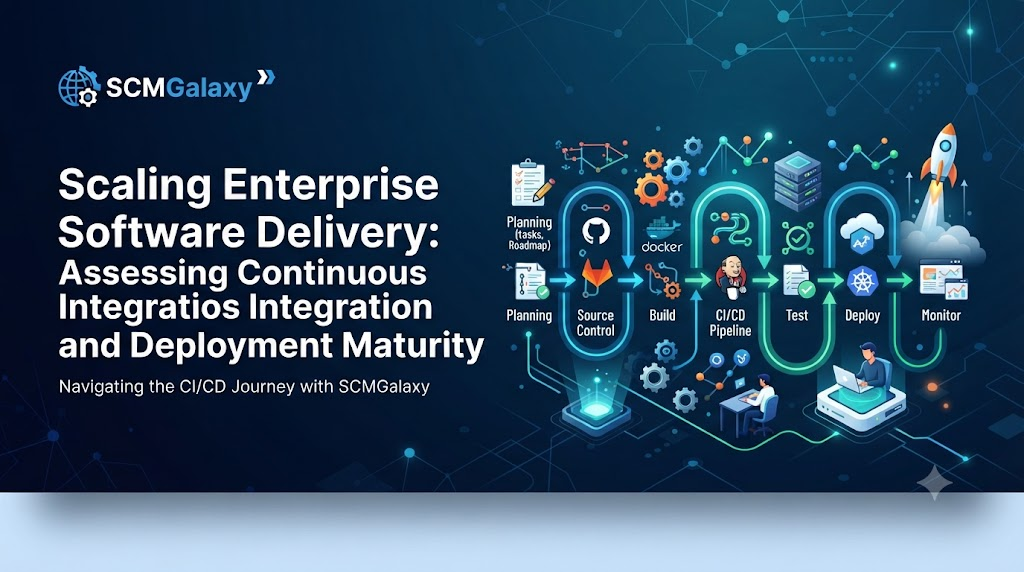
Modern software delivery has scaled beyond human visibility, often leaving technology executives with blind spots where massive investments in automated DevOps toolchains—like GitHub, Jenkins, Kubernetes, and Terraform—fail to guarantee engineering maturity, predictable release cycles, or foolproof compliance. Many organizations remain plagued by uncoordinated releases, late-stage security vulnerabilities, and fragmented workflows because they mistake tool adoption for process maturity. To bridge this gap and move from chaotic tool sprawl to measurable engineering excellence, progressive technology leaders leverage advanced Software Delivery Governance Platforms like SCMGalaxy OS to continuously evaluate, govern, and optimize software engineering capabilities across the entire enterprise delivery lifecycle.
Featured Snippet
What Is a Software Delivery Governance Platform?
A Software Delivery Governance Platform is an enterprise solution designed to centralize visibility, automate compliance policies, and continuously assess engineering maturity across the software development lifecycle. It integrates with existing DevOps toolchains to collect, analyze, and benchmark delivery performance metrics, helping leadership enforce standards, manage risks, and accelerate software delivery velocity.
Understanding Software Delivery Governance
What Is Software Delivery Governance?
Software delivery governance is the structured framework of policies, metrics, evaluation criteria, and automated gates used to ensure software application development and deployment activities align with organizational objectives, security postures, and quality benchmarks. It transforms subjective engineering preferences into standardized, quantifiable operational strategies.
Why Modern Enterprises Need Governance
Without governance, decentralized engineering teams construct unique, snowflake delivery pipelines. This lack of standardization introduces compliance vulnerabilities, escalates operational maintenance overhead, and prevents technology executives from getting a clear, macro-level perspective on code quality, release reliability, and delivery costs.
Tool Usage vs. Process Maturity
There is a fundamental difference between deploying an enterprise software tool and executing a mature engineering process. Possessing a modern continuous integration server does not mean an engineering group has achieved high delivery velocity or elite status. True process maturity implies that the tool is governed by automated policies, metrics, and quality controls that scale across all development teams without friction.
Tool Adoption vs. Delivery Governance
| Tool Adoption (Low-Maturity Behavior) | Delivery Governance (High-Maturity Behavior) |
| Teams independently configure GitHub repositories without branch protections. | Branch protections, access controls, and commit signing are globally enforced via automated policy. |
| CI/CD pipelines are manually written and modified by individual developers. | Standardized, modular pipeline templates are managed as code with compliance gates. |
| Security scanning tools run asynchronously, creating massive vulnerability backlogs. | Automated security gates stop non-compliant builds before they enter the environment registry. |
| Post-mortems are conducted informally via chat applications after major system outages. | Production incidents trigger structured root-cause analysis workflow loops linked to architecture metrics. |
Understanding Engineering Maturity
What Is a Maturity Assessment?
An engineering maturity assessment is an objective evaluation of an organization’s software development capabilities against industry benchmarks, operational indicators, and capability maturity frameworks. It provides a diagnostic snapshot of current workflows, highlighting operational risk and structural optimization points.
Why Maturity Measurement Matters
You cannot optimize what you do not measure. For enterprise leadership, maturity measurements remove emotional bias from engineering resource allocation decisions. Instead of investing capital based on subjective engineering complaints, executives utilize empirical data to fund targeted pipeline, cloud infrastructure, or security tooling transformations.
Characteristics of High-Maturity Engineering Teams
- Predictability: Consistent cycle times and low change failure rates.
- Autonomy: Self-service platform engineering infrastructure that limits cross-team dependencies.
- Resilience: Shift-left automated testing, continuous telemetry integration, and rapid automated rollback capabilities.
- Continuous Optimization: Data-driven review of development performance loops to remove delivery waste.
Common Signs of Low Engineering Maturity
- High deployment friction requiring massive weekend release coordination windows.
- Pervasive “tribal knowledge” where single individuals hold exclusive understanding of specific application pipelines.
- Security reviews treated as an arduous audit gate immediately prior to production deployment.
- Fragmented engineering telemetry that obscures the source of cross-service infrastructure failures.
Software Delivery Maturity Assessment
What Is a Software Delivery Maturity Assessment?
A software delivery maturity assessment systematically examines how code progresses from an engineer’s workstation to live runtime environments. It evaluates systemic process patterns rather than isolated developer actions to determine baseline system efficiency.
In Simple Terms
Think of a software delivery maturity assessment as a comprehensive medical physical for your engineering pipeline. It identifies structural blockages, measures metabolic health indicators, and provides a clear prescription to improve performance.
Enterprise Example
An international financial services provider with forty independent engineering teams discovered that software deployment times varied from forty minutes to three weeks. Running a software delivery maturity assessment uncovered that while ten teams utilized automated artifact registries, thirty teams still relied on manual asset handoffs over email.
Why It Matters
Standardizing software delivery practices across disparate groups minimizes the operational blast radius of broken updates, guarantees architectural compliance, and significantly reduces engineering onboarding times.
Key Takeaways
- Evaluates end-to-end code lifecycles rather than isolated infrastructure tools.
- Uncovers invisible operational bottlenecks across engineering silos.
- Sets an objective baseline for future automation and framework investments.
Key Assessment Areas
Source Code Management
Evaluates repository branch strategies, commit frequency standards, pull request review SLAs, and secret detection integrations across codebases.
Build Automation
Measures the speed, safety, and reproducibility of artifact creation loops, validating whether builds utilize immutable components and secure dependency validation pipelines.
Deployment Automation
Tracks how updates are moved through lower-tier stages into production clusters, highlighting the presence of blue-green, canary, or automated progressive delivery systems.
Security Controls
Analyzes the automated integration of static and dynamic code verification, open-source license scanning, and image verification gates inside developer workflows.
Observability
Assesses the organization’s capacity to aggregate metrics, distributed execution traces, and log data into intelligent analysis engines capable of discovering system regressions early.
Reliability Engineering
Evaluates fault-tolerant infrastructure designs, disaster recovery runbooks, failure injection testing, and automated healing parameters within production clusters.
Governance Practices
Examines policy-as-code adherence, infrastructure compliance drift tracking, and cryptographic signature verification across application artifact paths.
Engineering Maturity Scoring Framework
[Level 1: Ad-Hoc]   --> [Level 2: Managed]   --> [Level 3: Defined]   --> [Level 4: Measured]  --> [Level 5: Optimized]
Manual steps,           Basic versioning,        Standardized CI/CD,      Data-driven choices,     Self-healing systems,
Siloed knowledge,       Inconsistent builds,     Enforced security gates, Automated telemetry,     Continuous AI-assisted
No standard gates.      Reactive monitoring.     Cross-team compliance.   Predictable cycles.      governance loops.
DevOps Maturity Assessment
What Is DevOps Maturity?
DevOps maturity signifies how deeply an organization has synthesized collaboration cultures with programmatic automation to deliver value safely at high velocity.
In Simple Terms
DevOps maturity measures how fluidly your software development teams and systems operations groups work together as a single, automated unit rather than throwing code over a wall to one another.
Enterprise Example
A major retail corporation successfully transformed its engineering culture by utilizing automated self-service environment provisioning templates. Operations specialists wrote the infrastructure blocks, and software developers used them on-demand, dropping average compute provisioning timelines from twelve days to four minutes.
Why It Matters
High DevOps maturity directly correlates with superior business performance, faster time-to-market for digital products, and significantly higher developer retention rates due to reduced friction.
Key Takeaways
- Transcends tooling by prioritizing cultural workflows and shared accountability.
- Focuses heavily on eliminating cross-team wait states and request backlogs.
- Scales delivery execution by treating infrastructure as code.
Collaboration and Culture
Breaking down traditional operational silos by ensuring product managers, software quality engineers, and system administrators manage shared objectives and unified performance targets.
Automation Adoption
Eliminating manual interaction loops within build, test, data migration, and infrastructure management pipelines to guarantee reproducible software states.
Delivery Performance
Monitoring foundational system flow metrics such as Lead Time for Changes, Deployment Frequency, Mean Time to Restore (MTTR), and Change Failure Rate.
Continuous Improvement Practices
Leveraging automated retro-data metrics to continuously adjust environment architectures, refactor tech debt, and enhance deployment pipelines.
CI/CD Maturity Assessment
Understanding CI/CD Maturity
CI/CD maturity tracks the progression from scheduled, manual build scripts to highly optimized, event-driven pipelines that validate and ship individual pull requests automatically.
In Simple Terms
CI/CD maturity evaluates how automated and secure your assembly line is from the moment a developer hits “save” to the moment that change runs live in production.
Enterprise Example
A global SaaS firm advanced its CI/CD maturity by integrating automated load-testing suites directly into its staging pipelines. Any update that caused an application transaction latency regression greater than $5\%$ was automatically rejected and routed back to the owner.
Why It Matters
Mature CI/CD pipelines prevent catastrophic production failures by catching integration bugs, syntax issues, and regressions seconds after code creation, rather than weeks later.
Key Takeaways
- Converts manual validation tasks into an unyielding, deterministic software path.
- Requires declarative pipeline definitions that can be audited and versioned.
- Mandates granular testing types at every stage of build promotions.
Pipeline Standardization
Ensuring every software service utilizes authorized, centrally maintained pipeline blueprints that prevent custom, unvetted compilation hacks.
Deployment Automation
Decoupling release decisions from technical movements using continuous, zero-downtime deployment patterns to limit end-user disruptions.
Quality Gates
Enforcing programmatic gates that stop artifact progression if the code fails to hit preset code coverage percentages or unit test pass criteria.
Release Frequency
Transitioning organizations away from quarterly release windows toward safe, continuous intraday production updates driven by feature flags.
CI/CD Maturity Grid
| Metric Area | Low Maturity | Medium Maturity | High Maturity |
| Pipeline Definitions | Hand-crafted scripts stored on individual build servers. | Versioned configuration files maintained within application repositories. | Centralized, enterprise-wide immutable pipeline templates as code. |
| Testing Integration | Manual verification performed after deployment. | Automated unit tests run during compilation phases. | Comprehensive unit, integration, performance, and security testing gates. |
| Rollback Strategy | Manual database adjustments and redeployment of old files. | Scripted server rollbacks requiring engineering intervention. | Automatic telemetry-driven rollbacks triggered by system exception spikes. |
Release Management Maturity Assessment
Release Governance
Ensuring regulatory audit records, architecture change logs, and business stakeholder sign-offs are compiled cleanly through programmatic pipelines rather than manual spreadsheet tracking.
In Simple Terms
Release management maturity evaluates how safely, cleanly, and predictably you organize the launch of new business capabilities without inducing systemic operational chaos.
Enterprise Example
An enterprise healthcare system automated its HIPAA compliance reporting by configuring its release platform to pull pull-request peer reviews, cryptographic build logs, and security vulnerabilities directly into an immutable audit report for each production release.
Why It Matters
Automated release management eliminates human oversight errors, eliminates long compliance review stand-ups, and guarantees that every single production artifact matches exact regulatory requirements.
Key Takeaways
- Displaces human sign-off delays with machine-verified policy enforcement.
- Coordinates complex multi-service dependencies across large enterprise application structures.
- Links code deployments directly to transparent corporate risk strategies.
Change Management
Modernizing traditional Change Advisory Boards (CAB) into automated metadata validation engines that approve deployments instantaneously based on pipeline telemetry success profiles.
Risk Reduction
Leveraging canary deployments to route a fractional volume of live customer traffic to new system software versions, containing the impact of unexpected failure modes.
Deployment Coordination
Harmonizing service deployment configurations across interdependent microservice grids to prevent runtime schema mismatches or API handshake failures.
Release Reliability Metrics
Tracking software delivery indicators, including the ratio of successful automated deployments against emergency patch updates or hotfixes.
DevSecOps Maturity Assessment
Security Integration Across the SDLC
DevSecOps maturity highlights how effectively security controls are infused into every single stage of the software lifecyle rather than slapped on as a final checklist.
In Simple Terms
DevSecOps maturity means transforming your security team from a traffic cop standing at the end of the road into an automated co-pilot present throughout the entire journey.
Enterprise Example
An online banking application configured automated Software Composition Analysis (SCA) into its commit pipelines. When a developer introduced an open-source library containing an unpatched critical remote code execution flaw, the build failed immediately, shielding the organization’s repository from insecure builds.
Why It Matters
Remediating a software security vulnerability during initial coding phases is up to 100 times less expensive than attempting to fix a compromised application running in production.
Key Takeaways
- Democratizes security responsibility by delivering vulnerability feedback directly to software authors.
- Shields software supply chains against malicious code injections and compromised third-party dependencies.
- Assures continuous cloud compliance postures through real-time policy checks.
Shift-Left Security
Empowering individual software engineers with immediate IDE feedback, pre-commit scanners, and localized testing hooks to fix flaws at the moment of conception.
Compliance Automation
Translating abstract corporate regulatory mandates (such as PCI-DSS, SOC2, or GDPR) into explicit, executable testing parameters running within delivery pipelines.
Secure Software Delivery
Enforcing strict cryptographic signing of artifacts, verifying container image provenance using public key infrastructures, and tracking software bills of materials (SBOMs).
Risk Governance
Using dynamic software security dashboards to give security management real-time visibility into overall vulnerability backlogs, average remediation timelines, and compliance drift risks.
Observability and SRE Maturity Assessment
What Is Observability Maturity?
Observability and Site Reliability Engineering (SRE) maturity measures an organization’s capacity to proactively manage system reliability, understand complex system states, and resolve incidents with minimal business disruption.
In Simple Terms
Observability maturity evaluates how clearly your systems explain their inner state to you when things break down, and how structured your teams are at keeping systems operational under heavy load.
Enterprise Example
A telecom enterprise integrated advanced service-level indicators into its container platforms. If the $99\text{th}$ percentile latency of database transactions exceeded $200\text{ms}$ for more than two consecutive minutes, the system autonomously initiated horizontal pod autoscaling while dispatching diagnostic telemetry to the on-call team.
Why It Matters
High SRE maturity shifts operations from a chaotic, reactive fire-fighting model into a highly structured, data-driven engineering science focused on protecting customer satisfaction.
Key Takeaways
- Relies on structured data streams rather than simple server up/down checks.
- Uses business-aligned performance metrics to guide infrastructure changes.
- Maximizes user uptime through automated incident detection and recovery loops.
Metrics, Logs, and Traces
Unifying distinct monitoring telemetry types into single diagnostic platforms to trace requests smoothly across complex distributed microservice environments.
Reliability Engineering Practices
Executing proactive architectural practices such as error budget tracking, circuit-breaker implementations, automated health-checking endpoints, and chaos testing engineering.
Incident Management
Transitioning past chaotic paging alerts toward intelligently grouped notifications, automated runbook trigger executions, and data-linked post-incident timelines.
Service Level Objectives (SLOs)
Defining explicit, customer-centric operational reliability metrics that dictate whether engineering teams focus on shipping new features or improving system stability.
Software Configuration Management Platform
Importance of Configuration Governance
Software configuration management platforms act as the definitive source of truth for the entire environmental topology of an enterprise, tracking how code relates to configurations and infrastructure components.
In Simple Terms
Configuration governance ensures that every setting, database connection string, and infrastructure parameter is tracked, versioned, and applied uniformly across every environment.
Enterprise Example
A global logistics provider eliminated “configuration drift” across its thousand-node edge ecosystem by managing all infrastructure definitions inside centralized Git repositories, enforcing automated synchronization via a unified configuration platform.
Why It Matters
Mismatched configuration settings across testing and production environments represent one of the single most frequent catalysts for major enterprise application downtime events.
Key Takeaways
- Enforces structural parity across development, staging, and production clusters.
- Implements granular audit histories detailing precisely who adjusted what parameter and when.
- Accelerates recovery actions by enabling instant rollbacks of problematic configuration states.
Managing Infrastructure Consistency
Utilizing declarative infrastructure-as-code frameworks to guarantee that newly spun-up cloud regions match production environments down to single network routing rules.
Version Control Governance
Configuring precise management over repository architectures, tracking branching behaviors, and maintaining cryptographic histories of code updates.
Auditability and Traceability
Constructing unambiguous relationships connecting every active production package directly back to its original source repository code commits, peer review chats, and build outputs.
Configuration Compliance
Scanning active environmental parameters continuously to discover, alert on, and automatically remediate manual overrides or unauthorized security group additions.
AI Code Governance Platform
Rise of AI-Assisted Software Development
The integration of generative AI coding tools has dramatically accelerated raw code generation rates. However, this massive influx of machine-authored code introduces novel challenges around code quality, legal compliance, and systemic architectural alignment.
In Simple Terms
AI code governance measures, monitors, and controls the output of AI coding assistants to ensure that machine-generated contributions are safe, secure, and compliant with enterprise standards before they hit production.
Enterprise Example
A financial technology company deployed an AI code governance framework that evaluated all machine-suggested snippets for open-source license contamination and hidden security vulnerabilities, instantly blocking code that matched copyleft licenses before it could enter core repositories.
Why It Matters
Unchecked AI code contributions can rapidly introduce security risks, intellectual property issues, and complex technical debt into enterprise systems if not governed by automated verification pipelines.
Key Takeaways
- Prevents security vulnerabilities and structural tech debt from being introduced at scale by AI assistants.
- Guarantees all generated source components comply with open-source license standards.
- Assures that AI-assisted code adheres strictly to standard corporate architectural rules.
Risks of Uncontrolled AI Code Generation
Unmonitored generation patterns risk introducing outdated dependencies, copying protected source files, embedding hidden security vulnerabilities, and creating disconnected architecture designs that increase maintenance overhead.
Governance Requirements for AI Usage
Enterprises must establish automated scanning frameworks that validate the origin, security posture, and structural soundness of AI-generated content before allowing integration into production branches.
Code Quality and Compliance Controls
Enforcing automated linting rules, architectural compliance checks, and legal scanning pipelines to process AI contributions with the same rigor applied to human-written code.
Future of AI Governance
The evolution of automated software engineering requires governance systems that can autonomously assess, contextualize, and direct multi-agent AI frameworks as they write, test, and deploy code packages at scale.
Development Methodology Evolution
| Feature | Traditional Development | AI-Assisted Development Governance |
| Code Creation Speed | Linear; limited by manual human typing and design loops. | Exponential; massive volumes of code are produced instantly by AI engines. |
| Primary Flaw Catalyst | Human fatigue, logic oversight, or limited domain expertise. | Fragmented contextual awareness, outdated training data, or hallucinated APIs. |
| Governance Paradigm | Manual peer reviews combined with traditional static code scans. | Real-time automated verification pipelines, license matching, and context gates. |
How SCMGalaxy OS Works
SCMGalaxy OS acts as an enterprise control center for software delivery governance. The platform integrates directly with your existing technology stacks, extracting metadata across development paths to build an objective record of your engineering operations.
[Developer Tools] + [CI/CD Pipelines] + [Security Scanners] + [SRE Telemetry]
                                    │
                                    ▼
                        ┌──────────────────────┐
                        │    SCMGalaxy OS      │
                        │  Governance Engine   │
                        └──────────────────────┘
                                    │
            ┌───────────────────────┼───────────────────────┐
            ▼                       ▼                       ▼
   [Maturity Scoring]       [Risk Analytics]      [Automated Roadmaps]
Assessment Framework
The platform uses automated data connectors to continuously evaluate workflows against modern DevOps, DevSecOps, and SRE operational standards, eliminating the need for slow, subjective manual surveys.
Maturity Scoring Engine
SCMGalaxy OS processes telemetry data through an enterprise grading engine, calculating precise maturity scores across distinct operational categories like pipeline automation, code quality, and release safety.
Risk Identification
The system uncovers hidden process risks—such as unreviewed pull requests, fragile single-point-of-failure pipelines, missing security scans, or configuration drift—before they disrupt production systems.
Recommendations and Insights
Beyond identifying flaws, the platform provides tailored, contextual engineering recommendations to help teams improve their delivery performance and move up the maturity ladder.
Governance Dashboards
Engineering executives gain comprehensive visibility through centralized dashboards that track quality compliance, delivery performance metrics, and process maturity levels across the entire enterprise.
Transformation Roadmaps
The platform transforms evaluation findings into practical, phased improvement strategies designed to systematically advance organizational capability over time.
30-Day Roadmap: Visibility & Baseline
- Connect primary source control management systems and CI/CD tools to SCMGalaxy OS.
- Calculate initial maturity baseline scores across all internal engineering teams.
- Pinpoint high-risk process exceptions, such as missing branch protections or skipped security scans.
90-Day Roadmap: Standardization & Alignment
- Standardize core CI/CD workflows using secure, unified pipeline-as-code templates.
- Integrate automated quality gates across testing, security scanning, and compliance tracking.
- Set explicit engineering performance goals based on target maturity scores.
180-Day Roadmap: Optimization & Scale
- Deploy advanced progressive delivery models, such as canary releases and automated rollbacks.
- Implement AI code governance frameworks to safely manage machine-assisted development.
- Transition into a continuous optimization model driven by automated engineering telemetry.
Benefits of SCMGalaxy OS
- Visibility Into Engineering Health: Replaces guesswork with clear, data-driven insights into delivery velocity, code quality, and process consistency across all departments.
- Standardized Assessments: Eliminates the overhead of manual consulting audits by using continuous, automated governance benchmarks instead.
- Better Governance: Enforces corporate compliance and security policies systematically, ensuring no non-compliant code can slip through to production.
- Reduced Delivery Risk: Minimizes deployment failures and production outages by catching architectural flaws and pipeline inconsistencies early.
- Improved Reliability: Helps teams achieve greater system stability by embedding clear SRE practices and automated quality gates directly into their workflows.
- Stronger Security Posture: Simplifies compliance tracking by embedding automated vulnerability checks and software supply chain security directly into developer lifecycles.
- Executive Decision Support: Gives technology leaders the objective data they need to justify infrastructure investments and track transformation progress accurately.
Real-World Enterprise Scenarios
Enterprise DevOps Transformation
- Challenge: A multinational retail organization faced slow release cycles due to fragmented, siloed development and operations teams using disparate tools.
- Assessment Findings: Evaluation data revealed significant delivery bottlenecks caused by manual environment provisioning and a lack of standardized pipeline templates.
- Recommendations: Implement self-service infrastructure blueprints and centralize pipeline management using standard templates.
- Expected Outcomes: A $40\%$ reduction in change lead times alongside a measurable improvement in overall DevOps maturity scores within two quarters.
Platform Engineering Assessment
- Challenge: A financial technology provider struggled with inconsistent infrastructure setups and unpredictable deployment paths across thirty cloud teams.
- Assessment Findings: Continuous tracking identified significant configuration drift between testing environments and live production clusters.
- Recommendations: Establish a unified platform engineering model with automated configuration checks and policy-as-code controls.
- Expected Outcomes: Complete elimination of environment configuration drift and a $50\%$ drop in infrastructure-related deployment errors.
Multi-Team Governance Initiative
- Challenge: An enterprise healthcare group lacked clear insight into security compliance and release readiness across a sprawling microservices portfolio.
- Assessment Findings: Audit records showed inconsistent peer-review patterns and uneven security testing across different development groups.
- Recommendations: Enforce standardized release governance frameworks with automated compliance checks for every service line.
- Expected Outcomes: Achieved $100\%$ compliance documentation readiness for external audits while eliminating manual pre-release review steps.
Security Modernization Program
- Challenge: A high-growth software company kept discovering critical security flaws late in production, forcing costly emergency patching cycles.
- Assessment Findings: Vulnerability tracking showed security reviews were treated as a final hurdle just before release rather than being embedded in early pipeline stages.
- Recommendations: Shift security left by integrating automated application safety testing directly into developer commit workflows.
- Expected Outcomes: A $75\%$ reduction in production-level security vulnerabilities and significantly faster time-to-remediation for code flaws.
AI Development Governance Rollout
- Challenge: A large technology enterprise saw a massive spike in code production from generative AI tools but lacked visibility into the safety and compliance of those contributions.
- Assessment Findings: Code quality reviews indicated an increased risk of open-source license violations and inconsistent architectural patterns in machine-written snippets.
- Recommendations: Deploy an automated AI code governance platform to continuously vet machine-generated contributions for quality, safety, and compliance.
- Expected Outcomes: Safe, accelerated adoption of generative AI tools without compromising code quality, legal compliance, or system security benchmarks.
Common Software Delivery Governance Challenges
- Tool Sprawl: Managing a disjointed collection of engineering tools that don’t share data creates visibility blind spots. Solution: Use an overarching governance platform to unify telemetry from across your entire toolchain.
- Lack of Standardization: Allowing teams to build completely custom pipeline configurations introduces maintenance overhead and compliance risks. Solution: Use central, version-controlled pipeline templates that build security and quality gates directly into the development path.
- Poor Visibility: Operating without clear, high-level dashboards makes it difficult for engineering leadership to track systemic delivery blockages. Solution: Maintain real-time engineering health scorecards that show performance trends across every department.
- Inconsistent Processes: Relying on manual testing and release checklists often leads to unpredictable deployment quality. Solution: Turn human procedures into automated pipeline rules to ensure consistent execution every single time.
- Weak Security Controls: Treating security as an afterthought often results in critical vulnerabilities reaching live production environments. Solution: Build automated scanning and compliance checks directly into early delivery phases to catch issues early.
- Absence of Measurement Frameworks: Trying to run a major engineering transformation without clear baseline metrics makes it impossible to prove improvement. Solution: Use an objective, automated maturity framework to track progress over time.
Common Mistakes Organizations Make
- Measuring Tools Instead of Outcomes: Focusing purely on tool adoption metrics rather than tracking actual delivery velocity, software reliability, and system safety outcomes.
- Ignoring Engineering Culture: Attempting to force heavy-handed automation processes on teams without addressing organizational silos or establishing shared engineering goals.
- Assessing Once and Never Reassessing: Treating maturity evaluation as a single annual project rather than running continuous, real-time assessments to prevent process drift.
- Treating Governance as Compliance Only: Viewing governance frameworks solely as bureaucratic hurdles rather than using them as strategic tools to drive engineering speed and quality.
- Lack of Executive Sponsorship: Launching engineering improvement initiatives without clear, data-driven alignment with broader business goals and executive leadership support.
Governance Anti-Pattern Checklist
- Pipeline evaluations rely on self-reported developer surveys rather than objective telemetry data.
- Security reviews are handled as a manual step at the very end of the release cycle.
- Production deployments regularly require manual commands and human verification steps.
- Engineering metrics focus on developer activity volume rather than system value delivery and reliability.
- Infrastructure environments are updated manually without using version-controlled configuration templates.
Building a Software Delivery Transformation Roadmap
  [1. Assessment]       [2. Prioritization]       [3. Execution]        [4. Optimization]       [5. Continuous Imp.]
  Map toolchains &      Identify critical         Roll out unified      Deploy progressive      Run continuous auto-
  establish metrics     gaps and high-impact      pipeline blueprints   delivery models and     mated auditing to
  baseline.             remediation zones.        and automated gates.  advanced telemetry.     prevent process drift.
Assessment Phase
Map out your existing toolchain footprints, collect baseline performance data, and identify key operational bottlenecks using automated governance metrics.
Prioritization Phase
Identify critical performance gaps, focus on high-impact improvement areas, and align transformation goals directly with core business objectives.
Execution Phase
Roll out standardized pipeline templates, integrate automated quality gates, and empower development teams with self-service infrastructure blueprints.
Optimization Phase
Deploy advanced delivery strategies, such as canary deployments, and use unified telemetry platforms to deepen system visibility.
Continuous Improvement Phase
Establish a cycle of continuous improvement by running automated assessments regularly to maintain process standards and support ongoing optimization.
Future of Software Delivery Governance
- AI-Powered Governance: Using machine learning models to analyze pipeline data, predict delivery risks, and optimize environment resource usage automatically.
- Platform Engineering Governance: Providing internal developer platforms that give engineering teams secure, self-service infrastructure access while maintaining corporate compliance standards.
- Autonomous Delivery Pipelines: Building self-correcting deployment streams that can adjust traffic routing and system resources on the fly based on real-time operational feedback.
- Engineering Intelligence Platforms: Moving beyond simple code metrics to analyze holistic engineering health, organizational collaboration, and business value delivery.
- Continuous Maturity Measurement: Shifting away from periodic evaluations toward real-time, telemetry-driven tracking of delivery process maturity.
- Governance-Driven Transformation: Using objective, automated governance metrics to guide corporate engineering strategies and focus transformation investments.
Why Organizations Choose SCMGalaxy OS
SCMGalaxy OS gives modern enterprises a scalable framework to manage, evaluate, and optimize engineering performance across the entire development lifecycle. By replacing manual surveys with automated data analysis, the platform provides technology leaders with the objective insights needed to eliminate tool sprawl, minimize delivery risks, and sustain high velocity safely.
Whether your organization is focused on standardizing CI/CD pipelines, accelerating a DevSecOps rollout, embedding reliable SRE practices, or implementing AI code governance, SCMGalaxy OS unifies your engineering disciplines into a single governance framework. This comprehensive approach ensures large enterprises can move confidently from fragmented tool adoption to predictable, high-maturity software delivery at scale.
FAQ Section
1. What is a Software Delivery Governance Platform?
A Software Delivery Governance Platform is an enterprise solution designed to centralize visibility, automate compliance policies, and continuously assess engineering maturity across the software development lifecycle. It integrates with existing DevOps toolchains to collect, analyze, and benchmark delivery performance metrics, helping leadership enforce standards, manage risks, and accelerate software delivery velocity.
2. Why do organizations need maturity assessments?
Maturity assessments provide objective data that removes personal bias from engineering decisions. They help technology leadership spot delivery bottlenecks, find compliance gaps, and focus infrastructure investments where they will drive the most value.
3. What is DevOps Maturity Assessment?
A DevOps Maturity Assessment evaluates how effectively an organization blends cultural collaboration with programmatic automation. It tracks core delivery indicators—like lead time for changes, deployment frequency, mean time to restore, and change failure rates—to measure overall engineering efficiency.
4. How does CI/CD Maturity Assessment work?
This assessment evaluates how automated and secure your software delivery pipeline is from initial code commit to production deployment. It checks for things like pipeline standardization, automated test coverage, quality gates, and progressive delivery capabilities.
5. What is DevSecOps Maturity Assessment?
A DevSecOps Maturity Assessment checks how well security controls are integrated throughout the development lifecycle. It measures the adoption of shift-left security testing, software supply chain protections, automated compliance validation, and continuous vulnerability tracking.
6. Why is observability maturity important?
Observability maturity evaluates an organization’s ability to understand complex, distributed application states using structured metrics, logs, and traces. High maturity shifts teams from reactive fire-fighting to proactive reliability engineering driven by clear SLO benchmarks.
7. What is AI Code Governance?
AI Code Governance involves monitoring and evaluating code generated by AI coding assistants. It ensures machine-written code meets enterprise standard quality guidelines, remains secure, and complies with open-source licensing rules before hitting production.
8. How does SCMGalaxy OS generate maturity scores?
SCMGalaxy OS connects directly to your existing development tools to collect live operational metadata. It processes this data through an automated grading engine to generate clear, unbiased maturity scores across different engineering disciplines, avoiding the need for manual surveys.
9. What are 30/90/180-day transformation roadmaps?
These are phased, data-driven action plans generated by SCMGalaxy OS. They guide teams from initial setup and baseline assessment (first 30 days), to pipeline standardization and quality gate deployment (90 days), through to advanced optimization and scaling AI governance (180 days).
10. Who should use SCMGalaxy OS?
SCMGalaxy OS is designed for technology executives, including CTOs, CIOs, VPs of Engineering, DevOps leaders, Platform Engineering architects, and security compliance managers who need comprehensive visibility and structured governance across large-scale software operations.
Final Summary
Managing large-scale software delivery requires moving beyond tool adoption to automated, metric-driven process governance. Modern engineering organizations cannot afford the risks of siloed practices, tool sprawl, or unchecked AI code contributions. True delivery transformation requires continuous visibility, objective process tracking, and automated policy enforcement across every phase of the development lifecycle.
Platforms like SCMGalaxy OS give enterprise technology leaders a structured framework to evaluate and improve engineering maturity systematically. By unifying metrics across DevOps, CI/CD, DevSecOps, Release Management, and SRE paths, it enables organizations to eliminate operational risk, maintain strict compliance, and accelerate software delivery safely. Explore the capabilities of SCMGalaxy OS to unlock clear visibility into your engineering workflows and build a reliable, high-velocity development ecosystem.

Best Cardiac Hospitals Near You
Discover top heart hospitals, cardiology centers & cardiac care services by city.
Advanced Heart Care • Trusted Hospitals • Expert Teams
View Best Hospitals