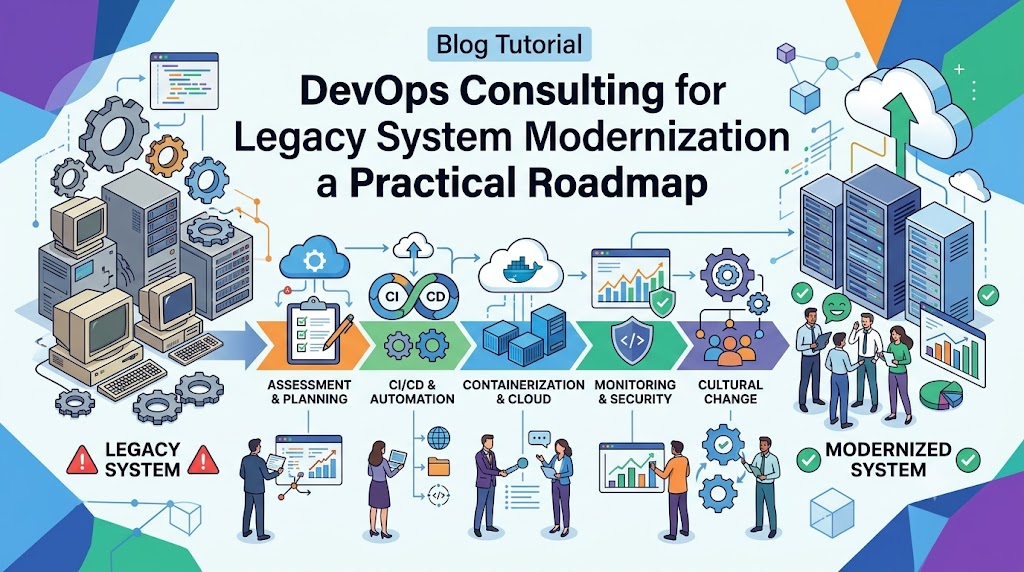
Introduction
Many global enterprises continue to rely on legacy infrastructure and monolithic codebases because they handle high-volume, mission-critical transactions that keep business running. However, maintaining these aging architectures introduces severe operational bottlenecks, including slow deployment cycles, poor scalability, security vulnerabilities, and high maintenance costs driven by a shrinking pool of legacy talent. Attempting a sudden, wholesale replacement of these systems introduces unacceptable business risks, such as prolonged downtime and data loss. Strategic DevOps Consulting for Legacy System Modernization bridges this gap by collaborating with specialized practitioners like DevOpsSchool to introduce an evolutionary, phased approach that prioritizes high-value components, automates continuous delivery pipelines, and transitions aging assets to agile architectures without disrupting daily business operations.
What Is Legacy System Modernization?
Legacy system modernization is the process of updating, optimizing, and transforming existing IT infrastructure, software architectures, and delivery workflows to align with modern digital standards. A legacy system is not defined solely by its age; rather, it is characterized by its inability to meet current business demands, support rapid software delivery, or integrate seamlessly with modern cloud ecosystems.
- Legacy Applications: These are typically tightly coupled monolithic software packages where business logic, data access, and user interfaces are bound together. A change in one small module requires testing and redeploying the entire application, which significantly slows down production releases.
- Legacy Infrastructure: This includes bare-metal servers, static virtual machines, and manual provisioning workflows. It lacks the elastic scalability and API-driven automation found in modern cloud platforms.
- Business Continuity: Modernization initiatives prioritize protecting existing revenue streams. The objective is to upgrade core software systems while maintaining transactional integrity, system availability, and data security.
- Modern Architecture: This state relies on decoupled services, microservices, micro-frontends, or modular monoliths that communicate via clean APIs and reside in dynamic environments.
- Continuous Improvement: Modernization replaces static release cycles with a culture of ongoing code enhancement, automated regression testing, and real-time operational feedback.
Why Organizations Modernize Legacy Systems
Maintaining outdated application architectures directly limits an organization’s competitive edge. Enterprise leaders pursue modernization to achieve measurable operational metrics:
- Improved Agility: Moving away from rigid architectures allows engineering teams to adapt to shifting market trends, roll out new features, and update software components independently.
- Faster Software Delivery: Legacy release windows often span quarters or months due to manual verification processes. Modern delivery frameworks cut this down to days or hours, accelerating time-to-market.
- Better Scalability: Monolithic applications require scaling the entire system horizontally, which wastes computing resources. Modernized architectures scale specific services independently based on traffic demands.
- Enhanced Security: Older software often depends on unpatched libraries or outdated operating systems. Modernization embeds automated vulnerability scanning directly into delivery pipelines to lower security risks.
- Lower Operational Complexity: Eliminating fragmented configurations reduces technical debt, allowing operations teams to manage infrastructure through software-driven parameters instead of manual intervention.
- Easier Maintenance: Documented configurations and clean code structures simplify onboarding for new engineers and reduce reliance on niche, legacy technical skill sets.
Role of DevOps Consulting
Transitioning an enterprise from legacy processes to modern delivery requires deep technical and organizational expertise. A structured DevOps consulting framework guides this transformation through an iterative lifecycle:
[Business Assessment] ➔ [Application Discovery] ➔ [Infrastructure Assessment]
                                                                │
[Automation Planning] ◀ [Modernization Strategy] ◀ [Risk Analysis]
        │
[CI/CD Implementation] ➔ [Infrastructure as Code] ➔ [Cloud & Container Adoption]
                                                                │
[Continuous Improvement] ◀ [Monitoring & Optimization] ◀ [Security Integration]
Business Assessment
Consultants begin by identifying organizational goals, budget limits, and regulatory constraints. This step ensures that technical changes directly support broader business objectives.
Application Discovery
This phase maps application components, software dependencies, data flows, and code complexities to identify tightly coupled modules that slow down development.
Infrastructure Assessment
Consultants evaluate existing computing resources, networking setups, and storage systems to find utilization bottlenecks and compute waste.
Risk Analysis
Consultants identify potential points of failure, data migration risks, and downtime liabilities to design appropriate rollback plans and mitigation strategies.
Modernization Strategy
Teams choose the right migration approach (such as rehosting, replatforming, or refactoring) for each asset based on the discovery data.
Automation Planning
This involves defining the testing, building, provisioning, and deployment steps that can be automated to remove manual friction from the workflow.
CI/CD Implementation
Consultants build deployment pipelines that compile code, run unit tests, and deploy packages automatically across environments.
Infrastructure as Code
This phase replaces manual server setups with declarative execution scripts, ensuring highly consistent environments from development to production.
Cloud & Container Adoption
Applications are packaged into standard container runtimes and deployed to managed cloud architectures or hybrid infrastructure to improve resource utilization.
Security Integration
Security policies are embedded directly into delivery workflows, automating static code analysis and image vulnerability scanning.
Monitoring & Optimization
Consultants implement real-time log aggregation and performance tracking to help operational teams spot bottlenecks before they cause downtime.
Continuous Improvement
Feedback loops are established to regularly update application code, refine automated scripts, and upskill internal engineering teams.
Legacy Modernization Strategies
Selecting the right modernization strategy requires balancing implementation costs against the desired business value. The table below outlines the primary strategic choices:
| Strategy | Best Use Case | Business Benefit | Technical Trade-off |
| Rehost (Lift and Shift) | Legacy applications requiring fast data center evacuation without code alterations. | Rapid migration with minimal upfront code modifications. | Misses out on cloud-native elasticity and retains technical debt. |
| Replatform (Lift and Shape) | Applications that run fine but need optimization, like moving to a managed database. | Lowers maintenance overhead without requiring a full code rewrite. | Limited to peripheral optimizations rather than structural changes. |
| Refactor | Monoliths with a sound codebase that need to be broken into modular microservices. | High scalability, better resource use, and rapid feature velocity. | Requires a significant engineering investment and thorough regression testing. |
| Rearchitect | Outdated applications that cannot scale or run on modern cloud infrastructure. | High performance and full alignment with modern cloud capabilities. | High complexity and longer project timelines. |
| Replace | Standard business logic that can be handled by a commercial SaaS platform. | Eliminates custom code maintenance and development costs. | Requires data migration and changes to internal user workflows. |
| Retire | Systems with redundant functions or minimal usage by business users. | Instantly slashes operational overhead and licensing expenses. | Requires careful data archiving to maintain regulatory compliance. |
CI/CD for Legacy Applications
Implementing Continuous Integration and Continuous Deployment (CI/CD) pipelines for legacy applications requires adapting modern automation tools to fit older application constraints.
- Source Control Integration: Many legacy applications rely on obsolete version control systems or file shares. The first step is migrating codebases to modern Git repositories, establishing branching models like GitFlow or trunk-based development to enable parallel engineering work.
- Automated Builds: Monolithic applications often suffer from unpredictable, manual build processes. Consultants replace these with automated build definitions using tools like Jenkins, GitLab CI, or GitHub Actions to compile binaries consistently.
- Automated Testing: To safely modify legacy systems, teams must implement automated testing frameworks. Pipelines are configured to run unit tests, component isolation tests, and integration suites against every code check-in.
- Incremental Deployments: To avoid risky big-bang releases, pipelines are designed to deploy small, isolated updates. Techniques like canary deployments or blue-green environments route traffic gradually, limiting the blast radius of unexpected issues.
- Rollback Strategies: Automated pipelines include fast rollback routines. If production monitoring spots performance drops right after a release, the system automatically switches traffic back to the previous stable state.
- Release Governance: Automated quality gates ensure that code changes move to production only after passing compliance, security, and performance benchmarks.
Infrastructure as Code (IaC)
Manual environment setups often cause drift between development, staging, and production environments. Infrastructure as Code (IaC) solves this problem by defining environment configurations in declarative code files.
+--------------------------+
|  Declarative IaC Files   |
|  (Terraform / Ansible)   |
+--------------------------+
             │
             ▼
+--------------------------+
| Automated Provisioning   |
+--------------------------+
             │
 ┌───────────┼───────────┐
 ▼           ▼           ▼
[Dev]    [Staging]   [Prod]
(Identical Environment States)
Tools like Terraform allow teams to provision cloud infrastructure, networking rules, load balancers, and storage tiers using version-controlled configuration files. For configuration management, Ansible helps automate patch installations, operating system configurations, and middleware setup on target systems.
This automation delivers environment consistency across the delivery lifecycle. Engineers can launch identical replicas of production setups for testing, eliminating bugs caused by hidden differences between environments. Furthermore, if a hardware failure or disaster occurs, operators can use these IaC scripts to rebuild the entire infrastructure in a new region within minutes, significantly improving disaster recovery readiness.
Cloud Migration and Containerization
Legacy modernization rarely happens overnight; it usually requires a gradual journey across hybrid, private, or public cloud infrastructures.
- Hybrid Cloud Deployments: Highly regulated industries often keep sensitive databases on-premises while moving front-end application layers to the public cloud, balancing security with agility.
- Containerization with Docker: Packaging legacy software components alongside their required dependencies, runtimes, and system libraries into isolated containers isolates the application from underlying OS variations.
- Orchestration with Kubernetes: As the container footprint grows, Kubernetes manages container placement, automates scaling based on traffic spikes, conducts health checks, and handles self-healing routines.
- Gradual Modernization: Organizations do not need to containerize everything at once. Teams can use the Strangler Fig pattern to gradually migrate specific modules into containers while keeping legacy backend services running on-premises, minimizing operational disruption.
DevSecOps Integration
Modernizing systems without a strong security focus introduces vulnerabilities, especially when exposing older applications to cloud environments. DevSecOps addresses this by building automated security checks directly into the CI/CD pipeline.
[Developer Commits Code]
           │
           ▼
[Static Application Security Testing (SAST)] ──> (Block if high-risk vulnerabilities found)
           │
           ▼
[Container Image Dependency Scanning]        ──> (Block if outdated/vulnerable libraries found)
           │
           ▼
[Automated Compliance Validation]
           │
           ▼
[Deployment to Secure Infrastructure]
This shift-left approach scans code for vulnerabilities during development rather than waiting for a pre-release audit. Pipelines run automated dependency analysis to flag insecure libraries, while secrets management tools like HashiCorp Vault securely inject API keys and credentials at runtime, removing hardcoded passwords from repositories.
Additionally, compliance-as-code policies verify cloud infrastructure definitions against regulatory frameworks like SOC2, ISO 27001, or HIPAA before provisioning begins. Continuous monitoring tools then keep track of the production environment, alerting teams to unauthorized configuration changes or suspicious traffic patterns.
Governance and Change Management
The success of a DevOps transformation relies heavily on organizational alignment and cultural change management. Without strong leadership and clear communication, modernization initiatives often stall.
- Executive Sponsorship: Enterprise transformation requires clear support from leadership to break down institutional silos, align cross-department goals, and secure funding for training.
- Evolving Change Management: Traditional Change Advisory Boards (CAB) that rely on slow, manual reviews are replaced by automated governance frameworks, where pipelines generate compliance logs automatically based on successful testing runs.
- Compliance and Auditability: Automated pipelines record every commit, test result, and deployment step, creating a clear audit trail that simplifies regulatory compliance reviews.
- Documentation and Knowledge Sharing: Documenting architectural changes, API contracts, and deployment workflows in centralized systems prevents knowledge silos and reduces dependency on single team members.
- Training and Upskilling: Teams need structured training paths covering modern cloud tools, container architecture, and automated testing to build internal expertise and ensure long-term operational success.
Measuring Modernization Success
To prove the business value of a DevOps modernization initiative, organizations should track key performance indicators (KPIs) focused on delivery speed, quality, and platform stability:
| Metric | Why It Matters | Business Value |
| Deployment Frequency | Measures how often code changes are deployed to production environments. | Indicates how quickly the business can deliver value and new features to customers. |
| Lead Time for Changes | Tracks the total time it takes for a code commit to successfully run in production. | Reflects engineering agility and the efficiency of the delivery pipeline. |
| Change Failure Rate | Calculates the percentage of production deployments that cause a service degradation or require a rollback. | Measures the accuracy and reliability of automated testing phases. |
| Mean Time to Recovery (MTTR) | Tracks how long it takes to restore service after a production outage or degradation. | High MTTR shows strong monitoring, clear alerting, and fast automated recovery paths. |
| Automation Coverage | Tracks the percentage of test cases, builds, and infrastructure tasks handled automatically. | Lowers manual toil, reduces human error, and optimizes engineering resource costs. |
| Infrastructure Availability | Measures total system uptime across production cloud environments. | Confirms that modernization efforts are protecting system stability and availability. |
Common Modernization Challenges
Transforming legacy systems comes with practical hurdles. The table below lists common enterprise challenges along with recommended solutions:
| Challenge | Impact | Recommended Solution |
| Legacy Dependencies | Tightly coupled software modules make it difficult to modify components independently without causing unexpected issues. | Apply the Strangler Fig pattern to intercept application calls and extract capabilities into APIs. |
| Skills Gaps | Internal engineering teams might lack experience with cloud-native tools, container runtimes, and IaC design. | Partner with organizations like DevOpsSchool to provide hands-on workshops and structured training paths. |
| Downtime Concerns | Mission-critical transaction engines cannot afford extended maintenance windows without impacting revenue. | Use blue-green deployment strategies or database replication layers to swap traffic smoothly. |
| Data Migration Complexity | Moving large legacy databases to cloud environments carries risks of schema mismatches or data loss. | Execute data migrations in phases, utilizing dual-write schemas to synchronize old and new databases. |
| Compliance Requirements | High regulatory hurdles can slow down cloud adoption and automated code deployments. | Build compliance checks directly into pipelines using Policy-as-Code frameworks. |
| Resistance to Change | Teams accustomed to traditional processes may resist adopting automated workflows. | Run small pilot projects to demonstrate early success and build trust across engineering teams. |
Best Practices
A successful modernization initiative relies on proven operational patterns rather than guessing. Follow this actionable checklist to guide your implementation:
- Assess Before Modernizing: Never begin a transformation without a clear map of application dependencies, performance baselines, and business requirements.
- Modernize Incrementally: Break complex monolithic architectures into small, manageable components rather than attempting a high-risk, all-at-once migration.
- Automate Repetitive Processes: Focus automation efforts on time-consuming tasks like code compilation, regression testing, and server provisioning to eliminate manual errors.
- Strengthen Governance: Embed compliance, security validation, and clear audit logging directly into delivery pipelines from the start.
- Improve Collaboration: Bring development, operations, and security teams together into cross-functional units to share responsibility for system reliability.
- Measure Outcomes Continuously: Regularly monitor DORA metrics and infrastructure health to evaluate the success of your strategy and drive continuous improvement.
Real-World Example
Legacy Environment Overview
A large logistics provider relied on a core on-premises monolithic application developed in the early 2000s to manage global supply chains. The application suffered from manual monthly deployment routines, long code verification times, and frequent downtime during peak holiday shipping seasons.
Consulting Engagement
The organization brought in expert DevOps consultants to map system liabilities, design an incremental migration strategy, and upskill internal engineering teams on automated deployment practices.
Modernization Roadmap
The project kicked off with a thorough dependency analysis. Consultants selected the Strangler Fig pattern to gradually isolate the order tracking and customer notification features from the core monolith, migrating them to separate services without disrupting ongoing business operations.
Phase 1: Dependency Mapping & Core Analysis
                     │
                     ▼
Phase 2: Extract Tracking/Notification Modules (Strangler Fig Pattern)
                     │
                     ▼
Phase 3: Package into Docker Containers & Deploy to Managed Kubernetes
                     │
                     ▼
Phase 4: Launch Automated CI/CD Pipelines & Real-Time Monitoring
Automation Implementation
The team introduced modern Git repositories, built automated CI/CD pipelines to run regression tests, and packaged the newly isolated services into Docker containers orchestrated by a managed Kubernetes cluster. They also used Terraform to define identical staging and production environments automatically.
Business Improvements
- The deployment lifecycle dropped from 30 days to multiple updates per week.
- Automated testing helped lower the change failure rate by over 60%.
- The containerized system automatically scaled up to handle holiday traffic peaks, preventing service outages.
Lessons Learned
The project showed that upskilling internal teams early on is just as important as writing automation code. It also demonstrated that breaking the migration into small, manageable phases is key to keeping the business running smoothly throughout the transformation.
Common Modernization Mistakes
- Modernizing Everything Simultaneously: Attempting to rewrite or migrate an entire enterprise portfolio at once creates massive operational complexity and increases the risk of project failure.
- Ignoring Business Priorities: Technical transformations should focus on areas that deliver real business value, such as improving customer-facing features, rather than just updating technology for its own sake.
- Choosing Tools Before Strategy: Purchasing expensive software licenses or cloud tools before defining your architecture, workflows, and goals leads to wasted budget and fragmented setups.
- Weak Documentation: Failing to document automated pipelines, cloud network topologies, and configuration scripts makes it difficult for teams to maintain the system long-term.
- Insufficient Testing: Moving legacy code to cloud platforms without automated regression and load testing often exposes performance bugs and causes unexpected production downtime.
Future of Legacy Modernization
Enterprise modernization continues to evolve as new technologies streamline old workflows. AI-assisted modernization tools are now helping engineers analyze complex legacy codebases, automatically identifying business rules and recommending ways to refactor monoliths into microservices.
At the same time, Platform Engineering has emerged to simplify cloud infrastructure for developers. Internal Developer Platforms (IDPs) allow engineers to provision secure, compliant environments independently through self-service portals, removing infrastructure bottlenecks.
+------------------------------------------------------------------------+
|                      Internal Developer Platform (IDP)                 |
|   [Self-Service UI] ──> [Automated GitOps Engine] ──> [Policy as Code] |
+------------------------------------------------------------------------+
                                    │
                                    ▼
                     +----------------------------+
                     | Compliant Cloud Resources  |
                     +----------------------------+
GitOps workflows are also gaining traction, using Git repositories as the single source of truth for infrastructure and application states to ensure highly consistent environments. These modern practices—alongside policy-as-code validation and intelligent automation frameworks—allow organizations to modernize legacy systems with higher precision and less operational risk.
Certifications & Learning Paths
To sustain a long-term DevOps transformation, organizations must invest in upskilling their engineering teams. Building expertise across cloud infrastructure, container orchestration, and automated pipelines ensures that modernization benefits last long after the initial consulting engagement. Leveraging educational ecosystems like DevOpsSchool helps teams build these critical capabilities:
| Certification Area | Best For | Skill Level | Focus Area |
| Enterprise DevOps Frameworks | IT Managers, Enterprise Architects, DevOps Leads | Intermediate to Advanced | High-velocity delivery strategies, breaking down organizational silos, and optimizing DORA metrics. |
| Cloud Solutions Architecture | Cloud Architects, Systems Engineers | System-level | Designing resilient hybrid cloud setups, managing migrations, and optimizing compute costs. |
| Kubernetes Orchestration | Platform Engineers, Site Reliability Engineers | Advanced | Managing container lifecycles, automated scaling, and configuring microservice networking. |
| Infrastructure as Code | Systems Administrators, Automation Engineers | Intermediate | Building reusable declarative configurations, environment automation, and state management. |
| DevSecOps & Compliance | Security Specialists, Quality Assurance Engineers | Intermediate to Advanced | Automating vulnerability scanning, managing secrets, and implementing policy-as-code gates. |
| Platform Engineering | SREs, Product Infrastructure Teams | Advanced | Building internal developer platforms, automating self-service tools, and reducing developer toil. |
Legacy Modernization Readiness Checklist
- [ ] Assess Applications: Map all dependencies, data flows, and code structures across the legacy portfolio.
- [ ] Define Business Goals: Establish clear project milestones, budget lines, and target metrics before making technical changes.
- [ ] Build CI/CD Pipelines: Migrate codebases to Git and automate compilation and core regression testing steps.
- [ ] Implement Infrastructure as Code: Use declarative configuration files to replace manual environment setups and prevent environment drift.
- [ ] Strengthen Security: Integrate automated dependency analysis and vulnerability scanning directly into the build pipelines.
- [ ] Modernize Gradually: Use patterns like the Strangler Fig approach to extract application capabilities step by step, protecting business continuity.
- [ ] Measure KPIs: Track key DORA metrics—like deployment frequency and lead time for changes—to verify project success.
- [ ] Continuously Optimize: Regularly gather performance data and operational feedback to refine automation scripts and clean up technical debt.
FAQs
1. What is legacy system modernization?
It is the strategic practice of updating older IT systems, monolithic architectures, and manual workflows to match modern digital standards, ensuring better delivery speed, scalability, and security.
2. Why should organizations modernize legacy applications?
Modernization helps businesses overcome limitations like slow release cycles, high operational costs, vendor lock-in, security risks, and the difficulty of finding talent to maintain outdated codebases.
3. Is cloud migration always required?
No. Modernization can follow a hybrid approach. Critical data stores can remain on-premises due to regulatory rules, while front-end components are modernized using containers and microservices.
4. How can DevOps consulting reduce modernization risks?
Consulting teams provide structured assessment methods, design phased migration plans, automate testing gates, and implement rollback strategies to prevent unexpected production downtime.
5. What role does CI/CD play?
CI/CD automates the building, testing, and deployment of code changes. This reduces human error, provides fast feedback on software quality, and cuts down delivery timelines.
6. Can legacy systems be containerized?
Yes. Many legacy applications can be packaged into Docker containers along with their required runtimes and libraries, isolating them from underlying OS changes and improving deployment consistency.
7. How should organizations prioritize modernization?
Priority should be given to application modules that offer high business value and carry low technical risk, allowing the team to secure quick wins without disrupting core operations.
8. What should leaders measure during transformation?
Key metrics include the four DORA indicators (Deployment Frequency, Lead Time for Changes, Change Failure Rate, and Mean Time to Recovery) along with infrastructure availability and automation coverage.
9. What is the Strangler Fig pattern?
It is a migration strategy where specific features are gradually extracted from a monolithic application into new services. Over time, the new services replace the old system entirely.
10. How does DevSecOps improve legacy system safety?
DevSecOps builds security checks directly into the deployment pipeline, running automated code analysis and scanning libraries for vulnerabilities before code reaches production.
11. What is the main cause of modernization project failures?
Most failures stem from trying to change too much at once, selecting tools before defining a clear strategy, or failing to train internal teams properly.
12. How does Infrastructure as Code benefit legacy systems?
IaC replaces manual configuration with version-controlled scripts. This ensures consistent environments across development, testing, and production, eliminating configuration drift.
13. Does modernization require a complete code rewrite?
Not necessarily. Depending on the application, strategies like rehosting or replatforming can optimize the system without requiring a costly full rewrite.
14. How long does a typical modernization project take?
Timelines vary based on scale. Small applications can be replatformed in a few months, while large enterprise portfolios often take several years of phased rollouts.
15. Why is cultural change management important?
Technology updates fail if teams continue to work in silos. Proper change management aligns incentives, improves collaboration, and helps teams adopt automated workflows smoothly.
Final Thoughts
Legacy system modernization is a long-term strategic investment rather than a brief technical fix. To protect core business operations, organizations must move away from high-risk, all-at-once migrations and instead adopt a phased, purposeful approach. By focusing on targeted automation, establishing clear metrics, and building a culture of collaboration, companies can transform their legacy systems into agile, cloud-ready platforms. Success requires balancing technical upgrades with real business needs, ensuring that every modernization step directly supports long-term growth and stability.

Best Cardiac Hospitals Near You
Discover top heart hospitals, cardiology centers & cardiac care services by city.
Advanced Heart Care • Trusted Hospitals • Expert Teams
View Best Hospitals