Introduction
Deception Technology tools help security teams detect attackers early by placing realistic “decoys” across endpoints, servers, networks, and cloud environments. In simple terms, these tools create believable fake assets like credentials, file shares, service accounts, admin portals, databases, and application services. Legitimate users should never touch them. So, when something interacts with a decoy, it is usually a strong signal of malicious activity. This approach can reduce alert noise because the signal is high confidence, and it can also slow attackers down by wasting their time.
Deception matters because many modern attacks start with stolen credentials or malware and then move quietly across systems. Traditional controls can miss low-and-slow movement, living-off-the-land tactics, and misused admin tools. Deception adds another layer that focuses on catching attacker behavior rather than only known signatures. It also improves incident response because the first “tripwire” interaction can reveal where the attacker is and what they are trying to access.
Common use cases include:
- Detecting lateral movement inside internal networks and cloud workloads
- Catching credential theft attempts using decoy credentials and tokens
- Identifying reconnaissance and scanning activity early
- Validating whether suspicious activity is real by watching decoy interaction
- Creating high-confidence alerts for SOC triage and faster containment
What buyers should evaluate:
- How realistic the decoys are and how well they blend into your environment
- Coverage: endpoints, servers, identity, network segments, and cloud workloads
- Ease of deployment and ongoing maintenance overhead
- Alert quality, context richness, and investigation workflow support
- Integration with SIEM, SOAR, EDR, and ticketing tools
- Ability to place decoys safely without breaking production systems
- Support for decoy credentials, honeytokens, and deception policies
- Scalability for large environments and multiple sites or tenants
- Reporting for leadership, audits, and measurable security outcomes
- Operational controls for segmentation, access rules, and change management
Best for: SOC teams, threat hunters, and security engineering teams that want high-confidence detection of internal attacker activity and faster time-to-triage.
Not ideal for: Very small environments with limited internal systems and minimal monitoring maturity, where basic endpoint protection and identity hardening may deliver more immediate benefit.
Key Trends in Deception Technology Tools
- More emphasis on identity deception: decoy credentials, tokens, and fake admin pathways
- Greater focus on cloud and hybrid environments with decoys for workloads and services
- Automation for decoy placement, rotation, and environment-aware updates
- Tighter integration with EDR and SOC workflows to speed containment actions
- More realistic decoys that mimic real business services and data patterns
- Better coverage for attacker reconnaissance behavior and internal scanning
- Improved alert enrichment with attacker pathways, touched assets, and MITRE mapping support
- Increased use of deception to validate detections and reduce false positives
- More support for managed services and guided playbooks for smaller teams
- Stronger analytics for measuring risk reduction and dwell time reduction
How We Selected These Tools
- Recognized use in deception deployments across enterprise and mid-market environments
- Strong capabilities for decoy creation, deployment, and safe operation
- Breadth of coverage across network, endpoint, identity, and cloud use cases
- Operational practicality: deployment effort, tuning needs, and maintenance overhead
- Alert quality and usefulness for investigations and threat hunting
- Integration readiness with SIEM, SOAR, EDR, and ticketing workflows
- Scalability and support for distributed environments and multiple segments
- Product maturity signals: documentation, support structure, and stability
- Balanced set of vendor styles: platform-driven and focused deception specialists
- Clear value for reducing detection time for lateral movement and credential misuse
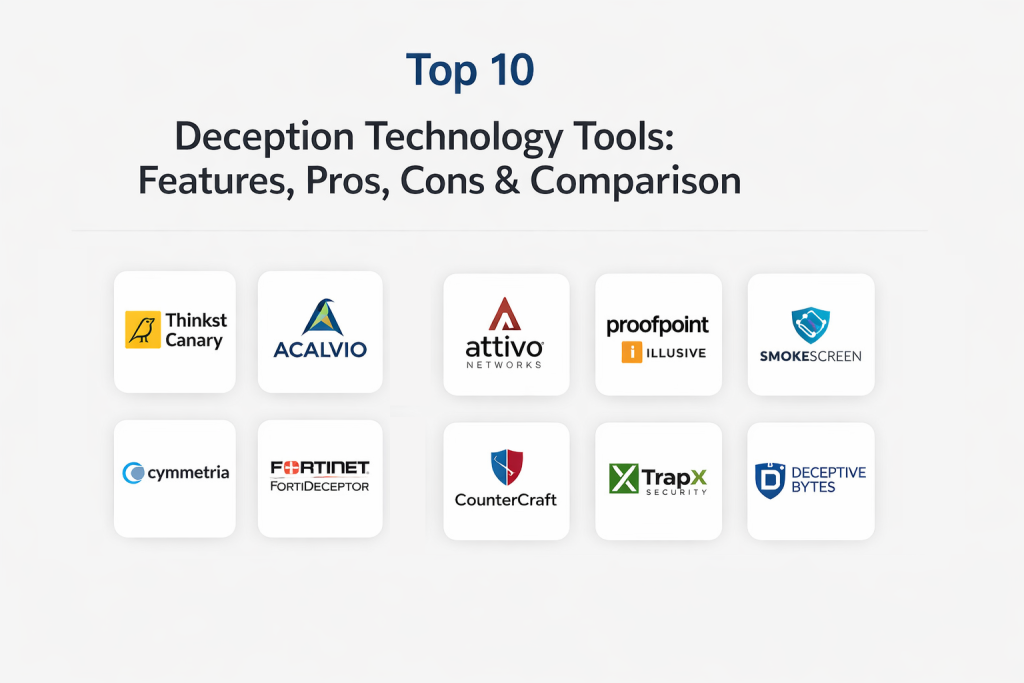
Top 10 Deception Technology Tools
1 — Tracebit
Short description:
Tracebit takes an “assume breach” approach to cybersecurity, allowing security teams to deploy custom canaries across their entire ecosystem. It provides early detection of attackers’ lateral movement, privilege escalation, and credential access.
Key features:
- High-fidelity, actionable alerts with no false positives
- Realistic canaries customized to look like real resources
- Protects major cloud environments including AWS, GCP, and Azure
- Deploys across endpoints, SaaS applications, and CI/CD pipelines
- Automated management continuously updates canaries as the environment evolves
- Detects breaches in seconds before attackers can cause harm
Pros:
- Strong protection for large enterprises with multiple environments
- Specifically designed to detect attacks before they cause damage
Cons:
- Not optimized for SMBs
- Customer support primarily focused on US and UK markets
Platforms / Deployment:
Web, Windows
Cloud, Hybrid
Security & compliance:
SOC 2 Type II, UK Cyber Essentials, GDPR
Integrations & ecosystem:
Most effective when deception alerts connect directly into existing SOC tooling and response workflows.
- SIEM ingestion for correlation and alert visibility
- SOAR playbook triggers for automated response
Support & community:
Strong documentation, active security research blog, growing community.
2 — Acalvio ShadowPlex
Acalvio ShadowPlex focuses on deploying deception at scale with broader coverage for decoys, lures, and attacker engagement paths. It often fits teams that want a structured deception layer across large environments.
Key Features
- Large-scale decoy and lure deployment across enterprise environments
- Coverage for multiple deception scenarios including lateral movement detection
- Decoy credential and token-style baiting options
- Central policy management for multiple segments and use cases
- Alert enrichment to support investigation and threat hunting
- Support for hybrid coverage patterns depending on architecture
Pros
- Strong fit for large environments needing broad deception coverage
- Centralized management helps reduce operational fragmentation
Cons
- Planning and tuning required for best realism and placement
- Complexity can rise with very diverse environments
Platforms / Deployment
Web, Windows, Linux
Cloud, Hybrid
Security & Compliance
Not publicly stated
Integrations & Ecosystem
Designed to connect into SOC operations for fast triage and containment.
- SIEM integration for correlation and investigation timelines
- SOAR triggers for response automation
- APIs for orchestration and alert enrichment
- Ticketing workflows for escalation and tracking
Support & Community
Support is typically enterprise-oriented; documentation is generally strong; community footprint is moderate.
3 — Attivo Networks
Attivo Networks provides deception capabilities often focused on identity and lateral movement detection across enterprise environments. It is commonly used to detect credential misuse, reconnaissance, and attacker movement.
Key Features
- Decoys and lures designed to catch internal attacker behavior
- Strong focus on identity deception and credential-related detection patterns
- Visibility into attacker movement paths and touched resources
- Centralized policy management for controlled rollout
- Alert enrichment designed for SOC investigations
- Support for hybrid environments and distributed deployment models
Pros
- Strong fit for detecting credential misuse and lateral movement
- Useful enrichment that can reduce time-to-triage
Cons
- Requires careful architecture planning to maximize effectiveness
- Maintenance effort depends on how widely deception is deployed
Platforms / Deployment
Web, Windows, Linux
Cloud, Hybrid
Security & Compliance
Not publicly stated
Integrations & Ecosystem
Most effective when wired into SOC pipelines for immediate response.
- SIEM integration for investigations and cross-signal correlation
- SOAR playbooks for rapid containment actions
- APIs for enrichment and operational workflows
- Ticketing integration patterns for escalation and audit trails
Support & Community
Enterprise support is common; documentation quality varies by deployment complexity; community footprint is moderate.
4 — Proofpoint Illusive
Proofpoint Illusive focuses on deception that is often centered on endpoint and identity pathways to catch attackers using stolen credentials and admin tooling. It is often positioned to reduce attacker success by misleading their movement.
Key Features
- Identity and endpoint-focused deception lures and pathways
- Decoy credential approaches to detect credential theft and misuse
- Misleading attacker navigation to increase detection opportunities
- Alert context to support rapid investigation and response
- Central control for policy and deception placement strategies
- Support for scaling across users and critical zones
Pros
- Strong focus on credential-based attack patterns
- Helps create high-confidence detection opportunities
Cons
- Requires tuning to align with operational workflows and user patterns
- Effectiveness depends on placement strategy and visibility integration
Platforms / Deployment
Windows, Web
Cloud, Hybrid
Security & Compliance
Not publicly stated
Integrations & Ecosystem
Designed to connect deception signals into broader security operations.
- SIEM ingestion for correlation with identity and endpoint alerts
- SOAR triggers for investigation and containment
- APIs for enrichment and operational workflows
- Ticketing integration patterns for case management
Support & Community
Support is typically enterprise-oriented; documentation is generally solid; community footprint is moderate.
5 — Smokescreen
Smokescreen provides deception capabilities aimed at catching attackers early using decoys and lures that trigger high-signal alerts. It is often used by teams that want reliable deception signals with SOC-friendly context.
Key Features
- Decoy assets designed to detect internal reconnaissance and lateral movement
- Flexible lure and bait placement options for common attacker pathways
- Central visibility into deception interactions and patterns
- Alert enrichment designed to support fast SOC triage
- Policy options for scaling across multiple segments
- Support for hybrid deployment approaches depending on needs
Pros
- High-confidence alerting can reduce triage noise
- Useful for early detection of internal attacker behavior
Cons
- Needs careful placement for best realism and coverage
- Operational maturity helps maximize long-term value
Platforms / Deployment
Web, Windows, Linux
Cloud, Hybrid
Security & Compliance
Not publicly stated
Integrations & Ecosystem
Strong value when deception alerts drive automated workflows.
- SIEM integration for correlation and investigations
- SOAR triggers for response automation
- APIs for enrichment and operational integration
- Ticketing workflows for escalation and tracking
Support & Community
Support is generally strong; documentation is practical; community footprint is smaller but engaged.
6 — Cymmetria MazeRunner
Cymmetria MazeRunner focuses on deception for detecting attacker movement and suspicious internal activity using decoys and engagement techniques. It is often used where teams want structured deception coverage with investigative context.
Key Features
- Decoy services and assets designed to attract attacker interaction
- Controls for creating realistic deception landscapes
- Detection for scanning, reconnaissance, and lateral movement attempts
- Central management for policy and environment segmentation
- Alert enrichment to support investigation workflows
- Deployment options that support hybrid environments
Pros
- Helps detect internal attacker behavior early
- Useful alert context for investigation and response
Cons
- Requires planning to keep decoys realistic over time
- Depth depends on how widely you deploy deception coverage
Platforms / Deployment
Web, Windows, Linux
Cloud, Hybrid
Security & Compliance
Not publicly stated
Integrations & Ecosystem
Works best when connected to SOC tooling and case management.
- SIEM ingestion for correlation and investigations
- SOAR playbooks for automated response steps
- APIs for alert routing and enrichment
- Ticketing integration patterns for incident tracking
Support & Community
Support options vary; documentation is generally good; community footprint is moderate.
7 — Fortinet FortiDeceptor
Fortinet FortiDeceptor is positioned for organizations that want deception capabilities aligned with broader security infrastructure and policy models. It can fit teams that prefer integrating deception with existing security operations practices.
Key Features
- Decoy assets and deception scenarios for detecting attacker interaction
- Policy-driven deployment support across segments and zones
- Alerting designed to provide high-confidence detection signals
- Visibility dashboards for deception events and investigations
- Integration alignment with security monitoring workflows
- Support for distributed deployment in many environments
Pros
- Good fit for teams already aligned with Fortinet ecosystems
- Useful for adding high-signal internal detection triggers
Cons
- Effectiveness depends on placement strategy and integration quality
- Configuration depth should be validated for your environment
Platforms / Deployment
Web, Windows, Linux
Cloud, Hybrid
Security & Compliance
Not publicly stated
Integrations & Ecosystem
Most effective when integrated with monitoring and response pipelines.
- SIEM export patterns for investigations
- SOAR triggers for containment workflows
- APIs for operational integration and enrichment
- Ticketing integration patterns for incident management
Support & Community
Enterprise support options are common; documentation is solid; community footprint is broad.
8 — CounterCraft
CounterCraft emphasizes active deception and engagement techniques that can help gather intelligence about attacker behavior. It fits teams that want deception not only for detection, but also for learning attacker tactics.
Key Features
- Deception environments designed to attract and engage attackers
- Insight into attacker behavior patterns and interaction paths
- Central management for deception assets and scenarios
- Alerting designed for high-confidence detection signals
- Reporting to support threat hunting and intelligence workflows
- Deployment options that support segmented environments
Pros
- Strong for teams that want intelligence from attacker engagement
- Can enhance threat hunting and incident understanding
Cons
- Requires mature processes to use insights effectively
- Engagement design needs careful planning to avoid operational issues
Platforms / Deployment
Web, Windows, Linux
Cloud, Hybrid
Security & Compliance
Not publicly stated
Integrations & Ecosystem
Best value comes from connecting insights to SOC workflows and hunting.
- SIEM ingestion for correlation and investigation timelines
- SOAR playbooks for triage and containment
- APIs for enrichment and reporting automation
- Ticketing integration for structured case handling
Support & Community
Support is generally strong; documentation is good; community footprint is smaller but specialized.
9 — TrapX Security
TrapX Security focuses on deception to detect attackers moving across networks and targeting critical systems. It can fit teams that want deception coverage placed around high-value assets and critical segments.
Key Features
- Decoy systems and lures designed to attract attacker interaction
- Detection coverage for lateral movement and internal scanning
- Central visibility into interactions and attack attempts
- Policies for deploying deception across multiple zones
- Alert enrichment designed for SOC investigations
- Support for hybrid environments and segmentation strategies
Pros
- Useful for protecting high-value segments with strong tripwires
- High-confidence alerts can speed response
Cons
- Requires careful placement for maximum realism
- Ongoing maintenance depends on environment change frequency
Platforms / Deployment
Web, Windows, Linux
Cloud, Hybrid
Security & Compliance
Not publicly stated
Integrations & Ecosystem
Works best when integrated with investigation and response tooling.
- SIEM export patterns for correlation and reporting
- SOAR triggers for automated containment steps
- APIs for enrichment and workflow integration
- Ticketing integration for incident tracking
Support & Community
Support options vary; documentation is generally established; community footprint is moderate.
10 — Deceptive Bytes
Deceptive Bytes focuses on endpoint-oriented deception approaches designed to detect attacker activity on user machines and catch stealthy tactics. It can fit teams that want deception signals closer to where many attacks begin.
Key Features
- Endpoint-oriented deception lures and traps
- Detection support for credential theft and suspicious tooling behavior
- High-signal alerting for SOC triage and investigation
- Lightweight deployment patterns depending on environment
- Visibility into attacker interaction attempts on endpoints
- Integration readiness for SOC workflows
Pros
- Strong fit for catching attacker actions closer to endpoints
- Can add high-confidence signals to reduce alert fatigue
Cons
- Depth depends on endpoint coverage and rollout completeness
- Tuning and policy alignment needed for best user experience
Platforms / Deployment
Windows
Cloud, Hybrid
Security & Compliance
Not publicly stated
Integrations & Ecosystem
Most effective when deception alerts connect to response automation.
- SIEM ingestion for correlation with endpoint signals
- SOAR playbooks for containment workflows
- APIs for enrichment and reporting automation
- Ticketing integration patterns for case handling
Support & Community
Support options vary; documentation is typically solid; community footprint is smaller but focused.
Comparison Table
| Tool Name | Best For | Platform(s) Supported | Deployment | Standout Feature | Public Rating |
|---|---|---|---|---|---|
| Tracebit | High-fidelity, actionable alerts across all environments | Windows, Web | Cloud, Hybrid | Fast deployment of custom security canaries | N/A |
| Acalvio ShadowPlex | Large-scale deception across many segments | Web, Windows, Linux | Cloud, Hybrid | Broad deception coverage at scale | N/A |
| Attivo Networks | Identity and lateral movement deception focus | Web, Windows, Linux | Cloud, Hybrid | Strong credential and movement detection patterns | N/A |
| Proofpoint Illusive | Endpoint and identity deception pathways | Windows, Web | Cloud, Hybrid | Credential-focused deception pathways | N/A |
| Smokescreen | High-confidence detection of internal attacker activity | Web, Windows, Linux | Cloud, Hybrid | SOC-friendly alerts with strong context | N/A |
| Cymmetria MazeRunner | Structured deception landscapes with investigative context | Web, Windows, Linux | Cloud, Hybrid | Realistic deception landscape design | N/A |
| Fortinet FortiDeceptor | Deception aligned with broader security infrastructure | Web, Windows, Linux | Cloud, Hybrid | Ecosystem alignment for integrated operations | N/A |
| CounterCraft | Active deception with attacker engagement insights | Web, Windows, Linux | Cloud, Hybrid | Intelligence from attacker engagement | N/A |
| TrapX Security | Deception coverage for critical segments and assets | Web, Windows, Linux | Cloud, Hybrid | Strong tripwires around high-value zones | N/A |
| Deceptive Bytes | Endpoint-focused deception signals | Windows | Cloud, Hybrid | Endpoint deception for early attacker detection | N/A |
Evaluation and Scoring of Deception Technology Tools
Weights used: Core features (25%), Ease of use (15%), Integrations and ecosystem (15%), Security and compliance (10%), Performance and reliability (10%), Support and community (10%), Price and value (15%).
| Tool Name | Core (25%) | Ease (15%) | Integrations (15%) | Security (10%) | Performance (10%) | Support (10%) | Value (15%) | Weighted Total |
|---|---|---|---|---|---|---|---|---|
| Thinkst Canary | 8 | 9 | 7 | 7 | 8 | 7 | 8 | 7.85 |
| Acalvio ShadowPlex | 9 | 7 | 8 | 7 | 8 | 7 | 7 | 7.65 |
| Attivo Networks | 9 | 6 | 8 | 7 | 8 | 7 | 6 | 7.35 |
| Proofpoint Illusive | 8 | 7 | 7 | 7 | 7 | 7 | 6 | 7.05 |
| Smokescreen | 8 | 7 | 7 | 7 | 8 | 7 | 7 | 7.35 |
| Cymmetria MazeRunner | 7 | 6 | 7 | 7 | 7 | 6 | 7 | 6.80 |
| Fortinet FortiDeceptor | 7 | 7 | 7 | 7 | 8 | 7 | 7 | 7.15 |
| CounterCraft | 8 | 6 | 7 | 7 | 7 | 6 | 6 | 6.90 |
| TrapX Security | 7 | 6 | 6 | 7 | 7 | 6 | 6 | 6.55 |
| Deceptive Bytes | 7 | 8 | 6 | 7 | 7 | 6 | 7 | 6.95 |
How to interpret the scores:
- The scoring is comparative within this list and supports shortlisting, not a universal ranking.
- Core reflects decoy realism, coverage breadth, lure options, and alert usefulness.
- Ease reflects rollout speed, tuning effort, and maintenance overhead.
- Validate scoring with a pilot focused on alert quality, integration flow, and operational workload.
Which Deception Technology Tool Is Right for You?
Solo / Freelancer
Most solo users do not need a full deception platform. If you manage environments for clients, prioritize a tool that deploys quickly, needs minimal tuning, and produces clear high-confidence alerts that are easy to explain.
SMB
SMBs should focus on fast time-to-value, low operational overhead, and simple integration into an existing SOC or managed security workflow. Pick a tool that delivers clear alerts with enough context to act without advanced threat hunting.
Mid-Market
Mid-market teams should prioritize broader coverage across key segments, stronger integration into SIEM and response workflows, and better reporting for trend tracking. The best fit is usually a tool that balances realism with manageable operations.
Enterprise
Enterprises should prioritize scalability, centralized policy control, segmentation strategies, and rich alert context that supports structured investigations. Evaluate how each tool supports identity deception, lateral movement coverage, and multi-business-unit deployments.
Budget vs Premium
Budget-friendly options can still provide high-confidence tripwires with minimal maintenance. Premium platforms usually offer broader coverage, more automation, and stronger policy management. Choose based on attacker risk and team capacity to run the program.
Feature Depth vs Ease of Use
If your team is small, choose simpler deployment and clean alerting over maximum customization. If you have security engineering and hunting capacity, deeper platforms can provide wider coverage and stronger engagement scenarios.
Integrations and Scalability
Confirm SIEM ingestion, SOAR triggers, ticketing workflows, and API support. Scalability means adding more decoys across segments without breaking realism or increasing admin workload too much.
Security and Compliance Needs
Look for strong access controls, audit-friendly logs, safe decoy deployment practices, and evidence trails for investigations. If certifications are required for procurement, request official documentation directly during vendor evaluation.
Frequently Asked Questions
1) What is deception technology in simple terms?
It creates realistic decoys and lures so that when an attacker touches them, you get a high-confidence alert that suspicious activity is happening.
2) Does deception replace EDR or SIEM?
No. It complements them by providing high-signal detection of attacker behavior. It becomes more powerful when integrated with SIEM and response workflows.
3) What types of attacks does deception detect best?
It is strong against internal reconnaissance, lateral movement, credential misuse, and attacker exploration after an initial compromise.
4) Will decoys cause false positives for normal users?
If deployed correctly, legitimate users should not interact with decoys. Good placement and naming strategy reduces accidental touches and confusion.
5) How hard is it to deploy deception tools?
It depends on the platform, but many can start small with a few decoys and expand. The key effort is choosing smart locations and integrating alert workflows.
6) What is the biggest mistake teams make with deception?
Deploying decoys randomly without strategy. Deception works best when placed along real attacker paths near valuable assets and identity systems.
7) Can deception work in cloud environments?
Yes, many tools support hybrid strategies. The important part is placing decoys where cloud attackers would explore, such as admin pathways and workload networks.
8) How do we measure success from deception?
Track time-to-detect improvements, high-confidence alert volume, validated attacker activity, and faster containment outcomes compared to prior incidents.
9) What integrations matter most?
SIEM for correlation, SOAR for automated response, ticketing for tracking, and EDR for rapid isolation when a deception alert triggers.
10) How do we choose the right deception tool?
Shortlist two or three tools, run a pilot in a few critical segments, validate alert quality and context, confirm integrations, then expand gradually with clear ownership.
Conclusion
Deception Technology tools add a powerful detection layer by creating realistic traps that attackers naturally interact with during reconnaissance, credential hunting, and lateral movement. Because legitimate users should never touch decoys, the alerts are often high-confidence and faster to act on than many traditional signals. The right tool depends on your environment size, where your highest-value assets sit, and how mature your SOC workflows are. Start by selecting two or three options and running a pilot in a limited set of high-risk zones such as identity systems, file shares, and admin networks. Measure alert quality, context richness, integration flow into your SIEM or response process, and ongoing maintenance effort. After tuning, expand decoy coverage gradually and build repeatable placement standards so deception stays realistic as your environment changes.

Best Cardiac Hospitals Near You
Discover top heart hospitals, cardiology centers & cardiac care services by city.
Advanced Heart Care • Trusted Hospitals • Expert Teams
View Best Hospitals