Introduction
Deep learning frameworks provide the building blocks to create, train, and deploy neural network models for tasks like image recognition, language understanding, recommendation systems, and speech processing. They simplify complex math and hardware acceleration by offering ready-made layers, optimizers, training loops, and integrations with GPUs and specialized accelerators. For teams, the right framework can reduce experimentation time, improve reproducibility, and make it easier to move from research prototypes to production services.
Deep learning matters now because organizations are using advanced models to automate decisions, personalize experiences, detect anomalies, and improve operational efficiency. Real-world use cases include computer vision for quality inspection, NLP for customer support automation, forecasting and time-series modeling, fraud and risk prediction, medical imaging assistance, and recommendation engines. Framework choice affects training performance, developer productivity, model portability, and long-term maintainability.
When evaluating a deep learning framework, buyers should consider model-building flexibility, training performance, distributed training support, hardware compatibility, ease of debugging, deployment and inference tooling, ecosystem maturity, integration with data pipelines, community strength, and total cost driven by development and operations effort.
Best for: ML engineers, data scientists, AI researchers, and platform teams building neural network models; organizations working on computer vision, NLP, recommender systems, and time-series deep learning; teams that need scalable training and reliable deployment workflows.
Not ideal for: teams that only need classical machine learning and do not require neural networks; environments where strict constraints prevent GPU usage and deep learning is not justified; projects where a simple rules-based or statistical model is more appropriate.
Key Trends in Deep Learning Frameworks
- Eager execution and developer-friendly debugging have become expected, lowering iteration time.
- More teams rely on distributed training for large models, so scaling and orchestration support matters more.
- Hardware diversity is increasing, with more focus on GPUs, accelerators, and efficient inference options.
- Model export and portability are key priorities to move models between research and production.
- MLOps workflows are tightening around frameworks, with stronger tracking, registry, and deployment pipelines.
- Efficient training techniques are being adopted widely to reduce cost and speed experimentation.
- Better tooling for model profiling, performance tuning, and memory optimization is increasingly important.
- More frameworks and libraries focus on production inference, not only training.
- Ecosystems around pretrained models and reusable components are becoming a major selection factor.
- Security and governance expectations are rising for model artifacts, environments, and dependencies.
How We Selected These Tools (Methodology)
- Selected widely recognized frameworks used for deep learning research and production.
- Prioritized active ecosystems, broad community support, and long-term viability.
- Considered flexibility for different model types: vision, NLP, time-series, and generative models.
- Evaluated training performance, distributed training options, and hardware compatibility patterns.
- Considered tooling for debugging, profiling, and deployment.
- Included a mix of general-purpose frameworks and specialized inference-focused options.
- Avoided claims about certifications or ratings, using “Not publicly stated” or “N/A” where uncertain.
- Ensured the list covers common enterprise and research adoption patterns.
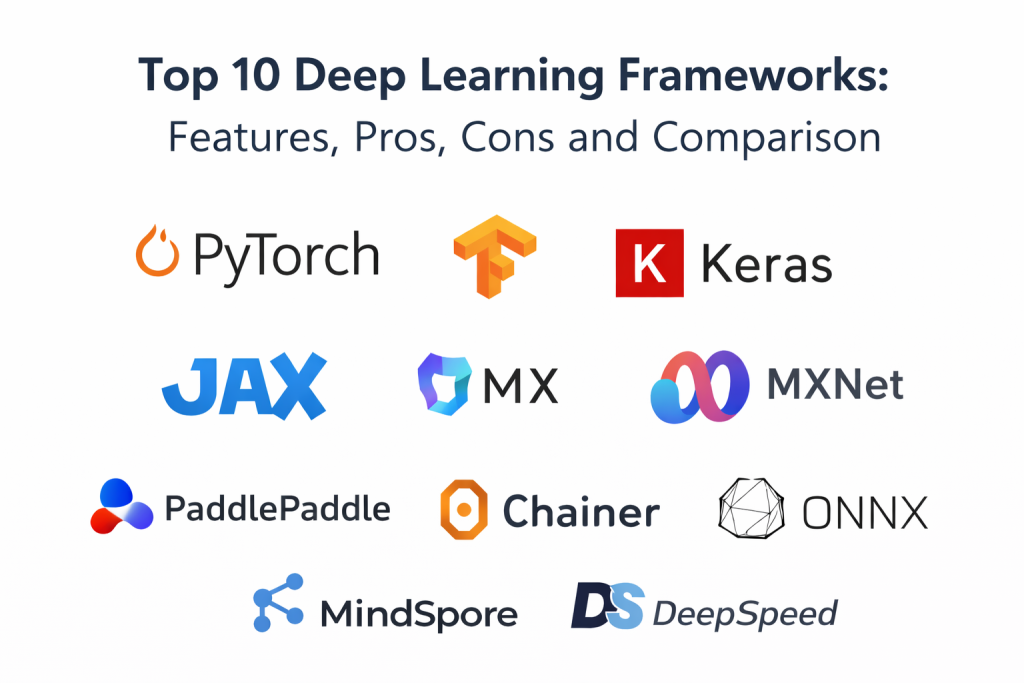
Top 10 Deep Learning Frameworks
Tool 1 — PyTorch
PyTorch is a widely adopted deep learning framework known for flexible model building and developer-friendly debugging. It is commonly used for research and production, especially for computer vision and NLP workflows.
Key Features
- Eager execution for intuitive debugging and iteration
- Flexible neural network building with dynamic graphs
- Strong GPU acceleration and training performance (Varies)
- Distributed training patterns and scaling options (Varies)
- Large ecosystem of libraries and pretrained models (Varies)
- Export and deployment tooling support (Varies)
- Strong support for custom layers and advanced research workflows
Pros
- Excellent developer experience and debugging workflow
- Very large community and ecosystem
- Strong for both research and production use cases
Cons
- Production deployment patterns can require additional tooling choices
- Performance tuning requires experience for large-scale training
- Some enterprise governance details depend on your setup
Platforms / Deployment
- Linux / Windows / macOS
- Cloud / Self-hosted / Hybrid (Varies)
Security & Compliance
- Not publicly stated
Integrations & Ecosystem
PyTorch integrates with many training, tracking, and deployment tools, making it easy to fit into modern ML stacks.
- Integration with popular data pipelines and training tools (Varies)
- Broad library ecosystem for vision and NLP (Varies)
- Compatibility with common experiment tracking tools (Varies)
- Export options for inference runtimes (Varies)
- Strong community extensions and utilities
Support & Community
Very strong global community, extensive tutorials, and broad production adoption across many industries.
Tool 2 — TensorFlow
TensorFlow is a mature deep learning framework used widely for training and production deployment. It is often chosen for teams that need stable tooling, scalable training, and broad production inference options.
Key Features
- Comprehensive APIs for model building and training
- Strong support for scalable training and performance tuning (Varies)
- Production-ready deployment tooling options (Varies)
- Broad hardware support patterns (Varies)
- Graph execution options for optimization (Varies)
- Ecosystem for vision, NLP, and serving workflows (Varies)
- Model export and portability support (Varies)
Pros
- Mature platform with strong production tooling
- Broad ecosystem and enterprise adoption
- Good fit for teams prioritizing deployment workflows
Cons
- Can feel complex for beginners compared to simpler APIs
- Debugging and performance tuning require experience
- Some workflows may feel heavier than research-first frameworks
Platforms / Deployment
- Linux / Windows / macOS
- Cloud / Self-hosted / Hybrid (Varies)
Security & Compliance
- Not publicly stated
Integrations & Ecosystem
TensorFlow has a large ecosystem around training, deployment, and model serving, supporting many production patterns.
- Serving and inference ecosystem options (Varies)
- Integration with common ML pipelines (Varies)
- Broad library support for model building (Varies)
- Tools for profiling and optimization (Varies)
- Export compatibility with inference runtimes (Varies)
Support & Community
Large community, extensive documentation, and broad learning content, especially for production and scaling topics.
Tool 3 — Keras
Keras is a high-level deep learning API designed for simplicity and fast prototyping. It is often used by teams that want readable model code and quick iteration, while still accessing strong backend capabilities.
Key Features
- High-level API for fast model prototyping
- Clean abstractions for layers, callbacks, and training loops
- Support for common deep learning architectures
- Works with backend execution engines (Varies)
- Strong usability for education and team onboarding
- Integration with common data workflows (Varies)
- Extensible for custom layers and training logic (Varies)
Pros
- Very approachable and readable for new teams
- Fast prototyping and experimentation
- Good fit for standard deep learning tasks
Cons
- Advanced research workflows may need lower-level control
- Performance tuning depends on backend and setup
- Large-scale distributed training requires careful design choices
Platforms / Deployment
- Linux / Windows / macOS
- Cloud / Self-hosted / Hybrid (Varies)
Security & Compliance
- Not publicly stated
Integrations & Ecosystem
Keras is commonly used in ML education and production prototypes, and integrates with many common model development workflows.
- Integration with popular training utilities (Varies)
- Works with common data and preprocessing stacks (Varies)
- Compatible with model export workflows (Varies)
- Large set of learning resources and examples
- Extensibility through custom components
Support & Community
Very large community due to simplicity and wide adoption in teaching and production prototyping.
Tool 4 — JAX
JAX is a high-performance framework for numerical computing and deep learning, often used by researchers for advanced model development. It is known for transformations like automatic differentiation and compilation-based optimization patterns.
Key Features
- Automatic differentiation for complex model training
- Compilation and optimization patterns for performance (Varies)
- Strong support for research workflows and custom math
- Functional programming style that enables transformations
- Scalable training patterns through ecosystem tools (Varies)
- Works well for advanced experimentation and optimization
- Integration with accelerator hardware patterns (Varies)
Pros
- Excellent for research and performance-focused training
- Strong flexibility for custom math-heavy models
- Efficient execution patterns when tuned properly
Cons
- Steeper learning curve for many teams
- Ecosystem for production serving varies by use case
- Debugging style differs from traditional imperative frameworks
Platforms / Deployment
- Linux / Windows (Varies) / macOS (Varies)
- Cloud / Self-hosted / Hybrid (Varies)
Security & Compliance
- Not publicly stated
Integrations & Ecosystem
JAX is often paired with additional libraries for deep learning and large-scale training, forming a strong research ecosystem.
- Works with high-level model libraries in its ecosystem (Varies)
- Integration with accelerators through compilation patterns (Varies)
- Experiment tracking integration patterns (Varies)
- Export and serving options vary by environment
- Strong research community tooling
Support & Community
Strong research community and increasing adoption; community resources are growing quickly.
Tool 5 — MXNet
MXNet is a deep learning framework designed for scalable training and efficient execution. It has been used in production environments and supports multiple language bindings.
Key Features
- Scalable training and distributed computing options (Varies)
- Supports multiple languages through bindings (Varies)
- Flexible model building and execution patterns
- Efficient computation graph optimizations (Varies)
- Support for common deep learning models (Varies)
- Integration with deployment tooling patterns (Varies)
- Suitable for large batch training workflows (Varies)
Pros
- Can perform well for scalable training scenarios
- Multi-language options can help certain teams
- Suitable for some production-grade workloads
Cons
- Ecosystem momentum varies compared to top frameworks
- Community size is smaller than PyTorch and TensorFlow
- Some modern model ecosystems may not prioritize it
Platforms / Deployment
- Linux / Windows / macOS (Varies)
- Cloud / Self-hosted / Hybrid (Varies)
Security & Compliance
- Not publicly stated
Integrations & Ecosystem
MXNet integrates through drivers, language bindings, and ecosystem tools, but ecosystem breadth varies by team use case.
- Support for common data workflows (Varies)
- Integrations with distributed environments (Varies)
- Model export patterns depend on workflow
- Multi-language support for integration needs (Varies)
- Tooling availability varies by environment
Support & Community
Community resources exist but are smaller; support depends on internal expertise and deployment context.
Tool 6 — PaddlePaddle
PaddlePaddle is a deep learning framework with strong adoption in certain regions and enterprise contexts. It supports training and deployment workflows and offers an ecosystem for model development.
Key Features
- Deep learning model development APIs (Varies)
- Training acceleration and optimization options (Varies)
- Support for computer vision and NLP workflows (Varies)
- Deployment and inference tooling patterns (Varies)
- Distributed training support (Varies)
- Pretrained model ecosystem availability (Varies)
- Integration with data processing workflows (Varies)
Pros
- Useful for teams aligned with its ecosystem and tooling
- Supports end-to-end model development workflows
- Can be effective for production deployment patterns
Cons
- Ecosystem relevance varies by region and organization
- Community resources may be less familiar globally
- Tooling choices depend on deployment context
Platforms / Deployment
- Linux / Windows (Varies) / macOS (Varies)
- Cloud / Self-hosted / Hybrid (Varies)
Security & Compliance
- Not publicly stated
Integrations & Ecosystem
PaddlePaddle includes supporting libraries and model resources, helping teams accelerate development for common tasks.
- Pretrained models and task libraries (Varies)
- Integration with accelerators and runtime tooling (Varies)
- APIs for deployment and integration (Varies)
- Connects to common data processing tools (Varies)
- Ecosystem tooling for training and inference (Varies)
Support & Community
Active community with strong adoption in certain regions; enterprise support depends on providers and use case.
Tool 7 — MindSpore
MindSpore is a deep learning framework designed for scalable training and deployment across different hardware environments. It is often considered in ecosystems where hardware optimization and deployment patterns are important.
Key Features
- Training and inference framework for deep learning (Varies)
- Support for hardware acceleration patterns (Varies)
- Graph and eager-style execution options (Varies)
- Distributed training capabilities (Varies)
- Tools for model development and optimization (Varies)
- Deployment tooling patterns (Varies)
- Ecosystem libraries for common model tasks (Varies)
Pros
- Useful for hardware-optimized environments
- Supports scalable training patterns
- Focus on deployment and optimization workflows
Cons
- Ecosystem adoption varies widely by region and industry
- Community size smaller than mainstream frameworks
- Portability and integrations depend on environment choices
Platforms / Deployment
- Linux (common)
- Cloud / Self-hosted / Hybrid (Varies)
Security & Compliance
- Not publicly stated
Integrations & Ecosystem
MindSpore is typically used where its tooling and hardware alignment offer benefits for performance or deployment.
- Integration with deployment toolchains (Varies)
- Support for model optimization workflows (Varies)
- Libraries for vision and NLP patterns (Varies)
- Integration patterns depend on deployment environment
- Ecosystem maturity varies by use case
Support & Community
Community and documentation exist, but global ecosystem varies; enterprise support depends on provider context.
Tool 8 — Chainer
Chainer is a deep learning framework known historically for dynamic computation graphs and flexible research workflows. It has influenced modern deep learning design patterns, though current usage varies.
Key Features
- Dynamic computation graph approach for flexibility
- Support for custom model research workflows (Varies)
- GPU acceleration patterns (Varies)
- Flexible APIs for building neural networks
- Integration with Python data science workflows (Varies)
- Extensibility for custom layers and training loops
- Suitable for experimentation and prototyping
Pros
- Flexible for research and custom experimentation
- Influenced many modern deep learning patterns
- Simple conceptual model for dynamic graphs
Cons
- Ecosystem momentum and modern adoption vary
- Smaller community and fewer modern integrations
- Production tooling can be limited compared to mainstream options
Platforms / Deployment
- Linux / Windows (Varies) / macOS (Varies)
- Self-hosted (Varies)
Security & Compliance
- Not publicly stated
Integrations & Ecosystem
Chainer integrates through Python workflows and can support experimentation, but ecosystem depth depends on community usage.
- Python integration for research workflows
- Works with common libraries for preprocessing (Varies)
- Deployment patterns depend on external tooling
- Community resources vary by region
- Best suited for learning and experimentation in many contexts
Support & Community
Community exists but is smaller than mainstream frameworks; many teams prefer newer ecosystems for production work.
Tool 9 — ONNX Runtime
ONNX Runtime is an inference-focused runtime designed to execute models efficiently across different hardware. It is often used to deploy trained models for fast inference and portability across environments.
Key Features
- High-performance inference execution for exported models (Varies)
- Hardware acceleration support patterns (Varies)
- Model optimization and graph transformations (Varies)
- Cross-platform deployment compatibility
- Integration with different training frameworks through export workflows (Varies)
- Supports CPU and accelerator inference patterns (Varies)
- Suitable for production serving and edge scenarios (Varies)
Pros
- Strong for production inference and portability
- Helps standardize deployment across different environments
- Useful for optimizing inference performance
Cons
- Not a full training framework
- Requires a separate training ecosystem for model creation
- Export and compatibility depend on model and framework choices
Platforms / Deployment
- Linux / Windows / macOS
- Cloud / Self-hosted / Hybrid (Varies)
Security & Compliance
- Not publicly stated
Integrations & Ecosystem
ONNX Runtime is commonly used as a deployment layer that complements training frameworks and supports optimized inference.
- Works with models exported from common training frameworks (Varies)
- Integration with serving systems and applications (Varies)
- Hardware acceleration patterns (Varies)
- Tooling for model optimization and conversion (Varies)
- Useful for consistent inference pipelines
Support & Community
Strong community around inference and deployment. Support and tooling are widely available for common production scenarios.
Tool 10 — DeepSpeed
DeepSpeed is a deep learning optimization library focused on training large models efficiently. It is often used with other frameworks to improve training speed, memory usage, and distributed scaling.
Key Features
- Distributed training optimization for large models (Varies)
- Memory optimization techniques for big models (Varies)
- Parallelism strategies for scaling training (Varies)
- Integration with popular training frameworks (Varies)
- Performance tuning and training acceleration patterns (Varies)
- Suitable for large-scale model training workflows
- Helps reduce cost and time for heavy training runs
Pros
- Strong for training large models efficiently
- Can reduce memory usage and improve scaling
- Useful for teams pushing the limits of model size
Cons
- Not a standalone training framework
- Requires expertise to tune and operate effectively
- Benefits depend on hardware and model architecture
Platforms / Deployment
- Linux (common)
- Cloud / Self-hosted / Hybrid (Varies)
Security & Compliance
- Not publicly stated
Integrations & Ecosystem
DeepSpeed typically complements core training frameworks, improving scalability and efficiency for demanding workloads.
- Integrates with training frameworks (Varies)
- Works with distributed training stacks (Varies)
- Supports acceleration and optimization patterns (Varies)
- Useful in large model training pipelines
- Tooling and recipes available through ecosystem resources
Support & Community
Strong community interest for large model training; support depends on your stack and deployment approach.
Comparison Table (Top 10)
| Tool Name | Best For | Platform(s) Supported | Deployment (Cloud/Self-hosted/Hybrid) | Standout Feature | Public Rating |
|---|---|---|---|---|---|
| PyTorch | Flexible research and production training | Linux / Windows / macOS | Cloud / Self-hosted / Hybrid | Developer-friendly dynamic modeling | N/A |
| TensorFlow | Stable production training and serving | Linux / Windows / macOS | Cloud / Self-hosted / Hybrid | Mature ecosystem for deployment | N/A |
| Keras | Fast prototyping with readable APIs | Linux / Windows / macOS | Cloud / Self-hosted / Hybrid | High-level developer productivity | N/A |
| JAX | Performance-focused research workflows | Linux / Windows (Varies) / macOS (Varies) | Cloud / Self-hosted / Hybrid | Compilation and transformation-based training | N/A |
| MXNet | Scalable training in certain environments | Linux / Windows / macOS (Varies) | Cloud / Self-hosted / Hybrid | Distributed training options | N/A |
| PaddlePaddle | End-to-end development in its ecosystem | Linux / Windows (Varies) / macOS (Varies) | Cloud / Self-hosted / Hybrid | Practical task libraries and tooling | N/A |
| MindSpore | Hardware-optimized training and deployment | Linux (common) | Cloud / Self-hosted / Hybrid | Focus on optimization workflows | N/A |
| Chainer | Flexible experimentation and learning | Linux / Windows (Varies) / macOS (Varies) | Self-hosted (Varies) | Dynamic graphs for research style | N/A |
| ONNX Runtime | Fast portable inference across environments | Linux / Windows / macOS | Cloud / Self-hosted / Hybrid | Optimized inference and portability | N/A |
| DeepSpeed | Efficient large-model distributed training | Linux (common) | Cloud / Self-hosted / Hybrid | Memory and scaling optimizations | N/A |
Evaluation & Scoring of Deep Learning Frameworks
Weights used: Core features 25%, Ease of use 15%, Integrations & ecosystem 15%, Security & compliance 10%, Performance & reliability 10%, Support & community 10%, Price / value 15%. Scores are comparative across typical deep learning workflows and should be validated with a pilot that reflects your model types, hardware, and deployment needs.
| Tool Name | Core (25%) | Ease (15%) | Integrations (15%) | Security (10%) | Performance (10%) | Support (10%) | Value (15%) | Weighted Total (0–10) |
|---|---|---|---|---|---|---|---|---|
| PyTorch | 9 | 8 | 9 | 5 | 8 | 9 | 8 | 8.30 |
| TensorFlow | 9 | 6 | 9 | 5 | 8 | 9 | 8 | 7.85 |
| Keras | 7 | 9 | 8 | 5 | 7 | 9 | 9 | 7.95 |
| JAX | 8 | 6 | 7 | 5 | 9 | 8 | 8 | 7.55 |
| MXNet | 6 | 6 | 6 | 5 | 7 | 6 | 7 | 6.20 |
| PaddlePaddle | 7 | 7 | 6 | 5 | 7 | 6 | 7 | 6.65 |
| MindSpore | 7 | 6 | 6 | 5 | 7 | 6 | 7 | 6.40 |
| Chainer | 5 | 6 | 4 | 5 | 6 | 5 | 7 | 5.45 |
| ONNX Runtime | 6 | 7 | 8 | 6 | 9 | 8 | 8 | 7.45 |
| DeepSpeed | 7 | 5 | 7 | 5 | 9 | 7 | 7 | 6.90 |
How to interpret the scores
- Weighted Total helps shortlist frameworks, but your model type and deployment needs matter more than rank.
- If you care most about training flexibility and research velocity, prioritize Core, Ease, and Ecosystem.
- If you care most about production inference, prioritize Performance and Ecosystem around deployment tooling.
- Validate using a pilot that measures training speed, memory behavior, and end-to-end deployment fit.
Which Deep Learning Framework Is Right for You?
Solo / Freelancer
If you want quick learning and fast prototyping, Keras and PyTorch are approachable and well-supported. If you focus on production inference and portability, pairing a training framework with ONNX Runtime can be practical. If you want to explore advanced research workflows, JAX can be powerful, but expect a steeper learning curve.
SMB
SMBs often want fast iteration and reliable deployment patterns without a large platform team. PyTorch is a strong default due to ecosystem depth and ease of debugging. TensorFlow can be strong when stable production workflows are required. Keras can speed up delivery for standard tasks. ONNX Runtime is useful when you need consistent inference across different environments.
Mid-Market
Mid-market teams often need scalable training and more disciplined deployment workflows. PyTorch and TensorFlow are common standards, with ecosystem depth for distributed training and monitoring. JAX can be valuable for performance-focused training and research, especially when the team has strong engineering skills. ONNX Runtime helps standardize inference, and DeepSpeed can improve large-model training efficiency when scaling becomes a challenge.
Enterprise
Enterprises typically prioritize standardization, governance, and production deployment readiness. TensorFlow and PyTorch are common choices due to maturity and strong ecosystem support. ONNX Runtime is often used to standardize inference and improve portability. DeepSpeed can be valuable for enterprises training large models where performance and cost become major concerns. Framework selection should align with internal skills, hardware investments, and deployment requirements.
Budget vs Premium
Most frameworks are open-source, but total cost comes from training infrastructure, developer time, and operations. PyTorch and TensorFlow can be cost-effective due to community support and talent availability. JAX can reduce training cost for some workloads if tuned well. ONNX Runtime can reduce serving cost through optimized inference. DeepSpeed can reduce training cost for large models by improving memory efficiency and scaling.
Feature Depth vs Ease of Use
Keras offers high ease of use and fast prototyping. PyTorch balances ease with flexibility for research and production. TensorFlow offers deep production tooling but can feel heavier. JAX offers powerful performance features but requires a functional programming mindset. ONNX Runtime and DeepSpeed are often used as complements rather than standalone frameworks.
Integrations & Scalability
PyTorch and TensorFlow have the broadest integrations and third-party ecosystem support. JAX has a strong research ecosystem and can scale well with the right tooling. ONNX Runtime supports portability across many deployment contexts. DeepSpeed strengthens scalability for large-model training. Region-specific ecosystems may make PaddlePaddle or MindSpore relevant in certain enterprises.
Security & Compliance Needs
Deep learning frameworks themselves are usually components inside a larger platform. Security depends on how you manage environments, dependencies, artifact storage, access controls, and model deployment pipelines. Define baseline requirements like access control, logging, and encryption for model artifacts, and validate supply-chain risks through dependency management. Do not assume compliance claims; confirm them through your normal review process.
Frequently Asked Questions (FAQs)
1. Which framework is best for beginners in deep learning?
Keras and PyTorch are often easiest to start with due to readable APIs and strong tutorials. TensorFlow is also widely taught but can feel more complex depending on the workflow.
2. Which framework is best for production deployment?
Both PyTorch and TensorFlow can be used in production, but deployment readiness depends on your serving stack and tooling choices. ONNX Runtime can help standardize and accelerate inference.
3. Do I need GPUs to use deep learning frameworks?
Not always, but training deep models is much faster with GPUs or accelerators. Many teams prototype on CPU and train larger models on GPU when needed.
4. What is the role of ONNX Runtime if it is not a training framework?
ONNX Runtime is used mainly for inference. You train models in a framework like PyTorch or TensorFlow, export them, and then run them efficiently in production with ONNX Runtime.
5. When should I consider JAX?
Consider JAX when you want performance-focused training and advanced research workflows, especially for custom math-heavy models. It is powerful but has a different programming style.
6. When is DeepSpeed useful?
DeepSpeed is useful when training large models that strain GPU memory or need advanced distributed scaling. It helps reduce memory usage and improve training efficiency.
7. Is TensorFlow still relevant for modern deep learning?
Yes. It remains widely used, especially in production environments, with a mature ecosystem for deployment, optimization, and tooling.
8. How do I choose between PyTorch and TensorFlow?
Choose PyTorch for faster research iteration and intuitive debugging. Choose TensorFlow when you want mature production tooling and a structured ecosystem. Many teams use both depending on projects.
9. How do I keep deep learning work reproducible?
Use consistent environments, seed control, versioned datasets, tracked experiments, and clear model registry practices. Reproducibility is a process and tooling problem, not just a framework choice.
10. What is a practical way to evaluate a framework?
Pick one real model and dataset, run training on your target hardware, measure training speed and memory usage, and test export and inference paths. Include debugging experience and team productivity in the evaluation.
Conclusion
Deep learning frameworks are a critical choice because they influence how quickly teams can experiment, how efficiently models train, and how smoothly results reach production. PyTorch is a strong default for many teams due to its flexible modeling and friendly debugging, while TensorFlow remains a mature choice for production-heavy environments. Keras is excellent for fast prototyping and onboarding, and JAX is powerful for performance-focused research workflows when teams are ready for its style. ONNX Runtime and DeepSpeed are important complements: ONNX Runtime strengthens inference portability and performance, and DeepSpeed helps scale large-model training with better memory efficiency. The best next step is to shortlist two or three options, prototype a real workload, measure training and inference performance on your hardware, and validate that deployment and team workflows remain simple and repeatable.

Best Cardiac Hospitals Near You
Discover top heart hospitals, cardiology centers & cardiac care services by city.
Advanced Heart Care • Trusted Hospitals • Expert Teams
View Best Hospitals