Introduction
Feature Store Platforms are specialized systems that help machine learning teams manage, standardize, store, and serve engineered features across training and production environments. In simple terms, they act as a centralized layer that ensures the same feature logic used during model development is also used during real-time inference.
As machine learning systems become operationally critical, feature consistency, governance, and low-latency access are essential. Without a feature store, teams often struggle with duplicated pipelines, inconsistent transformations, data leakage, and deployment friction.
Common real-world use cases include:
- Real-time fraud detection in financial services
- Personalized product recommendations in e-commerce
- Dynamic pricing models
- Credit risk scoring systems
- Customer churn prediction
- Predictive maintenance in industrial IoT
When evaluating a feature store platform, buyers should consider:
- Offline and online store architecture
- Feature versioning and lineage
- Real-time serving latency
- Data quality monitoring
- Integration with orchestration tools
- Governance and access control
- Scalability and performance
- Cost model
- Ease of onboarding
- Compatibility with existing cloud and data stack
Best for: ML engineers, data scientists, MLOps teams, AI platform architects, and enterprises running multiple production models across business-critical systems.
Not ideal for: Small teams experimenting with a few models without production deployment requirements. If ML usage is limited to research notebooks, a full feature store may not be necessary.
Key Trends in Feature Store Platforms
- Native support for real-time streaming pipelines
- Integration with lakehouse and unified data architectures
- Built-in feature monitoring and drift detection
- Support for vector embeddings and LLM feature pipelines
- Cross-cloud and hybrid deployment flexibility
- Governance-first architecture for regulated industries
- Declarative feature definitions
- Cost-aware materialization strategies
- Automated feature discovery assistance
- Tighter integration with CI/CD and MLOps pipelines
How These Tools Were Selected
The following tools were selected using these evaluation principles:
- Market adoption and industry recognition
- Completeness of offline and online serving capabilities
- Reliability signals in production use
- Integration ecosystem maturity
- Governance and access control mechanisms
- Real-time and batch performance capabilities
- Suitability across startup, mid-market, and enterprise segments
- Developer experience and documentation quality
- Scalability across large datasets and high-throughput systems
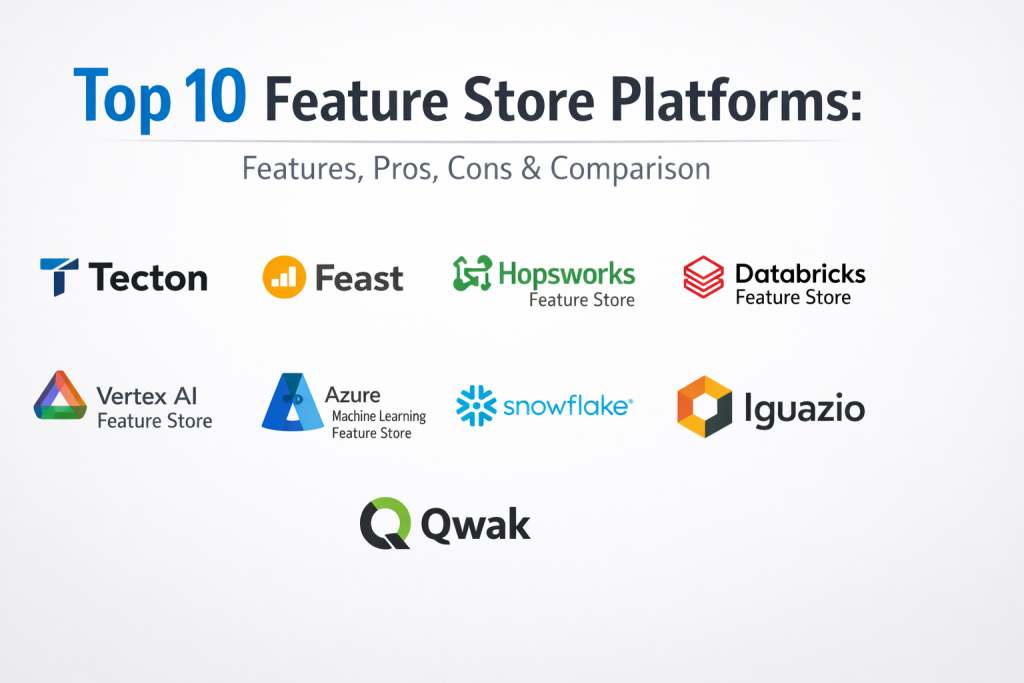
Top 10 Feature Store Platform
1.Tecton
Tecton is an enterprise-focused feature platform built specifically for real-time and large-scale machine learning systems.
Key Features
- Real-time and batch feature pipelines
- Declarative feature management
- Feature lineage tracking
- Low-latency online serving
- Built-in monitoring capabilities
- Cross-cloud compatibility
Pros
- Strong real-time performance
- Designed for production-grade ML systems
- Enterprise scalability
Cons
- Enterprise pricing structure
- Requires experienced ML teams
Platforms / Deployment
Cloud / Hybrid
Security & Compliance
Supports SSO/SAML, RBAC, encryption in transit and at rest.
Certifications: Not publicly stated
Integrations & Ecosystem
Integrates with modern data platforms and orchestration tools including Spark, Snowflake, Databricks, Kubernetes, and major cloud providers.
Support & Community
Enterprise-grade support with structured onboarding. Community presence is moderate compared to open-source alternatives.
2.Feast
Feast is an open-source feature store designed for flexibility and extensibility across different ML stacks.
Key Features
- Pluggable storage backends
- Offline and online store architecture
- Feature versioning
- Lightweight deployment model
- Cloud-native integration
- Open API framework
Pros
- Cost-effective
- Flexible architecture
- Strong community support
Cons
- Requires infrastructure setup
- Limited built-in governance features
Platforms / Deployment
Cloud / Self-hosted / Hybrid
Security & Compliance
Varies / Not publicly stated
Integrations & Ecosystem
Common integrations include Spark, Kafka, BigQuery, Snowflake, and cloud storage systems.
Support & Community
Active open-source community with growing ecosystem contributions.
3.Databricks Feature Store
Databricks Feature Store is integrated within the Databricks lakehouse ecosystem.
Key Features
- MLflow integration
- Lakehouse-native design
- Model-feature lineage tracking
- Scalable Spark processing
- Centralized governance
Pros
- Seamless within Databricks workflows
- Strong scalability
- Unified data and ML experience
Cons
- Platform dependency
- Best suited for Databricks users
Platforms / Deployment
Cloud
Security & Compliance
RBAC, encryption controls. Certifications: Not publicly stated
Integrations & Ecosystem
Deep integration with Delta Lake, MLflow, Spark, and cloud storage services.
Support & Community
Backed by enterprise support and strong platform documentation.
4.Hopsworks
Hopsworks provides a comprehensive ML platform including a robust feature store.
Key Features
- Online and offline store architecture
- Feature metadata tracking
- Data validation
- Real-time serving support
- Lakehouse compatibility
- Version control
Pros
- Rich governance capabilities
- Strong real-time ML support
- Developer-friendly interface
Cons
- Platform complexity
- Learning curve for new users
Platforms / Deployment
Cloud / Self-hosted / Hybrid
Security & Compliance
Encryption and RBAC. Certifications: Not publicly stated
Integrations & Ecosystem
Works with Spark, Kafka, Kubernetes, and cloud storage systems.
Support & Community
Commercial support available with active ecosystem engagement.
5.SageMaker Feature Store
A managed feature store service within AWS SageMaker.
Key Features
- Fully managed infrastructure
- Online and offline feature storage
- Real-time serving
- Integration with AWS analytics services
- Feature version control
Pros
- Reduced operational overhead
- Strong AWS integration
- Enterprise scalability
Cons
- Cloud dependency
- Limited cross-cloud portability
Platforms / Deployment
Cloud
Security & Compliance
Uses AWS-native security mechanisms including IAM and encryption. Certifications: Not publicly stated
Integrations & Ecosystem
Works seamlessly with S3, Redshift, Glue, and SageMaker pipelines.
Support & Community
Supported under AWS enterprise support programs.
6.Vertex AI Feature Store
Google Cloud’s managed feature store solution.
Key Features
- Fully managed service
- Real-time serving
- Scalable architecture
- Feature lineage tracking
- Native Vertex AI integration
Pros
- Minimal infrastructure management
- High scalability
- Tight GCP integration
Cons
- Cloud dependency
- Limited outside GCP
Platforms / Deployment
Cloud
Security & Compliance
Uses Google Cloud security controls. Certifications: Not publicly stated
Integrations & Ecosystem
Integrated with BigQuery, Dataflow, Cloud Storage, and Vertex AI pipelines.
Support & Community
Enterprise support through Google Cloud.
7.Snowflake Feature Store
A feature management capability integrated within Snowflake’s Data Cloud.
Key Features
- Unified data and feature storage
- Versioned feature management
- Secure data sharing
- Scalable compute
- Integration with Snowpark
Pros
- Strong governance
- High performance
- Works well in Snowflake environments
Cons
- Best suited for Snowflake-centric teams
- Cloud dependency
Platforms / Deployment
Cloud
Security & Compliance
Enterprise security controls. Certifications: Not publicly stated
Integrations & Ecosystem
Works with Snowpark, Python APIs, and cloud-native services.
Support & Community
Enterprise-grade support through Snowflake.
8.Iguazio
Iguazio provides an integrated MLOps platform including a high-performance feature store.
Key Features
- Real-time ingestion
- High-performance serving
- ML pipeline integration
- Hybrid deployment support
- Governance tools
Pros
- Strong real-time capabilities
- Integrated MLOps ecosystem
- Enterprise scalability
Cons
- Platform complexity
- Pricing transparency varies
Platforms / Deployment
Cloud / Hybrid
Security & Compliance
RBAC and encryption. Certifications: Not publicly stated
Integrations & Ecosystem
Integrates with Kubernetes, Spark, and cloud storage systems.
Support & Community
Enterprise-focused support with onboarding services.
9.H2O Feature Store
Part of H2O’s AI platform for managing features within predictive modeling pipelines.
Key Features
- Feature reuse across models
- Integration with AutoML
- Scalable infrastructure
- Enterprise integration
- Governance support
Pros
- Strong AI ecosystem
- Enterprise readiness
- Synergy with AutoML workflows
Cons
- Best within H2O ecosystem
- Limited standalone deployment
Platforms / Deployment
Cloud / Hybrid
Security & Compliance
Not publicly stated
Integrations & Ecosystem
Works with Spark, Python APIs, and H2O AI Cloud.
Support & Community
Commercial enterprise support model.
10.Qwak Feature Store
Qwak offers a unified ML platform including feature management capabilities.
Key Features
- Centralized feature repository
- Versioning and lineage
- Real-time and batch pipelines
- Deployment automation
- Monitoring integration
Pros
- Unified ML workflow
- Simplified deployment
- Developer-friendly experience
Cons
- Platform-specific ecosystem
- Enterprise pricing model
Platforms / Deployment
Cloud
Security & Compliance
Encryption and access control. Certifications: Not publicly stated
Integrations & Ecosystem
Integrates with Kubernetes, cloud providers, and ML orchestration systems.
Support & Community
Commercial support with growing platform adoption.
Comparison Table
| Tool Name | Best For | Platform Supported | Deployment | Standout Feature | Public Rating |
|---|---|---|---|---|---|
| Tecton | Enterprise real-time ML | Web | Cloud/Hybrid | Low-latency serving | N/A |
| Feast | Open-source flexibility | Web | Cloud/Self-hosted/Hybrid | Pluggable backends | N/A |
| Databricks Feature Store | Lakehouse ML | Web | Cloud | MLflow integration | N/A |
| Hopsworks | Real-time ML governance | Web | Cloud/Self-hosted/Hybrid | Feature metadata tracking | N/A |
| SageMaker Feature Store | AWS-native ML | Web | Cloud | Fully managed | N/A |
| Vertex AI Feature Store | GCP-native ML | Web | Cloud | Managed scalability | N/A |
| Snowflake Feature Store | Data Cloud ML | Web | Cloud | Snowpark integration | N/A |
| Iguazio | Streaming ML pipelines | Web | Cloud/Hybrid | Real-time ingestion | N/A |
| H2O Feature Store | AutoML ecosystems | Web | Cloud/Hybrid | AutoML synergy | N/A |
| Qwak Feature Store | Unified ML workflows | Web | Cloud | Centralized ML platform | N/A |
Evaluation & Scoring of Feature Store Platforms
| Tool Name | Core (25%) | Ease (15%) | Integrations (15%) | Security (10%) | Performance (10%) | Support (10%) | Value (15%) | Weighted Total |
|---|---|---|---|---|---|---|---|---|
| Tecton | 9 | 7 | 8 | 8 | 9 | 8 | 6 | 8.05 |
| Feast | 8 | 6 | 8 | 6 | 7 | 7 | 9 | 7.45 |
| Databricks Feature Store | 9 | 8 | 9 | 8 | 9 | 8 | 7 | 8.45 |
| Hopsworks | 8 | 7 | 8 | 7 | 8 | 7 | 7 | 7.75 |
| SageMaker Feature Store | 8 | 8 | 8 | 8 | 8 | 8 | 7 | 8.00 |
| Vertex AI Feature Store | 8 | 8 | 8 | 8 | 8 | 8 | 7 | 8.00 |
| Snowflake Feature Store | 8 | 8 | 8 | 8 | 8 | 8 | 7 | 8.00 |
| Iguazio | 8 | 7 | 7 | 7 | 8 | 7 | 7 | 7.55 |
| H2O Feature Store | 7 | 8 | 7 | 7 | 7 | 7 | 7 | 7.25 |
| Qwak Feature Store | 8 | 8 | 8 | 7 | 8 | 7 | 7 | 7.85 |
These scores are comparative within this list and reflect category alignment rather than absolute benchmarks. Organizations should validate performance against their own infrastructure and workloads.
Which Feature Store Platforms Is Right for You?
Solo / Freelancer
Feast is often sufficient for independent practitioners. It offers flexibility and avoids enterprise pricing.
SMB
Managed solutions like SageMaker or Vertex AI reduce operational overhead while providing scalability.
Mid-Market
Hopsworks or Databricks Feature Store offer balanced governance and performance.
Enterprise
Tecton and Databricks Feature Store are strong for mission-critical real-time ML systems.
Budget vs Premium
Open-source tools reduce licensing costs but require engineering effort. Managed enterprise platforms trade cost for reliability and governance.
Feature Depth vs Ease of Use
Enterprise platforms offer advanced governance and monitoring. Simpler tools may be easier to deploy but less feature-rich.
Integrations & Scalability
Choose tools aligned with your existing data stack to avoid migration friction.
Security & Compliance Needs
Highly regulated industries should prioritize enterprise-grade governance and access controls.
Frequently Asked Questions
1. What is a feature store?
A feature store centralizes feature engineering logic and ensures consistency between model training and production inference.
2. Do startups need a feature store?
Only when managing multiple production models or requiring real-time feature serving.
3. What is the difference between offline and online feature stores?
Offline stores support training datasets, while online stores deliver low-latency features during inference.
4. Are feature stores cloud-only?
No. Some support self-hosted and hybrid deployments.
5. How do feature stores improve ML reliability?
They prevent feature drift, duplication, and inconsistencies.
6. Can feature stores support streaming data?
Yes, many modern platforms integrate with streaming pipelines.
7. Are open-source feature stores enterprise-ready?
They can be, but may require additional governance layers.
8. How long does implementation take?
It depends on infrastructure complexity and team maturity.
9. Can you switch feature store platforms?
Yes, but migration requires planning around metadata and pipelines.
10. What is the biggest mistake teams make?
Implementing a feature store before production maturity or without clear governance strategy.
Conclusion
Feature Store Platforms have become foundational components of modern machine learning infrastructure. They reduce duplication, enforce consistency, and enable scalable, reliable model deployment across batch and real-time systems. However, the best platform depends entirely on your cloud strategy, real-time requirements, compliance constraints, and engineering maturity. Enterprise teams running mission-critical AI may prioritize governance and latency performance, while startups may favor flexibility and cost efficiency. The most practical next step is to shortlist two or three platforms aligned with your current data stack, run a controlled pilot using real workloads, evaluate integration depth and operational complexity, and then make a decision based on long-term scalability rather than short-term convenience.

Best Cardiac Hospitals Near You
Discover top heart hospitals, cardiology centers & cardiac care services by city.
Advanced Heart Care • Trusted Hospitals • Expert Teams
View Best Hospitals