Introduction
Cloud Workload Protection Platforms help security teams protect workloads running in the cloud and modern environments such as virtual machines, containers, Kubernetes clusters, and sometimes serverless workloads. In simple terms, CWPP tools focus on what is running inside the workload and how it behaves. They help detect runtime threats, reduce attack techniques, harden configurations, monitor processes and network activity, and enforce policies to prevent suspicious behavior. Many CWPP platforms also include vulnerability scanning for images and workloads, posture checks for workloads, and response actions like isolation, quarantine, or process blocking.
CWPP matters because cloud workloads are dynamic. Containers spin up and down fast, Kubernetes changes often, and workloads are exposed through APIs, service meshes, and identity permissions. Traditional security approaches often struggle to keep up with this pace. CWPP tools provide continuous visibility and protection where the workload actually executes, helping teams stop attacks like crypto-mining, container escapes, malicious processes, lateral movement, and credential abuse.
Common use cases include:
- Runtime threat detection for containers, Kubernetes, and cloud VMs
- Image scanning and vulnerability detection in container pipelines
- Workload hardening and policy enforcement across environments
- Behavior monitoring for suspicious processes and network activity
- Incident response actions for compromised workloads
What buyers should evaluate:
- Coverage across VMs, containers, Kubernetes, and serverless if needed
- Runtime detection depth and quality of alerts
- Policy controls to prevent or block risky behaviors
- Container image scanning and integration into CI/CD workflows
- Kubernetes security features such as admission controls and runtime context
- Performance overhead and reliability in production environments
- Integrations with SIEM, SOAR, ticketing, and cloud-native tools
- Evidence clarity for operations teams and incident response
- Scalability across clusters, accounts, regions, and teams
- Support maturity, documentation quality, and deployment experience
Best for: Cloud security teams, DevSecOps teams, platform engineers, and SOC teams that need runtime protection for cloud workloads and modern application platforms.
Not ideal for: Teams that only need cloud configuration monitoring. CWPP protects workloads at runtime, while posture tools focus more on cloud configurations and governance.
Key Trends in Cloud Workload Protection Platforms
- More focus on Kubernetes runtime security and cluster-level context
- Increased emphasis on prevention controls, not only detection alerts
- Better integration into CI/CD for image scanning and policy gates
- Stronger identity-aware workload protection and credential abuse detection
- Improved incident response actions and automated containment workflows
- More correlation with cloud posture and exposure data for prioritization
- Higher demand for low-overhead agents and stable production performance
- More visibility into east-west traffic and service-to-service behavior
- Better mapping of alerts to kill-chain style narratives for faster triage
- Stronger multi-environment governance across accounts and clusters
How We Selected These Tools
- Widely recognized CWPP platforms with real-world workload protection focus
- Coverage for containers, Kubernetes, and cloud VMs as core priorities
- Quality of runtime detection and operational usability
- Policy controls and prevention features for real production environments
- Integrations across security operations and DevOps workflows
- Evidence quality and incident response support
- Scalability across large cloud footprints and many clusters
- Deployment experience and documentation maturity
- Balanced mix of major security suites and cloud-native leaders
- Strong fit for modern cloud workload patterns and platforms
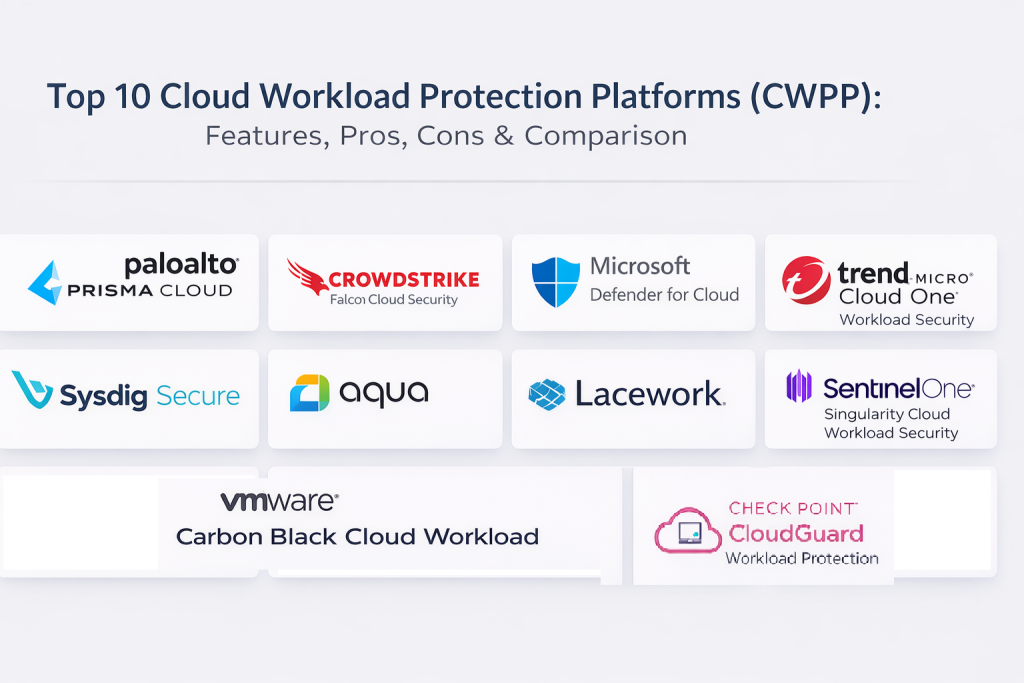
Top 10 Cloud Workload Protection Platforms
1) Palo Alto Networks Prisma Cloud
Prisma Cloud provides workload protection capabilities alongside broader cloud security functions. It is often chosen by organizations that want unified security controls across cloud workloads and environments.
Key Features
- Runtime protection for containers and cloud workloads
- Kubernetes security capabilities for workload and cluster monitoring
- Container image scanning and policy enforcement support
- Threat detection and investigation workflows
- Policy-driven controls and governance alignment
- Dashboards for workload risk and operational tracking
Pros
- Broad platform coverage and strong enterprise fit
- Useful for organizations seeking unified cloud security programs
Cons
- Setup and tuning can be demanding in complex environments
- Feature breadth can add operational complexity if not scoped well
Platforms / Deployment
Web
Cloud
Security & Compliance
Varies / Not publicly stated
Integrations & Ecosystem
Designed to integrate runtime signals into security operations and DevOps workflows.
- Integrations with ticketing for remediation tracking
- Exports to SIEM and security analytics workflows
- APIs for automation and policy workflows
- CI/CD integration patterns for image scanning gates
Support & Community
Enterprise support options are common; documentation is strong; community footprint is broad.
2) CrowdStrike Falcon Cloud Security
CrowdStrike Falcon Cloud Security provides workload protection with a focus on operational detection and response workflows. It fits teams that want cloud workload protection aligned with SOC processes.
Key Features
- Workload monitoring and runtime threat detection
- Protection capabilities for cloud workloads and containers
- Alerting and investigation workflows aligned with operations
- Visibility into workload behaviors and suspicious activity
- Policy and response actions for containment workflows
- Dashboards for workload exposure and incident tracking
Pros
- Strong operational workflow fit for security operations teams
- Useful for organizations seeking consistency across endpoint and cloud workflows
Cons
- Depth depends on telemetry coverage and deployment approach
- Some teams may need extra configuration to reduce noise
Platforms / Deployment
Web
Cloud
Security & Compliance
Not publicly stated
Integrations & Ecosystem
Often used where runtime signals must flow into SOC workflows quickly.
- SIEM and reporting pipeline integrations via exports
- Ticketing integration patterns for operational assignment
- APIs for automation and incident response workflows
- Supports integration into broader security operations processes
Support & Community
Enterprise support is common; documentation is solid; community footprint is broad.
3) Microsoft Defender for Cloud
Microsoft Defender for Cloud includes workload protections along with posture and security recommendations. It often fits organizations that want consolidated cloud security workflows, especially with Microsoft-aligned operations.
Key Features
- Workload protection capabilities depending on enabled coverage
- Alerts and investigation workflows for cloud threats
- Integration with broader security operations and identity context
- Policy recommendations and remediation guidance support
- Dashboards for security posture and workload risk
- Coverage aligned with connected cloud resources
Pros
- Strong fit for Microsoft-aligned security programs
- Useful consolidated dashboards for cloud security management
Cons
- Multi-cloud depth varies by environment and setup
- Full value depends on consistent telemetry and configuration
Platforms / Deployment
Web
Cloud
Security & Compliance
Varies / Not publicly stated
Integrations & Ecosystem
Designed to connect cloud threats and workload signals to operations workflows.
- Integrations with security operations and incident workflows
- Ticketing alignment depending on environment
- APIs for automation and reporting
- Works well when identity and endpoint signals are connected
Support & Community
Strong documentation and support footprint; community resources are extensive.
4) Trend Micro Cloud One Workload Security
Trend Micro Cloud One Workload Security is widely used for protecting cloud workloads with runtime security controls and vulnerability-related insights. It is often selected by teams seeking stable enterprise workload protection.
Key Features
- Runtime workload protection for cloud servers and workloads
- Vulnerability and configuration insight support for workloads
- Policy controls for hardening and threat prevention
- Monitoring for suspicious processes and behaviors
- Response actions for containment and investigation
- Dashboards for workload risk visibility and tracking
Pros
- Strong enterprise footprint and mature workload protection
- Useful policy controls and operational dashboards
Cons
- Setup and tuning may require planning for large environments
- Workload overhead and agent management require operational discipline
Platforms / Deployment
Web
Cloud, Hybrid
Security & Compliance
Varies / Not publicly stated
Integrations & Ecosystem
Built to connect workload protection into operational security workflows.
- Integrations with ticketing for remediation and tracking
- Exports to SIEM and reporting pipelines
- APIs for automation and policy workflows
- Supports integration into cloud operational processes
Support & Community
Enterprise support options are common; documentation is established; community footprint is broad.
5) SentinelOne Singularity Cloud Workload Security
SentinelOne Singularity Cloud Workload Security provides runtime detection and response for cloud workloads. It is often chosen by teams that want strong behavioral detection and response workflows applied to workloads.
Key Features
- Runtime monitoring and behavioral threat detection
- Workload protection aligned with detection and response operations
- Policy controls and response actions for containment
- Visibility into suspicious processes and workload behavior
- Dashboards for incident tracking and risk management
- Integration patterns for SOC workflows and automation
Pros
- Strong detection and response style workflows for workloads
- Useful for teams focused on behavioral threat detection
Cons
- Depth depends on deployment choices and telemetry coverage
- Tuning is needed to keep alerts actionable in busy environments
Platforms / Deployment
Web
Cloud
Security & Compliance
Not publicly stated
Integrations & Ecosystem
Designed to route workload threats into security operations workflows.
- SIEM integrations via exports and connectors
- Ticketing workflows for assignment and response
- APIs for automation and response playbooks
- Aligns well with incident response operations
Support & Community
Enterprise support options are common; documentation is solid; community footprint is broad.
6) Sysdig Secure
Sysdig Secure is strongly associated with container and Kubernetes runtime security. It is commonly chosen by cloud-native teams that want deep visibility into Kubernetes behavior and container runtime risk.
Key Features
- Kubernetes and container runtime threat detection
- Policy controls for workload behavior and security posture
- Image scanning and pipeline integration support
- Runtime visibility for processes, network activity, and system calls
- Investigation workflows for container incidents
- Dashboards for Kubernetes security and workload risk
Pros
- Strong Kubernetes focus and deep runtime visibility
- Practical fit for cloud-native engineering teams
Cons
- Requires Kubernetes and cloud-native knowledge for best results
- Tuning policies is important to reduce alert fatigue
Platforms / Deployment
Web
Cloud
Security & Compliance
Not publicly stated
Integrations & Ecosystem
Built to fit modern cloud-native pipelines and runtime workflows.
- CI/CD integration patterns for image scanning gates
- Exports to SIEM and security analytics workflows
- APIs for automation and policy deployment
- Integrations with Kubernetes tooling and cloud workflows
Support & Community
Documentation is solid; support options vary; community footprint is strong in cloud-native spaces.
7) Aqua Security
Aqua Security provides workload protection across containers and Kubernetes, often combined with vulnerability insights and policy enforcement. It is commonly selected by teams focused on securing containerized application platforms.
Key Features
- Runtime protection for containers and Kubernetes workloads
- Image scanning and vulnerability detection support
- Admission controls and policy enforcement patterns for Kubernetes
- Visibility into workload behaviors and risky actions
- Dashboards for risk tracking and remediation workflows
- Integration support for DevSecOps and operations workflows
Pros
- Strong container and Kubernetes security focus
- Practical policy controls for preventing risky deployments
Cons
- Requires good DevOps alignment and process discipline
- Some features may require tuning to reduce noise
Platforms / Deployment
Web
Cloud, Hybrid
Security & Compliance
Varies / Not publicly stated
Integrations & Ecosystem
Designed to integrate into DevSecOps pipelines and runtime workflows.
- CI/CD integration patterns for scanning and policy gates
- Ticketing workflows for remediation ownership
- APIs for automation and reporting
- Works well with Kubernetes operations and governance processes
Support & Community
Support options are common; documentation is strong; community footprint is broad.
8) Lacework
Lacework offers workload security capabilities with an emphasis on consolidating cloud risk signals and improving operational visibility. It is often used by teams seeking correlated findings and runtime insight.
Key Features
- Workload and cloud runtime monitoring capabilities
- Threat detection and investigation workflows
- Findings correlation to reduce duplicates
- Dashboards for operational tracking and risk trends
- Policy and alerting controls for runtime security
- Integration support for reporting and security workflows
Pros
- Useful consolidation and correlation for operational visibility
- Fits teams seeking one place to review cloud runtime risks
Cons
- Tuning is needed to keep detection outputs actionable
- Fit depends on required depth for Kubernetes and container security
Platforms / Deployment
Web
Cloud
Security & Compliance
Not publicly stated
Integrations & Ecosystem
Designed to connect runtime findings to operations workflows.
- Exports to SIEM and analytics pipelines
- Ticketing integration patterns for assignment
- APIs for automation and enrichment
- Works best with consistent tagging and asset grouping
Support & Community
Support options vary; documentation is typically solid; community footprint is moderate.
9) VMware Carbon Black Cloud Workload
VMware Carbon Black Cloud Workload focuses on runtime security and behavioral detection for workloads, often used by organizations that want consistent operational security workflows across workloads.
Key Features
- Behavioral detection for suspicious workload activity
- Monitoring and investigation workflows for incidents
- Policy-based controls and response actions
- Visibility into processes and runtime behaviors
- Dashboards for workload risk and incident tracking
- Integration patterns for SOC workflows and reporting
Pros
- Strong behavioral monitoring and detection heritage
- Useful for SOC-style operations workflows
Cons
- Best fit depends on environment and workload types covered
- Deployment and tuning can be needed for high-signal alerts
Platforms / Deployment
Web
Cloud, Hybrid
Security & Compliance
Not publicly stated
Integrations & Ecosystem
Designed to fit incident response and SOC workflows.
- SIEM and reporting exports for correlation
- Ticketing integration patterns for response coordination
- APIs for automation and enrichment
- Works best with structured incident response playbooks
Support & Community
Enterprise support options are common; documentation is established; community footprint is moderate.
10) Check Point CloudGuard Workload Protection
Check Point CloudGuard Workload Protection provides security controls for cloud workloads and cloud-native environments. It is commonly used by teams that want consistent policy-driven protection across workloads.
Key Features
- Workload security monitoring and protection controls
- Policy enforcement support for workload and cloud-native environments
- Threat detection and alerting workflows
- Dashboards for risk visibility and operational tracking
- Response and investigation support for workload incidents
- Integration patterns for ticketing and security workflows
Pros
- Policy-driven approach that suits governance-focused teams
- Useful operational dashboards for workload security management
Cons
- Tuning and deployment planning can be required at scale
- Depth depends on telemetry coverage and environment setup
Platforms / Deployment
Web
Cloud
Security & Compliance
Varies / Not publicly stated
Integrations & Ecosystem
Designed to integrate workload security findings into operational workflows.
- Ticketing workflows for remediation and tracking
- Exports to SIEM and security reporting pipelines
- APIs for automation and policy workflows
- Works best with cloud governance and security standards
Support & Community
Enterprise support options are common; documentation is solid; community footprint is moderate.
Comparison Table
| Tool Name | Best For | Platform(s) Supported | Deployment | Standout Feature | Public Rating |
|---|---|---|---|---|---|
| Palo Alto Networks Prisma Cloud | Unified cloud security with workload protection | Web | Cloud | Broad enterprise cloud security coverage | N/A |
| CrowdStrike Falcon Cloud Security | SOC-aligned cloud workload detection and response | Web | Cloud | Operational detection and response workflows | N/A |
| Microsoft Defender for Cloud | Consolidated cloud security programs with workload coverage | Web | Cloud | Integrated cloud security recommendations | N/A |
| Trend Micro Cloud One Workload Security | Mature workload protection in large environments | Web | Cloud, Hybrid | Enterprise workload security policies | N/A |
| SentinelOne Singularity Cloud Workload Security | Behavioral threat detection and response for workloads | Web | Cloud | Detection and response oriented workload security | N/A |
| Sysdig Secure | Kubernetes and container runtime security depth | Web | Cloud | Deep Kubernetes runtime visibility | N/A |
| Aqua Security | Container and Kubernetes security with policy gates | Web | Cloud, Hybrid | Admission controls and runtime protection | N/A |
| Lacework | Correlated cloud runtime findings and visibility | Web | Cloud | Consolidation and correlation of runtime signals | N/A |
| VMware Carbon Black Cloud Workload | Behavioral workload monitoring for SOC workflows | Web | Cloud, Hybrid | Behavioral detection heritage for workloads | N/A |
| Check Point CloudGuard Workload Protection | Policy-driven workload security controls | Web | Cloud | Governance-friendly workload security | N/A |
Evaluation and Scoring of Cloud Workload Protection Platforms
Weights used: Core features (25%), Ease of use (15%), Integrations and ecosystem (15%), Security and compliance (10%), Performance and reliability (10%), Support and community (10%), Price and value (15%).
| Tool Name | Core | Ease | Integrations | Security | Performance | Support | Value | Weighted Total |
|---|---|---|---|---|---|---|---|---|
| Palo Alto Networks Prisma Cloud | 9 | 7 | 8 | 8 | 8 | 8 | 6 | 7.80 |
| CrowdStrike Falcon Cloud Security | 8 | 8 | 7 | 7 | 8 | 8 | 6 | 7.40 |
| Microsoft Defender for Cloud | 8 | 8 | 8 | 8 | 8 | 8 | 7 | 7.85 |
| Trend Micro Cloud One Workload Security | 8 | 7 | 7 | 8 | 8 | 8 | 7 | 7.55 |
| SentinelOne Singularity Cloud Workload Security | 8 | 7 | 7 | 7 | 8 | 8 | 6 | 7.25 |
| Sysdig Secure | 8 | 7 | 7 | 7 | 8 | 7 | 7 | 7.35 |
| Aqua Security | 8 | 7 | 7 | 7 | 8 | 7 | 6 | 7.10 |
| Lacework | 7 | 7 | 7 | 7 | 7 | 7 | 6 | 6.85 |
| VMware Carbon Black Cloud Workload | 7 | 6 | 6 | 7 | 7 | 7 | 6 | 6.60 |
| Check Point CloudGuard Workload Protection | 7 | 7 | 6 | 7 | 7 | 7 | 6 | 6.85 |
How to interpret the scores:
- Scores compare tools within this list and help you shortlist based on your workload types and operating model.
- Core reflects runtime protection depth, Kubernetes support, image scanning options, and response actions.
- Ease reflects deployment complexity, tuning effort, and daily operational usability.
- Run a pilot to validate overhead, alert quality, and how quickly teams can respond and contain incidents.
Which Cloud Workload Protection Platform Is Right for You?
Solo / Freelancer
A full CWPP may be more than you need unless you manage multiple workloads for clients. If you choose one, focus on fast setup, clear alerts, and low operational overhead. Keep scope limited to critical workloads and production clusters.
SMB
SMBs should prioritize ease of deployment, sensible defaults, and strong alert clarity. Choose a platform that supports basic container and VM protections, integrates with your incident process, and provides clear evidence for remediation.
Mid-Market
Mid-market teams benefit from strong Kubernetes coverage, CI/CD integration for image scanning, and good workflow automation. Choose tools that reduce noise, support ownership routing, and provide response actions that align with your SOC or on-call practices.
Enterprise
Enterprises should prioritize scalability, governance controls, multi-team segmentation, and mature integrations. Look for deep Kubernetes runtime protection, strong response workflows, and reporting that supports leadership, audits, and continuous improvement.
Budget vs Premium
Premium tools often save time through better context, automation, and response actions. Budget-limited teams can still improve security using strong cloud-native controls, but they must invest more in process, tuning, and internal automation.
Feature Depth vs Ease of Use
If your platform team is strong, choose deeper features like policy enforcement and advanced runtime controls. If your team is small, prioritize usability, high-signal alerts, and stable performance overhead.
Integrations and Scalability
Confirm CI/CD integration for scanning and gating, SIEM export for alert correlation, and ticketing integration for remediation ownership. Scalability means you can roll out across clusters and accounts while keeping policies consistent and noise under control.
Security and Compliance Needs
If you operate in regulated environments, focus on audit-ready evidence, role controls, alert history, and repeatable incident workflows. You should be able to prove which workloads were monitored, what was detected, how it was handled, and what was improved.
Frequently Asked Questions
1) What is a CWPP in simple terms?
It is a security platform that protects cloud workloads like VMs, containers, and Kubernetes by monitoring runtime behavior and helping prevent or detect attacks.
2) Is CWPP the same as CSPM?
No. CSPM focuses on cloud configurations and posture. CWPP focuses on runtime protection inside workloads and how they behave.
3) Do CWPP tools need agents?
Many use agents or collectors, especially for deep runtime visibility. Some also support agentless options for certain checks, but coverage varies.
4) What should we protect first with a CWPP?
Start with internet-facing workloads, critical production clusters, and workloads that handle sensitive data or privileged access.
5) How do CWPP tools help with containers?
They commonly scan images, enforce policies, and monitor runtime behavior to detect suspicious processes, privilege escalation, or container escape attempts.
6) Will CWPP slow down workloads?
It can add overhead depending on the tool and configuration. A pilot is important to measure performance impact and tune policies.
7) How do CWPP tools reduce false alerts?
They use behavioral baselines, policy tuning, and contextual data like workload identity and Kubernetes metadata, but tuning is still essential.
8) Can CWPP integrate into CI/CD pipelines?
Many tools support image scanning and policy gates to stop risky images before deployment. The exact experience varies by tool.
9) What is the biggest mistake when adopting CWPP?
Rolling it out broadly without tuning and clear incident workflows. Start small, validate alert quality, then expand with strong ownership and SLAs.
10) How do we choose the right CWPP tool?
Shortlist two or three, test in a real cluster and a VM environment, measure overhead, check alert quality, validate CI/CD integration, and confirm response workflows.
Conclusion
Cloud Workload Protection Platforms help teams secure what actually runs in production by adding runtime protection, visibility, and response controls across VMs, containers, and Kubernetes. The best CWPP depends on your workload mix, your Kubernetes maturity, and how your security operations handle alerts and incidents. Start with a focused pilot on your highest-risk workloads, validate performance overhead, tune policies to reduce noise, and confirm that alerts include enough evidence for fast triage. Next, integrate image scanning into your build pipeline, route actionable findings to owners through tickets, and measure outcomes such as fewer high-risk deployments and faster containment of suspicious activity. When the process is stable, expand coverage gradually and keep governance consistent.

Best Cardiac Hospitals Near You
Discover top heart hospitals, cardiology centers & cardiac care services by city.
Advanced Heart Care • Trusted Hospitals • Expert Teams
View Best Hospitals